Why I Write


3077165795_1de3236610_o

From the time I wake up in the morning until the time I lose consciousness at night, my brain is like a leaky roof. Everything gets in. Too much traffic around this area. These people not getting the recognition they deserve. Those people just generally being inconsiderate asses to everybody else in the world. These little things seep in, like so much rain through old, patched-up shingles, and they soak the rafters in my old brain and start festering.

From the seeds of those spores (okay, seeds aren’t spores, whatever, I don’t science) I turn from observation to questioning. Why does traffic suck? What aren’t these people doing to get their recognition? What makes those people act like jerks?

From there, it’s conjecture. Maybe the traffic sucks because on the day the city planner designed this intersection, he’d just come in from a bad row with his wife over some unseemly texts on his cell phone, and he created a turn lane where what he really meant to do was bury the area underground with a few well-placed sticks of dynamite. Maybe these people aren’t getting recognition because deep down they don’t really need it, and they do the things they do not for fame and glory, but because it’s right and necessaryMaybe those jerks are jerks because they really don’t understand how society works, because nobody bothered to teach them, or because they haven’t actually taken off the blinders and have been staring hypnotized at the same clutter on their desks and the same general area around their television for the last EVERY YEAR OF THEIR LIVES.

Then, a strange alchemy occurs. Most of the thoughts I entertain throughout the day flow through the mind like water cycling through the toilets in your house before it returns to the sewer, but every now and then, a spark happens. I don’t know what causes the spark. If I did, I’d be making millions selling self-help books to writers (there’s a market for that, right?). But the spark reaches like the finger of a lackadaisical God down to one of these nonsensical musings and breathes life into it. Like an angry hornet trapped in the back windshield of a hot car on family vacation, that idea starts buzzing like a demon, throwing itself against the walls, crashing into the face of every innocent bystander it encounters. It makes itself unignorable, it demands to be heard, and whatever else I had in mind clears the fargo out of the way for fear of getting stung by this possessed seedling of a story.

I write to let the goldfingered hornets out of the car.

Until I put virtual pen to virtual paper, the car just fills up with those things until all I can hear all the time is a dull buzz behind everything, like the world is a radio station that’s tuned off the dial just a hair. Problem is, I didn’t realize until recently that that’s what was happening. I just thought that’s how the world was; a droning buzz filtered through the unholy cacophony of a car full of bees. And there was nothing wrong with that. But when I finally got off my donk and started writing regularly, it felt a little like those people putting in cochlear implants and hearing their own voice for the first time.

And it’s not just stories. Sure, writing is about giving the leash over to that angry hornet for a while and seeing what it has to say. But writing also allows me to focus my thinking, to bring under the microscope my meandering, jumbled thoughts on whatever issue is buzzing up my head on a given day. It gives me a productive way to process all the funny/weird/sad/infuriating/touching/puzzling/amazing things that happen in this life.

The point is that we’re all going to die one day. The only difference between a me who writes and a me who doesn’t is that the me who doesn’t write might be remembered by family for a few generations, while a me who writes might stick around in a general consciousness a little bit longer. In that way, I guess, my writing is motivated by a fear of being forgotten, by a selfish desire to make an impact on the world, no matter how small.

Writing, then, is a daily release, a self-guided meditation, a barbaric yawp into the void.

Writing is a way for me to envision a better world and ponder about how it might be brought forth.

And writing is, of course, about telling stories. I don’t think the human machine will ever satisfy its appetite for good stories, and if you can tell a good story, well, that’s your ticket to a kind of immortality.
The Weekly Re-Motivator: Visionary


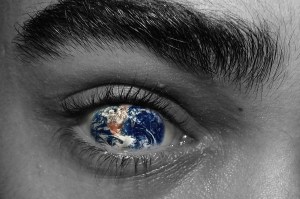
So the prompt for the week is the root: vis.

Now, I could interpret it in any number of ways, not least of which might be a fanfic about Elvis, but I just can’t kick this one impression from my mind: the word visionary. A lot of things get that label these days, probably because we no longer have any use for any modifier that is less than the superlative. (Things can’t, and shouldn’t, just be good. They have to be legendary, or epic, or un-fargoing-believable. We have built up a tolerance, through internet extravagance and the squabble for views and clicks, for anything short of eleven.)

What’s a visionary? It’s more than just a person who sees something where everybody else sees nothing. The visionary sees the world as it is and forces the rest of us to see it as it could be. Which is tied in to the reasons I write, actually: see my next post for more on that.

Photo by mind_scratch at Flickr.

Make no mistake, the world is amazing, and our position in it is even more amazing still. The fact that we exist in this universe alone is nothing short of astonishing, but the fact that we lead existences where we can relax and have hobbies and find love and get fat and sleep in as opposed to, you know, living or dying based on luck and the migratory patterns of predators transcends that. Life is awesome.

But it could always be better, couldn’t it?

That’s the domain of the visionary. Looking at a world that is already filled with good things and saying “let’s make it even better with flying cars and automated computer systems and remote controls so that you don’t even have to get up off the couch. Think about that. When television was first thought of, there was no remote. The mere idea of moving pictures, dancing and warbling in your living room, was so earth-shattering that nobody’s first thought was, yeah, it’s nice, BUT… But then, fast forward a few years, and somebody thinks to himself, I love television, but I hate getting up to change the channel. What if there was a way to switch the magical moving pictures without getting my donk out of this chair? And within a few years, WE HAVE IT. Not only do we have it, but now, it’s so much a part of the television-watching experience that my wife and I will wander around the house for hours on end looking for the remote, because you can’t even watch TV without it any more. Seriously. The newest set-top boxes have no buttons on their frontsides  for changing channels; if you lose the remote, you’re hosed.

And I was planning to write about how the line between a visionary and a lunatic is a thin one, thinner perhaps than the shoes that angels use for dancing on the heads of pins. I think, however, it’s a lot more productive to dwell on the visionary who takes the imaginary pictures in his head and uses them to change the world rather than the lunatic who sees the visions and mistakes them for the world which exists. Except that it’s hard to argue that all the great minds, all the visionaries who have changed the world for better or for worse, were also probably a little bit crazy. But being crazy is easy. Becoming a visionary takes work.

I mean, that’s what we’re all doing, isn’t it? On some level? Taking the visions we have for our futures and working to make them a little bit more real?

I’m particularly fascinated with the idea because, as you may have noticed if this isn’t your first foray to my midden-heap of writerly self-doubt and strife, I’m working on a science fiction novel that necessitates a world fundamentally different from the one we inhabit. Day in and day out I’m struggling with the vision for this different world, figuring out how to monkey-wrestle it into something that will be palatable to a critical audience. Without getting my face bitten off.

This weekly Re-Motivational post is part of Stream of Consciousness Saturday. Every Saturday, I use LindaGHill‘s prompt to refocus my efforts and evaluate my process, sometimes with productive results.

To Describe, or Not


I haven’t written or shared a ton about my current project, but if you’re a regular reader, you know it’s sci-fi.

Which I love.

Two of my top five movies of all time are science fiction (The Matrix and Back to the Future, in no particular order), so writing in the same genre, even if it were never to come to the light of day, sends thrills up the spine of my nerdy secret (yeah, not so secret) self. But film sci-fi and novel sci-fi are two different beasts, aren’t they? Because with the one you get to see everything as a director envisions it, but in the other you must create the images yourself based on what the author describes.

And there are pros and cons. Star Wars is what it is because of the dramatic and impressive visuals that linger forever in the minds of its devotees. (I’m talking about a starship that seems to go on forever, a space station the size of a moon, a battle with swords made out of fargoing light). And I’ve read a Star Wars novel or two, and they’re good, but they’re different. They don’t have to describe a lightsaber because we know what it looks like.

So, in my novel, there’s time travel. And there are robots. And there is other vaguely sciencey stuff floating around in the background.

And at every turn, I find myself wondering: how much do I need to describe this thing?

I picture the story unfolding in my own mind, and I see the characters and the places a certain way, but part of the magic of a book is that you get to decide for yourself to an extent what everything looks like. You get a sense of the whole, for example, in a book like Harry Potter: you can picture Hogwarts and its main features, but you don’t get into the grainy bits of detail. You don’t see the scorch marks on the brick from thousands of misfired spells, but you can imagine them. You don’t smell the faint musty funk on the community brooms in flying class, but you can make it up for yourself.

So as I’m writing my book, I keep crashing into this problem. Because description slows down storytelling, my usual tendency is to eschew it as much as possible. (See any of my Flash Fiction offerings.) But I also know how powerful it can be, and how much a good description helps to ground the reader in time and place. So, when the protagonist is picking through the long-abandoned house of the deranged and vanished eccentric who lived on the edge of town, how much do I need to describe the cobwebs on the walls, the countless volumes on physics and quantum theory scattered in all rooms of the house, the closets full of discarded, half-fused mechanical bits, the strange humming structure on the roof? Is it enough to say that the robot looks like half a tractor with a head like the front of a 1978 Buick, or do you want to see its feet like cinder blocks, its clumsy crab-claws-in-oven-mitt hands, its sparkling unstainable not-exactly-chrome finish? Do you want me to tell you about the faint whiff of burning hair that trails in its wake, or the fact that the ground trembles ever so slightly at its every plodding step?

And, given that it’s sci-fi and some funky pseudo-science-ish things are happening, how much should I try to describe that not-actually-science? Have the inventor hit my protagonists with a stream of technobabble and invented vaguely scientific terminology to give the concepts more depth or believability? Or just skim over the explanations of how any of this stuff works, throw any grounding in plausibility to the wind and, Sharknado-like, just expect my readers to get over it and get on for the ride?

Where’s the freaking line, in other words? How much description does a reader really need? How much is too much?

Outline, Schmoutline: A Cautionary Tale for Pantsers


I’ve kvelled for most of the summer about my difficulties with my current writing project. Those difficulties are made all the worse by the fact that I’ve been languishing in the mushy middle of the book; that part where the beginning has happened and ended, and we’re working toward an ending that will take up the last quarter of the book. Meanwhile, however, things seem not to be happening with much urgency or importance. I mean, parts are moving that have to move, but much like a sailboat in the middle of the Pacific, there’s some drift happening, and it’s hard to be sure moment-to-moment whether it’s good drift or bad drift. There’s nothing but deep blue sea out here. It all looks the same.

This, to be sure, is where my general go-to strategy for writing hits the wall like a midget riding a crazed pygmy bull. I’m a pantser, not a plotter, because I just can’t be bothered to make outlines. I tell myself and people who ask me (woe betide them) it’s because I write organically, whatever the fargo that means. In my head, it means that I craft the characters and the general situation and sort of “listen” to the characters as they “feel” their way through the situation and find their way through it. In practice, that means I’m basically making it up as I go along. The problem there is that Rome doesn’t get built in a day, and a novel is not written in a week. I’ve been working now for about three, four months on this project, head down, churning out the word count like a good penmonkey, but each day it’s the same. I know generally what has to happen next, I write it, I leave some notes to myself about tomorrow, I repeat. Which is fine for making my word count goals, but maybe not so fine for the story as a whole.

And making the word count goal has been difficult lately, not just because I’m in the doldrums of summer, but because I feel down to my bones the “lostness” of the project right now. It’s hard to make myself write 1000 words a day when I’m not sure where those words are leading me. This feeling would be very easy to mistake for Writer’s Block. In fact, Past Me would have gladly called it Writer’s Block and used it as an excuse to take a seven year sabbatical from the project. It looks like Writer’s Block, it smells like Writer’s Block. But it’s not Writer’s Block. I’m just lost.

6281142155_cf33c5be64_z

Because there’s nobody really steering the ship. It’s impossible to have the oversight I need to make sure the project is on track while also pushing out about 1000 words a day on this thing. All I can really do is watch the road directly in front of me and make sure I’m not driving into the ditch.

But that’s a problem, because I’m missing the road signs along the way, I’m missing landmarks, I’m not getting much feel for the arc of the story as a whole. I know where it needs to go generally, but it’s been a long time since I bothered to check the map and see whether I’m on course.

And what’s a map to a writer? Unfortunately for pantsers like me, it’s an outline.

And for a month now, I’ve felt that the narrative is adrift, that I don’t know where I’m going, that I’m getting a little lost. Time for a map check.

So tonight, instead of sitting down to pound out 1000 words of narrative, I resolved to do some outlining. I skimmed through what I’ve written so far and summed up the main points of each chapter. Which taught me that, some boring exposition aside, a few less-than-meaningful interactions aside, a few unnecessary characters who will be pruned in future drafts aside, the narrative actually clips along pretty well. Once I get the thing sanded down, it’s gonna hum, baby. Outlining also taught me that I’ve forgotten several details — even some key and important things I planted early in the draft which need to play major roles in the end of the book. They’d just slipped my mind, which is not surprising, because drafting a full-length novel and making it up as you go along is a little bit like juggling the entire contents of your kitchen at once, and then somebody hands you a baby.

So, with outline of everything I’ve written in hand, I’m ready for tomorrow’s session, which is going to be roughly outlining the back half of the book. It won’t be even a quarter as detailed as the outline of what I’ve already written, but what it will do is tell me the plot points I need to steer for when I get adrift again in the coming months of drafting. I’ve already seen, just from retracing my steps over the past couple chapters, what I need to do with the next three or four chapters. Which makes going back to work on the draft that much easier, because I don’t have to make it all up on the spot. I don’t have to find my way across the Pacific just by glancing at the night sky.

I’m here to tell you that I felt silly spending an hour and a half writing out an outline for a book I’ve already written half of. It’s going to be arduous work completing the outline for the prospective ending, especially knowing (as I already do) that that ending will change in some way, shape, or form by the end. But I’m also here to tell you that I see more clearly than I have in months the path that the book has been on and the path it needs to take. Foreign as it felt, the outline has reinvigorated me at a time when I desperately needed it.

So, my advice to my future self is:

  1. Write.
  2. Write some more.
  3. Outline what you’ve written.
  4. Write some more.
  5. Throw the outline out the window.
  6. Make a new outline.
  7. Repeat.

Terrible Review: Jurassic World


Who doesn’t love a good monster movie? I’m a bit late to the party with this one, but I hope you’ll forgive me. Finding childcare to go to the movies while my wife is working full-time is not the easiest of tasks, but we finally did it, and got the chance to sneak away and see the film we’ve been dying to see all summer.

Jurassic Park 3 v. 1.2: THIS TIME IT’S PERSONAL

Er, I mean, Jurassic World.

This is the part where I’d usually say something like “there be spoilers ahead”, but seeing as the movie has been out for, what, like six weeks now? It’s on you if you are trying to stay unspoiled and ended up here. Instead, this is me being extremely upfront about NOT saying “spoiler alert.” Totally not saying it.

Let me say upfront that I had mixed feelings about going to see this film from the first trailer. I mean, I saw this promotional image:

And my first thought was, so the raptors are allowing Starlord to ride a bike within scenting distance — hell, within shredding distance — and they haven’t served him up with a side of motorcycle tires? How am I supposed to take this seriously? But then I remembered that I was going to a blockbuster summer film, and “taking it seriously” was the last thing I should be doing. It’s got Chris Pratt, and that one girl from that one movie (Zero Dark Thirty, right?) (I’m kidding, I know she isn’t Jessica Chastain) (but only because I leaned over to my wife during the film and made a joke about how she might find Osama in one of the dinosaur caves, and she was all like “you know that’s not Jessica Chastain, right?). I loved Jurassic Park the first, I didn’t mind Jurassic Park the second, and I don’t even remember Jurassic Park the third (it had pterodactyls or something, maybe), so this one was guaranteed to at least hold my interest for the space of an afternoon.

Well, buckle up, and spray yourself down with anti-raptor juice. You didn’t bring your anti-raptor juice? Oh. Well… just stand downwind, I guess.

What’s Awesome?

  • The special effects. No, really. Perhaps the computer-generated Indominus Rex and its less invented-name kin lack some of the magic of the practical robots and puppets from the original, but things have come a long way from the pseudo-lizard CGI monstrosity sloppily hacked into the streets of San Diego in The Lost World. The only moment I had where I thought, boy, that looked fake was toward the opening, where they had an extreme close-up of a hatchling busting out of an egg. Aside from that, everything looked really well done, and more importantly, was edited smoothly into the scene and cleanly acted by the cast to give it all a seamless appearance.
  • The Top-Billed Cast. Chris Pratt’s performance is charming and charismatic as ever, while disparate enough from his showing in Guardians of the Galaxy to show some range, which is nice. Bryce Dallas Howard and her high heels started off obnoxious but then sort of grew on me not unlike a series of barnacles on a moored ship, and I’m not sure if that’s a result of the writing or the actress. Either way, a pleasant surprise. I also felt that their inevitable love connection, while obligatory by dint of their presence in said summer blockbuster franchise, had its share of chemistry. I didn’t hate them together, is what I’m saying, not that I went to see this film looking for the love story angle.
  • The Showdown. This film, perhaps more than the others, follows the Big Bad construct — the one major villain that everybody must band together to stand against. For comparison, the first film was kind of about the danger of dinosaurs as a whole (the raptors had some kills, the T-Rex had some kills, and that one thing with the umbrella on its head got to eat Newman); the second film had a lot of human antagonists (the bald guy trying to up the wow-factor by opening a park in San Diego… and screwing it up by unleashing the T-Rex on the city, and don’t forget bumbling paleontologist Julianne Moore who seriously makes every mistake ever); and the third film was… god, who even remembers? Pterodactyls, right? …Anyway, everything in this film is tied to the Indominus Rex, a genetic invention that (of course) gets loose and wreaks hell on the park. The film ends with not just humans banding together, but the other dinosaurs on the island getting a piece as well. Believable? Fargo, no. But fun as hell.
  • The Comic Relief. Some might argue that there was too much of it, but I found myself laughing out loud just when tension reached a high point due to what I felt was some brilliant comic relief. The bit parts played by Jake Johnson (of New Girl fame) and Lauren Lapkus (of Orange is the New Black) were glittering gems of giggles for me, but Pratt and Howard had their moments too. The director struck a nice balance between showing just how fargoed the park was and not taking himself too seriously to have a good time.

What’s Not So Awesome?

  • The supporting cast. Outside of the two leads, name a character and they’re pretty awful. The kids? Wanted to shoot them. The military dude trying to subvert the project and turn dinosaurs into a weapon? Completely one dimensional and boring; he might as well have been twirling an oiled mustache rather than lugging around his ridiculous gut. The parents outside the park? Snore. I can’t even figure out why these characters are present. There’s a subplot about the parents getting divorced, but really, who gives a sharknado? I can barely bring myself to care about the obligatory romance between Generic Male Lead and Generic Female Lead, I can’t be bothered with an offscreen relationship on the rocks.
  • The gimmicks. Okay, remember a while ago when I said you can’t take a film like this seriously precisely because it’s a big summer blockbuster? Yeah, that only goes so far, because a film still has to maintain its audience’s willful suspension of disbelief. This film takes that and chucks it out the goldfingered window.
    • The gyrosphere.Nope, uh-uh, no way. A free-rolling, user-operated pinball amongst dinosaurs that are probably better than five tons? Forget it. They take this thing under the feet of (what I think were) brontosauri, five stories tall. The liability would be crushing. Not to mention how inefficient it seems for the sheer number of visitors to the park. And all it takes is a few beers (don’t pretend they aren’t selling alcoholic beverages at the park) and you’ve got a couple of drunk rednecks playing Atlasphere with these things. Oh, you don’t remember Atlasphere?
    • Kayaks. Down the river. Again, around the feet of dinosaurs who, if spooked or upset or even simply careless, could crush a person like godzilla crushes cars. I don’t care how neat the idea is, it would never, ever, ever happen.
    • Raptors in formation with the motorcycle. I mentioned it already, and yeah, I get it; they’re trained, he’s the Alpha, and it’s that eye-catching WOW moment from the preview. But, sorry, no. Ask Siegfried and Roy how things go when you get ONE well-trained animal in a semi-controlled environment, and then ask them if they’d take a platoon of somewhat-trained flesh-eaters out on a HUNTING MISSION. By all means, send the raptors, but if I’m the trainer I’ll be leading the hunt from an armored vehicle, thanks very much.
  • The mini-reversal. Toward the end of the film, while the raptors are out on the hunt for the big game, they track it down, move in for the kill, and … suddenly they start talking to it — in dinosaur chirps and clicks, mind you — before they turn on their human caretakers. Because the Big Bad “had some raptor in him.” Look — the Indominus was enough of a stretch to begin with: Camouflage? Check. Ability to control its body temperature to fool thermal cameras? Check. Mental capacity to stage an elaborate prison break? Check. More teeth than an alligator with dental implants? Check. And I know that things have to go “from bad to worse”, but by that point, the park is a smoldering ruin, the body count is in the hundreds, and the movie is already at the hour and a half mark. You just don’t need the raptors joining up with the Big Bad. And to make it even dumber, THEY TURN RIGHT BACK after they dispatch the military guys because of course they do.

What’s Hard to Quantify?

  • The science. This is a sticking point for lots of critics of the film. I don’t think it is for me. Because if you start with the premise of reanimating dinosaurs after millions of years of extinction, nothing is too much of a stretch. (Splice them with frog DNA? Lizard DNA? Potato DNA? Why not?) For me, I think every film in the franchise is monster flick first, science-fiction imaginarium second, but some don’t see it that way, and would like to see the film being more scientifically sound. Bollocks, I say. Who cares if raptors were nowhere near the size they are in the film, or if a lizard the size of Indominus would never be able to support its own weight? THEM DINOSAWRZ ARE SCARY IN THE MOVIE.
  • The kids. Why does the franchise keep involving kids in the movies? The only time the kids didn’t suck bowling-ball sized eggs was in the first film. (I still laugh my donk off seeing the little blond kid get blasted off the high-voltage fence.) Since then, what have we had? An adopted gymnast whose gymnastic training allows her to best a raptor in hand-to-hand combat? Shenanigans! Some kid who managed to survive in the wilderness with dinosaurs for several weeks using… what, his charm? (Seriously, I don’t remember the third movie at all.) And now this film, with the nerdy kid whose encyclopedic knowledge of dinosaurs helps him NONE, and the goofy-looking older brother who shamelessly makes eyes at every teenage female within groping distance despite his girlfriend at home who totally loves him?Seriously, we know this isn’t the kind of movie where they’re going to let a dinosaur eat the younger-than-adult familial relations of one of the lead characters, so why are they even here? Just to get traumatized and make me want to stab their eyes? Maybe this kind of stakes-raising works for some in the audience, but not me. The only way they do work is by making Claire scramble and find her inner high-heel wearing badass to save them, but even that’s kind of a cop-out. I think it’d be more compelling if she just released the beast without having family members thrown into a fridge first.

The Verdict:

Shortcomings aside, this film was easily the most fun I’ve had at the cinema since the raw we’re-having-fun-in-here-and-you-can-either-come-with-us-or-gtfo-who-cares-if-it-makes-sense whimsy of Guardians of the Galaxy. I hate to compare this film to that; it feels lazy seeing as they share the same star. But summer movies should be, above all else, enjoyable and action-packed and visually impressive, and Jurassic World fits the bill on all counts.

And you don’t even have to have seen the prior films to understand anything going on with this one. But honestly, who hasn’t seen the prior films, or at least the original Jurassic Park? Sidenote: I recently learned that my own father, who is responsible for much of my education in blockbuster film, hasn’t seen it. So… yeah. Seriously, just go see it.

All images are property of Universal Pictures. Except for that one from American Gladiators, which is property of MGM Worldwide.