The Weekly Re-Motivator: Mind Over Mind


I was sitting at work the other day, having just come back from one of several “important” meetings during my planning time, lamenting my general loss of productivity of late. It’s been an adjustment, getting back into the school routine: waking up earlier to get in my runs and workouts, bundling the sprouts off to germcare (sorry, daycare), putting in my time at school, coming home exhausted but still having to cook dinner and wind the sprouts down for the evening, and finally collapsing in a boneless heap to hope that the kids sleep through the night (they’re both in a bit of a midnight waking sort of phase right now, which is a real bummer).

As a result, I’ve lost some momentum on my writing front. I’ve dropped from writing about 800 words a day on my current WIP to 600 or so, and I’m down from five postings a week here at the blarg to three or four if I’m lucky. Which is frustrating. Toward the end of the school year, I was priding myself on those statistics.

Then again, when I think back on it, my workouts were suffering during that time. I was gaining momentum in one area at the expense of the other.

And then further still, I think back to the beginning of summer, when the routine of the workday disappeared and I fell into a funk and wasn’t accomplishing my workouts or the writing I wanted to. I did some, sure, but I just felt so wiped, so burnt out, so unmotivated. Did I need a bit of time to recuperate from the end of the school year? Probably. Did it merit the amount of down time that I took? Meh… I have a hard time justifying that.

And then, my brain flashed back to my time in college. This is a thing I tend to try to stop my brain from doing, because the results are rarely good. I loved my college days, but man oh man were some poor decisions made. And needless to say, the brain doesn’t flash back to the good things when it senses I need a good kick in the arse. No, it flashed back to a stretch of about a year and a half where I did little more than sit in my room and play video games for hours and even days on end. I failed a class, something I’d never done in my life. My other grades tanked. I packed on about fifteen pounds. I turned into a big old jerk (well, even more than normal). Why? I just lost the drive. I felt worthless so I was worthless. And in the depths of that toxic fog, a good friend of mine (who was somehow still my friend despite all my atmospheric jerkitude) came to me with a bit of advice: “The more you do, the more you can do.”

I don’t know if she plagiarized that, and I don’t care. Because it’s true. The mind is a weird organ. It believes what it wants to believe, often contrary to the empirical evidence all around it. That little aphorism led me to get back into my classes and write the first drafts of the play that would grow into Accidentally Inspired, the work that in no small way set the course for the next chapters of my life, and is still setting the course for me.

The more you do, the more you can do.

Momentum matters.

You pick yourself up out of the funk and do something — anything — take a walk around the block, scribble a few bits of dialogue on the page, bang out a few push-ups, chase your kid around the room a few times — and there’s pushback, sure. Your negative momentum holds you in place. But your brain also says to itself, “hey, that wasn’t so bad, we can do that again.” And if you’re smart, you do, and you do a little more next time.

If the me who heard my friend drop that little truth-bomb on me back in college could see what I’m up to these days — even in my current, slightly diminished and frustrated state — he’d have a heart attack. Married, two kids, full-time job, coaching soccer after school, working out five or six times a week, writing novels and short stories like it’s my job, operating a website… The me of the past didn’t believe he could do all that, so of course, he couldn’t. But little by little, he started to believe. Little by little, momentum grew. Little by little, his mind changed.

Were there setbacks along the way? No doubt. The road is neither straight nor level. But by taking on a little more at a time, slowly upping the ante, slowly turning up the burners, I was able to trick myself into becoming moderately productive.

Which reminds me, it’s time to take the kids out on a walk, and then come back and write…

tumblr_mg9p3wt2xu1rwir03o1_1280

This weekly Re-Motivational post is part of Stream of Consciousness Saturday. Every Saturday, I use LindaGHill‘s prompt to refocus my efforts and evaluate my process, sometimes with productive results.
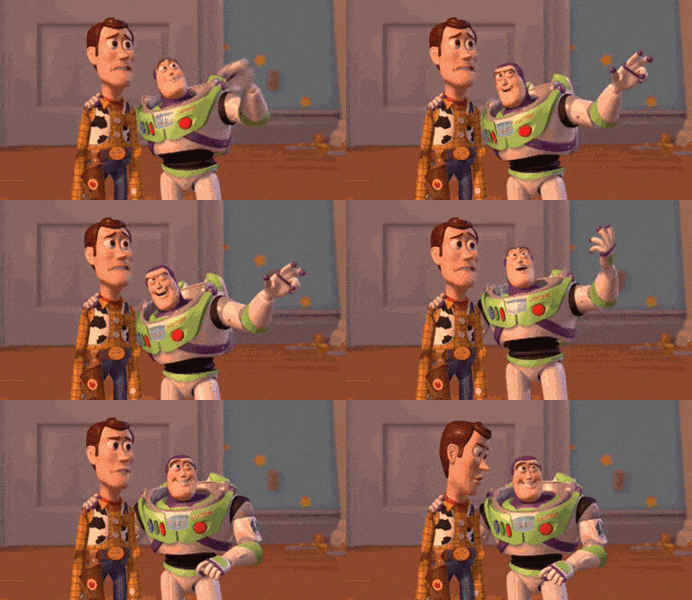
How to Write an Ending Like a Boss: Ask Pixar


So you wanna write a great ending. Look at the classics, right? Well…

Disney Pixar animated GIF

It may or may not surprise you to learn that we watch a lot of kids’ movies at our house. Rather, it might be more correct to say that we watch a few kids movies a hell of a lot. Now, I love a good kids’ movie. In top rotation at our house are Frozen, Cars, Toy Story, The Lego Movie, The Little Mermaid, and an occasional Despicable Me or Aladdin (which the kids will suffer through only when my wife and I can’t stand another iteration of the first string). Now, those are all, in their own right, pretty good movies. Check their Rotten Tomatoes scores for that. But what I didn’t realize was just how good these kids movies were at endings.

Think about it. How many stories have you read, movies you’ve watched, TV series you’ve slogged through, only to get to the end and say “what a let down”? Fantastic premises can take you only so far. A good ending ties a bow on the story and sends you walking out of the theater or running out to buy the next book in the series buzzing with excitement.

As a general rule, any writer will tell you that you should never solve a conflict without a cost. For every step the protagonists take toward their goal, either the target should move or the zombies should snap at their heels. As a result, the story becomes a series of “Yes, but”s: Do the space pirates find the lost treasure of Kala-Zeron? Yes, but the ruins of the ship are filled with moon-vampires; or “No, and”s: Can the star-crossed zombie lovers find each other before the survivors hiding in the mall blow their brains out? No, and also, each of them is losing limbs at an alarming rate.

It’s not hard to find this pattern in any story. Good stories do this effortlessly, but what I’ve noticed is that not only is the entire plot of Toy Story set up this way, but the last ten minutes not only sticks to the formula, but cranks it up to eleven.

These go to eleven.
These go to eleven.

The characters go from ALL IS SAVED to ALL IS LOST again and again, and each setback is worse than the last.

Take a look at the last ten minutes of Toy Story to see what a roller coaster ride a good ending can be, and bear in mind that all of what happens below passes after the big bad has been dispatched.

Woody and Buzz and Sid’s toys best Sid in time to make it to Andy’s car before he leaves on his move across town. ALL IS SAVED! But Buzz, with Sid’s ridiculously oversized rocket still strapped to his back, can’t fit through the fence. ALL IS LOST.

Woody jumps off of the car to help free Buzz from the fence. ALL IS SAVED! Buzz is loose, but the car drives off just as they reach for it. ALL IS LOST.

Luckily, the gate strap on the moving truck hangs really low, and as it drives over them, they realize they can grab hold of it and get onto the truck. ALL IS SAVED! They catch the moving truck, but Sid’s dog (who was let out of the house earlier in their scheme) chomps onto Woody’s leg and he can’t get on the truck. ALL IS LOST.

Buzz is no slouch, and saving people in need is his jam. Just as Woody did for him, Buzz sacrifices his ride to launch a suicide attack on the dog, who immediately lets go of Woody. ALL IS SAVED! But, now, Buzz is in a tangle for his life with the dog. The dog whips him around and he skitters to rest under a car as the truck drives off. ALL IS LOST.

Woody is safe on the truck, but is now more determined than ever to bring Buzz home with him. He opens the back of the truck, quickly finds his buddy RC car, and kicks him out onto the street to go scoop up Buzz. ALL IS SAVED! But the other toys, distrustful of Woody after knocking Buzz out of Andy’s window in the first place, think he’s just tried to murder another of their friends. They toss him out of the back of the truck. ALL IS LOST.

Buzz, still on a crash course with the truck from Woody’s driving, plows into Woody and scoops him up. Now they race after the truck together on the remote controlled car (now driven not so remotely by Woody). ALL IS SAVED!

They catch up to the truck through some smooth driving, but they can’t quite make it onto the platform dragging behind the truck. ALL IS LOST.

Slinky Dog extends himself as a lifeline to pull them in. They catch hold of Slinky Dog, and it looks like they’ll make it into the truck after all. ALL IS SAVED! But all of a sudden, the car’s batteries start to die, and as the car slows to a halt, Slinky slips out of their hands and goes recoiling into the back of the truck. ALL IS LOST, for real this time.

This time, it really looks dire. RC is dead weight, and the truck has sped off into the distance. All seems lost, but then they realize that Buzz is still wearing the rocket, and Woody still has a match to light it. ALL IS SAVED!

Woody lights the match, but a passing car blows it out. ALL IS LOST.

Woody prostrates himself on the ground in sorrow. The light from the sun refracts through Buzz’s bubble helmet and begins to cook Woody’s hand. Woody, having earlier been roasted under a magnifying glass, has a revelation; Buzz’s helmet can function as a focusing lens. They can light the rocket. ALL IS SAVED!

They light the rocket, remembering an instant too late that rockets explode. But there’s nothing for it; the rocket ignites and sends them screaming after the truck.Their breakneck speed causes them to lift off as they close on the truck. Woody tosses RC car back into the truck with the other toys as the rocket carries Woody and Buzz soaring into the air.

It looks like they are well and truly fargoed. Either the rocket will blow them to bits, or they will smash themselves to pieces as they fall back to earth. Woody says his goodbyes, but Buzz extends his wings, shearing the tape. The rocket explodes in dramatic fashion as Buzz and Woody sail away on Buzz’s previously-thought-useless wings.

They sail through the air with the greatest of ease, passing the truck entirely. The ride ends as Buzz and Woody drop through the sunroof into the very car they were trying to get into in the first place.

Tracking the ups and downs is enough to give you whiplash, not to mention the callbacks to previously established arcs (Buzz’s determination to fly, Woody’s redemption in saving Buzz, Sid trying to blow up Buzz but giving him the means to save himself and Woody). This is a truly masterful ending. Now, if only I could get a fraction of that many twists and turns into my upcoming ending…

All screencaps are courtesy of Disney Screencaps dot com. Toy Story is property of Disney / Pixar.

The Weekly Re-Motivator: Write From the Wayside


If you look down the path any writer has walked, you’re likely to see piles and piles of detritus littering his footsteps. Busted plots like broken wagon wheels tossed by the wayside. Failed or half-formed characters curled up like dead beetles, hollow and husk-like, waiting for the broom. Exercises and sketches and scattered bits of dialogue and unturned plot twists like so much broken glass and twisted slag. People think of writers as creators, but they destroy and abandon twice as much again as they ever shape to completion.

But it’s a poor writer indeed who walks that path, strews the debris of all the ideas that didn’t make the cut in his wake like so many dead fish after an oil spill, and doesn’t double back now and then to pick through the scraps and see if a scarecrow can’t be fashioned out of the trash.

Photo by Rene Schwietzke @ flickr.

Because, sure, we toss those ideas out the window, discarded cheeseburger wrappers fluttering on the wind, because they didn’t work, because they don’t fit, because something about them makes them not belong. But just because an idea didn’t work with this project, doesn’t mean it can’t work for any project. We’re like sharks. If we stop moving, we die, and when one idea has run its course, the next one bubbles to the surface like the breath of some great beast of the deep. A writer has to be a hoarder, ready to cover old ground and see if some of those old puzzle pieces fit with the new project better than they fit with the old.

If it’s a writer’s nightmare to end up in a publisher’s slush-pile, wasting away for eternity in the purgatory of unread manuscripts, then it’s an idea’s nightmare to end up in the writer’s slush-pile, atrophying and turning to dust while waiting its turn to find just the right story to fit into.

But you’ve got to keep that slush pile.

Whether it’s old notebooks covered with chicken scratch and legions of notes hastily scribbled in the margins, or an overflowing cache of text documents in a dusty folder in the depths of your hard drive, or reams of parchment in the forgotten tongues of Eldritch terrors, those ideas have to be allowed to hang around. There’s no room for minimalism in the mind of the writer. There’s no sense in cleaning out the garage. A writer is only as good as his storehouse of ideas, only as good as the engine of his creativity.

So as you write, be ruthless. Be brutal. Cut the dead weight with savage abandon and cast by the wayside that which doesn’t make the story sing. But keep a roadmap, so you can find your way back to the gems that you leave behind.

This weekly Re-Motivational post is part of Stream of Consciousness Saturday. Every Saturday, I use LindaGHill‘s prompt to refocus my efforts and evaluate my process, sometimes with productive results.

Writer Moments: The Tipping Point


In any endeavor there are magical moments.

There’s the brilliant beginning: full of purpose and brimming with the righteous light of conviction, you take your first wobbly-kneed steps into the great unknown. Sure, your steps are uncertain and the path is dark, but you move forward anyway, driven by the cattle prod of motivation that drove you to pick up the torch in the first place. Every problem is just another step in the road. Every question, a mystery full of wonder and delight. Every setback serves only to motivate you further, and every accomplishment is a furious gale beneath your wings, buoying you toward the heavens. This is the honeymoon period, and no obstacle you face is too large, no challenge too stout, no door too locked. (Can a door be too locked? Don’t stop me now!)

There’s the elated ending: exhausted beyond the limits of what you once thought possible, you stumble across the finish line and collapse into a smelly, grumpy heap. The imperfections, the wouldas and the couldas, the endless desert of possibilities, all lie like the discarded husks of cicadas in your wake, as useless and irrelevant to you now as a screen door on a battleship. The journey is over, the battle won, and all that matters for the moment is the whistling glory of the wind in your ears, the sweet cocktail of accomplishment and fulfillment served with a job done. (Not necessarily well done.) The dragons are slain, the damsels are rescued, and all is right in the world. This is when you lay back, have a cigarette (no you don’t have a cigarette, smoking is banned everywhere in the world, what’s wrong with you??), and bathe in the vapors of completion.

But there’s another moment that doesn’t get nearly as much attention, and it’s maybe more important than the others. It’s a moment when you’re not finished yet, when the road stretches on and on in front of you and in back. When you’ve left home so far behind that you can’t even remember the last time you were there, but the end is still so far in front of you that it might as well be on the moon.

It’s a tipping point.

This is the moment when you aren’t yet at your goal, but you can look back on the path you’ve walked and see the arc of the gains you’ve made up until now. You aren’t running marathons yet, but you booked a 15-miler this past weekend. Your novel isn’t finished yet, but your characters and the action are all poised for the grand finale. Your kid still needs a diaper to get through the night, but you haven’t had to clean crusted-on poop out of the creases in his crotch for over a month.

This is a moment almost sublime in its transcendence. At this stage, perhaps more than any other, you feel the gravity of both extremes — the beginning, when the task seemed impossible, and the end, when it will all have been worth it — but you know, deep down, that short of an asteroid smashing into the planet and obliterating all life, you’ll finish the thing you’ve been working on for months if you can just keep at it for a little bit longer.

This is a moment to be relished, to be savored, like the last drop of a Dr. Pepper. This is a moment to pat yourself on the back just a little bit while girding your loins for the home stretch. The air is still up here; still but full of static, the twenty minutes of quiet before the hurricane hits.

Because, make no mistake, you’re not done. The finishing is not for the faint of heart. You will be chewed up. You will be spit out. You will suffer the slings and arrows of outrageous fortune.

But if you’ve come this far, you can make it through.

This post brought to you by me reaching the 75% mark of my novel today.

The Weekly Re-Motivator: We Are Not Enthused


I’m a teacher, as I believe I may have mentioned before, and it’s back-to-school week in Atlanta. Which means, from one perspective, a brand new crop of impressionable young minds, ripe and ready for me to rain upon them a bounty of knowledge that will allow them to flourish and grow into the pillars of tomorrow’s society. From another perspective, it’s another motley crew of jaded, disinterested teenagers, just marking time in my class until they can graduate from high school, go out into the world, and infect society with their brand of poisonous, dull humor, ridiculous taste in music, and skewed views of entitlement and overconfidence in their abilities.

Either way, they’re in my class, and we’ve got several months of together time ahead, which means it’s time to be on my toes. Because if there’s one thing I’ve learned from five years teaching (wow, has it been that long?) it’s that if you want them to care about the material at all — outside of those rainbow-encircled few who have Ivy League dreams and would probably flay and flambe an elf at Christmas if I promised them an A — you have to find a way to make them care about the material. If they aren’t having at least a little bit of fun, then, well, neither will the teacher.

Which is a good reminder of the relationship between author and reader, actually. Because unlike my captive audience in the classroom, whose attendance I can count on if not their attention, the author has no hold at all over the reader. The vast majority of my students aren’t gonna walk out of the room if I fail to entertain them — they might check out, but they’ll suffer through, because they need my course to graduate. But a reader is a different animal. Not only does a reader not need my course to graduate, but a reader can choose from any of the myriad other teachers out there and take their class instead.

So a writer has a tougher job than a teacher, because a writer can’t really have an off day. If I lose focus or just don’t have energy one day or come in wearing a bad mood like an oversized, angry “fargo the police” shirt, I can put on a movie or give them a crossword puzzle or any number of distracting activities to give myself a break. The writer, on the other hand, who brings sub-par writing to the table, who leaves in his story those things that are boring, or nonsensical, or that just don’t move the story, loses his audience immediately.

And how does one keep an audience enthused? Well, I think a first step is to stay enthused oneself.

The middle of my current WIP has been sodding boring. It’s trudged along with its narrative feet in treacly mud, losing its boots and its socks and its gumption in the muck. Partially, that’s because I have been trying to figure out where the story wants to go next, and partially, it’s because after an actiony bit at the beginning, the narrative (I felt) needed a bit of time to breathe and relax before gearing up for more actiony bits toward the end. And that may be true — there may be a need to take the foot off the gas here and there — but perhaps most telling of all is the fact that while writing it, beyond the first 25,000 words or so, I haven’t been having much fun.

And if I, the guy writing and inventing the story, am not having any fun, how can I expect a reader to have any fun?

So I took that thought and poured it into a syringe the size of a blood sausage, and I injected it straight into the heart of my story. I axed a major character who was a ball-and-chain on the leg of the story, had the schemer stop scheming and start doing, and threw in a sneak attack from the villain who had been lying dormant for far too long. The result? The story lifted itself out of the water like a speedboat zipping along at full throttle. The writing became less like performing invasive dentistry on an angry shark and more like trying to keep your laptop bag dry in the rain (hey, writing is never easy, it’s only varying degrees of wish-I’d-never-started mixed with have-to-get-this-story-out-before-my-brain-explodes). And, big shocker here, but I was suddenly having fun with the story the way I haven’t since those first 25,000 words.

In other words, I was enthused, and I think and hope that a reader reading will be enthused at this point in the tale.

Now, first drafts are pretty much universally sharknado. Getting it right the first time is neither expected nor necessary. You can always fix it in post, and you can keep it in post for as long as you need to. But when you’re fixing up a first draft in the editing stage, it’s a lot easier to shape it into a sleek, aerodynamic sports car if it at least looks something like a car to begin with. That task is a lot harder if the first draft is an elephant braying as the tar pit sucks it slowly down.

So, when writing, have fun. Stay enthused. Or else you can’t be mad at readers for giving up on you.

This weekly Re-Motivational post is part of Stream of Consciousness Saturday. Every Saturday, I use LindaGHill‘s prompt to refocus my efforts and evaluate my process, sometimes with productive results.