Science Sunday with the Mythbusters


I’m a big nerd.

I dunno if you know this or not.

I love science fiction, astronomy, physics… I can’t get enough. I subscribe to Crash Course Astronomy on youtube. I am counting the days to the new Star Wars movie. So I guess it was inevitable that I would love a show like Mythbusters, which takes a scientific look at everyday turns of phrase and bits of movie magic to see if there’s any actual truth to them.

After filming their final season, the show’s hosts have been on a tour lately, doing speaking engagements and sharing some of their favorite moments about the show around the country.

Last night, they were in Atlanta.

And because my wife is awesome, she got me tickets to the show for my birthday back in July.

Now, I’ll be the first to admit that the show is a little nichey; that while it has its fans, it’s probably not widespread enough in popularity for most people to even be familiar with it outside of maybe seeing a rerun of it on the weekend. Still, they basically sold out the Fox theatre in downtown Atlanta. Further, the audience was wonderfully diverse: people of all ages and all ethnicities filled the rows, but maybe more impressive were the families, especially those with kids as young as six or seven. And I will happily admit that I spent the bulk of the show with a big dumb fangirly grin plastered to my face.

Still, I didn’t know exactly what the show was all about. I thought they’d show some clips from the TV show, answer a few questions, maybe do a few live demonstrations. But it was a lot more than that.

The show was full of lovely little moments. My heart warmed when they called their first volunteer up onto the stage — an eleven year old girl — who proudly proclaimed that math was her favorite subject in school. Adam talked about some experiments they had run but never been able to use on the show, like a ridiculously explosive, easily accessible chemical that they are forbidden to disclose, and a lab rat that turned cannibal during a food experiment. The usually stoic Jaime got emotional when asked about his most frightening moment on the show.

Simply awesome.
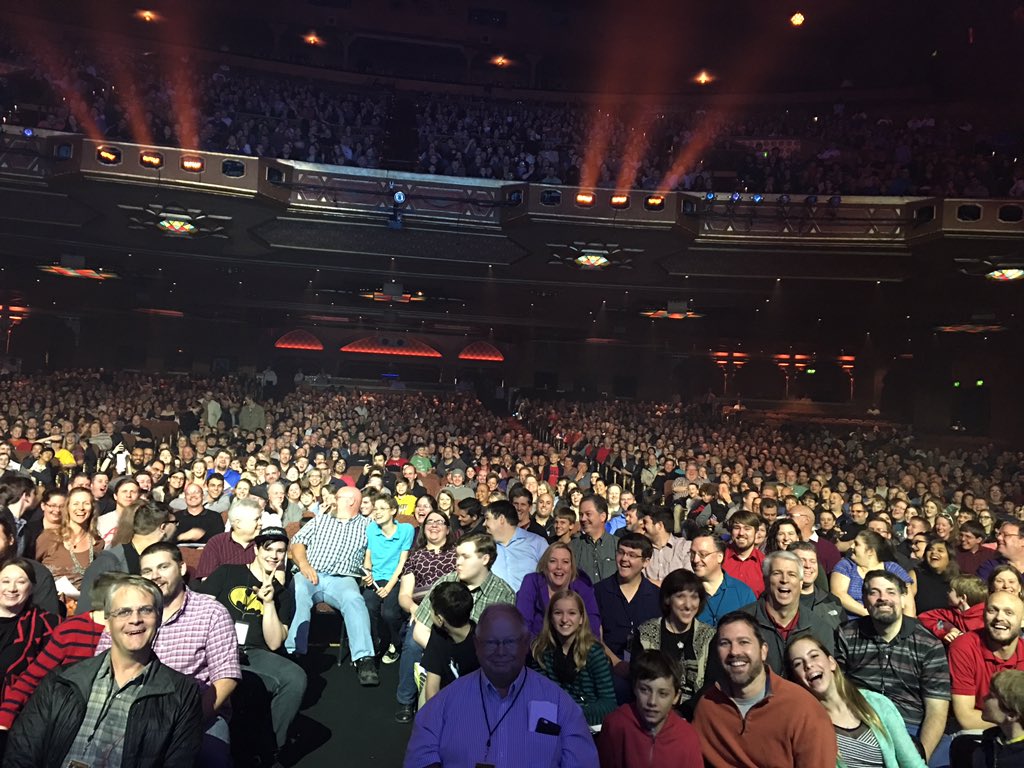
(My brother and I are about thirty rows back on the left.) You can tell based on my formless face-shaped dome head.)

But what I really want to talk about is Adam Savage.

Adam Savage is one of the nerdiest nerds around, putting a gusto and chutzpah into his geekiness that’s really enviable for a more low-key geek such as myself. While I expected to see a few neato science experiments and hear a few funny stories about being on the set (and there was certainly plenty of that), what really resonated with me was the opening moments of the night, wherein Adam told some stories about growing up geeky and what led him to the sort of thinking and experimentation and self-instruction that would eventually lead to a career doing special effects for movies and television and web series about science.

Being the big nerd that I am, I whipped out my pencil and notepad and began scribbling.

Out of the evening, I came away with a list of reading material that I need to look into (100 Years of Solitude, and the works of Raymond Chandler) and some lovely poignant aphorisms about science in particular and learning and being human in general. They were even, believe it or not, applicable to writing. So I thought I’d share a few of them here.

  1. The deeper you go, the harder it gets. Adam told a story about learning to juggle, starting with the absolute basics and eventually undertaking to learn tricks. At first, the gains and improvements came quickly and readily, and he was able to master new facets of the skill every couple of days. (As a fellow novice juggler, I can certainly identify.) But very quickly, you come up against a wall beyond which the improvements become harder to achieve. While he mastered basic juggling in under a week, it took him well over two weeks to master even a few simple tricks, and he found he simply didn’t have the drive or the time needed to undertake it further. As a result, he’s a decent if not impressive juggler. And, well, that’s like writing, or hell, like anything really, innit? Anybody can do it, anybody can undertake to string sentences together and even craft a narrative. But if you want to be good, if you want to impress people with your talent, well, you’ve got to slay a whole other sort of beast. You’ve got to live and breathe with your work for long months and years, you’ve got to study, practice, think about language, try and fail in a thousand different ways. In short, you have to put in the miles. I’d wager that most would-be writers don’t have the gumption to do that. It remains to be seen whether I do.
  2. The Champion of one notch above mediocrity. As a result of all this, he became just barely decent at a lot of things: he had fascination with tons and tons of different skills and ideas, but didn’t have the follow-through to devote himself to get really good at any one thing. As a result, he was seasoned in lots of areas and knew a little bit about a lot of subjects, but never became an expert in any of them. I think we could all take a page from that book. There’s value in trying lots of things, even things you don’t expect to plumb the depths of (see my collection of Flash Fiction for examples). Out of those tiny forays comes growth, comes a broadening of the experience.
  3. Failure is always an option. If you watch Mythbusters, you’re familiar with this little epithet already; rare is the episode that doesn’t feature an experiment blowing up — sometimes literally, often dramatically — in their faces. But this isn’t a setback. In fact, they seek this moment because if you simply skate through an experience and everything goes to plan, you maybe enjoy a bit of success, but you don’t really learn much. Failure, however, is a fantastic and ruthless teacher; nothing teaches you how not to suck like picking over the charred and smoldering remains of your failed forays beyond mediocrity. Unless you failed at skydiving. No second chances in skydiving.
  4. Art and science are just two different kinds of storytelling. This one shook me to my core. I like to think there’s something magical and even otherworldly about storytelling, in the artistry of a nicely turned phrase, the cleverness of a well-tuned plot. But as with so many things, the moment I sat down to think about it, the pieces started sliding into focus like a Magic Eye painting. Stories tell us why people do the things they do. Science tells us why the world is the way it is. We love art because it speaks to worlds and people and emotions that might be, and we love science because it shows us the magical things we never knew about the world we currently inhabit. Furthermore, I don’t think you can have a good story without science — even if it’s just the inexact science of human interaction — nor can you have good science without a bit of art — the elegant organization and tracking of variables, the spiraling recursion of repeatability.

I’ve gone on enough, but suffice it to say that while I went to the show expecting a bit of fun, I came home with a whole new respect for a show I once thought of merely as a diversion.


Elvis is Everywhere


The radio chirped out an all-call, and Officer Barkley shifted his grease-paper wrapped double cheeseburger from one hand to the other to scoop up the comm.

“This is car 57, go ahead.”

“211S in progress, Third and Main.”

Robbery. Bank robbery, most likely; there were about a dozen banks and ATMs in the strip-mall on that block. It had been a while since Barkley had gotten involved in more than a traffic stop; a byproduct of his recent return to field work after his injury apprehending a murder suspect five months ago. He cut his eyes at his partner, a new recruit by the name of Presley, who nodded curtly and switched on the sirens.

“Car 57 responding. Details on the suspect?”

There was a hesitation on the other end of the line. “It’s, uh… it’s Elvis.”

Barkley’s heart caught in his throat. “Viva Las Vegas,” he muttered.

#

Sandra hit the street and immediately broke out in a sweat, and only partially because of the two hundred thousand dollars she’d managed to shove in her gunny sack. It was a hundred and six degrees out, and the bejeweled jumpsuit and pompadour wig she sported were not what you could call forgiving in the heat. She snapped her sunglasses down and cast about in something closing in on panic. The shrill trilling alarm from the bank was a dead giveaway; pedestrians were parting around her like a boulder in a stream.

The streets should have been flooded by now; maybe one of the performances had run long. A siren rose in the distance; she only had a few minutes. She’d shoved the pistol into the waistband of her rhinestoned white pants, but there was nothing for it; she grabbed it and dashed up the sidewalk, ignoring the panicked cries of the passersby.

#

“There he is,” Presley said, jabbing a finger at the windshield.

Barkley followed her finger; sure enough, there went the King, white jumpsuit and all, running against the flow of traffic and scattering people in his wake. Hard to tell at this distance, but he could have been carrying a gun. Barkley gunned the engine and the car lurched onto the curb, scattering overweight gamblers in Hawaiian shirts.

“Go,” Barkley said.

Presley jumped out of the car and ran after the King, shouting for him to stop. But it was no good; the confused pedestrians parted in front of the suspect and then swarmed behind him with cell phones trying to catch a picture, getting in Presley’s way. Barkley dropped the cruiser back in gear and took off.

#

The cool air of the hotel lobby hit her like an Arctic blast, icing a bead of sweat oozing out under her wig. In front of her, a sign: Jailhouse Convention, ballroom C. Sandra threw a glance over her shoulder; the copy was closing, about fifty yards behind. To punctuate the situation, the door crashed open, and a shrill “STOP! Police!” rang out through the lobby. But there were too many people around for the cop to get a shot. Sandra kept running.

She flew down the disjointedly patterned carpet with her gun in one hand and her sackful of cash in the other, bills fluttering to the floor in her wake like startled butterflies, scattering hotel guests like spilled jellybeans to the left and the right. Here and there, pompadours and oversized sunglasses and bellbottomed jumpsuits turned to watch the commotion. At the end of the hall, a brass sign for ballroom C floated above a set of double doors. She kicked them open and charged into the throng of startled Elvis impersonators.

“BOMB!” She shouted.

The gyrating speaker on the stage dropped the mic and pandemonium broke out. Sequins scattered. A few hundred hunks of burnin’ love ran in all directions. Sandra yanked her wig off, shed her jumpsuit, and stole through a side exit.

#

To the tune of dozens of fire alarms, a flood of Elvises erupted from the rear exit of the building. They broke around the squad car and officer Barkley, who waited patiently with his weapon drawn on the door. Finally, under the cover of three particularly rotund impersonators, she slipped out, cutting immediately down the side street.

“Sandra,” he said.

She froze. Didn’t turn, just sighed and ran a hand through her hair, matted and lank with sweat from its stint under a wig cap. “Hank.”

“Didn’t think you’d actually do it.”

“Didn’t think you’d remember.”

She turned toward him then, caught him with her eyes. She was still beautiful, dammit. Moreso than she’d been when they were together, if that were possible.

“Your partner’s not so bright,” she said. “Looking for me in the midst of all that.” She flicked her head carelessly back toward the throng. You never saw so many blue suede shoes.

“Presley’s new.”

She laughed. “Guess it’s just you and me, then. So what’s it gonna be?” A wicked grin twisted her lip. “Are you lonesome tonight?”

Barkley swallowed hard. It had been a crap year on the force. He’d probably never make captain now, not with a bullet in his leg and a limp to match. Judging from the size of the bag she was carrying, she had at least a hundred thousand dollars, maybe more. His hound dog eyes rolled wearily across her, remembering the years together, the heartbreak, the bridges, the troubled waters.

The wind went out of him, and he lowered his gun. With a knowing look, she tossed him her wig and jumpsuit. It was big on her, but on Barkley, it would fit just about right. Unless… “Have you put on weight since I saw you last?”

He scowled. “I’m flushing my career, I’d like a little less conversation out of you.”

At that, she cackled. “Come on honey. Don’t be cruel.” And she grabbed his hand and guided him out of the alleyway.

#######

Chuck’s challenge this week is the perennial random song title challenge: my song was “Elvis is Everywhere” by Mojo Nixon. I’d apologize for all the song title puns in the story, but I’m actually not at all sorry.

Photo courtesy of Wikimedia Commons: Photo taken by Paul Smith for http://www.apepta.co.uk and kindly supplied by Martin Fox at http://www.elvis2k.co.uk

I Wish I Had The Words


Usually I use Saturday to post a reflection about writing and its process, hoping through that rumination to unlock some secrets about my own work or to unblock the filters that periodically need cleaning out.

But I’m not in the mood to ruminate, or to make light, or to ponder the mysteries of life and the blank page.

This morning I’ve got an indescribable rage in my heart over the events in Paris.

I could say it’s a white-hot point of light in my chest, but that doesn’t explain the cold detachment I feel. Maybe it’s more like a stabbing lance of pain in my gut, but that doesn’t jive with the dull numbness all over.

One way or another, over one hundred people are dead this morning in yet another terrorist attack, and I’m just dumbstruck. My heart is breaking.

How long can we allow this to continue?

How many more sons, daughters, mothers, fathers, brothers and sisters have to die in the name of a twisted religion before the rest of us agree that it’s time for that religion to go?

I try not to traffic in hatred and despair, because I don’t think there’s much to be gained there. But on a day like this, with over a hundred dead and the savages responsible celebrating in the streets, it’s hard. It’s really hard.

If I were the praying kind, I’d pray for Paris.

As it is, all I can do is hope that maybe our world leaders will decide that this is the line, that this is the time to drop the hammer on these stone-age degenerates once and for all.

The Seeker of Approval


“Are you proud of me today?”

My son was sitting on the toilet, pants around his ankles, hands bracing the sides — the classic pooping toddler pose. I was leaning against the sink, thinking about whatever it is parents think about when they are trying not to think about the fact that they have to be present while their kids are pooping. Probably penguins. (It’s usually penguins.) You can’t look straight at the kid, that makes him nervous. You can’t wander out of the room, he gets upset. You just have to be present and sort of stare into the bathtub for a few minutes.

“What’s that, buddy?”

“Daddy, are you proud of me today?”

I’ll confess that I don’t put a whole lot of planning into the words I use around my kids, outside of course of trying to stay away from the Sharknados and Mother Truckers that inadvertently bubble to the surface when they, for example, dump entire boxes of cereal on the floor, or throw freshly laundered running shoes into toilets. I mentally replay the conversations I’ve had with the boy in recent months. Surely I’ve told him I was proud of him a few times, but never made a big deal out of it. Oh, you counted to ten. I’m so proud of you!

But here he is, mid-deuce, asking me if I’m proud of him.

“I’m proud of you every day, sprout.”

“Well, are you proud of me TODAY?”

He has this funny way of asking a question where he sort of smiles but forgets to turn his mouth up at the corners. Just bares his teeth at me. It’s adorable but unsettling. He leans his head to the side a little when he does it, sort of like a Cheshire Cat that fails to vanish.

“Sprout, I’m always proud of you.”

“Today, daddy?”

“Yes, of course, I’m proud of you today.”

“Okay.”

That seemed to satisfy him. He focused on the task at hand for a moment, a tiny vein popping out in his tiny forehead as he strained.

“I can’t go poop, daddy.”

“That’s okay, sprout. Sometimes you just can’t. We’ll try again later.”

“Okay. Daddy?”

He thinks, I think, that if he doesn’t address me every time he speaks to me, I’ll forget he’s speaking to me. I’d be willing to wager that he says “daddy” over five hundred times a day. Easily 50% or better of his daily lexicon.

“Yeah?”

“Are you still proud of me?”

“Buddy, I will always be proud of you, all the time. No matter what.”

I held up my hand for a high-five and he gleefully obliged, and we went downstairs. He wanted to complete a puzzle for the fifth time of the evening. Sure, kid. No problem.

If only we could all ask so guilelessly for approval for such small accomplishments.

The Actor’s Nightmare


Why, nearly ten years removed from the stage, do I still get the Actor’s Nightmare?

If you’re not familiar, the Actor’s Nightmare is a simple but prevalent one among denizens of the stage, in which a performer finds himself thrust into a performance for which he is woefully unprepared.

Common tropes of the dream:

  • You learned all your lines, but have forgotten them and everybody stares dumbly at you as you “um” and “uh” your way through.
  • You never learned all your lines, but somehow made it to performance night anyway, and everybody stares dumbly at you.
  • You know your lines, but are unable to speak, and everybody stares dumbly at you.
  • Your costume is ridiculous or unfinished or ludicrously fails to fit you, and you must go onstage in street clothes, naked, or in the idiotic costume anyway.
  • The set is unfinished or worse, still in active construction, and your performance takes you through a minefield of sharply upturned tools, unsteady platforms, and other threats to life and limb.
  • Your performance is brilliant, but the audience is completely empty.
  • Your performance is an utter travesty, and the audience is completely full.
  • Your performance doesn’t matter, because the audience is full of T-Rexes who fall upon you and your fellow actors in a bloodbath of Shakespearean epithets.

Every actor in every performance ever has played out all the ways a show could go wrong in his mind multiple times throughout rehearsal for said show, and in the Actor’s Nightmare they all parade across the screen of our minds with the saucy abandon of a dog rolling in roadkill.

I’ve had the Nightmare ever since I started with theater. I will probably have the Nightmare my whole life, seeing as the theater was such an enormous formative element of my salad days. It’s just too much a part of who I am, I think, for me to ever be rid of it.

Still, why does it persist?

I don’t buy very much into dream interpretation, except in the broadest sense. If somebody tells you that because you dreamed you were falling from the 37th floor of an office building into a dumpster full of unicycles, you will soon find a new job at the office of Forestry under a supervisor named Shwampa or something… that’s garbage.

But the Nightmare, I think, is just another manifestation of doubt, of anxiety, of the rampant feelings of inadequacy that so many of us have. Notice in the list that a common thread is “everybody stares dumbly at you,” as if you’re out of place or you’ve wasted their time. Well, that’s a very real and present fear in the life of this particular writer. Also recurrent is that idea of things being “unfinished” or “unprepared,” which, well, yeah. I never feel particularly ready even to get out of bed in the morning, let alone to ply my trade as a wordslinger (though I did optimistically and automatically call what I do a “trade”, so maybe there’s something there).

Point is, there’s an undercurrent of doubt behind everything I do, no matter how brashly or confidently I brag about it. I don’t know, for all that I love my kids and my wife, how good I am at being a father or husband. I’m maybe a decent teacher, though I am regularly in class thrust up against the reminder that I don’t really know what I’m doing up there. I fancy myself a decent recreational runner, but I’m definitely not winning any trophies these days, and I’m always afraid I’m going to injure or re-injure myself. And as for my writing, well, I talk a good game, but no matter how many words I write, the Howler Monkey of Doubt is right there, with his empty eyes and his judgmental grin.

wpid-scragz.jpg

Of course, the upshot is that the Nightmare fills me not with the abject howling terror of being devoured by an audience of T-Rexes (okay, sometimes). Rather, I wake with the slightly bemused SOMETHING of watching a couple of cats wrestle for a moment and then lick each other’s butts. For a moment, it was scary, but now it’s just a weird thing that happened. The Nightmare is a reminder that, while that doubt can be crippling in the moment, it’s one hundred percent a creation of the mind.

The truth is, I’ve never gone on stage unprepared.

Or naked.

Or in front of a bunch of T-Rexes.

But maybe the thought that I may one day have to will help keep me sharp.