The Weekly Re-Motivator: Expiration Date


Consider a tree. Nourished and nurtured and planted in fertile soil, it can flourish and tower and bear remarkable fruits. Neglected and sheltered and forgotten about, it withers and crumbles and gets overrun with ivy or tree cancer or tree-eating beetles or something horrifying like that.

Just so with the creative brain. Given room to grow, freedom of expression, and a steady diet of inspirational art, the brain grows stronger, desires to create for itself, and spawns incredible creations. Left to fester, the brain shuts down, gives up, stops trying.

Creativity must be tended, just like a tree, or that crappy vegetable garden my wife and I tried to plant a few years ago. We didn’t know anything about anything when it came to growing actual food, and figured, you know, the human race has been handling this gardening thing for millennia; how hard can it be, right? Bloody hard, as it turns out; not to mention the fact that neither of us actually has the patience or the drive to actually maintain the thing. What, you mean it takes more than a sunny spot, a few holes in the ground, and some foolish optimism to grow food in your backyard? To hell with that!

But of course it does. You’ve got to monitor that crap. Track the pH levels in the dirt. measure the amount of water in the soil. Pull weeds. You know. Effing work at it.

And if not tended properly? Those fruits wither on the vine, or worse, they shrivel up and die before their tiny little seeds can even germinate.

And so it is with creativity. Ask any writer or artist or whatever where their ideas come from, and their answer will probably be something like: it’s not finding the ideas that’s hard, it’s deciding which ones are worth my time that’s difficult. I’m not even that much of a writer, and still the thought will cross my mind at least once a week — sometimes once a day! — hey, I should write a story about this or that would make a really cool turn in my novel or man, I wish I’d had that idea three months ago on that other project.

But these ideas are like the produce at Aldi: they have an expiration date measured in hours, not days. Your brain serves them up from wherever ideas come from. (The black hole in the back of your brain? The quantum tunnel that connects your brain to every other brain in the world? Narnia?) They land on the shelf where your conscious mind peers at and ponders over them like an aging bachelorette on a diet. And whichever ideas don’t get put in the cart? Whichever ones don’t get spun pretty quickly into tonight’s dinner or slapped into the deep-freeze of your ever-expanding Evernote file? They go brown, they turn spotty, and they end up in the dumpster out back.

Age, Bacteria, Bio, Biology, Bread, Breakfast, Bug

Which is fine and natural (not the exorbitant amount of food waste in our country, of course — but the life cycle of ideas). A few bananas go bad — it’s no big deal, the grocery store knows it’s gonna sell more bananas. But those kiwis? Those mangoes that look so good but taste so bad? The more they rot, the less the store wants to put them on the shelf.

But your brain works the same way. It serves up these fantastic ideas day after day, week after week, and the more you don’t do anything with them? The more they expire, unused, on the shelf?

The less your brain is going to serve them up.

This is why I try to write, at least a little bit, every single day. The more I write, the more I notice my good ideas when they crop up — and the more, it seems, I have to choose from.

Your creativity — your good ideas — they have an expiration date.

Waste not, want not.

This weekly remotivational post is part of Stream of Consciousness Saturday. Every weekend, I use Linda G. Hill’s prompt to refocus my efforts and evaluate my process, sometimes with productive results.

Suddenly Supercharged


There comes that moment when you’re writing a story and it just gets stuck.

Maybe it’s in a rut and not a lot is happening, or maybe the characters have backed themselves into a corner, or maybe it’s you the author who is blocked and unsure where to go next.

I’ve been in that place for the last couple of weeks with my project, probably owing in no small part to the fact that summer is over and I’m back to work. New employer, new commute, new routine, new stress. Hard to dedicate the grey matter that I’d like to the book, and it’s suffered for it. I’ve been writing by rote, pushing the story forward like it’s a stalled Ford Fiesta miles from the nearest gas station. (To say nothing of my scanty posts around here.)

Luckily, though, characters have a life of their own, and every once in a while, if you keep at it, the muse will flutter down and blow some glitter up your butt. My main character — perhaps as frustrated as me at the aimless wandering going on at this point in the draft — took the wheel and steered us right off the road during my morning session. Jumped ahead to a conflict I wasn’t planning until very late in the book indeed, if at all. Exposed the raw nerve floating right beneath the skin and vented some spleen all over the gooey sludge of this story.

It’s a turn I wasn’t expecting — wasn’t even thinking about when I sat down to write — but it fits perfectly with the character and the story. Of course it does. I told myself when I sat down to write not to force anything but just to let a conversation happen, and before I knew it, I was over quota for the day and my protagonist and antagonist have increased the boiler pressure well past the safe range.

Which serves as a good reminder of something I forget often: sometimes you just have to get the fargo out of the story’s way.


On My First Rejection Letter


I sent out my first query at about seven last night.

By the time I went to bed, I had a rejection in hand. (Well, in box.)

A kindly worded, encouraging rejection, but a rejection nonetheless.

It’s okay. I was prepared. Rejection is the name of the game, so I hear, and I had no illusions that the first shot into the blue would strike a rainbow or anything. I sent it off the way I buy a lottery ticket — much more this almost certainly won’t work, but wouldn’t it be awesome if it did than THIS IS THE ONE — so the rejection is not in any way shocking.

What surprises me is how little it bothers me. Seriously. I went to bed feeling not terribly upset about it, but I figured I was still in shock over the fact that I actually mustered up the nerve to send it off in the first place. But I woke up still feeling not all that upset about it. Kind of like finding a bunch of fallen leaves and pine straw on my car: not what I particularly like to see, but not unexpected, and certainly not going to impact my day in any way.

A far cry, in other words, from the soul-crushing despair I might have expected after submitting the fruits of over a year of work to one of The Gatekeepers and receiving a resounding “eh” in return. I feel like I should be thrashing in an existential tsunami of doubt. Like I should be questioning every creative thing I’ve ever done. Like I should be getting seriously depressed about all the time I spent working on this thing. But I’m not doing those things.

This confirms — for the moment, at least, but check back with me after maybe a dozen rejections — what I’ve always known about writing: the hardest thing to do is to actually start doing the thing. The step that always seems impossible is the first one.

It’s like in Indiana Jones and the Last Crusade. There’s that cave on the other side of the cavern, with an impossible chasm in the way. The only way to get there is a leap of faith. He resists every natural instinct in his body and steps out into the void, only to find out — there’s a bridge. Just not one he can see from where he’s standing.

The worst part is over. The leap is behind me. And all of a sudden, that step doesn’t look nearly so intimidating at all. Kinda makes me feel silly for dreading it so much.

In fact, the second letter has already gone out this morning.

LightningStruck


Often, I rail against the mortal writing sin of “waiting for inspiration.” The fact is, you can’t count on inspiration. The muses are busy little bees, and if they only turn their divinely inspiring faces your way even every few months, well, you should consider yourself lucky. But you don’t get things done by sitting around, waiting for that to happen. Novels are not written with a muse perched over your shoulder, hmming and ahhing as you get to the good bits, putting whiskey into your hand just when you need it, and yanking you out of your stuffy crapsack apartment every now and then for the fresh air you so desperately need to keep the creative juices flowing. The muses have better things to do, and you should have better things to do than to sit around waiting for them.

Still, though, on some days the car just won’t start. Some days, you’re in between projects, and your routine is shattered, and you’re unsure what to do, and even the thought of opening up that blank document and screwing it up with your words is enough to send you into an existential spiral of doubt and dread and you go binge-watch Orphan Black instead. Some days, it’s hard to believe that you ever thought of yourself as a writer at all. Who does that, anyway? Who has the time or the creativity to turn out stories day after day, to think up new characters and conflicts, to flesh out entire worlds? It can’t be done. The authors who’ve done it are either fake people — computer-simulated AI programs that analyze market trends and tailor the storylines to what people really want to read. Or maybe they’re just independently wealthy people who don’t have to hold down jobs or families or any other inconveniences of living in modern society. That must be it.

These are the days that break a lot of folks down. They’re the days that broke me down in the past. “I just don’t feel like writing today, so I’ll start the new project tomorrow.” “I’m not sure what to do with this scene; I’ll just ponder on it until I figure it out.” “The story’s kind of up a tree. Maybe I just need to let it be for a while.” The problem is, momentum matters. “Tomorrow” turns into the next day, then a week, and so on until the novel you are writing turns into the novel you were writing, once upon a time. “Until I figure it out” becomes “until I feel like it,” which becomes the trash fire of “maybe I’ll get back to it one day.” “Letting it be for a while” likewise becomes “dust on the shelf.” You’re writing, you’re writing, you’re writing, and then poof, you lose the spark, and all of a sudden, you’re not writing anymore. You’re waiting.

For what? For the magic to happen?

Keep waiting. There is no magic in this world outside of the magic we create, so if you want inspiration, you have to seize it where it comes and drive it in front of you like a herd of goats when it doesn’t.

It shames me to admit (though I must) that I’ve been waiting for a while. Sitting back, letting my tomorrows turn into one days, letting my until I figure it outs turn into until I feel like its. I’ve had excuses. Good excuses, even! It was the end of the year; I was focused on wrapping up at school. I had just finished the AI edit, I needed some time to decompress before the next project. I wasn’t even certain what the next project wanted to be; how could I just start working on something with no guidance, no map?

Well, valid excuses turn into crap ones the longer you stretch them out, and I’ve stretched mine for about a month. And I wish I could say that I have seized gumption by the scruffy nethers and started shaping my creative expression like a sculptor with a particularly pliable bit of clay. That I hoisted myself by the bootstraps and threw myself back into the habit and started crotchpunching the sharks out of my way.

But the sad fact is, it took a visit from the muse to kickstart me into motion again.

Lightning, Thunderstorm, Storm, Weather, Clouds, Nature

Somewhere between trolling the internet, not thinking about writing too much, and mowing the lawn, lightning struck, and all of a sudden my brain is like a pack of jackals scrabbling against the inside of my skull. All of a sudden, the story demands to be written.

I’m not saying I wouldn’t have gotten started up again, but there’s no telling how long it might have taken. That scares me. More than a little bit. It’s humbling, this thought that for all I preach about the virtues of sticktoitiveness, of writing through every day even when the writing sucks, I got mired in the morass myself.

But you know what?

I’m writing again. And you know that thing they say about gift horses.

Jump on and ride them till they throw you.

Lose Yourself on the Trails


I’m a creature of habit and routine. (As are we all.) The only way things work in my life is if they find a way to fit into the routine. That goes for writing, obviously (which is one reason I haven’t written much lately: because the school year is almost out and that’s basically like tax time for an accountant). But it’s true for running, too.

Any exercise routine needs … well, it needs routine if it’s going to work. You can’t just squeeze it in when you get the chance, because who ever really feels like running three miles just because? (Well, aside from lunatic runners like myself.) The routine is what keeps you honest on a day like today, when I shut off my alarm and laid my head back down instead of getting up to go run, and then 15 minutes later the guilt took over and I suited up for a couple of miles anyway. And my routine works because it’s simple and accessible: I just step out the front door and go. If it wasn’t that easy, I wouldn’t be a runner.

And I live in the suburbs, so the runs are routine, too, even if I change up my route. There’s no danger of getting lost. No chance I’ll be unable to find my way back. When you’re in town, even one that isn’t familiar to you, there are landmarks everywhere marking the safe path. Buildings. Street signs. Rusted out shopping carts in the ditch. You can see these things and construct the path that brings you back.

Which is awesome, but let’s agree, pretty boring, too.

Which is why every runner should take it to the trails every once in a while.

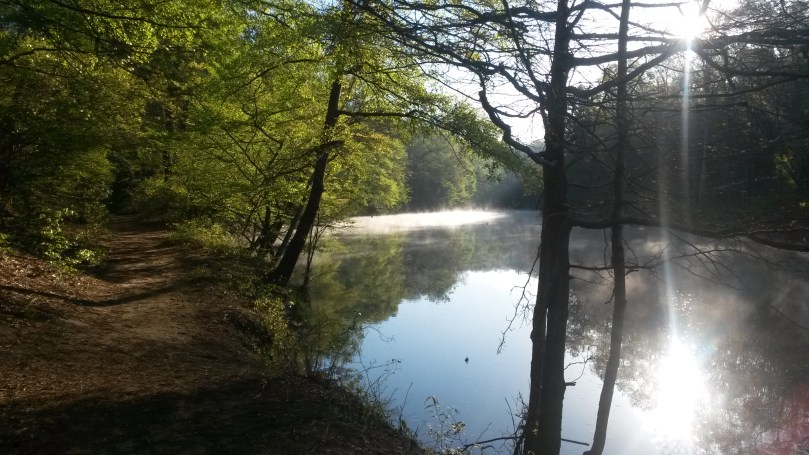
20160404_083206.jpg

I could go on about the physiological benefits to running on trails (dirt is softer, ergo easier on the legs and feet; the uneven surfaces force you to recruit more stabilizing muscles and result in a better workout; the roots and rocks in your path force you to be present and focused on what you’re doing), but that’s not why I like trails.

I could also extrapolate on the mental benefits of the trail (studies show that proximity to nature confers clearer thinking and reduced stress levels; the smog is replaced with the flowery, earthy scent of nature; and let’s not underestimate the value of not having to dodge traffic), and those are great, but they’re not my favorite thing about trails.

I like trails because you could get lost out there. Even on the well-cultivated, clear-cut trails at the parks and preserves near my house, there are side trails and detours and twists and turns not marked on any map that, were you to ignore good sense and plunge in unprepared, could turn your one-hour excursion into a two-hour one, at the very least, or a three-day-weekend surprise-camping-trip at worst. Landmarks are few and far between if they exist at all. What you’re left with is a boundless sea of green all around with a tiny ribbon of dirt that swerves off into the thicket. Not much way of telling where you’re going, nor of telling where you’ve been. One tree looks much like another, and when the canopy grows together over the top of the trail (as it does on most of the trails I frequent), you don’t even have the sun to help you navigate.

You’re lost, except for the blind trust that you’ve read the map correctly (which, let’s be honest, you probably haven’t).

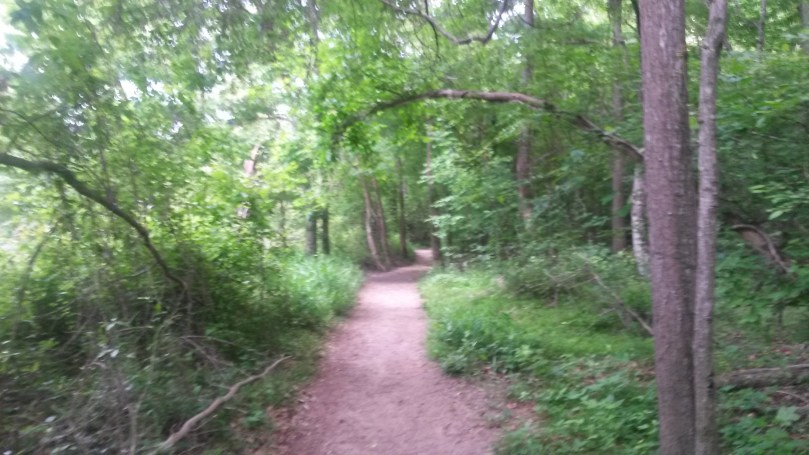
wpid-20150509_091438.jpg

And this is the best part! Because this is when you realize that for all that humanity has tamed the world and the wilderness, there are still great stretches of it everywhere, just waiting to swallow you up. Which is — wait for it — just like writing.

You start your project with an idea. Maybe you map it out deliberately and painstakingly, or maybe you just jump in and start writing. One way or another, you take those first steps off the well-cultivated road and pretty soon it’s nothing but identical trees in every direction but for the tiny scrap of trail disappearing behind you and stretching off into more trees ahead. And your cultured, educated brain tells you that it’s not so far ahead that the trail should jerk hard back around to the right — the way back to civilization — but all of a sudden the path dips and bends off to the left.

Was that the way? Or are the woods playing tricks on you? Suddenly you’re filled with uncertainty, and you think you’re heading in the right direction, but all you really have is your hope. That, and the tiny bit of story you just wrote and the tiny bit you can see from where you stand. Every now and then you break through — the canopy parts and you can see for a stretch down the river or across the valley — but in moments, it’s all swallowed up again in the green maw of the forest.

As runners, I think we have to leave behind what we know and go get lost every once in a while. Partly for the benefits it confers, but mostly because running is one of the few sports that encourages us to enter and explore the world all around us in its natural state.

And as writers … well, I think as writers we should maybe spend more time lost than found.

Happy trails.