Kid Art: In which my 3-year-old teaches me a thing or two about creativity


I’ve been sitting around for the past couple of days when I have a spare minute, watching my son playing with his new chalkboard table.
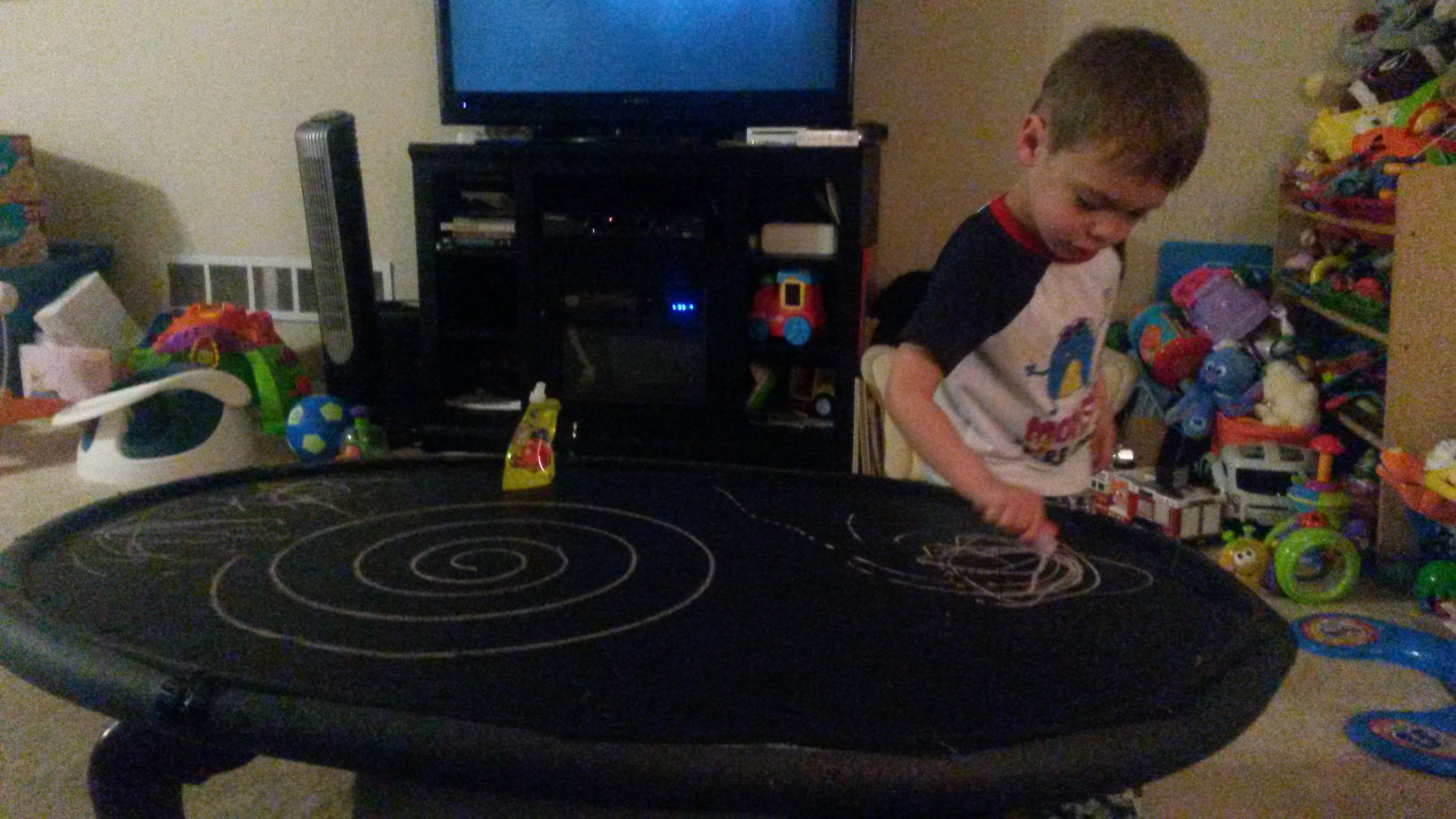
wpid-20150516_204505.jpg

Just a sidenote: if you have kids, and the kids are in any way artistically inclined, you owe it to yourself to make one of these. Just take any old crappy coffee table, go to Home Depot and buy a $15 can of chalkboard paint, lay down a couple of coats on top of the table, and let it dry overnight. Easiest and most rewarding DIY project I’ve ever undertaken.

Anyway, my boy has a dubious approach to the thing. He loves coloring but lacks any kind of… I don’t want to say the motor control, because he seems to be doing what he wants to do… what I’m trying to say is, the things he draws aren’t shapes I recognize from this universe. Everything looks like a sea urchin, or a squiggle, or maybe just one long shapeless line. He will draw these designs, over and over again, one on top of another, until the table literally looks like a bucket of chalk vomited all over it, then he will gleefully take a rag, wipe the table clean, and start anew.

The crazy thing is, he knows what he’s drawing. I can point to this squiggle, say “Sprout, what’s this?” And he will say, confidently, “apple.” Point to this two-foot-long wobbly line: “water fountain.” This wonky-looking unidentifiable polygon: “dinosaur.”

Which is, in itself, adorable and delightful; hours of fun just asking the boy what he’s drawn and trying to imagine how exactly he sees these things.

But it goes a level deeper.

Because sometimes, he’ll decide to draw something himself. “I going to draw a car.” Okay, sprout, go ahead. *scribble, scribble.* He works with such intensity sometimes that I find myself looking over his shoulder to see exactly how he’s going to describe the shape of a car. Of course he isn’t. It’s just a shapeless blob of color. But he will finish, stand back to admire his work, and say, “Oh, that’s not a car, that’s a banana.” And then go on drawing something else.

Or I’ll ask him to draw something. “Draw daddy,” I’ll say, and his eyes will light up with glee, and he’ll begin the painstaking, arduous work of outlining my bald head and bugging eyes and ha ha just kidding, he scribbles a little bug-splat of color, stands back and looks, and announces to me, “Oh, that’s not daddy, that’s blocks.”

This little game simultaneously cracks me up and creeps me out, because I know he knows his shapes from any of the myriad of little puffy books or kids’ youtube videos we’ve looked at together. He can identify a triangle without batting an eye, can tell the difference between a duck and a penguin, and knows his boats from his spaceships. He knows things. But he also has the ability to recognize his nonsensical artistic representations of these things as these things, despite the fact that the two bear no resemblance whatsoever to one another. And I know he’s not just making it up, because he can lay down five or six spaghetti-tangle pictures which he names as completely different things than he originally set out to draw, and then he can point to each one again and tell me what it is with 100% accuracy. And I’m sorry, if he’s just making this stuff up off the top of his head, I don’t think he has the wherewithal to piece together a fiction. I really think that to him, that squiggle somehow says, “dinosaur,” while this one says, “grocery store.”

It’s a nifty little parlor trick, I guess, for a three-year-old to be able to do, but I started thinking about the boy, and I started thinking about creativity and art in general, as is my wont, and then came the lightning strike moment. The moment where the mundane, not-at-all special and completely-by-accident whimsical actions of a toddler shake my preconceived notions of the world to the very roots.

How many times have I found myself banging my head against a moment in a story? A character who just doesn’t seem to behave the way I want him to? Or a fiddly bit of plot that just won’t jive with the pieces all around it? Or an element that I need for the story to move forward, but I can’t figure out how to work it into the story? Or, maybe, the problem is more intrinsic to the story: I’m trying to write a science fiction thriller but it detours into comedy, or I’m trying to write a lighthearted romantic-comedic bit, but suddenly things feel all melodramatic? I always talk about how stories have lives of their own, how the characters have drives and desires buried within them that are sometimes a surprise even to me, but I still find myself trying to force square pegs into round holes. No, the story is meant to be this way. No, I need to focus on this aspect of the plot now. No, I’m trying to send this thematic message.

But not my son. The art takes him in a new direction, he’s happy — even ecstatic — to detour and abandon the thing he thought he was working on. The story changes, he changes with it. He has no preconceived notions of what it should be, there is no consideration for creating the wrong thing. The thing he creates is fine by him, whether it’s what he set out to create or not.

And I think that’s pretty freakin’ awesome. Because when you don’t get hung up on the problems in your story, when you don’t wander off into the bog of unrealized expectations, you can process the project in front of you with the unbiased perception of… well, of a child. To a kid, things are what they are. And there’s nothing wrong with that.

The Itch, or Why It’s Better To Just Go Ahead and Write Something, ANYTHING


Work was a beast today. Finals time, students are panicking, banging down my door, shoving papers in my face, “HERE GRADE THIS HASTILY SCRIBBLED TWO-MONTHS-LATE ASSIGNMENT SO I CAN PASS THE CLASS.” I debated a hundred times giving the lecture: “Had you done all your work at the appropriate time instead of, perhaps, staring gobsmacked into your cell phone when you should have been paying attention in class, then maybe you would have the grade you wanted and wouldn’t feel like the ant looking at the descending boot right now.” But that’s in vain, at this point. I’ve only been saying it for months. If they haven’t learned it from me by now, it ain’t gonna sink in today. Still, I don’t have to put the grades in until Monday. So maybe I’ll let those failing grades hang over their heads for the weekend, each of them enduring their own personal Sword of Damocles.

Anyway, I didn’t meet my writing goal today. This is not the end of the world (#writerproblems are not #realproblems) but it irked. It settled into my shoe like a microscopic bit of gravel and yanked at my mind throughout the afternoon and the evening, chewing on my thoughts like a voracious little psychic were-rabbit. Wrapped up my school day. Didn’t get your writing done. Went for another delightful trail run. There’s still writing to do. Got home, made dinner. You only wrote 500 words today. There’s still time. Made the final arrangements for tomorrow night’s soccer banquet. Only 100 more to make your bare minimum goal. You can cough up 100 words sitting on the toilet if you have to. Skyped with the wife and kids. They’d love you more if you would finish your writing. Watched a bit of TV, because goldfinger it, I deserve that. Slacker. How dare you consume media when you could be CREATING media. Shut everything down and headed for bed.

Oh, that’s cute. You think I’m going to let you sleep, knowing you only have to write 100 words to shut me up?

I could be joking, but I’m not. I feel like a total and abject failure as a writer if I have the opportunity to get it done and I don’t get it done. I feel no comparable sense of shortcoming for virtually anything else in my life. Didn’t get that stack of papers graded? They’ll keep til tomorrow. Yard didn’t get mowed today? Grass’ll still be there in the morning. Pets haven’t been fed lately? They could stand to lose a few pounds. (Let’s sidebar and establish that I don’t actually starve my pets, okay? THIS IS FACETIERY, PEOPLE. And, yeah, okay, fine, facetiery isn’t a word, but dag derg it, it should be.)

So I lay in bed for twenty minutes, eyes shut, focusing on the soothing sounds of the rumbling thunderstorm simulated by the white noise machine on the bedside table (how I ever slept in my life without one of these I will never know), completely failing to fall asleep, because the voice wouldn’t shut up. 100 words. Just 100 words. 100 words and you’d be done. If you weren’t a failure, you’d write the 100 words. Come on. You’ll feel better if you write a little bit. Just a little bit. Just 100 words. Come on. COME ON. GET UP AND WRITE. DON’T BE A B–“

So I got up. But I can’t write just 100 words, so I ended up writing 300. Then I had a good idea for something that should really happen earlier in the story, so I wrote another hundred words or so of notes to myself about what I need to go back and establish at a prior juncture. Then I remembered another couple of things I wanted to have happen at this leg of the narrative, so I doubled back and added them in as well. All told, I ended up writing about 600 words in the story, to add to the 500 I wrote before, so not only did I make my goal, I took a victory lap as well.

And what’s a victory lap deserve? Another victory lap on the blarg, because now my mind is racing and won’t shut up, and I have to spin off this mental energy somewhere. So there’s another 700 words of blarg drivel before I fall asleep.

If writing is my new addiction, I think I can live with it.

Little Victories Fuel Big Victories


If you’re like me, a wannabe writer trying to figure out how to make the dream happen, you might be struggling to write every day. I know I did; writing the first draft of my first novel was as challenging as pulling the teeth from an enraged baboon while whistling “Happy Birthday” backwards. Sure, you start off full of chutzpah, ready to slay dragons and save the world every day, but the honeymoon only lasts so long. After a few weeks, you find yourself tasked with churning out more and more words, even though you’ve already used up your good ideas — or even though you don’ t know how to get to the good ideas.

That blank page stretches out in front of you like a wasteland, cruel and without end.

Some days are better than others, but every day is hard. Not just because you have to claim your time from the jaws of your enemies with blood and fire, but because you have to keep the creative engine churning, you have to keep the cursor moving, you have to keep that word counter ticking over like the odometer on a road trip.

Now, I’m not an expert. I’ve yet to make a dime off of anything I’ve written creatively, so I can’t claim to know any better than anybody what you should do to make any money at this endeavor. But I do know that if you aren’t writing, every day, you’re handicapping yourself before the race has even begun. Momentum matters, and if you keep the ball rolling a little every day, you don’t have to kickstart it from a dead stop again. To that end, if there were one piece of advice I’d offer to anybody trying to start writing, it’s this:

You need a daily goal. A set amount of progress that you will, one way or another, put to “paper” one way or another before today turns into tomorrow. Momentum matters. Achieving this goal every day will keep you sliding forward like a glacier. You can’t set out to say you want to write eighty thousand words by November and hope to get there by focusing on the eighty thousand. It’s too big. You might as well be thinking about climbing the summit of Mount Everest when you haven’t even left base camp. It’s a good goal to have, but you’re not going to achieve it today. Or tomorrow. Or next week. And when you fail to achieve that goal, you will lose gumption, you will lose drive, you will lose the confidence that you can achieve this thing. What you need is to focus on what’s in front of you and achieve that, however big or small that goal is. What’s your daily goal? 100 words? 300? 2000? It depends on the kind of time you have available in your days (or, more correctly, the amount of time you can prise from your day’s cold, dead fingers).

I find that, on a normal workday, I can usually find about 45 minutes to write, and that tends to be enough time for about 900 words.

Now, 900 words assumes I’m able to write productively and without pauses for almost the entire time, and that’s not always the case. So my “on paper” goal per day is 600, even though I’m really trying for 900. 600, therefore, is what I want to accomplish so that I can feel I’m not neglecting my writerly duties. 900, however, makes me happy.

How does it go, writing 900 words a day?

A little something like this:

0-100 words: Man, this is hard. Why did I decide to do this, again? I’m not sure what I should be writing at all. (re-reads yesterday’s work.) Okay, maybe this can happen, or maybe this character can set this trap… I dunno, it sounds lame. But if I don’t get to work, I’m not getting my words. Whatever. Just write something.

100-300 words: Well, I guess this is happening. I’m not sure I love what’s happening, but it’s happening. Make sure to keep that character involved. Think about what this character is thinking. Where is this heading? Just keep writing.

300-500 words: Okay, I like what’s happening now, and I see where it’s heading. Maybe, though, it doesn’t make sense for this character to say this thing now, or to take this action now, but I’m not sure how else it could go. Don’t think about it, don’t think about it, don’t think about it… fix it later.

500 words: SHARKNADO. I just realized the perfect thing that should have happened earlier to set up the thing I just realized needs to happen now. Do I go back and fix it? Press on and make a note? (This is usually where I get up and walk around for a minute to rearrange my thoughts.)

500-700 words: I’m either going back and inserting an alternate text to something I already wrote, or I’m forging ahead full-speed with today’s beats. Either way, at this moment, I’m in a state of flow, just letting the words come on their own and keeping up with the narrative as quickly as it’s unspooling in my head.I don’t even check word count during this step. It just happens.

700-900: Flow continues and the possibilities for future events are exploding like popcorn, one after another, each one showing a road to the rest of the novel that might develop into something or that might wither on the vine. There’s no telling which one is the right one, though, so I grab hold of one and ride the wave while it’s high. At some point in this range I realize that I’m almost out of time for today, so…

900-1???: I use my remaining time to find a stopping point. I used to try and finish a beat, but now I like to either stop right in the middle of one or just at the beginning of a new one. That way, when I come back to write next time, I still have fresh in my mind some semblance of where this scene is going. I don’t usually want to stop writing at this point, but by this time there are other responsibilities banging on my door, either literally or figuratively.

So that’s pretty much every day. I push through five days a week like that when I’m drafting. I aim for a blarg post about every other day or when I can manage it, but I don’t stress about the length of the posts anymore (I used to shoot for 1000 words… yeah, this post is over 1000 already, but sheesh, that’s a lot in a day).

900 words might seem like not very much to you. Or maybe it seems so lofty as to be insurmountable. Point is, it’s been a sweet spot for me: It’s a challenge to get there, but not so daunting that I have to struggle every day to make it. But it’s not so easy that I can do it without any effort at all. It’s significant enough to give me a pick-me-up when I meet the milestone, but not so significant that I feel I can’t make it. Pick a goal that stretches you a little bit, but one that you can realistically reach from where you are. Little victories fuel big victories.

I’ll admit I’m feeling somewhat at sea with my current story. There are loose ends all over the place, I’m still getting a feel for the characters, and I’m not even 100% sure where I want the story to go. But what I do know is, I’ll be writing about 900 words a day every day for the next few months. If I can keep to that schedule, then long about September, I’ll have my second novel drafted.

How do you eat an elephant? One bite at a time.

Broken Ankle at the Finish


I know, okay? I get it.

It’s become too much of a motif around here, this procrastination, this failure to complete, this inability to batten the last hatches. If writing my novel has been a marathon, I’ve snapped an ankle in the last mile. Or maybe sprained it. Or maybe I just tripped and fell and I’m only really really tired, and every scratch feels like a gash, and every shallow breath is a gasp. But that’s no excuse for not slogging myself across the line.

There isn’t much left to do. There really isn’t. I can only belabor the point so much. I can only pretend for so long that I’m stuck on an issue — this character isn’t working out so well, or that plot turn doesn’t feel quite right — before the truth bubbles to the surface like an eyeball in your soup: that I’m not stuck on an issue within the novel, I’m stuck on finishing the novel.

Because that’s all there is. This first edit has drawn on like an endless summer, and I’m bogged down just a mile from the finish line. The car’s blown a tire and there’s no phone service, and even stepping foot out into the sun has me sweat-soaked and exhausted. The prospect of knuckling up and walking it out to the finish has me dreaming of shade trees and ice-cold lemonade.

The last issue is this one character. I don’t know what to do with her, and I could conceivably go back and write her into a few more scenes or write her out of the novel completely… it honestly makes no difference to me at this point. I’m almost ready to hand the manuscript off to some beta readers (a term that never made sense to me… I mean, I guess I’d be the alpha reader, but does that really make sense? Anyway…) and just let them tell me what to do with her, but then I know it’s probably not a professional move to hand off a work with glaring, unresolved issues and expect other people to fix them for me.

But even more than I’m frustrated at my block about finishing this thing, I’m even more frustrated at the prospect of not finishing it. I didn’t come this far; I didn’t write 90,000 words and then re-write about a third of them; to give up now. I can smell the blistered pork of the hot dogs, taste the swirled sticky sugar of the cotton candy. (What? It’s totally gonna be a carnival when I finish.)  No, I’m going to finish this damn novel if I have to crawl across the line dragging two dead, broken legs behind me.

And sooner rather than later. Because I’m a little bit burned on it.

Not that that’s not glaringly obvious or anything.

*Removes cobweb from eyebrow*

An Idea is Born


The stream of consciousness prompt this week is “scene/seen”, and that feels like kismet. Because if you’ve spent any time around my blarg, you know that one of the things that’s been front-of-mind for me over the last year or so is my novel. And I think so much about what the novel is and what it may yet be that it’s easy to forget what it once was, which was a dumb little scene I wrote for a playwriting class I took in my fourth year at UGA. I say dumb not because I thought that scene was bad (though if I read it again I might have to reconsider that assessment), but because I wrote it almost as a throwaway. We’d been in the class for maybe three weeks, were still learning the ropes, and this assignment was an easy one to get us thinking outside of the box a bit.

“Have a character enter your scene from somewhere unexpected.”

Were you to give me that prompt now, I’d have a hard time deciding which outlandish entrance to use. I’d have somebody come crashing through the window or the ceiling. I’d have an escaped prisoner tunnel up through somebody’s living room floor. I’d have a reincarnated Elvis enter from the bathroom in a cloud of psychedelic lights and smoke. (Okay, so I stole that Elvis entrance from Steve Martin’s Picasso at the Lapin Agile). The problem would not be “how do I write this scene,” the problem would be “how do I choose?”

But at the time, the prompt stymied me. It wasn’t that I couldn’t think of strange entrances — I could — but I couldn’t think of a way to justify any of them. The idea would strike, but I wouldn’t know how to connect it to anything meaningful. Even as I write that, I find myself shaking my head — it was just an exercise scene, it didn’t have to connect to anything meaningful! — but I was stuck. Stuck, stuck, stuck. I sat in front of my computer staring at a blank page for the better part of an hour, unable to write this scene, too nervous to take a chance.

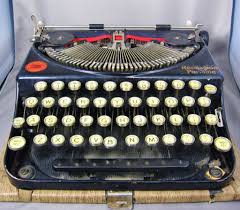
typewriter

The one piece of writing advice that everybody knows is to write what you know. Frustrated with the assignment and my inability to pen even a single word, I fell back on that old axiom. I’m blocked? Can’t crack this scene? Fargo it. And I wrote my character, a frazzled, frustrated guy, sitting white-knuckled and scruff-faced obstinately in front of a typewriter. (Yeah, yeah, I know, I have a thing about typewriters.) I had him struggle and hem and haw and make excuses and bang his head against the wall, and then, finally, he just gave up trying to be creative and wrote a crappy, cliched little scene. Nothing special about it. Except that it appeared out of nowhere (the unexpected entrance, such as it was) and played out right in front of him. Taken aback at first, he spoke to the characters that suddenly existed right there in his crappy apartment. The newly created characters shared their thoughts (this setting sucks! I would never read that book! Why would I even say that to her?), he took their advice, and in a matter of moments he had figured out that the best way to write was to get the fargo out of the way and allow the characters to explore their own situation.

I thought it was crap. I mean, really, I was almost ashamed of it. So ashamed that I almost didn’t go to class the next day. But crappy though it was, I had enjoyed the taste of writing it, so I went. Naturally, the teacher (the inimitable Stanley Longman) called on me as one of the first to present. With sheepish disclaimers, I handed copies of the scene to three of my classmates, who took a few minutes to read over it before assuming positions on the stage. I heard them giggling as they ran through it and thought, great, it’s as terrible as I feared and now I’m going to be exposed for a hack. Then they read the scene, and the laughter continued; little snickers here and there, even a stray guffaw. Finished, the actors took their seats and I sat on the feedback stool, red-faced in front of everybody, and waited to be verbally crucified.

First hand raised, I called on a girl whose name I didn’t know at the front of the room. I’m paraphrasing, of course: “First of all, it was really funny. I loved the interplay between what we expected from his characters and what they really wanted for themselves.” Nods from around the room. Next up, a guy who sat near me and whom I’d collaborated with on an earlier exercise. “I recognize that struggle when I write,” he said, “it was cool to actually see it on stage. And it worked.”

The workshop continued. I got critical feedback as well as praise. But my professor’s comment stuck with me more than any of the rest. He scratched his head and spread his hands like a big grandfather gorilla. “The concept needs a little work, just to polish up the how-is-all-this-happening, and the why. An audience wants that. But it’s funny, you’ve nailed that. Those comedic elements are the hardest to pin down, and you’ve done it. Don’t you think?” He inclined his head past me toward the class, and there were vigorous nods of assent. He chuckled. “I loved it.”

That class was my favorite experience in my undergraduate years. Much though I loved that class, I got distracted from that scene and didn’t think about it for a few years. When I graduated and moved back home, I had the opportunity to work with my old high school and ended up taking the core concept of that scene — an author at war with his characters — and expanding it into a full length production. It went over like gangbusters, and, shock of all shocks, it played a role in my meeting with my wife (her mother saw the show, knew me from my work with a community theatre, and kinda-sorta shoved her in my direction).

Now, eight years later, that stage play is becoming a novel. And I feel the same fears in its formation that I felt in those days struggling with that seedling of a scene: that it’s contrived, that it won’t be funny, that it’s ultimately utter crap. But somehow, this time around, I’m not nearly so fearful as I was. Maybe it’s that I’m older and jaded and I don’t care what people think like I used to. Maybe it’s because I’m more confident now than I was then in the concept and my ability. Maybe it’s because I’m older and losing touch with reality and don’t know well enough to be properly nervous. Whatever the reason, it’s a nice reminder to myself that I’ve had success with this story once, and there’s no reason why it couldn’t happen again.

This post is part of Stream of Consciousness Saturday.