A Buffet on Cheat Day


I used to steer away from nonfiction books the way you steer away from cliffs or angry moose. What, read something that isn’t about story? Something from which I can’t learn about character and plot and structure and all things writerly? Nonsense. I only have so many hours in the day; that’s time wasted.

And, well, I used to be a lot dumber than I am these days, too. (Which is not, by the way, to say that I am not currently dumb. I am currently very dumb about a great many things. But not, I think, as dumb as I used to be.)

Because if fiction books are good (we hope!) for learning about all those things in that top paragraph — awesome, deep characters, twistedly perfect plots, etc — nonfiction books are infinitely better for learning what your stories are really about. The world we live in. The private worlds that exist inside our heads. The nuts and bolts of reality. The often harrowing stranger-than-fiction stories that have really happened to real people.

I can’t believe I used to turn my nose up. Thanks to my re-discovery of the stunning awesomeness of libraries, I’m diving into nonfiction with a passion.

But the time! I hear my former (and current) self crying. Reading a book is such a significant investment of time and mental energy — how do you pick?

Well, here’s another secret I’ve learned about nonfiction: you don’t have to read the entire book. (This goes for fiction, too, but the sense of commitment to characters is a lot harder to overcome.) In fact, it’s a rare nonfiction book that I’ll read cover-to-cover, unless the writing is just dynamite (in which case there are things to learn there outside the subject matter of the book itself).

I treat my nonfiction books like a buffet on cheat day. Sure, the salad bar is there. And I’m welcome to fill up a plate with the leafy greens of statistics and deep technical jargon of astronomy or sociology or the mechanics of religious faiths. But what I really want are the slabs of steak and greasy chicken with piles of mashed potatoes and everything that’s fried: the raw, personal anecdotes and shocking first-person accounts and fascinating glimpses into the invisible.

So when I pick up nonfiction, the first thing I do is scan the chapters like I’m scoping out the buffet on the way to a table. Ooh, I definitely have to have some of that. Maybe a nibble from over there. Not going anywhere near those. And I’ve got to save room for dessert.

Not only does this make reading nonfiction — which has a bad rap for being a bit dry and tasteless — more fun and mentally engaging, but it paradoxically encourages me to read even more widely on things I might not have bothered with. I know I’m not making a week-long commitment before I even crack the cover; I know I can put the book down and move on to something else if it isn’t moving me.

All of which leads me back to one of my personal axioms not just as a writer, but as a teacher and a human as well:

All reading is good reading.

At best, you’re learning new things and improving yourself in the process. At worst, you’re learning what not to do and what to avoid. Win-win, baby.

Pass the mashed potatoes.

(Actually, don’t. Tomorrow is cheat day — I’ll just take them in a doggy bag.)
Accidental Philosophy: The Futility of “Should”


“Should” is a useless word. 

-Delilah S. Dawson, Hit

There’s something that’s been bugging me for a while now. I couldn’t quite put my finger on. I couldn’t name it, so it just sort of floated around in the back of my brain like a dragon fly, darting this way and that, sometimes getting right up in your face, then skittering away whenever you swat at it or grab for it.

It’s about people, and the way we talk to each other, and the way we talk about the world. Specifically, it’s about certain kinds of people and the way they want the world to be. You know these people. They talk about the way the world ought to be, saying things like “wouldn’t it be better if …” or “things would be perfect if only …”

And some of these people even find their way into office in this country. And they start making laws and enacting statutes and directing policy to bend things to the way they say they “ought to be”. Trouble is, things are what they are, and changing them around isn’t so easy as that. Especially when the things are people.

Before I get too carried away, let me wander back to the point. My leisure reading the last two weeks was Delilah S. Dawson’s Hit, a YA dystopian thriller about a future where banks have seized control of the country and are forcing children to become debt-collecting hitmen.

(Why kids? Because it’s too diabolical to be believed, and who’s gonna point a gun at a kid coming to their door? And also, because YA. Pretty wild, but who cares, it was a fun read.)

Anyway, about a third of the way into the book, one of the characters is lamenting their situation and moaning about how “things shouldn’t be this way” and the protagonist snaps back, “should is a useless word.”

I read that. And all of a sudden, that dragonfly in my brain stopped skittering, landed on a lonely dendrite, and took root.

“Should” is a useless word. Yet it’s one we use all the time.

“I should have gotten up earlier.” Yeah, I should have, but I didn’t — so what am I going to do about it?

“People shouldn’t steal.” Yeah, they shouldn’t, but they do — so what are we going to do about it?

“He shouldn’t have even been there.” Yeah, but he was — so what are you going to do about it?

See what happens there? Any time somebody says “so-and-so should …” there’s an automatic “but” followed by a “so what” that comes in response.

“Should” seems more and more to me like the refuge of the coward. It says, “I don’t like this situation, so instead I’m going to talk about what I would rather it had been (yikes, grammar is hard when you get rid of “should”) without doing anything about it.” And yeah, sometimes the “should” statement is followed by action, but a lot of times, it isn’t. A lot of the time, we just say “well, it should be this other way” and we leave it at that.

For that matter, a lot of what people go around “shoulding” about has nothing to do with them. “Gay people shouldn’t get married.” “Women shouldn’t be in those jobs.” “He should take better care of himself.” None of which has anything to do with the person saying it. We have a rule in my house and in my classroom. Rule #1. MYOB. Mind Your Own Business.

The fact is, people use “should” to hide from things they don’t like, from things that make them uncomfortable, from things that scare them. They use “should” to build a fantasy world in their heads. A make-believe universe where things are perfect, unoffensive, unscary. “Should” represents a fundamental failure (or, worse, refusal) to see the world as it is in favor of how we expect it to be.

But the “shoulding” doesn’t do a damn thing. Things are what they are, and all the shoulds in the world won’t change them.

What changes things is action.

And guess what?

You can take action without griping about how things “should” be first. Address things as they are, recognize that there is no such thing as “perfect” (because the world we live in is messy and filled with other people who don’t automatically agree with you) and work to make things better.

Don’t waste your time moaning about the way things “should” be.

Get to work on fixing what’s wrong.


On Bloody Ears and the Problem of Luck


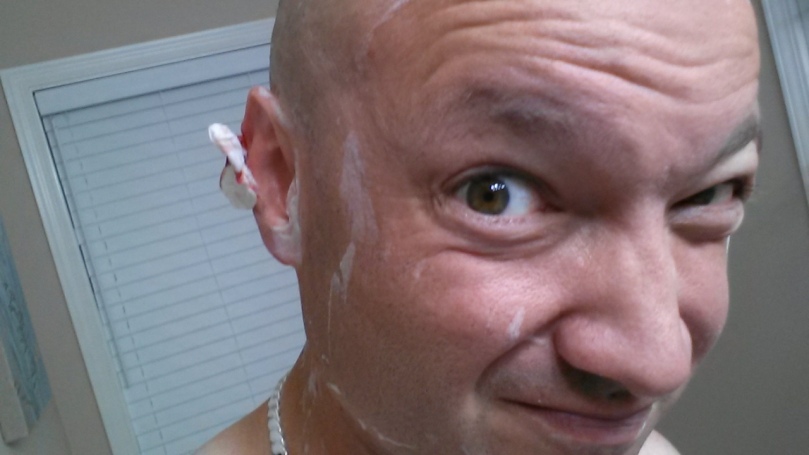
I cut myself shaving this morning.

Not a big deal. I wasn’t the only one. And it’s not like it has messed with my day in any major way. You get a cut, you stop it up with some tissue paper, you forget about it and walk into the office with spritzes of bloody tissue on your face, life goes on.

Except I didn’t cut my face, as one might expect. I cut my ear.

And not the low-hanging fruit of the lobe, which, while unusual, is still within the realm of the normal and understandable. No, I sliced the top of my ear.

20180806_054659.jpg

This is virtually impossible to do under ordinary circumstances, unless, like me, you’re a guy taking a safety razor to your dome once a week.

(Side note: the safety razor is not particularly aptly named, as it turns out. Your average dollar-store special is way harder to injure yourself with — though it doesn’t give you nearly as nice a result.)

Worse still, I’ve done it before — and it’s the kind of mistake that, really, you shouldn’t make that often. Cuts that high up on the head sting terrifically, and bleed with the abandon of a five-year-old running toward a playground, which is to say, total. One would think that one would, therefore, remember the unpleasantness of the entire affair and take care to avoid it.

The trouble is, of course, that shaving is one of those things that becomes routine, that you do so regularly that they become automatic. And when things become automatic, our minds tend to wander while we’re about them. (See also: driving. Unless something seriously significant happened — a near accident, for example, or a strange sighting, like a murder-clown walking along the street side — what can you really remember about your drive this morning? Probably not much. Your brain handled it for you, on autopilot, while you listened to the radio or thought about what you had to get done today.) And when the mind wanders while you’re about a routine task, well. You can come away missing pieces of yourself.

This is called automaticity, by the way, and is one of the few concepts I recall with perfect clarity from my college days. Who knows why. Probably it’s the funny word, which WordPress’s spellchecker does not recognize.

But shaving is not a thing that I should be doing in such a carefree manner. The blade I’m using is sharp, and the technique for its use is not necessarily intuitive. Not to mention that the curved surface of a skull is not the easiest thing to shave when using a blade that is flat. There’s care involved, and skill, and attention to detail. And getting above and behind the ears is fiddly even by head-shaving standards. I really should know better.

But no, instead of focusing on the task, I was listening to a podcast. Trying to learn a few things about the world we live in. (A back episode of The Skeptic’s Guide to the Universe, for the curious.) You know, trying to better myself. And then, snag, slice, recoil.

And here I am, bleeding. I thought it might not be that bad, until a few seconds later when blood began dripping onto the bathroom counter. (Pit pit pit. Cue dizzy panic.)

There’s something to be thought, here, about luck. I was unlucky this morning, but this is my MO every time I shave, and usually I am not unlucky. (To put it into perspective, consider: many, many people text and drive, some of them alarmingly often. Some unlucky few will get into accidents, or even hurt or kill somebody, as a result. Only those disastrously unlucky enough to have accidents happen are likely to suffer any significant penalty or jail time; most people who text and drive suffer no consequence at all. Yet they all participated in the same inadvisable behavior. Some are lucky, the others are not. Shouldn’t those who text and drive, even without causing any harm to anybody on the occasion, suffer the same penalties we would levy against the person unlucky enough to hit somebody with their car? Why should those who were simply unlucky bear a harsher penalty? Needless to say, this is a practice I do not partake in.)

Anyway, just some food for thought on a Monday morning. Maybe I need a bit more mindfulness in my day. I’ve got a bloody neck and shoulder to remind me. It leads me to wonder: just how much of our days do we complete on autopilot?


It’s Still There


Thanks to being back at work, and restoring some semblance of normality, I was able to sit down and do a little bit of work on the ol’ novel again. And as I opened up the document and began to type, I was worried it would feel a little weird. Like seeing that person in the hall who used to be a friend, but then you stopped saying hi and only nodded at each other in the hall, and then even that stopped, so you had no idea what had happened with your relationship.

Me and my novel were like that. Not estranged, just strange with each other.

Luckily, a collection of words is incapable of holding a grudge or getting salty about unsent thank-you cards or misremembered first names. The discomfort with the work lasted about thirty seconds.

I’ve found this often to be the case, though I always seem to forget it when I most need to remember it: the story is there, waiting for you, whenever you’re ready to pick up the pen. Or the brush. Or the typewriter. Or whatever. Just because you haven’t written anything down yet doesn’t mean you never will. Just because you haven’t worked on it in a week, doesn’t mean you can’t work on it today. Or tomorrow. Or next week after that Thing In Your Life That’s In The Way loosens its chokehold on your windpipe just a smidge. When you finally decide (or become able) to make time for it again, the words will come.

Kinda like the tap around back of that old abandoned farmhouse in the middle of the woods. You’d think the water company would shut off service, but for some reason, once you fight your way past the murderous crows and rampaging squirrels and the nest of poisonous vipers that for some reason have twined themselves into a humanoid mass that chases you for miles through the dark wood, you brush off the cobwebs, twist the faucet, and out comes a stream of cool, fresh, water. And, probably, the water is laced with as-yet-unidentified bacteria that will slowly eat you from the inside out, but you won’t know that for weeks. But that’s a problem for future you. For now, you’re happy.


It Begins (Again)


Teaching is one of those jobs that carries all kinds of asterisks and disclaimers. And it’s not a job for the faint of heart.

But one thing it has going for it — that not many jobs do — is an enforced sense of renewal and rebirth.

You spend a year going through the mud with your students. You get embroiled in their lives. Sure, you find out all about their grades and their academic progress. Definitely you discover all their little behavior … quirks. (Let’s call them quirks.) Sometimes you find out about their parents and their lives outside of school. (Often, this answers many questions you may have had previously.) And depending on what kind of teacher you are, you find out a lot more. You learn how they talk to each other. (Frightening.) You learn about their relationships with each other. (Ew.) You learn what they think of other teachers in the building. (Yikes.)

But it doesn’t stop there. By the end of the year, you know what makes them laugh. What makes them upset. You know what they’re going to do before they even do it. (Tyler, in the fourth row, is gonna ask me what a metaphor is when I talk about this story, even though I’ve explained it a dozen times this year, and when he does, Tevin, next to him, is gonna sigh and roll his eyes — and probably swat him — because he’s tired of hearing my spiel.)

You come away from the school year, in other words, covered with their gunk. And not just the students’ gunk. Gunk from other teachers and their frustrations that you have to listen to in the workroom, the mailroom, before the faculty meeting. Gunk from the seemingly endless meetings, by the way, that could have been e-mails. Gunk from the unpleasant encounters you had with parents, from the stress about the extra time you had to spend in the building at the expense of your family time, from the piles and piles and piles and piles of paperwork.

And in most other jobs, you’re stuck with all that gunk — because as soon as one job is done, it’s right on to the next. No downtime, outside from the occasional vacation (which only puts the gunk aside for a little while, to be picked up and re-applied upon your return.)

But teachers get that summer break. And what I’ve learned in my eight years (help!) of teaching is that it’s a rare educator that comes back in the fall still gunked-up. The summer lets you really clear your head, lets you drop all the baggage of the previous year — the gunk, bit by bit, just falls away.

We get to start the new year, every year, clean and fresh. Maybe not smiling and bright-eyed (we’re out of the habit of waking up early after all, but this is why coffee exists), but at least optimistic that the year ahead could be a good one.

Maybe we make some changes to the way we run things; maybe we don’t. Maybe we’ll have a magic combination of minds in our classes that makes every day teaching a joy; maybe we won’t.

But whatever the new year brings, we get a chance to start it un-gunked. Clear-headed. Renewed, reborn. Maybe even a little bit hopeful.

My first students will breach the doors in a little under an hour.

To those about to teach, I salute you.

See you on the other side.

20180801_062159.jpg