Bend One Over For Me


My wife is a librarian.

She’s a lot smarter than I am, as I may have mentioned before. Which probably explains why she had a career, first in the news (where she wrote the words you’d see on your trusted news sites — and sometimes coming out of the anchors’ mouths), and second in the school system, facilitating students’ access to the carefully chosen words of thousands of authors and information sources.

She’s an expert, is what I’m trying to say, on the written word. And I’m, you know, working on that. Needless to say, our house is full (yeah, probably overly full) of books. We keep books everywhere: the bedside table, the downstairs library, the shelf in the living room, the cubby in the kitchen, our children’s bedrooms, our personal spaces at work, our bags going to and from work. I even keep books in my car, and I’ve been known to sneak a page in at that one reeeally long traffic light. We give books as gifts to each other and to others. We know books, we love books.

But one thing you’ll find in my books that you won’t find in hers? Dog-eared pages.


See, I used to re-read books that I enjoyed. I still do that occasionally, but I just don’t have the disposable time that I used to have. There are still, though, those passages in books of all stripes that just hit me — a nasty literary hook to the solar plexus, a wicked narrative cross to the temple — that I know I will want to experience again. I may not have time to go cover-to-cover again, but when I’m jonesing, I can pick up a tome I’ve traveled before and browse the greatest hits.

But how do I find them again?

I have to mark them.

I usually try to keep a pencil quick-to-hand, but especially at home, that isn’t always the case. When I’m neck-deep in a gripping read, the last thing I want to do is put the book down and cross the room. I’m not doing that. Plus, even if I do have a pencil handy, what are the odds I’m going to see my pencil mark as I flip through the pages? Not great. Sure, there are highlighters for such quandaries, but highlighting reminds me too much of school, and this is leisure, not work. So highlighting is out, for me. (Unless we’re talking e-books. Which we’re not. We have some standards around here. [Just kidding. E-books are great. I have lots of them. But you and I both know that there’s nothing like the real thing.])

No, if you really want to find that knockout passage again, you need to mark the whole page so that you can open right to it.

Again, there are methods for such things. Some people, I understand, like post-it notes or little scraps of paper. To that I say, who has the time? If I’m not going to interrupt my read to get a pencil, I’m darn sure not going to go downstairs to the office to get a post-it to stick between the pages. I’m not going to sit here and rip up a piece of paper to make a dozen tiny bookmarks. (Also, they fall out!) Nonsense.

No, what I’m going to do, when I find that lexical 10-point-dive, is I’m going to do what any lazy (read: normal) person would do. I’m going to read it, realize I’ve just had my world rocked, read it again, then reach up to the top of the page and bend that corner over. Bang. Done. I didn’t have to get up, I don’t have to fiddle with other implements, and I’ve created an effortless-to-find mark in the book that will last, at the very least, until I open the book again.

It probably goes without saying (though I am happy to say it anyway) that I have a chosen handful of books so dog-eared that the unbent pages are rarer than their bent brethren. My copy of the Ultimate Hitchhiker’s Guide comes to mind. As does my (and I shake my head a little at this) little pink-covered edition of Zen and the Art of Motorcycle Maintenance. I may not have the time to read them again these days (for the fourth, or the fifth, or the forty-fifth time), but if I need a fix I can crack them open and browse through some of the passages that made me love them.

20180823_083021.jpg
Assuming I can find the passage I was looking for. Heck, I’ll find SOMETHING good on one of those pages.

If not for dog-ears, where would I be? Lost, that’s where.

Which, for my personal collection of Books That I Own, is fine.

But I’ve rediscovered the library, lately. And, oooooooooh, does my wife have a problem with me putting a dog-ear in a library book.

Because if books are sacred (and inasmuch as I hold that nothing is sacred, books may be the closest thing to it), then library books are doubly so. They belong not to one, but to all. They are a shared resource, a tool for the entire community. Bending the pages is damaging them, she says, as surely as is scribbling in the margins, bending the cover back, or dropping them in a puddle. I’m leaving the book in a less-than state for the next reader when I damage it.

And, as far as damage goes? Yes, I totally agree. Library books, by dint of their communal nature, are sacred and should be taken extra care with. (Don’t end a sentence with a preposition, they said. Avoid passive voice, they said. Rules are for breaking.)

But I hold that dog-earing, and even the occasional note in the margins (I wouldn’t write in the margins personally, but I don’t mind finding writing in the margins), is the antithesis of damage. It’s enrichment.

In fact, if I find that a book I’ve just checked out is dog-eared up already? Ooh boy, I know I’m in for a treat. A dog-ear in a book I haven’t read yet is a flashing neon sign, the finger of an unseen deity saying “the stuff you want in this book? It’s right here.” If it’s a nonfiction book, I’m opening right to that page. In fiction, I note that page the way you note the dessert table on your way into a buffet. Can’t wait to get THERE. (Seems like I’m having a food motif of late around here. Couldn’t possibly be the new diet.)

So, naturally, I feel that when I dog-ear the pages of an enjoyable book, I’m returning the favor. Paying it forward. Marking off the trail for the prospective readers yet to come. And if it does benefit the next reader, that’s awesome. But the truth is, I would do it anyway. Dog-earing a book is one of those rare acts which is both selfish and serves the community. I do it for myself, but it might benefit somebody else, too, and I think that’s awesome.

Heck, Kindle — or maybe it’s Google Books, or maybe both — will already identify for you the passages that other readers often highlight in the books you read. Isn’t this basically the same thing?
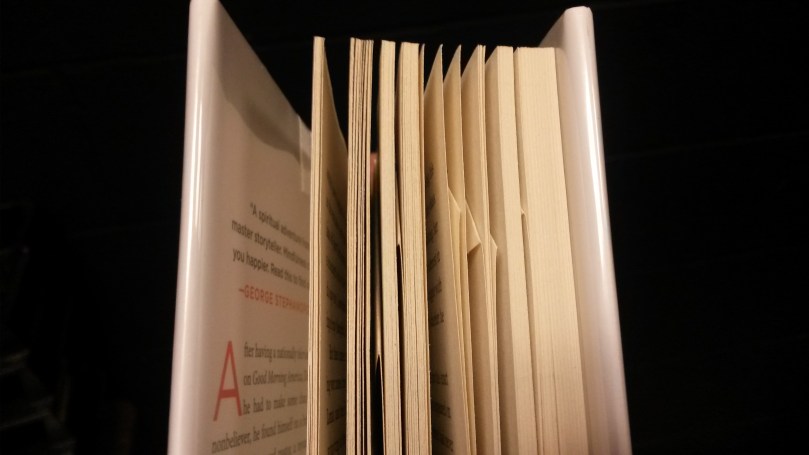
20180823_082308.jpg
The library-owned copy of “10% Happier” I’m currently working through. Sorry not sorry!

Still, my wife scowls at me when she catches me at it. “How can you do that to a library book?” she demands.

How can you not, I don’t dare say in return.

Except that, uh, the jig will be up when she reads this.

So … yeah.

Am I wrong for this? Or is this not a service we owe to one another?

10% Chance of Woo


I’m consumed, at present, with Dan Harris’s book, 10% Happier.

I’ll make all appropriate caveats to say that I’m not done with the book. In fact I’m only about halfway through it, if that. But it’s the kind of book that for whatever reason is shaking me on a fundamental level. The book’s subtitle — How I tamed the voice in my head, reduced stress without losing my edge, and found self-help that actually works — sort of sums it up for you.

It’s fascinating reading. Harris basically uses his pages to recount a personal journey, from tv reporter-turned-anchor to drug-addicted high-chaser to spiritual sojourner to — well, as I said, I haven’t finished it yet.

The book is funny, full of great turns of phrase and idioms — he describes Deepak Chopra as “the Golden Arches or Nike Swoosh of spirituality — a globally recognized icon next to whom celebrities could pose when they wanted to signal ‘depth’,” for example. But more than that, the book is simply shatteringly honest., which is giving it a charm with me that’s hard to describe.

I don’t often read nonfiction books cover-to-cover, but with this one, I can’t help myself. I see myself in the narrator. His thoughts are mine, often before I even realize it. He’s a deep, committed skeptic (yep, that’s me) who’s constantly besieged by feelings of doubt and inadequacy (totally me) and constantly plays out the myriad ways everything could crumble around him (ME) and can’t get a moment’s peace inside his own head as a result (ME ME ME).

When drugs don’t solve the problem, he takes a hard left into the world of spiritualism.

At this, my eyebrows went up. Spiritualism is one of those fluffy, impossible-to-define words that generally seems to involve a lot of hippy crap like hugging trees and breathing deeply and sipping tea to solve life’s problems. A great way to fool yourself into believing there’s “something more to life” after you’ve let organized religion go but you’re not quite ready to dive into the icy waters of atheism. A middle ground.

And, well, I have some feelings about middle grounds, but mostly, middle grounds are not to be dwelled on.

Luckily, Harris has the same reaction. His battered brain-boat beaches itself on the strange shores of Eckhart Tolle and the aforementioned Deepak Chopra and he finds himself (despite himself) going along for the ride. Because despite the fact that both men (and countless others in the spiritualism circle) speak in insane intelligent-sounding but ultimately indecipherable word salad and deepities, something clearly seems to be working for them.

So he dives in. And, I guess, sometime in the coming pages, he begins meditating. And apparently this works for him.

Meditation is one of those things for me that I’ve always been kind of fascinated with but have never given it an honest shot. You hear “meditation” and you picture some kind of monk staring at the wall and pressing patterns into the floor through the sheer power of repetition. Sounds hokey, sounds fake, sounds too good to be true.

Furthermore, I have enough to do in my day; even ten or twenty minutes spent actively doing nothing seems entirely counterintuitive. Then again, I say that and I think about how much time I actually waste in a day — a few minutes here or there watching hilarious videos on Youtube of people falling off bikes, more than a few minutes hate-watching or hate-reading the news, lots and lots of minutes with my novel open, minimized in the background of my computer when it should be maximized and locked in front — and I wonder if an investment of ten or twenty minutes wouldn’t be worth it, if it helped me to reclaim some of that lost time.

And now, writing this post and reading this book, I realize that this is already an idea that’s wandering the halls of my subconscious, idly drawing patterns in the dust with a finger, now and then opening the fridge to see if anything tasty has magically appeared in the meantime. Just hanging out, waiting for something to do. In my first novel, I had a character who indulged in meditation every day to keep from losing her mind with the competitiveness and craziness of her job.

I wrote a character who practiced this very thing, even though I’ve never really tried it, even though I think it’s hokey and self-delusional. And it WORKED for her.

Anyway, a passage that had me reeling last night was the following:

The ego is never satisfied. No matter how much stuff we buy, no matter how many arguments we win or delicious meals we consume, the ego never feels complete.

And, you know, damn. I feel that. Right down in my recently-operated-upon guts.

All of which is to say that I think meditation is a thing I may have to try. But, you know, in that “do or do not, there is no try” kind of trying, where you actually commit to the thing. (I know, I know. Add it to the list of “things I want to try,” which quickly molders into a pile of “things I tried once or twice and gave up on almost immediately”.)

So, do I have any meditaters (meditators? Spell check doesn’t like either one, go figure) in the house? Any firsthand advice or things I should know?

Just One More Page


I keep falling asleep reading.

More and more over the past year, but especially in the past few weeks, my day ends to the lethargic turning of pages, a heavy-lidded struggle to finish just one more chapter that becomes just a few more paragraphs then maybe I can actually finish this sentence before finally devolving to part of my brain knows I’ve read this word five times already yet I have no memory of it.

Image result for i have no memory of this place

And then, at some point, I wake up. The light is still on and the book has tumbled clumsily onto my chest and my wife is snoozing beside me and I’m overcome by sadness, because first of all I can’t remember what I read and second of all I’m going to have to read it again and third of all I’m awake late at night which does not bode well for the following morning. Sometimes I manage to bookmark my progress and put the book on the bedside table before I lose consciousness for good; sometimes the book ends up in the floor and I’ve doomed myself to rereading passages if not entire pages again the next night.

Could I learn from this? I could. Logic dictates that I should know when I lie down for the night whether I’m alert enough to pick up a book and grind through a few pages. But logic doesn’t know a damn thing about my life. I’m trying desperately to not be one of those jerks who goes to work, comes home, ignores his kids, and disappears into a black hole of bad TV and beer before he succumbs to unconsciousness, only to repeat the process ad infinitum until his life is as meaningless as the jokes inside a Bazooka Joe wrapper. I’m trying — perhaps not with Herculean effort, but trying nonetheless (damn you Yoda) — to improve.

Image result for there is no try

That means waking up earlier than I have to to put some miles on my sneakers. It means working on my novel or reading during my lunch break. It means playing some video games with the kids when I get home, or chasing them around the yard a little bit. And it means carving out time to read every night before I finally shut my eyes, even when my pillow’s siren song is at its most irresistible.

And maybe it’s because my reading fare of late is a bit, I dunno, drier than what I’ve read in the past. (This week’s tome: A Brief History of Time, by Stephen Hawking.) Fascinating stuff, to be sure, but still — not exactly an edge-of-your-seat thriller.

Or maybe it’s just that I’m getting older and the old man needs his sleepies.

This post is part of Stream of Consciousness Saturday.

Honk if You …


I was out on a run this morning, and a guy honked at me.

Context: I run in the wee predawn hours, while most of the normals are still asleep. And I run in the suburbs of a fairly rural county. (Depending on the direction I go, I can pass more cows than cars on the road. And no matter which way I go, there will surely be roosters crowing.) This means streetlights are scarce and trees are ubiquitous.

What I’m saying is, as much as I love my generally peaceful starlit runs, they are scary, too. And I say that, fully cognizant that as a good-sized white dude, I probably have less to fear from the world at large than anybody in a similar circumstance.

I can’t see very far. Anything could be lurking in the trees. And despite my day-glo reflective vest, I can never be entirely sure that the oncoming car is going to see me or not. I mean, the driver is out before 5 in the morning — they’re probably sucking down coffee or shaving or applying their makeup or stuffing their face with a buttered biscuit, expecting (fairly!) zero human contact on our sleepy back roads. They’re not expecting to see a lunatic pounding the pavement with his idiot dog in tow.

All of which is to say: there I am, running. I hear the car coming up from behind. I see its headlights illuminating the trees along the roadside. Then, as it passes me: BEEEEEYOWWWWWWW.

Nice, firm blast. Not the quick, cheery ‘toot’ of “good morning, fellow early riser.” This is laying-on-the-horn. This is “you deliberately blocked the intersection in front of me, and now I can’t go, and nobody behind me can go, and now NOBODY ANYWHERE CAN GO SO I WILL HONK AT YOU IN FUTILITY.” This is the vilest of expletives delivered without words.

And because I’m out running in the scary night and I’m always a little on edge in that situation, I jump off the road and stumble into a ditch. Dog gets tangled up in my legs and starts yowling. It’s chaos.

Here’s the thing, though. I’ve been honked at before, and every other time, the driver adds some comment to clarify his communication (strangely enough, it’s always a “him,” innit?). Lots of times I can’t make it out because they can barely get the window open in time to shout it out and the doppler effect or their naturally neandarthalic speech smears the words into an unrecognizable buzz. Lots of homophobic slurs, for some reason. Tons of “idiot”s or “a-hole”s. I even had a car slow down and pace me for a good, solid minute once. That was scary.

But none of that this time. Just the horn in the dark and a drive into the night. And it left me wondering, as I climbed out of the ditch and untangled my dog’s leash, “why?”

Why beep at a runner in the dead of night? A runner, mind you, on the opposite side of the road, whom you are in no danger of hitting, who is causing you no inconvenience, who might well be one of your neighbors?

I have some theories.

  1. He just wanted to let me know he was coming. This is a favorable interpretation, but a dumb one, because a car coming down a dark road with its lights on is the most noticeable dangerous thing possible for me.
  2. He wanted me to know that he thinks I’m a jerk for running on the road. Sorry, pal. Gonna need a little more clarification than that. Say it to my face. (I bet I can outrun you.)
  3. He saw something in the trees and wanted to warn me of the danger. Again, unlikely, but hey, I can still be charitable.
  4. He hates runners because a runner once killed his brother, and he now wages a private crusade against all runners by honking at them. Sorry, bro.
  5. He just noticed a bee in the car and hit his horn in the ensuing panic for his life. If this was the case, I totally understand.
  6. His horn just goes off sometimes. That’s okay, honey. It happens to all guys sometimes. Still, maybe get it checked out.
  7. I offended his life choices as a fat slob with my in-your-face running lifestyle, and he had to voice his displeasure.
  8. What he really wanted to do was cross the center line and run me over, but in lieu of a murder charge, he honked his horn instead.
  9. He thought I was a luminous, highly reflective monster coming to devour him and his entire lineage, and he honked to scare me back into the night.
  10. He thinks I’m awesome and wants me to keep it up.

Yeah, we’ll go with #10.

Hiatus Interruptus


After my operation about a month ago, I was instructed not to run.

I guess that’s an instruction that your average human might be only too happy to receive, but for me, it was a little like telling a duck not to waddle, or a cat not to chase little red laser-pointer dots, or a leftover lasagna not to go bad in the fridge. Goes completely against nature. But I made the mistake of asking if, after the surgery, I could run, and was told “not until you’re recovered.”

“What’s that mean? How long is that?”

“Well, you’re a healthy guy. So anywhere from 2-4 weeks until you’re up to your full range of normal activities. But don’t overdo it too early or you could end up back in here.”

“When’s too early?”

“You’ll know if you do something you shouldn’t.”

I will?

How will I know? Will I immediately be in terrible pain? Or will it start sore and become awful? Maybe there will be a tearing sound with no pain at all? Can anybody ever really know anything?

So I’ve been in a state of supreme doubt ever since, and out of an abundance of caution, I haven’t run. Jogged a little. Chased my kids around the yard a few times. But no miles.

In six years, I’ve never taken such a long hiatus. Partly that’s out of fear: momentum matters, I know, and when you stop for a long time, like that hulk of an automobile growing weeds through its engine block, it’s hard to start up again. Partly it’s because I never had cause to think I needed to take such a break. And partly it’s because runners seem to be, by rule, dumb and willing to pigheadedly push through pain even when they should stop. And I, as one of my students taught me to say, am sick with that germ.

But I gave it a month. And then I gave it a few more days. Abundance of caution. I’m hardly the picture of youth anymore; I have to play smart, not hard. The goal is not to be the best, it’s to be the best I can be without blowing myself up in the process.

This morning, though, I laced up again. Beautiful morning for it — sixty-five degrees or so. Cloudy. No meteors, but I guess you can’t win ’em all. In what now seems like a sign from the running gods, my GPS watch died within the first minute (of course I could have predicted this; it hadn’t been charged in a month because I hadn’t had to plug it in for a month!). As a result, I wasn’t harried in the least by thoughts of pace or distance for their own sakes.

I just ran, stopping here and there to let the dog sniff in the high grass or to catch my breath and look out for meteors. (Sadly, there were no meteors. I may have mentioned this. I always seem to miss these celestial events. Still sad, hours later.)

I didn’t go as far as I usually do. And I probably didn’t go as fast as usual, either. But heading out this morning was more like knocking a little dust off than it was like pulling weeds out of a carburetor. The month off maybe cost me a few steps, but it didn’t put out the fire.

Better still? Tracing the outline of a shape I already knew, I find myself wanting to write more today than I have in a while. The running helps the writing, and when the running helps the writing, the writing makes me want to run.

Positive feedback loops, not negative ones.

More miles await.

And maybe, someday, if I’m lucky, meteors.