The Floodgates of New Ideas


It always happens like this, dunnit?

I’m plugging away at my current project, having what I wish I could say was a trying time with it but which, if I’m honest, is giving me serious existential doubt not just about this particular project but about my entire experiment as a writer. (Seriously, I’m in the murky expanses of the mushy middle, wherein all the conflicts are established and now I have to go about finding ways to begin resolving them without bogging down the book in the taffy-like quicksand of extended exposition.)

Then I’m out for a run this morning.

Nothing special about this run except that I don’t have the sprouts in the stroller with me, so I’m running a little lighter than usual. I also don’t have to respond to the constant stream of three-year-old-out-in-the-world babble (what’s that? where’s that bird going? where’s mommy? can we go to the playground? how does that car move? i need to go potty. daddy, are you running? WHAT IS THE MEANING OF LIFE?), so for the first time in a while, I got to run with a podcast. I get to think. (For the record, it’s The Skeptic’s Guide to the Universe.)

So I’m listening and I’m running, which is a great way to pass the miles, when all of a sudden, they mention something off the cuff, and it plows through my ear canal and smashes into my cerebellum like a six-mile meteor. It claws its way across my grey matter, sinks its glistening fangs in, and burrows in like a microscopic tick.

This is how ideas strike me.

I don’t think of a character and invent whole backstories and weird relationships and quirky mannerisms. I don’t fixate on places and ambience. I get a little snippet of something strange, something unexpected and quirky and strange, and I train the Max-Gro Overinflating Laser on it. What would the world be like if… and before I know it I’ve created, not individual characters, not even a central conflict, but a whole city, a whole society, a whole world wherein everything is colored, changed, tainted by the exponential possible implications of this tiny little seedling that just glanced off my consciousness.

And now it’s all I can think about.

I’m considering the characters that a world like this should be primarily focused on. I’m exploring a conflict that is possible in the real world but intensified by this new thing. In short, the idea is growing across my brain like kudzu across the side of my house, sinking its leafy tendrils into all the cracks and crevices, splitting open the siding, choking out the flowers I’m trying to cultivate for the project I’m, you know, trying to work on.

So I spent the fifteen minutes after my run, sweat still pouring from my everywhere (gotta love that humid Georgia weather), jotting down ideas and impressions, possible characters and conflicts, and every implication that I can think of for a world that includes this one little difference.

But I can’t abandon the current idea in favor of this one.

Because if I do that, then it’ll happen again; I’ll get halfway into writing the new novel and another new idea will strike, tempting and consuming, and I’ll abandon the new idea for the next big thing.

So this one goes on the pile for now. (The pile of potential projects I want to write is now… what… about four or five deep? And that’s ideas I’ve spent a good bit of time thinking about, considering whether they’d actually make for a good story, and determining that they would. This says nothing for the landfill of seedlings that strike and get immediately discarded, which are innumerable as lost rings in the ocean.)

It’ll be there waiting, when this one is done.

But the neat thing about this is, it has primed my creativity for the day, and I can’t wait to work on my current project now.

Creativity is weird like that.

The First Draft: The Shape-Shifting Target


Writing, as I think I’ve mentioned before, is an exercise in futility.

You work so hard to craft a story, to chisel characters from the soft stone of imagination and breathe life into their formless husks. You try to communicate themes, to send messages, to tie up loose ends, to suggest ideologies, but it’s all a mug’s game, really. I was reading the other day another blogger’s dismay that her father refused to read the Lord of the Rings series, or watch the movies, on the grounds that it was “satanic”. For all the work that you put into a story, all that matters at the end of the day is what other people make of it.

Which is kind of a bummer, because you can only involve other people so much in the writing of it, which is to say, you can hardly involve them at all. I mean, research aside, 99% of the writing of a story is completed by the author himself, probably in a dark room with no windows, certainly removed from most human contact, except for the plate of gruel that gets pushed through the slot in the door a couple of times a day.

So you try to write a story for other people, but that’s a mug’s game, too, because you simply can’t control the headspace that another person lives in, you can’t sit there over their shoulder to tell them this character is blowing up the village because she really wants everybody to love her. You can’t be there on-call to answer questions your readers have. They make their own meaning, and that’s that, so there’s not much point in trying to steer their interpretations — the best thing you can do is write the story you want to write, and write it as best you can.

But even that’s next to impossible, it seems, because a story has a life of its own. You set out to write a science-fiction thriller and end up writing a teen angst comedy. You set out to write a romance and end up with a twisted love-hate psycho-suspense novel like Gone Girl. My current project has changed from the seedling I started with so many times, I can’t even keep track. It’s a post-apocalyptic horror book. No, wait, it’s a sci-fi mystery. No, never mind, it’s a YA coming-of-age.

It doesn’t stop there. My protagonist is a nerdy guy who has never lived anywhere for more than three months. No, she’s a photography student with a project from a whimsical art teacher on deadline. No, I have three protagonists. And there’s a wild-eyed scientist who may or may not be directly responsible for the apocalypse that we’re living in post of. But he’s really a good guy. No, he’s really a bad guy. No, he’s really a bad guy who pretends to be a good guy. No, wait, he’s just this guy who really doesn’t care about the protagonists, and concepts like good and bad are a little bit like asking whether I want chocolate or vanilla ice cream for dessert, because the answer is inevitably “yes please, a little of both.”

There’s a time machine. No, there are time portals scattered around. There’s an evil robot. No, there are lots of evil robots. There’s a robot that gets captured and reprogrammed to allow the heroes to thwart the system. There are no robots at all, but everybody has biological implants that make them act like robots.

My first draft contains elements of ALL OF THE ABOVE, thrown together and mangled like the lump of junkyard metal that used to be my ’99 Chevy Malibu (god rest that train wreck of a car).

Because the story keeps changing on me, the target keeps moving. Not only does it move, it changes shape and size and color and even, in this case, blinks in and out of existence as it dances through different dimensions of my unsettled imagination.

And there are two ways to feel about that.

Way number the first: get incredibly frustrated. You start a story with a certain idea in mind, you should stick to that idea. Deviations from the path are a waste of time and counter-productive. Bang your head against the wall until the poisonous ideas go away and you find your way back to the one true path that you started with, no matter how long it takes.

Way number the second: Fargo the target. Write what feels good, allow the story to change and shift its shape, allow it to tangle itself up in knots and to contradict its own existence, until it figures out just what the hell it wants to be, anyway.

I feel like I should feel the first way, because that would make me feel more powerful as a writer. You set out to write a story and you end up with pretty much that story, plus or minus a few unexpected elements along the way.

But I’m starting to feel okay about the fact that, deep down, I really feel the second way. Because it’s a lot less stressful writing when you allow yourself not to make perfect sense, when you allow yourself to make mistakes and detour down all the dark, twisting paths in the maze.

Because writing is one of those rare things that you don’t have to get perfect the first time. You get a second bite at the apple, and a third, and a fourth, and in fact you can get a whole other apple after you’ve chewed the first one to bits, because until you’re published, it doesn’t matter if the apple is green or red or golden or filled with worms or made of plastic.

I think it’s okay if you set out to build a tree house and end up building a coffee table instead. Maybe that’s your subconscious telling you that what you really needed, deep down, was a place to put your coffee cups. And magazines. And remote controls. And dirty diapers.

Okay, things got too real there for a moment. Point is, if the target is moving, maybe it’s not the target moving at all.

Maybe it’s you.

And you can argue against it and rail against it, or you can accept that the picture has changed, take aim, and keep shooting.

51%


I don’t update a whole lot about my projects on here anymore — I can only say the same things about authorial strife and creative doubt so many times before even I get tired of listening to myself — but the current project hit a milestone.

I was typing merrily along today, the words flying from me like so much projectile vomit from my one-year-old’s mouth (okay, that’s a lie, the words have been tooth-yankingly recalcitrant lately, springing forth only when I literally shackle myself to the desk and allow myself to do nothing but write), when I happened to glance at the progress bar.

Glancing at the progress bar is something best done rarely if at all. When you’re penning a 90,000 word novel that seems to be fighting your will to birth it into the world (sort of like, I imagine, the way a honey badger might be born), checking your overall progress is a little bit like watching paint dry. That is, if you left the paint in the can and just waited the long winter for it to congeal into a paint brick. It ticks away, slowly, resolutely, like an inchworm shimmying its way down Route 66, but I’m lucky to get 2% in a day. Some days, it doesn’t move at all, even after an hour’s slavish work in the word mines.

Nonetheless, today I checked it, my eye flopping inartfully across it like a cat falling off the arm of the sofa as it stretches for the fading noonday sun.

And it was at 51%.

Over halfway.

That’s shocking to me, because even though I know the time has been passing, and I’ve been dutifully plugging away on this project all the time, it just hasn’t had the same flow as my first project. If the first project was a traipse trough a neglected, overgrown garden — mostly clearing brambles and weeds but occasionally strolling through patches of still-blooming wildflowers — this project has been more like clear-cutting a path through the rainforest to make way for an interstate bypass. Using a hand axe. I feel every sluggish, seemingly ineffectual stroke of the axe-pen.

Still.

51% is a pretty good milestone. One worth bragging about, going into the weekend.

51% is like, I’ve rebuilt the shell of a classic Mustang in the garage, now all I have to do is put the engine back together, reassemble the transmission, rewire all of the electrics, replace the tires, and paint the thing.

51% is like, I’m making a pot luck dish for fifty of my co-workers and I’ve been to the grocery store, now all I have to do is prep the dish, cook it, portion it up neatly, wrap and seal it, and carry it in to work.

51% is like, I’ve cleaned one bathroom in the house, so I might as well clean the other bathroom, and the living room, and the kids’ bedrooms, and the garage, and maybe take down all the blinds that the cats tore up a year ago.

51% means the story is more written than not, and it would be a damn shame not to A) acknowledge that fact and B) really fling myself into the writing of it for this second half.

The pieces are all there. The characters are all there, and behaving as expected (or, if not as expected, at least teaching me how they would prefer to behave). The answers to the questions posed by the first half of the book are lurking in the mist like razor-sharp cliffs and rocks, shapes to be carefully navigated around as I search for the harbor.

Only 44,000 words to go.

Write Anyway


Some days, the writing sucks.

Like today. The kids were up way too early. The sun hasn’t come out all day, so it’s like the world never really woke up. It’s literally obscured by smoke that has blown in across the country from wildfires in Alaska. The house is a wreck and I have no drive to clean it.

In short, I feel like crap, though there’s nothing physically wrong with me.

When I got the kids down for a nap, all I wanted was to close the light-filtering curtains, crank up the white noise machine to drown out the noise of the cats crashing around in their midday shenanigans, and join them in dreamland for a blissful hour or so. I was feeling completely exhausted, bone-crushingly uninspired, will-sappingly unmotivated, and in short like a total waste of space. (I won’t call it Writer’s Block, because I firmly believe that Writer’s Block is just a fancy way of saying that I am not responsible for my creative ability. Writer’s Block can last for years. It’s a crutch. It’s a way of hiding from the work you really want to be doing. Fargo Writer’s Block.)

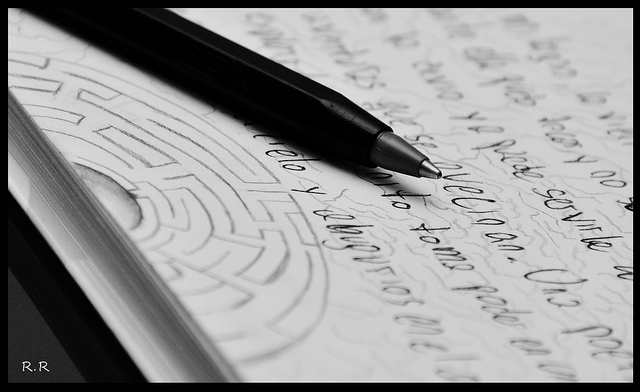
But I wrote anyway.

6281142155_cf33c5be64_z

And I felt better.

It damn sure wasn’t my best work, but upon reflection, it probably wasn’t my worst, either. And the house is still a mess, and my son is cranky because he peed the bed, and my daughter is clinging to me like a tick to the underside of a particularly furry dog because she fell asleep way too late. And there are dishes to do and toys to pick up, and the world still feels kinda sharknado-ey today.

But there are always these days. The kids are always going to find reasons to be cranky or jittery or whiny or loud or awful. The house is always going to be messy or in need of repair or stinky from last night’s dishes I didn’t wash or the trash I didn’t take out. There will always be days when the weather sucks, when my mood sucks, when the world itself seems to want you not to write. Or, you know, whatever your thing is. Life and the world will get in the way of your thing.

But today I wrote anyway, and I feel a little better.

Because I really want to be a writer. And if I’m not writing, then I’m not a writer.

Photo by Ramiro Ramirez @ Flickr.

Weekly Re-Motivator: Summary Stew


I can’t stand the summary.

You know, you crack the book open, and on the inside fold or the back cover or wherever, you get the blurb that tells you in a nutshell what the story is all about.

Karl Wisenberg is a mild-mannered office worker hiding a secret: his radioactive toenails. But there’s something more sinister than glowing fungus afoot…

Alice Klepper sells jewelry by day and state secrets by night. But will an unexpected purchase by an eight foot tall stranger provide her with the biggest secret of all?

The summary is supposed to give you a taste for the story without spoiling it for you; it’s supposed to whet your appetite and get you to crack the book and keep on cracking it until the end.

And I hate it. Because it gives the impression that the story is all about plot, that the narrative is a simple math equation with all these different elements — character, setting, tension, conflict — that add up to something. But a story is more than the sum of its parts. Because holding it all together is a fumy glue all the stuff you can’t fit in the summary: the creeping sense of dread you get every time a character opens a door in the story, where you don’t really know whether behind the door will be a harmless delivery man or a hatchet-wielding trans-dimensional wasp-man. Or the biting irony that infuses every word, wherein you can feel the author’s arched eyebrow and hear the sardonic twist behind every turn of phrase.

You can’t get that in a summary, and that’s the most important part of the story, I think. Because really: whatever you’re writing, the story has been told before. No matter how unique, how original, how unexpected your twists and turns are, somebody, somewhere has twisted and turned down that road. The only difference, the only thing that makes your story unique, is the way you tell it, the specific blend of spices you drop into the mix, the character that you build the story into.

Because a story is a living thing. It’s not just a chain of events, one thing leading into another like a dull-witted chain-gang of tromping inevitability. The story itself, just like the characters, has a flavor; the narrative itself has a feel about it that is much more than just the things which happen in it. And that flavor is what makes the story unique, that flavor is the thing that sticks with you after you’ve finished the book and brings you back, like the unbelievable egg rolls at your favorite restaurant.

Which is what I’m struggling with in my current project. I’ve got a decent chain of events, I’ve got decent characters and reasonable tension and a good smattering of conflict. But I haven’t found the right flavor for the brew. And the story, and my motivation for working on the story, is suffering as a result. I haven’t found the right feel for the story, and the story feels wrong as a result. Feels bland, uninteresting. Luckily, writing isn’t like cooking. You want a good solid stew, you have to get all the spices in at just the right moment to release their flavor and bring out the best in the dish. In writing, though, you get as many chances as you need. Screw up the flavor and you can add more salt at the last minute, or strain out the bad spices and replace them with new ones, or even toss the whole dish and rebuild it from the ground up.

But the flavor will come. The thing with writing is to keep plugging away at it, keep working, keep creating. The more these characters simmer in the narrative stew I’ve created for them, the more the subtle notes will come out, the more I’ll be able to tell what flavor is right for this tale.

So, as you’re writing, don’t stress about the summary. Focus on the flavors, focus on the interplay between elements, focus on the parts between the “important” story elements, because those are what keep readers coming back for more.

Am I wrong? Is the summary more important than I give it credit for? What flavor do you most appreciate in a story?

This weekly Re-Motivational post is part of Stream of Consciousness Saturday. Every Saturday, I use LindaGHill‘s prompt to refocus my efforts and evaluate my process, sometimes with productive results.