The Weekly Re-Motivator: The Anchor


So, you’re a writer.

And you have this project.

It’s a project that you’ve had for months, or maybe even years. It’s a project you return to time and time again, when inspiration for other work deserts you or when a bolt from the blue strikes and you just have to, have to, go work on that project again. Maybe it’s your first project, maybe it’s your latest one, maybe it’s a project you started and forgot about and go back to every few months. When your mind goes blank, inevitably your thoughts turn to that one project, and even if you’re not actively working on it, your brain is always bent toward it.

This project is the anchor.

anchor-954927_1920

Like a security blanket, you need this project. It comforts you in times of need, it fills you with nostalgia; even just opening the file (or turning the pages, or unrolling the parchment you scribed it onto, you insane purist) makes you smile. Like a true anchor, this project keeps you moored. Keeps you grounded. Keeps you from getting off course, keeps you true to yourself — or at least true to the self you were when you started the project. Without the anchor project, you wouldn’t be the writer that you are, you wouldn’t write the way you do.

The anchor project is a good thing.

But the anchor project can’t stay forever.

Like a security blanket, it works wonders for you for a while, but eventually, you start to outgrow it. People stare if you’re still dragging it around in public. It gets threadbare and worn-out, and not even functional for its original purpose beyond a point. Like a true anchor, well, it keeps you from drifting off during the storm, but it also keeps you from letting down the sails and exploring the ocean.

Comes a time when you have to cut the anchor loose, when you have to accept the fact that you’ve outgrown it and move on. When you have to drop the anchor and sail out into the wild blue. When you realize that the anchor is not the project that needs your time, your effort, your constant thought anymore.

Accidentally Inspired has been my anchor project since I was in college, which is to say, for about fifteen years. The idea was born in a scriptwriting class in 2002, I expanded it into a full-length play by 2004, when it actually saw production with my old high school. Then I mothballed it for almost a decade, though I always hung onto the idea of turning it into a novel, and there it nested in the depths of my brain, ripening on the vine.

Well, I’ve followed through on that seed of an idea, finally. I wrote the novel. I’ve revised and edited it through several iterations. I’m working on one last edit now.

And somewhere along the road in this last edit, I realized it’s time to cut this anchor loose.

I love this project. I always will. but the longer I keep reworking it, the more I’m neglecting other stories I want to tell, the more I give in to the fear of putting it out there and letting it walk on its own, like a wobbly-kneed colt.

I’ve got about one more month left in this phase of the work, and then it’s time to pull up roots and let this puppy go.

Bittersweet, to be sure, but the time is right. It’s time to move on.

Am I alone in this, or is there an anchor holding you back, too?

This weekly remotivational post is part of Stream of Consciousness Saturday. Every weekend, I use Linda G. Hill’s prompt to refocus my efforts and evaluate my process, sometimes with productive results.
It’s ALMOST Time


So a weird thing happened.

I was sitting here, working on the novel (you know, that thing I NEVER talk about), and it struck me. I’ve enjoyed the work over the last few days. Really enjoyed it. Story’s pretty good. Like the dialogue. Love the plot. It’s starting to feel pretty close to finished.

So on a lark (literally, I mounted a lark) I googled literary agents in Atlanta.

I’ve done this once before, years ago when I wrote a play that I thought was good. It filled me with faceless dread and mindless terror then, because I knew (or maybe only feared, it was impossible to tell) that the work was … I won’t say bad, but it certainly wasn’t everything it could be. I googled and then I cowered in fear and self-doubt, and I never submitted anything.

But now, I’ve put in the time. I’ve slaved over this book. It feels ready. So I googled for agents, and it didn’t fill me with terror.

It filled me with purpose.

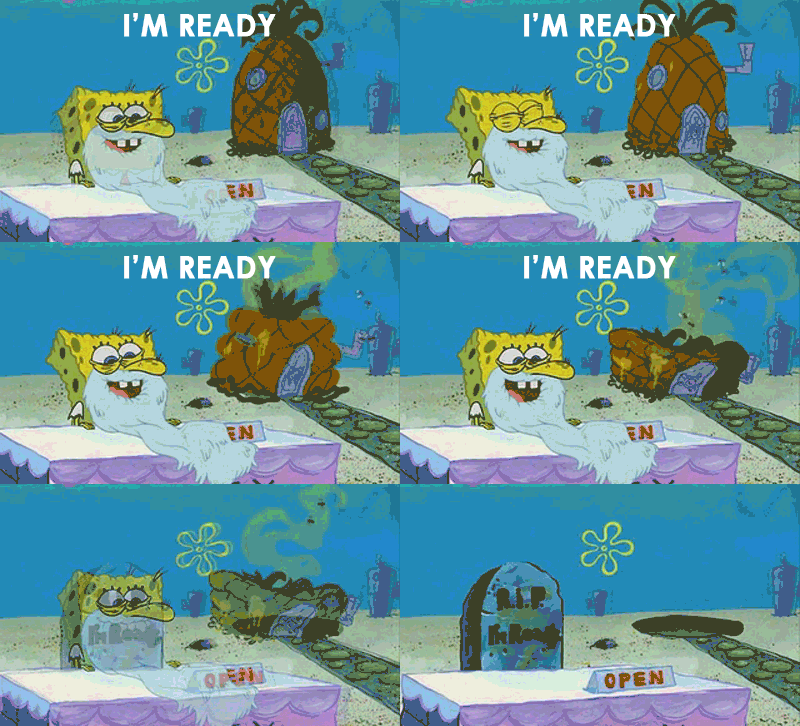
I think the book is ready. I think I’m ready.

I'm Ready

Well, almost ready. Another ninety pages to edit.

But then I’m ready.

So … uh … how the balls do I find a good agent?

Glimpses of Non-Suckitude


I was beginning to get a little fatigued with this latest edit. Cleaning up the junk language, tightening up all the moments, trimming out the unnecessary. It felt like most of what I had written was crap; that it all needed serious work before it could be “ready”.

But I reached a few passages today that absolutely crackle with life and energy. Passages that had me laughing to myself while I sat in my darkened room reading jokes I myself had written, even though I already knew all the punchlines. Passages possessed of a sort of self-evident, unconcerned eloquent beauty, the like of which I would not attribute to myself. Passages that make me think maybe I’m not so bad at this writing thing after all.

This novel (and this blog for that matter) is keenly interested in the question of inspiration: where it comes from, how useful it is, what it can do for you when you have it. And by and large, I have come to believe that inspiration is just a bunch of baloney sandwiches. You either work or you don’t, but some days are better than others.

Still.

As I read my own work of the last year and a half, it’s encouraging — and kind of awesome — to see those flashes of inspiration peeking out through the cracks.

I like to liken (like to liken, tee hee) writing to a long, arduous slog through vine-darkened jungle, or to a hopeless trek in a desert. And it damn sure feels that way a lot of days. But every now and then, light penetrates the canopy and wakes up the critters on the jungle floor, and the rare flowers open their petals to the light. Here and there, water bubbles up to shape an oasis amid the scorching sands.

For now, though, it’s back into the caves.

Increments


*Pokes his head out of the editing gopher-hole*

Advice I’ve heard more than once says that you should give your projects time to breathe in between revisions. Like, ideally, you should be able to read it with objective eyes, as if you yourself didn’t slave over it for months.

And I laughed at that advice, because I thought it was impossible. And in a panoramic sense, it is. An author can probably never divorce himself so completely from a work as to not recognize it. (Sidenote: I think that may be the first time I’ve ever referred to myself as an author. Feels cozy.)

But that’s the work as a whole. The prose? Oh my god. I’m sixty pages into the edit and … yeah, it feels like some arsehole idiot who basically knows nothing about writing wrote this thing.

And that’s coming from an arsehole idiot who basically knows nothing about writing.

It’s not bad. But man… if it feels this unpolished to me now … I mean, I have to take that as a sign that I’m getting better, right?

Right?

I’m not saying I’m an expert or anything, but … even incremental progress, yeah?

*Vanishes back down the gopher-hole*

The Weekly Re-Motivator: Die Hard


So the prompt for the week is “movie titles”, and the movie that’s front-of-mind right now is Die Hard. (Actually, who am I kidding; the movie is Star Wars VII, but I’ve talked that one to death around here of late… even I kinda want to lightsaber my own face if I bring it up at the moment.)

So, Die Hard. I hadn’t seen it until about a week ago.

I know. I know. I’m sorry. How I was ever carrying a man card before that, I don’t know. But it’s been remedied. Movie seen. Balance in the universe restored.

But my weekly re-motivator is about writing, right? So how is Die Hard about writing?

Maybe the better question is: how is it not?

McClane faces an impossible task: take down a squad of international terrorists. The writer faces many: stare down and overcome the impossibly intimidating blank page, stay focused and driven enough to finish his projects, and eventually, swim out into the open waters chummed with the manuscripts of his fallen comrades.

McClane is hamstrung (literally by his bare, and eventually, his ruined feet; metaphorically by an inept police chief and FBI agents who only make the situation worse), having to overcome obstacles that a normal person in his situation really shouldn’t have to. So, too, the writer: he must conquer his usually over-inflated sense of self-doubt about his abilities, his lingering and ever-present fear of rejection, even his lack of simple time in the day to do the thing he wants to do.

McClane is actually not trying to save the day for everybody; he’s trying to save his wife. (Disclosure: I’ve only seen the first two movies. I know. I’m working on it.) The thing everybody thinks he’s doing — defeating the terrorists, saving the civilians, foiling international intrigues — is secondary to the immediate need to save something that matters to him. Writers? I’ll posit that people think anybody trying to write is trying to become the next J.K. Rowling or whoever wrote Fifty Shades of Grey (shudder). In reality, though? Basically every writer I’ve come across — myself included — is a person who feels he must tell stories; who needs the creative outlet and the meditative focus that writing can bring like he needs oxygen. Not that we would eschew widespread acclaim (nor would McClane turn up his nose at saving buildings and planes full of people), but it’s not necessarily the primary goal.

And then, of course, just like action movies, writing is a thing best punctuated by the occasional bout of gratuitous explosions.

Nah, that’s not a metaphor; that one’s delightfully literal. Because every writer is a little bit of an action hero in his own mind, I think. John McClane saves the day because it’s just what he does. Writers write because that’s just what they do.

Write Hard.

This weekly remotivational post is part of Stream of Consciousness Saturday. Every weekend, I use Linda G. Hill’s prompt to refocus my efforts and evaluate my process, sometimes with productive results.