To Extremes


This week’s prompt is “an emotion and its opposite.” Now, the obvious one is love/hate, and that would be an easy one to explore. As a writer, I swing back and forth between loving and hating my work like the tides. Hell, I swing back and forth between loving and hating the craft. But love/hate is obvious.

No, the dichotomy that seems most apt to me is confidence/doubt. These two phases, like the peaks and troughs of a ray of ultraviolet light, alternate with alarming alacrity (triple alliteration bonus, whee).

One minute, I feel at home in the me who is on this adventure. I know what I’m doing. I’m staying smart, looking sharp, making good decisions. Every new bit of text is a good one. Every cut makes perfect sense. Every edit improves the whole. There is no shaking me off the course I’m on as I work inexorably toward writing the best inaugural novel that’s ever been written.

Then the light goes out, and I remember that I’m miles deep in an unfamiliar jungle with the dark rustle of foreboding creatures of the night on all sides of me. That bit of dialogue I thought was scorchingly clever the first time around seems a bit hackneyed upon further review. The character arc I’ve worked so hard to create feels like a flamingo on roller skates; all awkward angles and feathers crashing everywhere. The cut that felt so necessary when I made it now looks like a gaping wound, and the patient is bleeding out.

Then I stop working for a while, and by the time I come back to the novel, I feel like I could drive nails with my forehead again.

Do any other writers suffer from the same up-and-down, hot-and-cold, bulletproof-then-made-of-glass feeling? Do all of them? I have a hard time believing that my sentiments on writing are unique, but by the same token, not every writer can be so schizophrenic.

In fairness, though, the ride is pretty fun. There’s something to be said for riding the roller coaster til you throw up the oversized cotton candy you just horked down while you were waiting in line. Then wiping the pink fizz from your lips and lining up for another turn. Some might call that crazy.

No, that would be me. I’d call that crazy. I’m too old for that sharknado. But the writing, okay. I can handle the swings of that ride.

This post is part of Stream of Consciousness Saturday.

Stakes and the Blarg


Boy, oh boy, do I love a good stake. Charred crust, pink and bloody in the middle, melt-in-your-mouth flavor, rancid farts for the rest of the night…

What? Oh. STAKES.

Woo! Vampire hunters and silver crosses and garlic and…

Huh? Ugh. Okay, fine. Just stakes.

I guess there’s a lot to be said about stakes in writing, but today I’ve got the stakes of writing on the brain. Not least of which because I’m passively reading a book called The Right to Write by Julia Cameron. (“Passive” reading is my pleasant euphemism for “book-I’m-reading-on-the-toilet.”) And… well, for starters, I don’t think I’m this book’s target audience. Each chapter is essentially its own workshop and meditation on some aspect of the writing process, and much of it is the kind of rah-rah-rah-you-can-do-it stuff that would be more at home in a literal cheerleading squad than in a book aimed at burgeoning authors. For another, the tone of the book is through-and-through the sort of hippy-dippy, peace-and-love drivel that can give you a toothache if you swallow too much of it. It’s all “writing is a gift” and “the story speaks through me” and “anybody and everybody is a writer at heart”. Then there’s a lot of meditation on the sun rising over her private valley and rumination on her horses as they watch her through the kitchen window, and that’s about when I really want to induce vomiting so I don’t choke on her privilege. Now, okay, those ideas are lovely and all, but it’s all too Kumbayyah for me to ingest in anything other than the tiniest bites.

I don’t need that. I enjoy writing enough in its own right that I don’t need somebody pushing me to do it or ensuring me that it’s okay for me to do it. Whether or not anybody is truly “cut out” for writing is irrelevant, as any list of bestselling books will tell you. Horrible writers still write. This book is aimed at convincing somebody who’s perhaps too timid to leap into the pond that he might, in fact, have something worth writing about in his mind. It’s designed to invite you into the world of writing one baby-step at a time, by writing first about things in your house, then in the news, then about your family, and blah blah blah. If you’re a sometime reader of my blarg, it’s pretty obvious that I do that stuff on my own already.

That said, there’s something comforting in the way she puts her ideas forth.  And even among the platitudes and smug self-righteousness, there are gems of wisdom, little kernels of edible advice embedded in the stew of saccharine crap.

The one on my mind has to do with stakes, and what she has to say about it is this. When novice writers (and sometimes experienced writers, too) sit down to do their capital-W Writing — be it their novel or screenplay or short story or news article or whatever — there is this inescapable sense of pressure and dread surrounding the act. Because it has to be perfect. If I write something crappy, that’s all anybody will ever remember. It’s all will ever remember. Inability to achieve that perfection and to get all the things exactly right is paralyzing; it can lock up the mental faculties like a bit of chain snarled in the spokes of your bicycle. And this is a fear that I’m on a first-name basis with. (Its name is Todd. Like all horrible things.)

The well-hidden reciprocal of that fear is the fact that so many of us, writers and non-writers alike, engage in writing every day in which we feel no pressure at all to perform at some elevated level. These are your e-mails to colleagues about whatever projects you’re working on, your text messages to your spouse about what you need to pick up at the grocery store on the way home. Okay, it’s not Writing, but they are still words that you form for the purpose of communicating an idea to somebody else… and that’s writing, innit?

The trick, then, is to capture that free, unfazed, not-even-aware-of-any-kind-of-pressure feeling associated with e-mails and apply it to your capital-W Writing, to leap into your manuscript with the same abandon with which you fire off a scathing comment on a message board or a snarky response to your sister’s joke about your mom. It’s hard to do, but I’ve felt flashes of it when working on my novel.

It almost made me mad when I realized it. While I was having a chuckle at all the peace-love-dope sentiment in her book about writing, Cameron had thrown a literary dart and pinned my Id-Writer to the corkboard like a doomed insect. In her suggestion that writing doesn’t have to be this big deal that a lot of people (myself certainly among them) make it out to be, she had explained away the entire r’aison d’etre for this blarg. This is my low-stakes writing. It doesn’t matter what I write here; what matters is simply that I write. That I break apart the dam of mud and sticks clogging up the river of my faculties. That I pull the release valve on the hot-water heater of my brain. That I let the toddler out into the yard to run around in circles and scream its head off so that the adult in my Ego-Writer can get some peace.

This, then, is why we read; this is why it’s important to engage critically even when the subject matter seems like a laugh. You never know when the river of sharknado is going to belch up a hunk of gold. I’m going to keep reading Cameron’s book, even though it irks me, and even though I will no doubt find myself rolling my eyes like a hamster on a wheel at its pithy sayings. Much as it gives me the chuckles, there may just be a few more juicy tidbits in its pages.

Also, it was a gift, and I’d feel really bad about tossing it.

Thanks, sis.

No, not that sister. The other one.

Thanks.

The Fifty-Year Sequel


Apparently, some fifty years after penning the one-off novel that would rumble the foundations of the literary world and haunt the nightmares of eighth-graders for years hence, Harper Lee has penned a sequel.

Maybe not a sequel, so much. According to the press releases I’ve seen, it’s a new story that features several of the same characters as To Kill A Mockingbird, not least of which are Scout and Atticus.

I’m of two minds about this.

On the one hand, it’s fantastic. Scout and her world are so beloved, not just by lovers of literature, but by people who in some cases have never read another book, that to see her gracing the pages of another story tickles me in places I maybe shouldn’t talk about.

On the other hand, I’m apprehensive. Already, the hype machine is surging to life, heralding the release of this new novel, Go Set a Watchman. It seems that Harper Lee wrote this novel before Mockingbird, which is interesting in its own right. Then, Mockingbird took flight and Watchman sat on a dusty shelf for all these years. Unfortunately, with Mockingbird being what it is — a staple of the American literary canon, an adored favorite of kids and adults alike, a harsh but hopeful look at so many issues of its time — Watchman now has to contend with some frankly unfair levels of expectation.

Imagine if J.K. Rowling vanished from the face of the earth for thirty years and then materialized in a cloud of smoke and thunder to bestow on us an untold story of Harry, Hermione, and Ron as adults — and, oh yeah, she actually wrote it when she was in high school and has just been hiding it from us all this time. Imagine the shockwave produced as fans broke the sound barrier to line up for their copies. Imagine the poor bedraggled fibers of the internet sparking and fizzing out as every e-reader in existence simultaneously tried to purchase this book. (Or, hell, we’ll probably be reading books through implants directly into the brain stem by that time, who knows.)

I’m really excited about the new novel, but I almost wish that it could have been released under a pseudonym (of course, then, who would buy it) or that it could have been released back when it was originally written, or just after Mockingbird (of course, then, it wouldn’t be nearly the big deal that it is). This book is going to be subject to so much scrutiny and analysis and comparison to the original that its pages may literally spontaneously combust from the magnification of so many critical lenses. And I think that’s kind of awesome, because literature is important to our world in that way. Things always mean things, and this book will mean a lot to a lot of people. But I also think that’s kind of sad, because every story deserves the chance to stand on its own and be appreciated for what it is, and this story will never have the chance to do that. Like a rhinoceros born into captivity, it will never know the free, mud-stomping whimsy of the wild, never feel the thunder of the plains under its feet. All its meals are pre-determined, and it will be bathed for all of its existence by caring and well-meaning caretakers dressed all in khaki while bemused families gawp at it from behind their strollers and fannypacks.

An Idea is Born


The stream of consciousness prompt this week is “scene/seen”, and that feels like kismet. Because if you’ve spent any time around my blarg, you know that one of the things that’s been front-of-mind for me over the last year or so is my novel. And I think so much about what the novel is and what it may yet be that it’s easy to forget what it once was, which was a dumb little scene I wrote for a playwriting class I took in my fourth year at UGA. I say dumb not because I thought that scene was bad (though if I read it again I might have to reconsider that assessment), but because I wrote it almost as a throwaway. We’d been in the class for maybe three weeks, were still learning the ropes, and this assignment was an easy one to get us thinking outside of the box a bit.

“Have a character enter your scene from somewhere unexpected.”

Were you to give me that prompt now, I’d have a hard time deciding which outlandish entrance to use. I’d have somebody come crashing through the window or the ceiling. I’d have an escaped prisoner tunnel up through somebody’s living room floor. I’d have a reincarnated Elvis enter from the bathroom in a cloud of psychedelic lights and smoke. (Okay, so I stole that Elvis entrance from Steve Martin’s Picasso at the Lapin Agile). The problem would not be “how do I write this scene,” the problem would be “how do I choose?”

But at the time, the prompt stymied me. It wasn’t that I couldn’t think of strange entrances — I could — but I couldn’t think of a way to justify any of them. The idea would strike, but I wouldn’t know how to connect it to anything meaningful. Even as I write that, I find myself shaking my head — it was just an exercise scene, it didn’t have to connect to anything meaningful! — but I was stuck. Stuck, stuck, stuck. I sat in front of my computer staring at a blank page for the better part of an hour, unable to write this scene, too nervous to take a chance.

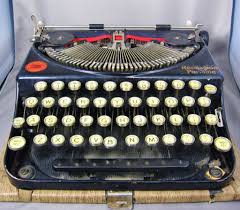
typewriter

The one piece of writing advice that everybody knows is to write what you know. Frustrated with the assignment and my inability to pen even a single word, I fell back on that old axiom. I’m blocked? Can’t crack this scene? Fargo it. And I wrote my character, a frazzled, frustrated guy, sitting white-knuckled and scruff-faced obstinately in front of a typewriter. (Yeah, yeah, I know, I have a thing about typewriters.) I had him struggle and hem and haw and make excuses and bang his head against the wall, and then, finally, he just gave up trying to be creative and wrote a crappy, cliched little scene. Nothing special about it. Except that it appeared out of nowhere (the unexpected entrance, such as it was) and played out right in front of him. Taken aback at first, he spoke to the characters that suddenly existed right there in his crappy apartment. The newly created characters shared their thoughts (this setting sucks! I would never read that book! Why would I even say that to her?), he took their advice, and in a matter of moments he had figured out that the best way to write was to get the fargo out of the way and allow the characters to explore their own situation.

I thought it was crap. I mean, really, I was almost ashamed of it. So ashamed that I almost didn’t go to class the next day. But crappy though it was, I had enjoyed the taste of writing it, so I went. Naturally, the teacher (the inimitable Stanley Longman) called on me as one of the first to present. With sheepish disclaimers, I handed copies of the scene to three of my classmates, who took a few minutes to read over it before assuming positions on the stage. I heard them giggling as they ran through it and thought, great, it’s as terrible as I feared and now I’m going to be exposed for a hack. Then they read the scene, and the laughter continued; little snickers here and there, even a stray guffaw. Finished, the actors took their seats and I sat on the feedback stool, red-faced in front of everybody, and waited to be verbally crucified.

First hand raised, I called on a girl whose name I didn’t know at the front of the room. I’m paraphrasing, of course: “First of all, it was really funny. I loved the interplay between what we expected from his characters and what they really wanted for themselves.” Nods from around the room. Next up, a guy who sat near me and whom I’d collaborated with on an earlier exercise. “I recognize that struggle when I write,” he said, “it was cool to actually see it on stage. And it worked.”

The workshop continued. I got critical feedback as well as praise. But my professor’s comment stuck with me more than any of the rest. He scratched his head and spread his hands like a big grandfather gorilla. “The concept needs a little work, just to polish up the how-is-all-this-happening, and the why. An audience wants that. But it’s funny, you’ve nailed that. Those comedic elements are the hardest to pin down, and you’ve done it. Don’t you think?” He inclined his head past me toward the class, and there were vigorous nods of assent. He chuckled. “I loved it.”

That class was my favorite experience in my undergraduate years. Much though I loved that class, I got distracted from that scene and didn’t think about it for a few years. When I graduated and moved back home, I had the opportunity to work with my old high school and ended up taking the core concept of that scene — an author at war with his characters — and expanding it into a full length production. It went over like gangbusters, and, shock of all shocks, it played a role in my meeting with my wife (her mother saw the show, knew me from my work with a community theatre, and kinda-sorta shoved her in my direction).

Now, eight years later, that stage play is becoming a novel. And I feel the same fears in its formation that I felt in those days struggling with that seedling of a scene: that it’s contrived, that it won’t be funny, that it’s ultimately utter crap. But somehow, this time around, I’m not nearly so fearful as I was. Maybe it’s that I’m older and jaded and I don’t care what people think like I used to. Maybe it’s because I’m more confident now than I was then in the concept and my ability. Maybe it’s because I’m older and losing touch with reality and don’t know well enough to be properly nervous. Whatever the reason, it’s a nice reminder to myself that I’ve had success with this story once, and there’s no reason why it couldn’t happen again.

This post is part of Stream of Consciousness Saturday.

Terrible Reviews: Activity Tracker Edition


At some point in the past several years, trackers have gone from the stuff of spy movies and government conspiracies to the latest tech-slash-fashion-slash-fitness-slash-self-absorption craze. Being somewhat concerned with fitness, consistently fascinated by tech, not at all interested in fashion, and supremely selfish, I decided over the holidays that I might want one of these.

And I didn’t get one.

But that’s why God invented gift cards, innit? So a few days after Christmas, I had done some research with my wife looking over my shoulder, and we went and bought a Jawbone Up Move for each of us.

I’m pretty sure I hate the name. “Jawbone,” meh, whatever, that’s the name of the company, and I think they made headsets or something originally, so that gets a pass. “Up” is the name for their line of trackers (they make enough models to consider it a line now). I can’t say I endorse using an adverb as your product identity. Adjectives, sure. Speedy! Flamboyant! Hoopy! But an adverb? As an English teacher, I can’t say an adverb stands well on its own. Then there’s “Move”, which I don’t really have a problem with, as that’s what the gizmo is designed to get you to do. Plus, it’s in that authoritative imperative mood, so it sounds like an angry gym coach shouting at you to GET UP THAT ROPE COSTANZA. But you put it all together — Jawbone Up Move — and it sounds a little ridiculous. But you have to put it all together; you can’t just say “Up” or “Move” on their own because Google doesn’t know what you’re talking about, and other humans look at you funny or punch you. I’m just going to refer to it as the “JUM” herein, because that sounds a little like gum, and who doesn’t like gum?

In a world of Fitbits and Garmins and wrist straps and belt clips and skull implants and constant satellite monitoring, (you didn’t get the skull implant and satellite monitoring with your soy half caff? [I have no idea what a soy half caff is]) why the JUM? I’m not gonna lie, it was one of the cheapest options available, but it still boasts access to the Up app, which was highly favored by a slew of online reviewers, and which, after three weeks, I’m pretty fond of. What the JUM lacks in visual appeal and features it makes up for in simplicity and battery life — unlike most of these gadgets, it runs off a watch battery and doesn’t have to be plugged in every few days. Considering the veritable snakepit of little dongly things choking the drawers in our kitchen, this was no small selling point.

Look, it’s not my goal to actually review the thing, as I’m not an expert. All I really want to do is talk about my experience with it, which is equal parts insightful, amusing, and hilarious, and I imagine this experience would be more or less the same for any of these trackers.

Let’s start with insightful. The JUM perches quietly on your wrist or in your pocket or at your waistband or clipped to your earlobe or embedded in your spine (technology pending) and it counts your steps.

No, really, that’s about all it does. Like a sweatshop gnome hunched over an archaic adding machine with the tape spilling out onto the floor and his knobby knuckles hammering at the “+1” over and over again, it logs your steps throughout the day. More correctly, it counts step-like-movements, which can be gamed a little bit by swinging your arms around while you talk on the phone, for example. It also purports to track your sleep by the same metric (tracking movements while you lay in bed under the premise that you hold exceptionally still while asleep). That sounds cool, but I have my doubts about how accurate or reliable that information can be.

In short, all of this is built around the premise that 10,000 steps a day can help you lose weight and get healthier, which is probably true, because as it turns out, 10,000 steps is actually rather a lot.

But it’s more impressive than just counting, because it also syncs with your phone to track the time you took all those steps. So it can tell you, for example, that from seven-thirty AM until eight-fifteen AM, you took 300 steps as you milled around your apartment getting ready for work, from nine until five you took thirty steps as you parked your donk in your cubicle all day, and from five-after-five until five-twenty, you took seven thousand steps as you chased down and murdered your co-workers with an axe. The JUM then aggregates this data for you and pushes it at your face through these bright and cheerfully colored graphs.

So you’re left with collections of numbers and pages upon pages of graphs that describe what you were doing and when and for how long, which probably has useful implications in case you’re ever questioned about all the suddenly axe-murdered employees at your job. And that’s interesting and insightful because it allows you to pinpoint the times of day when you are active and the times of day when you could use a bit more chasing and stabbing and digging and burying to get your heart rate up.

It’s also where the JUM becomes amusing. Because, if I’m honest, I don’t need the step counter to tell me that between 5 and 9 pm I don’t move that much, or that I get a bunch of steps in every day at work without even really trying. But the amounts are amusing. Turns out I walk about 2-3 miles daily at work, most of it in a thirty foot square classroom. And while that 10,000 step goal seems lofty and hard to reach on some days, on other days (and especially on my weekend long run days) it gets shattered. I put in (checks a big orange graph with a smiley face) 16,000 steps last Saturday, which brought my daily step average up to a little over 12,000. So the app now thinks that I need a challenge and it wants me to do 13,000 steps a day. And maybe I could do it, but the app slides it my way like a high-roller palming a twenty off to the valet, like it’s no big deal.

Then there’s the sleep tracking. The JUM supposedly tells you not only how many hours you sleep, but how long it takes you to fall asleep and how many times you wake up in the night. This is well and good and cool as long as you take into account that the thing isn’t measuring your brainwaves or anything, so it doesn’t actually know you’re sleeping or not; all it knows is that you weren’t moving very much, and this it interprets as sleeping. But my wife and I have kids. Two of them, under three years old. They wake up in the night, sometimes often. (Don’t talk to me about how nonsensical the phrase “sometimes often” is. I stand by it.) As a result, when we view our sleep data, we wind up with these deep canyons of orange (wakeful activity) in between the scattered cliffs of blue (various “stages” of sleep). Like a river-carved monument to our ongoing sleep deprivation.  The amusing part is the concept that I might need the app to tell me I woke up in the night. As if the raccoon eyes and the fact that I can’t keep my head upright during the day would let me forget. (And the centripetal force from my wife’s eye-roll just literally knocked me from my chair.) (She wakes up with the kids WAY more than I do.)

Speaking of my wife, that’s where the JUM gets hilarious. We try to be health-conscious: it’s the whole reason I started running, and I think the JUM feeds that in a quantifiable and productive way. And if the aim of the product is to get people off their butts and moving their feet in an attempt to better their health, I think that’s admirable.

But now, things have taken a whole other turn. My wife and I have both hit 10,000 steps every day for almost three weeks now. That doesn’t, however, mean that we’ve each had full, active days every day. It means we’ve managed to place our feet on the floor in an alternating pattern 10,000 times every day. It’s not an uncommon sight to find my wife walking laps around the living room or the kitchen, listening to podcasts while the kids are napping or asleep. I’ve jogged in place in my pajamas next to the bed on a couple of occasions to get a final 1000 steps in. Even now, my as I type, my wife is stomping a moat into the carpet around our coffee table while my son chases her in advance of his bedtime. We’ve become walking robots. This little gizmo on our wrists has made us competitive to the point of absurdity, which I suppose means the product is working as intended, though I’d be lying if I said it didn’t make me feel like an idiot a lot of the time.

All told, the JUM (and, by extension, probably just about every other tracker on the market) therefore falls into the category of wholly unnecessary but nonetheless delightful little devices that are now a part of my life, next to my keyless entry for the car, my smartphone, my bluetooth earpiece (say what you will, I know they’re douchey as all get-out, but I love that thing for the car and while doing chores around the house), my GPS watch, and any number of laptop peripherals. This is one of those things that if you think you’ll enjoy it, you probably will, and if you think you won’t, well, there are certainly better things to spend your money on.

Now, if you’ll excuse me, I somehow have to find 3000 more steps before the bedtime my JUM has set for me at 9:57.