Pareidolia, Foie Gras, and Guardians of the Galaxy 2: A (sort of) Terrible Review


Have you ever been in the midst of a dream, and then realized that you were dreaming? You’re there, and you’re standing naked in front of the class, or you’re taking the stage and you’ve forgotten your lines, or you’re soaring in the sky with psychedelic dolphins or whatever, and it clicks: this isn’t real. It can’t be real. The world doesn’t work this way.

Suddenly, the dream is a lot less convincing. Probably you wake up. Or maybe you turn into Neo and you’re able to change the dream to suit your whims or something. Either way, it’s like one of those pareidolia images of faces in everyday objects: once you see it, there’s no unseeing it. You can’t ignore it and go back to believing that the dream was real.
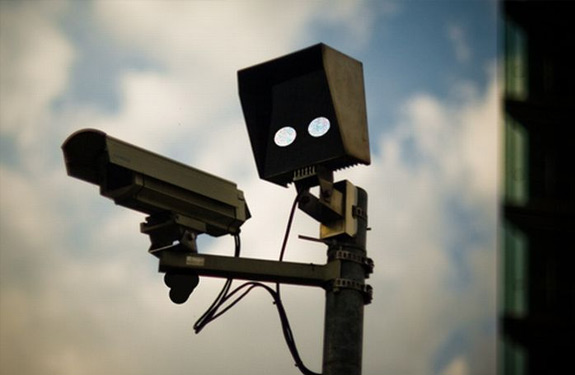
pew-pew-pew

What’s all this about, then? Well, the wife and I saw Guardians of the Galaxy 2 last night. And about halfway through the film, like Neo in The Matrix, I woke up. Not that I had fallen asleep — no, as is Marvel’s wont, the action is cranked to eleven in this offering. Rather, I looked around. Noticed the seams on the walls, the jagged edges at the periphery, the hidden patterns in the carpet. And the spell was broken. I wasn’t just watching a movie anymore, I was in a world that I knew had been crafted deliberately, created to work surreptitiously on my subconscious.

(Spoiler note: This isn’t exactly a review, and there’s nothing explicitly spoiler-ific here. But if you’re planning on seeing it, and want to be able to immerse yourself fully, you might want to don your peril-sensitive sunglasses now.)

Now, sure, movies are designed to do this to you anyway. Hell, so are stories. Creators craft these things to manipulate your brain from top to bottom: telegraphing some story elements to invite you to make predictions. Playing to well-known tropes to help you find your footing in a strange world.

And GotG2 does that. But this isn’t that. I wasn’t discerning the hand of the creator in the brush strokes. Rather, I was discerning the hands of the studio execs molding the story externally as it was crafted. A whole new matrix within the matrix.

Here’s what I mean: Marvel’s using a pretty simple formula these days. Stories get bigger and bigger. Crazier, wilder villains (see: Doctor Strange doing battle with a god). Savvier, snarkier self-satirizing heroes (see: the entirety of Deadpool). And a sequel is always measured against the yardstick of the original.

And how do you make a sequel better than the original? Easy, you take the same characers, craft an entirely new storyline that plays to their developing relationships and strengths that tests them in all new ways, encouraging more growth, more development, more feels from the audience. Right? HA HA HA no. The way you make a sequel that plays as well as an original is you take everything the original does well and you do it more.

Don’t sweat the storyline so much: you’ve already got viewers baked-in. Just ratchet up the things they loved about the first movie. Give the funny characters more funny. Make the romantic tension a little more taut. Make the explosions even more explodey.

What made GotG1 so much fun — what audiences loved about it — were a few things. The old-school music soundtrack laid over a futuristic world. The irreverence. The niche-ifying of every character (there’s the snarky central guy, the badass no-nonsense chick, the brick-joke, doesn’t understand sarcasm or interactions in general dude, the jerk-store a-hole raccoon, the mute monster with a heart of gold. See also: Five-Man Band.)

And about halfway through the film, I realized that this film wasn’t actually doing what a sequel should do. There was very little new development. Not much added to the larger universe of which this story is a part. Instead, this movie was focus-grouped to make me want to watch it by giving me more of what I liked about the first one.

Let me not drive this into the ground: a few examples will prove the point.

Musclebound Drax, whose brick humor was the cornerstone of his character development (what, again, does he actually contribute to the team?) is tossing out even more deadpan sarcasm-proof jokes here, at what felt like a ratio of twelve-to-one over the original.

Angry little ball of sentient fur Rocket, in GotG1, made his place by throwing out sarcasm and lashing out when people called him a raccoon and just general dickery. His character development here: he’s a total a-hole to everybody, with at least two characters specifically pointing the fact out to him along the way.

And of course, the soundtrack is just as jarring in its strange setting, but there feels like even more of it, and it even becomes a focal point of the story itself: the central villain spins one of the songs into a metaphor for his own development. It’s well done, mind you. What at first seems like this big, romantic yen about wanderlust morphs into a twisted, sociopathic rejection of humanity (and all lifeforms in the galaxy, actually — readers of The Hitchhiker’s Guide to the Galaxy will hear echoes of the denizens of Krikkit in the villain’s desire to wipe out everything in the universe that isn’t him).

There’s nothing wrong with any of the above. But once you hear the voice in your head — the voice that says “OH YOU ENJOYED THIS THING ABOUT THE ORIGINAL MOVIE? HERE HAVE MORE OF THAT THING” — you see it everywhere in this movie. Douglas Adams wrote brilliantly about humor that what makes it so lovely is its rarity. In the midst of a hot summer, you run out into a surprise thundershower for the joy of splashing around in the puddles, for the sprinkle of the rain on your face, because these things are rare and not happening every day. But when humor is everywhere — when it’s been raining for weeks and weeks, each day like the last, with no hint of the sun — the rain is a little less magical. GotG2 is like that: it’s a week-long deluge when what I really want is the surprise afternoon shower.

Put another way: they make foie gras by force-feeding geese until their stomachs explode. Having watched GotG2, it feels that I’ve been force-fed in the single aim of extracting more dollars from my wallet. And my stomach is near to bursting.

I say all that to say this: GotG2 is good fun. It’s perfect summer fare — lighthearted, action-packed. If you liked the first one, well, you’ll probably like the second one; not least of which for the reasons I’m talking about here. But if you miss the movie? Well, you’re not missing much.
Riding The Wave


We’re back from a week’s vacation. Back from a week of beaches and relaxation and not thinking about work at all and HA HA no, we were on vacation with our kids naturally, so it was pretty much life as usual: waking up before the sun, stretching out every activity by about 50% to allow for tantrums and foot-dragging and lost shoes / stuffed animals / underwear, and remember when I said that thing about relaxing? There’s no such thing as relaxing when your kids are five and three and will fight about literally anything if given ten seconds of opportunity.

So: didn’t get as much opportunity to write as I’d hoped.

But on the night when we were uncertain whether the storm of the decade was coming through, my wife and I did sneak down to the ocean to ride some (for the gulf) killer waves. Actually, to be clear, my wife had the good sense to not try riding the waves, but as good sense is rarely one of my dominant characteristics, I jumped in with both feet, and often my head.

Surfing (okay, fine, boogie-boarding because I’m not that coordinated or cool) is a great way for a thirty-something guy to get thoroughly humiliated and smacked around in return for a few sparks of short-lived adrenaline.

But I realized — as I was on vacation, hiding from responsibilities and from my craft of choice — it’s also a pretty good parallel for writing.

To wit: here’s how surfing works. You grab your board and you head out into turbulent waters, fighting the current and the crashing waves to get yourself out a decent distance from shore, where the waves are fewer and farther between but bigger, more powerful. There, you wait until just the right one comes along, and then — with every ounce of strength and dexterity you can muster, you abandon your fingernail grip on safety and attempt to ride that thing all the way back to the shore.

Fun, but also pointless and much more likely to leave you smashed against the ocean floor, unsure which way is up, filling your lungs with ocean water than to deposit you safely on the shore, stepping casually off your board as if the thing you just accomplished were really no big deal as the ocean breeze ruffles your sun-kissed hair.

Which is basically writing. Let’s be honest: life would be easier if you just didn’t. The world doesn’t want you to write, like the world doesn’t want you to surf. Those waves are monstrous, relentlessly pounding you back to shore, which is really where you should be hanging out: grinding out your daily routine, seeing to your land-lubberly responsibilities (i.e. your job), sticking to the land you evolved to walk upon and not the sea which your evolutionary ancestors abandoned.

Every wall of water that breaks upon you is shoving you back toward land. The sea doesn’t want you there — it knows you don’t belong. Just like the writer trying to make time for himself when he has family and job and mortgage payments to contend with. That’s where you and your energy belong, not splashing around in the ocean that’s just going to leave you cold and bruised and waterlogged. But you fight your way out anyway, whether you’re chasing a thrill or an escape or because somewhere deep in your primeval brain you feel like you do belong out there.

Then you wait. The shore — and the safety and normalcy it represents — is distant. All around you break waves that you allow to pass by for one reason or another: Not big enough, not breaking at the right time, too fierce. The waves are the writer’s ideas: plentiful and without end, but mostly useless to the writer, for many of the same reasons: too big in scope for the author to tackle, too small to really hold his attention, or interesting but just not one he’s feeling right now. Most of them roll right by.

But eventually, you see the one. It’s just right, this wave, big enough to give you a thrill but also just big enough to scare you a little. (It’s the idea that frightens you a bit that will keep you writing.) So you jump on it, and this, too, is a struggle — because in the build-up to the wave, the current changes. The ocean draws the water back to itself to gather strength for the new wave, and it pulls you out to sea with it. But you find yourself atop it nonetheless, and then everything changes. Now you’re flying along at the speed of creativity, as this madcap idea explodes and crashes all around you in an erupting chaos of foam and spray — the castoffs of a story being woven from nothing.

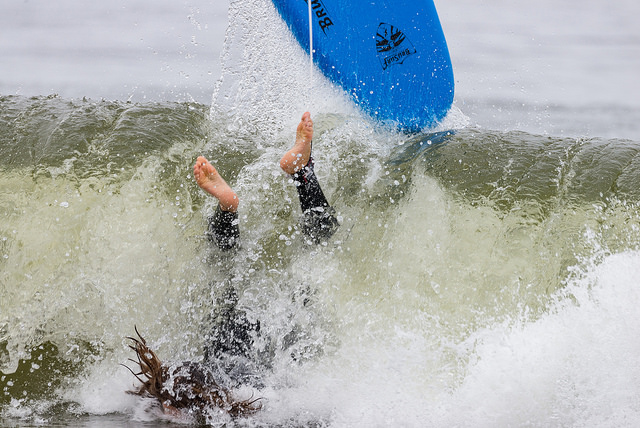
And who knows? Maybe the wave turns on you — it breaks over your head and tumbles you end-over-end. It slams you into the sand and the ocean rushes into your mouth and nose and ears and you feel like you might as well be a mile underwater for all you can see and feel. This is where the idea leaves you and the inspiration rushes right out leaving you lost and adrift and doubting every decision that brought you to this point, reconsidering an easier life, perhaps as an accountant.

https://www.flickr.com/photos/johnkay/28911174342/
Image by John K at Flickr.

Or maybe you ride it all the way home, bumping gently onto the sand as you stick a perfect landing: the ending writes itself, the conflicts wrap themselves up neatly, and you step off the board, nary a hair out of place.

Either way, you find yourself back on land again — beaten and half-drowned or charged up and riding high — but not quite satisfied either way. Nobody heads out to ride just one wave, do they? There’s an infinity of stories out there waiting to be told, an interminable ocean of waves waiting to be ridden.

Grab your board.

Or, y’know. Your pen. Or keyboard. Or whatever.

WriterSpawn


It’s 7:45 AM. The sun is out, the weather, gorgeous. The beach is deserted. A dreamland for a kid who’s already been awake for two hours, mainlined a bowl of sugary cereal and awakened every adult in the house.

And instead, he’s doing this:wp-image--2074352929

I even asked him if he wanted to go down to the beach. He said, “no, I want to finish making my book. I’m so excited to read it to you.”

As parents you sometimes find yourself in these moments. Moments when the heavens open up and celestial light shines down, and you realize that you’ve done the right things, and your kid is going to be OK, that he’ll be a force for good in the world.

Then there are other moments. Moments when you wonder whether the next time you see your kid, he (or maybe you!) will be on the wrong side of iron bars and bulletproof glass, and you question every parenting decision you’ve ever made.

I’m not sure which of those moments this is. If he’s a writer in the making (and he’s definitely not an athlete, so, you know, maybe!) then he’s doomed to a life both torturous and wonderful. Afflicted with a sickness that causes him to think about everything, absorb everything, and never let his mind be quiet. Gift and curse. Not sure if good or bad.

But this morning, he’s a creator and not a consumer, and that’s more than a little inspiring.


Toddler Life, ch. 68: (Lack of) Sleep Chronicles


My daughter has never been much of a sleeper.

I mean, she’ll do it, in much the same way I eat my vegetables. (I know it’s a thing I have to do, and if I don’t do it for long enough, I start to feel really funky.) But it’s not a thing she’s ever chosen to do, or done willingly. I think it’s safe to say she expends more tears in a week of bedtimes than the average pregnant woman does over the course of her nine-month term.

And that’s at home, where all the routines are firmly ensconced and the deviations from said routines are rare.

But this week, we’re on vacation. Which means: strange beds, strange rooms, strange barometric pressure, the total absence of anything like routine, and her absolute favorite person in the world (grandma!) hanging around to dote on her at any time. Which by extension means that if sleep is usually a struggle, this week it’s more like healthcare (who knew it could be so complicated?)

Tried her pack & play (for the uninitiated, that’s a fancy word for a “quick set up” crib that doubles as a playpen, which has accommodated both of my kids — in either task — for maybe three hours TOTAL) in a couple of quiet rooms in the condo. Nothing doing. Tried the air mattress we packed in case the pack & play didn’t work. Not a chance. So on night one, she slept in my bed with my wife while I slept on the air mattress (which I’m pretty sure is Greek for, oh, you’ve never had back problems in your life? Well, surprise, now you do).

Surprise surprise, the baby who doesn’t sleep very soundly by herself sleeps even less soundly while sharing a bed with an adult. My wife hardly slept a wink with the little princess kicking her, tossing and turning next to her, waking up to scream and falling immediately back to sleep.

So I slept with the baby last night, while my wife — who actually has legitimate back problems — opted willingly to dance the dance of death with the air mattress instead. This doesn’t seem like a terrible call. I’m a sound sleeper in exactly the way my daughter isn’t, so theoretically, we should balance each other out.

Should.

I woke up five times that I can remember in the night.

Every successive wake-up I found myself closer to the edge of the queen bed. Somehow, the little girl 20% of my size and body weight managed to completely box me out of the bed until I was, quite literally, dangling an arm and a leg onto the floor, somehow managing to hold onto my place either by biting the pillow or clinging on with my toes.

When we went to sleep, she was arrayed on the mattress like a normal human. Head on pillow, feet pointed downward toward the edge of the bed.

First wakeup: she’s angled herself away from me slightly, head pointed away and feet pushing firmly against my hip.

Second wakeup: She’s aligned herself like a torpedo aimed at my shoulder blades, the top of her skull driving into my spine and forcing me towards the edge.

Third wakeup: The toddler torpedo has reversed itself and is now pushing its feet into the small of my back while she lays flat on her face, arms at her side, like one of those planking videos from five years ago, except that in a truly remarkable abuse of the laws of physics, she’s leveraging me — 150 pounds her better — off the side of the mattress. At this point, I actually get out of the bed, redistribute her like an actual human in the bed, and reclaim y rightful half.

Fourth wakeup: she’s curled up in the fetal position against the small of my back, which is kind of adorable, except she’s pressing the dagger points of her toenails into the soft tissue behind my knees. I concede an extra quarter of the mattress again to make the pain stop.

Fifth wakeup: it’s now six AM, the time when she ordinarily begins to stir when we’re at home. I open my eyes to find her face inches from mine, eyes wide open and gleeful, teeth bared in what I guess is a smile but what appears to my newly-awakened brain to be the grin of the very angel of death itself. She giggles and swats me with frankly astonishing strength in the ear. This is a fantastic move if you’re ever in a fight as it discombobulates your opponent and bollockses their hearing. It’s a real jerk move to pull on your father who was, moments ago, asleep, as it discombobulates the hell out of him and bollockses his hearing.

In slow motion, I slither out of the bed and collapse to the floor and attempt to sleep just five more minutes while my beautiful, delightful daughter — the apple of my eye, the joy of my life — continues to rain blows upon me.

Chaotic Evil


I don’t do it all the time, but occasionally when working with characters, I think about their alignment.

You know. Dungeons & Dragons. Two sliding scales. Chaotic/Lawful, Good/Evil. It’s a more nuanced way of thinking about characters: rather than just saying “this is a bad guy,” you get “this is a character who is going to do everything he can to further his own ends without breaking the rules of society.” Or “this is a girl who will do everything she can to help somebody in need, even if it means hurting herself in the process.”

This approach was particularly instructive when drafting Villainous (working title!), a central theme of which was the blurred line between good and evil. I didn’t want cookie-cutter good- and bad-guys, so I tried to make sure that each character had strong motivations and believable reasons for the things they were doing and their worldview in general.

Why am I thinking about the alignments of my heroes and villains when I really should be focusing on the edit that’s in front of me?

Because of our goldfingered president.

I thought I was crafting a pretty cohesive psychopathic chaotic evil villain in my novel, but it turns out I had no idea what I was doing. Trump is chaotic evil to his orangey, fatty core:

A chaotic evil character tends to have no respect for rules, other people’s lives, or anything but their own desires, which are typically selfish and cruel. They set a high value on personal freedom, but do not have much regard for the lives or freedom of other people. Chaotic evil characters do not work well in groups because they resent being given orders and do not usually behave themselves unless there is no alternative. (Wikipedia)

And of course, just yesterday, Trump literally put his own short-sighted interests (namely: money and continuing to appeal to those in this country who have already voted for him instead of, you know, anybody else) above the interests of the ENTIRE FRIGGIN’ PLANET with his decision to pull the U.S. out of the Paris agreements.

Let’s say nothing of the fact that he can just do this when 70% of the country he represents is against the decision. That’s a political power seminar I’m not qualified to even wonder about. Let’s not even say anything of the fact that the rest of that blurb fits big Orange to a “T”. (Resents being given orders? Check! Do not behave themselves? Grab them by the check!) I’m just concerned with the morality of it, which is entirely bankrupt.

He’s literally willing to watch the world burn if it benefits him for an election cycle. (Oh, and it’s yet another not-so-subtly-symbolic middle finger to his predecessor.)

I mean, in a way, it’s inspiring, because I can take a page from that for the characters in my own work.

But it seems a bit hopeless to be thinking about works of fiction at a time like this, when the villains we face are all too real.