
The Buzzing of Flydeas


I don’t always start my blargs by writing a title first, but when I do, I tend to immediately recognize the problems with the title. For example, I just titled this blarg “The Buzzing of Flydeas” (sticking with that, totally), and I realized that in that context, it might read more like Flydeas is a person perhaps of pseudo-Greek descent (Flid-E-es, or like Darth Sidious for you Star Wars berks out there) and not the mashup of flies and ideas (Fly-deas) that I intended. Incidentally, I’m setting aside “The Buzzing of Flydeas” (pseudo-Greek mythological hero) as a potential story idea. Trademarked, copyrighted, no takesy-backsies. If that’s even how you spell takesy-backsies. Takesie-backsies? Doesn’t feel right.

Anyway. I love Ghostbusters. Both of them. And one of my favorite moments of both movies is in the second film (is it pretentious to call Ghostbusters a “film”?) is when Yanosh (Janos? I dunno) is telling the ‘Busters, who have just busted up the museum and screwed up Lord Vigo’s resurrection attempt: “He is Vigo! You are like the buzzing of flies to him!” and he turns to see that Vigo has vanished completely. The confidence in his project that Yanosh has is so complete and inspiring, and then his despair when he sees that his master has (apparently) deserted him is priceless.

So, yeah. When I saw that the week’s SoCS prompt was “onomatopeia,” I thought immediately of Lord Vigo and the buzzing of flies. Here’s a guy with the power of the cosmos at his control. Survived multiple assassination attempts, harnessed the dark spirits of the underworld, bound his spirit into a painting so that he could come back from the dead in the new millenium, and rocked a freaking mullet. He had his sharknado together, even if his sharknado was all about building his throne of blood. And he was so focused on his sharknado that even the best resistance the world could muster against him (the Ghostbusters) was only as the buzzing of flies to him. So focused he saw his obstacles only as blurs in the side of his vision, tuned them out like static on the radio.

Where’s this metaphor going? Well, writing, of course. Because I’ve got the new novel on my mind in a big way. I started it with goals and portents in mind, but it’s been a bit of a slow start… I’m waffling on my protagonist a bit, I’ve agonized over the point of view, I’ve kvelled over the themes and tones and structures in the book. But this past week, that magic thing is happening; that thing where, like Frankenstein bunging a fork of lightning into the cerebellum of his reconstructed monster, the story flickers to life and starts to move of its own twisted accord. Characters have started doing things I didn’t expect. Unforeseen twists and deviations are sprouting up on all sides. The thing is getting seriously fun to write.

Which is awesome.

But. (There is always a but.)

The surge in creative energy (and creative determination: the writing is going well, so I’m more determined to get the writing done, which makes the writing go well, which…) has my head buzzing with ideas all the time. Some of them great for the story, lots of them not, scads of them completely unrelated to the story. Just a week ago I tossed off a really delightful (I felt) short story about a door-to-door salesman for vampires, and for whatever reason, it seemed to resonate with people. Whether it soaked up some of the creative juice from the novel or whether I just hit on something else good at the same time, it worked. And it worked so well, it got me thinking, “what if I extended it? Could this short about a solicitation by a wandering con man turn into a full short story rather than just a flash fiction? Could it grow into a novel?” And all of a sudden, I felt that story — that side tale, that deviation, the buzzing of flies — pulling me off my goal for the current novel.

The navicomputer was failing. I was drifting off target. (In much the same way I’m mixing my filmic metaphors now.)

But here’s the thing. When I’m in the flow, when I’m writing well and really enjoying the work, this kind of thing happens all the time. The ideas spew out like a pipe has burst in the wall: liquid inspiration pouring out of ceilings, drywall, light fixtures, electric sockets. Paradoxically, the project that generates the inspiration becomes really, really difficult to focus on for all the flydeas buzzing around (see, I finally got there). And it’s hard to say that this is a bad thing, because it gives me more material to think about for the Time that Comes After, that dread expanse of time after writing and editing the novel when it goes out for reading to various folks whose opinions matter when you have to start work on the next big thing.

Still, it gets frustrating dealing with all the buzzing of the flydeas when they’re all in your ear while you’re trying to get something done. What to do?

Make notes. I always keep note cards handy so that I can jot down any idea when it strikes me. I keep a notebook now, (one that I will not lose again, like I totally did about eight months ago) for more long form exploration of those ideas when I have a bit more time to sit with them. And I’ve started using Evernote, which is a fancy way to keep notes in a virtual space that’s accessible from any computer. Point is, if you’ve got all these flies buzzing around your head, ignoring them isn’t going to make your life any easier. You’ve got to either smash them (shut the idea down completely, which — just like swatting a fly — good freaking luck) or open the window and let them out (which means getting up from your work for a moment — stepping aside from the project for an instant to make a note — so that you can come back and resume your focus).

The Flydeas are a curse for pulling me off the project, but they’re a blessing too — they remind me that my creativity doesn’t live and die with the project I’m working on.

Let ’em keep buzzing. But they’ll do it in the tiny little jars I’ve trapped them in.

This post is part of Stream of Consciousness Saturday.

How do you deal with your off-topic ideas when they strike?
Climb the Trope Ladder


I fell into a TVtropes rabbit hole today.

If you’re a writer, and you don’t know about TVtropes.org yet, you should.

I don’t know if there’s a better resource for teaching you that there really and truly is nothing original left in the world for artists to create. A wholly humbling browsing experience. Yet, by the same token, it’s encouraging to click through its wealth of pages to see all the stories that use the same old tired tricks and do just fine.

If you haven’t seen TVtropes yet, it works like this:

You land there for whatever reason. Maybe a fellow writer or critically-minded movie buff refers you to it. Maybe you’re looking for the name of that one guy who was in that one movie and you stumble upon the site. Maybe somebody who secretly hates you and wants to destroy your productivity sends you a link.

You click around a little bit, maybe trying the “random trope” or “random text” functions to have the site spoon up a tasty helping of trope-centric technobabble to your face. Want to write your story with a hero who unwittingly unleashes even greater evil upon the world? There’s a trope for that. How about the twist where a loved one is left dead for the hero to find? Yeah, it’s been done. Maybe you want to see a bunch of examples of the ways heroes have sacrificed themselves in stories. TVTropes has you covered. Whatever your device, whatever the circumstance, whatever unique idea you think you have, it’s been done before and TVtropes has it on record.

Hours later, you’ve got twenty-four browser tabs open compiling all the different sins of all the movies and books you love and all of the tropes with cool names like Toxic Phlebotinum and you forgot to eat lunch and they turned the lights off in the building and you’re wondering, finally, how you can weave all these things into your next story.

The cycle will repeat as long as you leave even one tab open. One thing leads you to the next, and then the next, until you’re miles deep in the forest and everything looks the same. The only way out is for the power to fail on your computer, and even then, you have to have the resolve not to click on that bright, shiny “restore tabs” button when you get booted back up, lest you find yourself falling once more into the black hole…

In all seriousness, while the site sounds like it’s a great way to depress yourself at the prospect of seeing exactly how much and how often a certain device has been done (to death), it’s fascinating nonetheless to see all the different permutations of plot and character which can be perfectly successful. In addition, I’m not sure if there’s a better tool for thinking of ways to carry on a stuck project; simply look up a beloved story, identify some of its defining tropes, explore those tropes, and then bend them to your will.

What felt like endless, zombie-like wandering through the dark alleyways of the site has filled my head with all kinds of ways to expand my current story.

I think that means I can qualify all that mindless clicking as research.

So, I’m off to do more studying…

An Idea is Born


The stream of consciousness prompt this week is “scene/seen”, and that feels like kismet. Because if you’ve spent any time around my blarg, you know that one of the things that’s been front-of-mind for me over the last year or so is my novel. And I think so much about what the novel is and what it may yet be that it’s easy to forget what it once was, which was a dumb little scene I wrote for a playwriting class I took in my fourth year at UGA. I say dumb not because I thought that scene was bad (though if I read it again I might have to reconsider that assessment), but because I wrote it almost as a throwaway. We’d been in the class for maybe three weeks, were still learning the ropes, and this assignment was an easy one to get us thinking outside of the box a bit.

“Have a character enter your scene from somewhere unexpected.”

Were you to give me that prompt now, I’d have a hard time deciding which outlandish entrance to use. I’d have somebody come crashing through the window or the ceiling. I’d have an escaped prisoner tunnel up through somebody’s living room floor. I’d have a reincarnated Elvis enter from the bathroom in a cloud of psychedelic lights and smoke. (Okay, so I stole that Elvis entrance from Steve Martin’s Picasso at the Lapin Agile). The problem would not be “how do I write this scene,” the problem would be “how do I choose?”

But at the time, the prompt stymied me. It wasn’t that I couldn’t think of strange entrances — I could — but I couldn’t think of a way to justify any of them. The idea would strike, but I wouldn’t know how to connect it to anything meaningful. Even as I write that, I find myself shaking my head — it was just an exercise scene, it didn’t have to connect to anything meaningful! — but I was stuck. Stuck, stuck, stuck. I sat in front of my computer staring at a blank page for the better part of an hour, unable to write this scene, too nervous to take a chance.

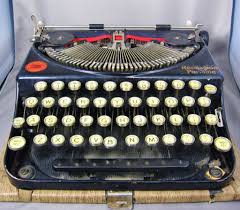
typewriter

The one piece of writing advice that everybody knows is to write what you know. Frustrated with the assignment and my inability to pen even a single word, I fell back on that old axiom. I’m blocked? Can’t crack this scene? Fargo it. And I wrote my character, a frazzled, frustrated guy, sitting white-knuckled and scruff-faced obstinately in front of a typewriter. (Yeah, yeah, I know, I have a thing about typewriters.) I had him struggle and hem and haw and make excuses and bang his head against the wall, and then, finally, he just gave up trying to be creative and wrote a crappy, cliched little scene. Nothing special about it. Except that it appeared out of nowhere (the unexpected entrance, such as it was) and played out right in front of him. Taken aback at first, he spoke to the characters that suddenly existed right there in his crappy apartment. The newly created characters shared their thoughts (this setting sucks! I would never read that book! Why would I even say that to her?), he took their advice, and in a matter of moments he had figured out that the best way to write was to get the fargo out of the way and allow the characters to explore their own situation.

I thought it was crap. I mean, really, I was almost ashamed of it. So ashamed that I almost didn’t go to class the next day. But crappy though it was, I had enjoyed the taste of writing it, so I went. Naturally, the teacher (the inimitable Stanley Longman) called on me as one of the first to present. With sheepish disclaimers, I handed copies of the scene to three of my classmates, who took a few minutes to read over it before assuming positions on the stage. I heard them giggling as they ran through it and thought, great, it’s as terrible as I feared and now I’m going to be exposed for a hack. Then they read the scene, and the laughter continued; little snickers here and there, even a stray guffaw. Finished, the actors took their seats and I sat on the feedback stool, red-faced in front of everybody, and waited to be verbally crucified.

First hand raised, I called on a girl whose name I didn’t know at the front of the room. I’m paraphrasing, of course: “First of all, it was really funny. I loved the interplay between what we expected from his characters and what they really wanted for themselves.” Nods from around the room. Next up, a guy who sat near me and whom I’d collaborated with on an earlier exercise. “I recognize that struggle when I write,” he said, “it was cool to actually see it on stage. And it worked.”

The workshop continued. I got critical feedback as well as praise. But my professor’s comment stuck with me more than any of the rest. He scratched his head and spread his hands like a big grandfather gorilla. “The concept needs a little work, just to polish up the how-is-all-this-happening, and the why. An audience wants that. But it’s funny, you’ve nailed that. Those comedic elements are the hardest to pin down, and you’ve done it. Don’t you think?” He inclined his head past me toward the class, and there were vigorous nods of assent. He chuckled. “I loved it.”

That class was my favorite experience in my undergraduate years. Much though I loved that class, I got distracted from that scene and didn’t think about it for a few years. When I graduated and moved back home, I had the opportunity to work with my old high school and ended up taking the core concept of that scene — an author at war with his characters — and expanding it into a full length production. It went over like gangbusters, and, shock of all shocks, it played a role in my meeting with my wife (her mother saw the show, knew me from my work with a community theatre, and kinda-sorta shoved her in my direction).

Now, eight years later, that stage play is becoming a novel. And I feel the same fears in its formation that I felt in those days struggling with that seedling of a scene: that it’s contrived, that it won’t be funny, that it’s ultimately utter crap. But somehow, this time around, I’m not nearly so fearful as I was. Maybe it’s that I’m older and jaded and I don’t care what people think like I used to. Maybe it’s because I’m more confident now than I was then in the concept and my ability. Maybe it’s because I’m older and losing touch with reality and don’t know well enough to be properly nervous. Whatever the reason, it’s a nice reminder to myself that I’ve had success with this story once, and there’s no reason why it couldn’t happen again.

This post is part of Stream of Consciousness Saturday.

The Thunderdome of Ideas


How do you make sense of the ideas that occur to you?

I’m talking here about stories, lyrics, visions, hell, even blarg ideas. They come from somewhere, and whether that source is some external stimulus like a news story or a fantastic article or a brilliant film or a gripping novel, they all end up getting filtered through the mire of neurons and synapses inside your skull. Which means that from the time an idea first strikes, it gets tossed into the Thunderdome that’s raging inside your head at any given moment.

Maybe I should step away from the second person (pardon me, second person) and stick to the first (oh, hi, me). It’s a Thunderdome in my head. Many ideas enter. Few survive to be acted upon.

Seriously. It’s a wonder I can get anything done. I’m as scatterbrained as they come, so when a new idea strikes for me, it’s thrown into the arena with the other millions of things I’m thinking about, which include, but are not limited to:

  • My kids and whether I’ve remembered to feed them / change their diapers / change their clothes / clean up their messes / set a good example for them / actually know where they are at the moment / OH GOD WHERE ARE THE KIDS
  • The dollars and cents flowing through all the metaphorical holes in my metaphorical pockets (because money isn’t real anymore you know, it’s all just ones and zeros on some bank program and okay this is not a conspiracy theory blog) and all the stress associated with that.
  • The fact that it’s winter, and in the four winters we’ve weathered in this house, we’ve had pipes freeze and burst in the walls twice despite our best efforts, so does winter number five mean that nightmare is coming around again…
  • The kids have been quiet for a while, WHAT IS MY TODDLER DOING
  • The scent of burning that’s coming from somewhere and I can’t isolate it… is it the neighbors burning leaves? A car burning oil? The wires in the walls spontaneously combusting and preparing to burn the house down?
  • The theme song from Thomas the Tank Engine just keeps bouncing around in there for no good reason; it certainly isn’t helping me to focus. (Sidenote: “shunt” is a fun word that sounds dirty but isn’t–meaning to shove aside or divert–try using it at parties!)
  • How the balls did my kid dump an entire two pounds of dog food into the water bowl without me hearing it?

And that’s just the past, say, thirty seconds.

So any idea I’m trying to have, whether related to my current novel or any other prospective novel I may ever conceivably get around to writing if I ever finish this one, has to step into the steel cage death match with these other thoughts if it wants to win my focus long enough to be pondered, let alone written down and saved for later. And these other thoughts take no prisoners. They have nailbats and rusty crowbars and spiked shoes. That Thomas theme song carries around a friggin’ garrote in its pocket and will dispatch an interloping idea without batting an eye.

Somehow… somehow… some ideas make it through the riot of distractions and make it into the novel. I’m working on weaving in a particularly good one that occurred to me a few weeks ago while I was writing a blarg post about how I was stuck for ideas about how to improve my draft. Did it arise out of need? Was it the strongest of a series of weak, malformed conceptions of various other plot points I could have used instead, and the strongest survived? Or did it blunder through, catching the toddlers during a nap and catching that Thomas theme song looking the other way long enough to escape into daylight?

I have no idea where the ideas come from or how they get processed. I feel like if I did I’d be a tremendously better writer, and I could therefore avoid unnecessary and cumbersome adverbs in my prose, like “tremendously,” to choose a particularly egregious offender completely at random. Also egregious offenders: “particularly,” “completely,” and “egregious” (not an adverb but still offensive).

See, the idea to sidetrack into all that nonsense about adverbs came from somewhere, I decided it was a good detour to make and I made it. Somebody (even if that somebody is me) sent that message, and somebody (probably me) received it and acted on it.

Where does that impulse come from?

Is that my authorial text-transcending through-line? Is it an undercurrent of subconscious thematic tendency? Or did whoever’s pulling the strings in my writerly Thunderdome take pity on the adverb idea and give it a set of poison-tipped spiked brass knuckles to help it in the fight?

I fear this is one of those unknowable things that philosophers might struggle with through the ages, though they’d perhaps do it more eloquently than with Thunderdomes and brass knuckles. And they’d certainly steer clear of Thomas the Tank Engine and any associated theme songs.

This post is part of SoCS. This week’s prompt was the diabolical homonym quartet of “sense / scents / cents / sent”, a series of words which basically describes why anybody learning English as a second language might end up banging his head against a wall. Because I’m a fool for pain, I used them all.

Shunt.

Rookie Move (or, why writers should keep pens and paper handy all the time, even when it’s impractical to do so)


One of the sort of take-it-for-granted bits of writing advice I once heard was, “make sure you’re always able to write something down.”  It makes sense.  If you believe in inspiration as I do (for the most part) then you know that it can strike you at any moment, without the slightest provocation, and that it can depart again with as little warning as it gave you when it arrived.  This is why, in my work bag, I keep a composition book and two pens at all times, no matter where I’m going or for how long.  It’s why I keep a stack of note cards binder-clipped in my back pocket and a pencil on my ear just about everywhere I go.  It’s why I keep a pocketknife ready to carve strips of flesh from my arm in the semblance of words I can later affix to a page, though I’m happy to announce I’ve not yet been reduced to that particular method of transcription yet.

Still, ideas sometimes slip through.  Occasionally I’ll have a brilliant idea strike my cerebellum only to bounce off like so many hailstones on the pavement.  Or, more often, something will seem earth-shatteringly clever to me as the thought strikes, but then when I try to articulate it, I realize it’s so foolish it doesn’t bear further thought.  Then there are the days when the fountain seems to dry up entirely and no amount of coaxing, cajoling, pondering or preening will make the ideas come forth.  It’s a crap shoot, in other words, whether the good ideas will get through or not, which is why it’s doubly important to always have the net ready to catch them before they crater in the vast depths of the ideas I will never write.

Let me back up.

The wife and kids and some extended family and I were all on vacation in a fairly swanky condo in Florida over the weekend.  I mentioned it last time, and then in a dutiful showing of a man on vacation, I didn’t write again until today.  Anyway, I had to come back for work, but my wife and kids stayed on and are staying on for a few more days of sun and surf (NOT THAT I’M JEALOUS OR ANYTHING), which means I’m at home by myself for a few days.  No kids.  No wife.  No distractions.  Perfect conditions to get some writing done.  And I did, and I plan to, and night one was brilliant and night two is shaping up just fine so far.

But at night the monsters come out.

Routine is a powerful thing, and when your routine is shattered, it tends to snowball out of control, like a tiny crack in your windshield spiderwebbing like a mutant octopus every time you hit a bump in the pavement.  With no kids, there is no bedtime.  With no wife, there is no meditative glass of wine before the bedtime I don’t have.  I found myself in bed at the appropriate time last night but unable to get to sleep for lack of the vague comforts that knowing your children are asleep in the next room can bring.  No warm backside to press my cold, bony toes into.  The actual night part of last night was, in short, all wrong.  In addition to staying awake for an hour and a half before sleep took me, I woke up of my own volition several times in the night: something I never do (if only because the kids will make noise and wake me up before I ever have the chance to wake myself).  But something else happened unexpectedly in the night: inspiration struck.

It struck with the illumination and voltage of a 1.21 gigawatt lightning strike direct to my cortex, and unfortunately departed just as quickly.  Because for all my various preparations and eventualities for capturing the most fleeting of writerly ideas during my waking hours, I’ve somehow never had the good sense to stash pen and paper next to the bed.  I just don’t get great ideas at night (or if I have, I’ve forgotten them).  But inspiration struck hard and fast enough to wake me and make me think, “gosh golly, I should really write that down,” which lasted me roughly until I remembered that I didn’t have pen and paper at bedside, and I’m sorry, but I’m not one of those writers who is going to huddle over and mash my latest screenplay snippet into my phone with my mutant monkey thumbs.  I’m just not.  No, the inspiration struck, and I realized I had no way to write it down, and I assured myself that this idea was so good, so inescapably awesome, that I would surely remember it in the morning.

So here I am, grasping at the straws that may once have stuffed its scarecrow, but which more likely were the bed for some flea-bitten ox with a penchant for pooping literal poop rather than the brilliant story ideas I might prefer it to poop.  I know it involved either Sherlock Holmes or some Holmesian character.  I’m pretty sure there was genetic modification involved.  There may have been a jetpack.  Also a rhinoceros on a train.  But it’s all one big useless jumble.  No more good to me than the vague idea that I really should have gotten up early and gone for a run today.

Lesson learned.  Paper is going on the bedside table tonight, where it will probably lie untouched until, months from now, I wonder what the hell I put paper on the bedside table for, and move it back downstairs where it belongs.