The Long Con


I’ll be honest, as I’ve been in the past: I have no idea what I’m talking about. I’m making this all up as I go along. All of it. Life. Fathering, writing, teaching, running, husbanding… you will find no stores of expertise here, and precious few pearls of wisdom in a heap of dusty crumbs of idiocy. But you’ll also see that that doesn’t stop me from pretending.

I use this blarg all the time to talk about things I pretend to know a lot about. I dispense all sorts of marginally intelligible writing advice, I wax eloquent about the virtues of distance running, I tell funny stories about baby poop that hint at, but never actually deliver, profound lessons about life. Why bother doing all this, when I’m not actually a writing guru, not actually a running yogi, not actually a SuperDad?

Because I want to be those things.

But here’s the trick: you don’t get to flick a switch and start being those things. The road from where you are to where you want to be is beset on all sides by the iniquities of the weak and the tyranny of evil men. (Or maybe that’s only if you’re Samuel L. Jackson.) Oh, you want to write? There are thousands of writers out there. What makes you think you’ll make it? Good point, you think, and give it up, wisely saving your efforts for more productive endeavors. Oh, you want to start exercising? What’s the point? Most people fall short of their exercise goals and give it up anyway; you might as well hang it up now and save yourself the heartache. Too right, you think, and cancel your gym membership.

But where do those voices of doubt and dissent come from? Sure, there are haters out there that will poop on your dreams and ask you to thank them for it, but the louder, more convincing voices are the ones in our own heads. I know I can speak for myself when I say I’m my own worst critic. The voice in my head that tells me I can’t do things speaks like Morgan Freeman with a 50,000-watt station broadcasting down to the very marrow of my soul. It’s overbearing, constant, undeniable. How do I overcome it?

By pretending.

I’m not an expert writer, but I can pretend to be one. And I can bang out over 1,000 words a day on average despite my full-time job and part-time daddy duties as if I were an expert writer. And I can shovel out advice like a steamshovel about my experience and pretend to know what I’m talking about to give the illusion that I actually do know what I’m talking about. Because that’s what experts do. They look confident. They walk the walk and talk the talk. You wanna be that thing? You have to start doing the thing.

Nobody’s born a brilliant novelist. No athlete pops out of the womb running ultramarathons. The people that do those things have the same voices of doubt that you or I have. The human experience, for all its vast variations, striations, complications and salutations (whatever, I ran out of good rhymes), is actually pretty standard. We get a life, we get some challenges, and we either overcome them, or we don’t. If you want to get ahead, you have to learn to be a con man.

But not so that you can run a swindle on some unsuspecting rubes. (Though I guess that helps, too.) The con you want to run — the long con that you work for years and years — is on yourself. You have to fool that inner voice of doubt into believing that you’re not to be doubted anymore. You have to fake it til you make it. That means pretending to be the thing you want to be, every day, in public and in private, until one day it’s no longer a con and you are that thing.

Wanna be a writer? Write buckets of garbage. Drivel, drivel, drivel. Pile it on and pile it on and write boring stories and hackneyed narratives and cliched tripe and nonsensical dialogue until one day, when you’re not even thinking about pretending to be a writer anymore, you’re simply writing because that’s what you do now, you write something and it’s not half bad, and your inner voice of doubt will say, as if you’ve just demonstrated that the world is not, in fact, flat, as he previously believed, “oh. Well… I guess that makes sense, then.” And BLAM KAFIZZLE, you’re a writer.

Wanna be a runner? Get outside and run until you can’t anymore, and then stop and walk home. Then do it again. And again. And again and again and again, until you can run for a mile, and then for two miles, and then one day you’ll be out for your daily torture session, except you’ll realize it’s not actually torture anymore, it’s rather enjoyable, come to think of it, and you’ll start looking forward to those runs. And when people ask you what you’re doing this weekend you’ll respond airily, with a casual wave of your hand like you’re just going out for eggs, “oh, I’m going out for a 10k this morning,” and they’ll be all like “whoa, you’re running in a race?” and you’ll be all “no, that’s just what I do — I’m a RUNNER NOW.” And you’ll stomp on their toes for emphasis. Or maybe not. The stomping is optional, though it sends a good, strong message.

Point is, all the old adages are true. If you believe you can or you believe you can’t, you’re right. A thing always seems impossible until it is accomplished. You have to fake it until you make it.

The power of sticktoitiveness (not a word, but yeah, totally a word I love) cannot be overstated. If you wake up every morning determined to accomplish a thing, and then take the steps and do the work necessary to take one step on that journey EVERY DAY, you can get there.

But what do I know? I’m not an expert.

I’m only pretending to be.

This post is part of Stream of Consciousness Saturday.

How to Crush your Saturday Morning (a guide for schlubs)


At its heart, this blog is a journal. A daily (more or less) recounting of what’s front-of-mind. I dispense a fair bit of advice on this blog, much of it about writing and parenting, but occasionally, I like to step out of my comfort zone and write about things that I probably shouldn’t, and today feels like one of those days. The flavor du jour?

Saturday morning.

As a guy not so long out of his twenties, more or less recently become a father, and still very much making it up as I go along, it occurred to me not long ago that I was really screwing up my Saturday mornings. I used to think Saturday morning was the initiation of the weekend, and that meant sleeping as late as you possibly could, then slothing around the house until you could no longer put it off. But the older I get, the more I feel that Saturday is just another day in which lots of things have to be done. Maybe it’s the grocery store. Maybe it’s your kids’ soccer games. Maybe it’s a crapton of yard work. (Ha ha, I don’t care about my yard, score one for me.) And as the health organizations have been telling us, what’s the cornerstone of a good day? Breakfast.

Problem is, if you’re like me, you learned how to do Saturday morning lazy, and you don’t know how to bridge the gap. You end up eating cold cereal or leftover pizza instead of eating proper breakfast fare. Maybe you don’t know how to cook. Maybe you’re crap at time management. Let’s work on that.

I’m no master chef, but I do believe that anybody can learn to cook one or two basic things and then parley that knowledge into fleecing people into believing that you know how to cook. And the easiest place to start? Breakfast. Why breakfast? First of all, it’s simple. Breakfast doesn’t have a lot of options as far as cooking goes. Eggs, bacon, pancakes, toast… You branch out from there, but those are the basics. Secondly, eggs are super cheap, so while you learn to cook ’em, you won’t be breaking the bank (because, let’s be honest, you WILL screw up a few times). Third, who doesn’t love a hearty eggs ‘n bacon breakfast? Nobody, that’s who. You’ll be a hit if you can serve up some tasty eggs and bacon in the morning.

So, for those guys (and gals!) like me, who are totally lost when it comes to cooking and starting your weekend off right, I want to share with you my method for CRUSHING your Saturday morning in just about thirty minutes. This is especially designed for guys (or gals!) who have a significant other and/or kids they need to feed first thing in the morning, but you know, you can scale it to your needs.

So, get your eggs and bacon ready.

Step 1: Preheat the oven to 400 or so.

Purists will say bacon should be cooked in the pan. Nonsense, I say. I learned about cooking bacon in the oven about two years ago and I’ve never looked back. Bacon in the pan requires constant attention, lots of turning, and I always ended up with raw bits and blackened bits on the same piece. In the oven it’s picture-perfect every time, and the slow cook of the oven frees you up to do other things.

Step 2: Dishes (first time).

Oh, you’re one of those who unloads the dishwasher as soon as it’s done washing? YOU DON’T NEED THIS GUIDE. Look, doing the dishes is a chore, and it’s best done when you have nothing better to do, which is almost never. But now, you’re waiting for the oven to preheat, so take those five minutes or so to clear that thing out. It’s full of the dishes you ran last time, and you’re going to need the space in a minute… stop putting it off and unload those dishes.

Step 3: Bacon in.

Line a cookie sheet with tinfoil (you’ll thank me later) and lay the bacon in. Cooking time will depend on how thick your bacon is, but the sweet spot for me has been about 19-20 minutes at 400, depending on how crispy you like it. If in doubt, start checking it as early as 15 minutes. Set your timer and forget about it.

Step 4: Dishes (second time).

Oh, you’re one of those who washes dirty dishes the moment they’ve been used and leaves your sink empty at night? YOU DON’T NEED THIS GUIDE. Seriously, who feels like doing dishes right before you go to bed? You left them in the sink just like I did; don’t pretend you’re fooling anybody. That bacon needs 20 minutes to cook and you’ve got ten minutes before the next step starts; might as well dive in. You just emptied the dishwasher, and a dishwasher isn’t happy unless it’s full of dishes. MAKE YOUR DISHWASHER HAPPY.

Step 5: Prep the eggs.

Get your skillet on medium heat, and, if you prefer, get the butter out. I prefer bacon grease, but use whatever brings you the most joy. Now, if you don’t mind the idea of flavoring your food with the grease of delicious pigs, follow closely. Pull the bacon pan from the oven (there are probably about five or six minutes left, you might want to check and see how it’s doing anyway), and tilt the pan slightly. A bunch of grease will run down the pan; use a spoon and scoop a bit of it into your skillet. I like a teaspoon for 2-3 eggs, both to grease the pan and to make the eggs taste like literal heaven on a fork. Adjust as necessary; 2 eggs per person is usually pretty reasonable. Me, I like eggs, so I go for a little more. If I’m feeding myself, my son, and my wife (the infant is still on baby food), six eggs does the job pretty perfectly.

Step 6: Eggs in.

Yolks or not depends on taste and cholesterol needs in your household, but you cook them the same either way. You have to experiment with your stove to get the cook time right, but for me, eggs in any form take no more than 3-4 minutes in the pan. (If you’re keeping track of the time, you see what’s developing here: the eggs should finish up within a minute or two of the bacon.) Start with scrambled eggs, and you can get fancier with your prep as time goes on. If in doubt, scrambled eggs are done when they’re firmish and still glistening. When they lose their glisten, they’re getting dry. I’ve heard that you shouldn’t season the eggs until late in the cooking process because the salt can screw up the flavor if it goes in while the egg is raw, but I’ve never been so sensitive to the taste to notice the difference. Also, if you know that much about seasoning, again, YOU DON’T NEED THIS GUIDE. Anyway, I like to season once the eggs start to firm up just a little bit, but you know, figure out what works for you.

Step 7: Toast (optional).

Yeah, carbs are the devil. I’ve stopped taking toast with my breakfast, but toast is easy enough. Pop it in about the time you get the eggs in the pan and you’ll be fine.

Step 8: Plates.

If you timed it right, the timer’s going off on the bacon within about a minute of the time you’re pulling your eggs off. It’s ideal if the bacon’s done first so that you can get it on a plate to cool and pat some of the grease off first, but that’s not a deal breaker. Anyway, spatula the bacon onto a plate lined with paper towels to draw some excess grease off. While it’s draining, spoon the eggs onto plates (along with the toast, if you made it). Serve, and enjoy.

My plates look nothing like this. Who cares? If it’s delicious (and it will be), nobody cares. And if you put that green thing on your plate for breakfast at home, I’ll kill you.

Step 9: Dishes (last time).

Remember how nice it was having a clean sink about halfway through this process? It was glamorous, right? Well, now you’ve got all these dishes from your cooking adventure mucking up that canvas. Don’t go into Saturday with dirty dishes hanging over your head. Take the five minutes and finish up; that egg skillet will never be easier to clean than right after you cook with it — leave your dishes and that egg residue turns into lacquer. Know what lacquer is? They used it to protect paintings back in the day because it doesn’t wash off. Clean it now, before it sets.

Step 10: Enjoy the rest of your freaking day.

See that? Do you see what just happened? You fed your family, cleaned up after yourself, ate a hearty breakfast, and demonstrated your role as provider and master of the house, and now you get to carry that feeling of accomplishment with you for the rest of the day. You feel like a boss, right? And it only took you thirty minutes. For bonus points, next weekend, do the same thing all over again, but this time, get up before everybody else so that the aroma of your boss-cooked bacon hypnotizes them to walk dreamlike down the stairs for the breakfast you have waiting for them.

Now your schedule is all cleared for that SVU marathon you’re totally going to end up watching instead of fixing the toilet like you were supposed to do.

This post is part of Stream of Consciousness Saturday.

De-Grumpified


How do you measure a day?

For the longest time, I’ve been a Grinch about virtually every holiday. Christmas, Halloween, Thanksgiving, Valentine’s… you name it, I can give you a good reason to hate it.

Christmas? Over-commercialized. Flimsy reason for overspending and going into debt around the same time every year. Based loosely off some religious gobbledygook wrapped around a Russian mythology that bears virtually no resemblance to the fat man in the sled who apparently runs the show these days. Pure invention, for the sake of blackmailing kids into being good for a few months out of the year. Can it.

Halloween? If you feel the need to disguise yourself once a year, to let your “wild side” or whatever out of your system, you probably aren’t living your life right. If you’re an adult and you’re dressing up for a halloween party, you missed the memo that it’s time to grow up. If you’re a kid and your parent is driving you around to trick or treat, you’re doing it wrong… in my day we WALKED house to house. If you’re a teenager… get off my freakin’ lawn. Also, a poor excuse for making me buy a bunch of candy that I’m going to have to eat later.

Thanksgiving? Yeah, does the rest of the world need a signifier that we Americans take things to excess? So we have a holiday for the express purpose of eating ourselves into comas. Pass the gravy and the weird uncles, and I’ll be in the corner nibbling on cornbread until the in-laws are strangling each other over political issues.

Valentine’s? The canned argument is that if you need a specific day to show your special somebody that you love them, you’re doing it wrong. But I won’t even go there. I’ll fall back on the fact that this one is another one that’s pure invention, and who can stand all that red and pink? And, for that matter, the overnight megainflation of flower stock. Racketeering sanctioned by the people.

The list goes on, but you get the idea. I don’t go in for holidays or birthdays or any of that. My wife hates it, but I can’t help it. Any holiday is just a futile attempt to add significance to an otherwise insignificant day, a way to add punctuation to another year.

Uplifting, right?

But our son is three this year. And our daughter is coming up on one.

And… dammit, everything is different. I find my Grinchly armor cracking at the seams, I feel the warmth of caring and celebration clawing its way into my cold, cold heart. Like… okay, this year was the first year he really cared about Christmas at all. In years past it was just a pile of toys that he got excited about for a few hours and then forgot about. But this year, he freaked out about Santa, and he jumped up and down on the morning of and he was talking about Santa Claus all day, and … god, it warmed my heart.

A chink in the armor.

And today, Easter.

Say what you want about religious connotations, but Easter is another holiday that’s had America’s grasping capitalist claws rending at it. The bunny, the chocolates, the eggs… honestly it sounds like one big acid trip if you ask me. Ridiculous. Ripe and ready for my scorn. And scorn it I have, and did this year, too… right up until about 11 AM this morning.

Why 11 this morning? Well, at 11 this morning I found myself in the midst of this seething throng of humanity…wpid-20150404_114802.jpg

… and if you know my thoughts about holidays in general, it should come as no shock at all that I really don’t much care at all for being around crowds like this. People are at their worst in crowds. That herd mentality sets in, and all of a sudden you don’t have individuals making clear decisions on their own merits, you have a mob in the ragey throes of pack logic.

But today was Easter, and my mother had the great idea to take the sprouts to this big Easter Egg hunt, and, well, there we were. And there were moments — several of them — when I wanted to bail, to take my kids and get as far from this manufactured mass of pastels and candy as possible. But we went through with it.

And you know what?

The kids had a great time, and that’s all that fargoing mattered. Who cares if their grumpy dad was uncomfortable with the crowds, if he was inwardly sneering at all the colors and smiling faces? Who cares that the parking was a nightmare, or that my son wimped out on the bouncy slide we waited five minutes to get him on, or that the sno-cone we bought him cost two freaking dollars? (TWO DOLLARS. FOR ICE AND SUGAR WATER. It still hurts me.) He came back talking about doing more Easter hunts, and his face was illuminated with the joyous glow that I can only dream of having in my own cranky old disillusioned soul. I will never in my life feel the joy that permeated his being and exploded from his every pore at the simple happiness of the balloon handed to him at the tent operated by the local Plumbing group, except for the joy I can feel vicariously through him. I even grinned at the simple but pure greed of sprout #2, who was too young to know what was going on, but not too young to go back for one taste after another of the delicious purple ice I offered to her.

This is my wife’s fault. She’s known all along that there was more to these occasions than I ever allowed myself to believe, and she staunchly held her ground against my protestations that we shouldn’t bother celebrating any of them all these years. As is so often the case, she gets to have the last laugh now.

wpid-20150404_114823.jpg

It was a day I should’ve hated, but it was the best Easter I’ve ever had. And there must be something seriously wrong with me, because I’m thinking it wouldn’t be a terrible idea to do it again next year.

This post is part of Stream of Consciousness Saturday.

An Idea is Born


The stream of consciousness prompt this week is “scene/seen”, and that feels like kismet. Because if you’ve spent any time around my blarg, you know that one of the things that’s been front-of-mind for me over the last year or so is my novel. And I think so much about what the novel is and what it may yet be that it’s easy to forget what it once was, which was a dumb little scene I wrote for a playwriting class I took in my fourth year at UGA. I say dumb not because I thought that scene was bad (though if I read it again I might have to reconsider that assessment), but because I wrote it almost as a throwaway. We’d been in the class for maybe three weeks, were still learning the ropes, and this assignment was an easy one to get us thinking outside of the box a bit.

“Have a character enter your scene from somewhere unexpected.”

Were you to give me that prompt now, I’d have a hard time deciding which outlandish entrance to use. I’d have somebody come crashing through the window or the ceiling. I’d have an escaped prisoner tunnel up through somebody’s living room floor. I’d have a reincarnated Elvis enter from the bathroom in a cloud of psychedelic lights and smoke. (Okay, so I stole that Elvis entrance from Steve Martin’s Picasso at the Lapin Agile). The problem would not be “how do I write this scene,” the problem would be “how do I choose?”

But at the time, the prompt stymied me. It wasn’t that I couldn’t think of strange entrances — I could — but I couldn’t think of a way to justify any of them. The idea would strike, but I wouldn’t know how to connect it to anything meaningful. Even as I write that, I find myself shaking my head — it was just an exercise scene, it didn’t have to connect to anything meaningful! — but I was stuck. Stuck, stuck, stuck. I sat in front of my computer staring at a blank page for the better part of an hour, unable to write this scene, too nervous to take a chance.

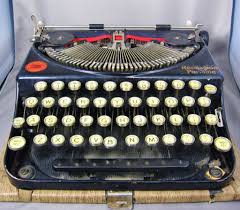
typewriter

The one piece of writing advice that everybody knows is to write what you know. Frustrated with the assignment and my inability to pen even a single word, I fell back on that old axiom. I’m blocked? Can’t crack this scene? Fargo it. And I wrote my character, a frazzled, frustrated guy, sitting white-knuckled and scruff-faced obstinately in front of a typewriter. (Yeah, yeah, I know, I have a thing about typewriters.) I had him struggle and hem and haw and make excuses and bang his head against the wall, and then, finally, he just gave up trying to be creative and wrote a crappy, cliched little scene. Nothing special about it. Except that it appeared out of nowhere (the unexpected entrance, such as it was) and played out right in front of him. Taken aback at first, he spoke to the characters that suddenly existed right there in his crappy apartment. The newly created characters shared their thoughts (this setting sucks! I would never read that book! Why would I even say that to her?), he took their advice, and in a matter of moments he had figured out that the best way to write was to get the fargo out of the way and allow the characters to explore their own situation.

I thought it was crap. I mean, really, I was almost ashamed of it. So ashamed that I almost didn’t go to class the next day. But crappy though it was, I had enjoyed the taste of writing it, so I went. Naturally, the teacher (the inimitable Stanley Longman) called on me as one of the first to present. With sheepish disclaimers, I handed copies of the scene to three of my classmates, who took a few minutes to read over it before assuming positions on the stage. I heard them giggling as they ran through it and thought, great, it’s as terrible as I feared and now I’m going to be exposed for a hack. Then they read the scene, and the laughter continued; little snickers here and there, even a stray guffaw. Finished, the actors took their seats and I sat on the feedback stool, red-faced in front of everybody, and waited to be verbally crucified.

First hand raised, I called on a girl whose name I didn’t know at the front of the room. I’m paraphrasing, of course: “First of all, it was really funny. I loved the interplay between what we expected from his characters and what they really wanted for themselves.” Nods from around the room. Next up, a guy who sat near me and whom I’d collaborated with on an earlier exercise. “I recognize that struggle when I write,” he said, “it was cool to actually see it on stage. And it worked.”

The workshop continued. I got critical feedback as well as praise. But my professor’s comment stuck with me more than any of the rest. He scratched his head and spread his hands like a big grandfather gorilla. “The concept needs a little work, just to polish up the how-is-all-this-happening, and the why. An audience wants that. But it’s funny, you’ve nailed that. Those comedic elements are the hardest to pin down, and you’ve done it. Don’t you think?” He inclined his head past me toward the class, and there were vigorous nods of assent. He chuckled. “I loved it.”

That class was my favorite experience in my undergraduate years. Much though I loved that class, I got distracted from that scene and didn’t think about it for a few years. When I graduated and moved back home, I had the opportunity to work with my old high school and ended up taking the core concept of that scene — an author at war with his characters — and expanding it into a full length production. It went over like gangbusters, and, shock of all shocks, it played a role in my meeting with my wife (her mother saw the show, knew me from my work with a community theatre, and kinda-sorta shoved her in my direction).

Now, eight years later, that stage play is becoming a novel. And I feel the same fears in its formation that I felt in those days struggling with that seedling of a scene: that it’s contrived, that it won’t be funny, that it’s ultimately utter crap. But somehow, this time around, I’m not nearly so fearful as I was. Maybe it’s that I’m older and jaded and I don’t care what people think like I used to. Maybe it’s because I’m more confident now than I was then in the concept and my ability. Maybe it’s because I’m older and losing touch with reality and don’t know well enough to be properly nervous. Whatever the reason, it’s a nice reminder to myself that I’ve had success with this story once, and there’s no reason why it couldn’t happen again.

This post is part of Stream of Consciousness Saturday.
Newton’s Laws of Writing


A while ago, there was this guy.

He sat under a tree for a while — a really long while — until eventually the tree sharted an apple on his head, and instead of just finding a different tree to sit under, this enterprising fargoer went and derived the laws for all freaking motion in the universe from that one little incident. I’m pretty sure he also went on to invent some awful cookies, although the real depth of his genius might be measured by the fact that he convinced people that those little bits of sandpaper wrapped around pseudo-fruit-filling were cookies in the first place, and not, in fact, aardvark turds rolled in discarded cicada husks.

But yeah, his more important contributions to the world were probably the three laws. But what Newton didn’t know (or at least, I have on good authority from this absinthe fairy that’s twinkling around the room at the moment) is that the three laws apply not just to the motion of things in the universe, but they apply to everything. And that means they apply to writers, too. I’m one of those, so here’s how it works:

First Law: An object in motion tends to stay in motion. That’s inertia, which is married to momentum, which is a concept I’ve found myself a little … obsessed is too strong a word … we’ll say “fixated” with here on this blarg and in my writing journey. I’ve written about it a few times before. In the universe, it means that if, say, you’re a planet hurtling through space, you will continue to hurtle until an asteroid many times your size smashes into and pulverizes you in a gigantic horrifying cosmic fender bender, or until a burgeoning sun swallows you up like the gnat I swallowed on my run this morning. To writers, it means that it’s easy to keep writing as long as you keep doing it. In other words, if you’re writing, and you want that writing to turn into something other than pointless scribbles in a forgotten word document, you have to forget the excuses and make sure you write a little bit, like, every day. Or at least almost every day. You’re only human, after all. Unless you’re a planet, in which case, I’d love to read your autobiography, except maybe try writing it in English instead of the eldritch tongue of star screams and soul-tearing that you probably write in.

Second Law: Look, the metaphor falls apart here in the middle. This is a stream-of-consciousness post, okay? I only planned it so far. I’m going to be honest. I remember the 1st and 3rd laws of motion from high school physics but I had no idea what the second law was. So I googled it, and found some highly technical descriptions of it, and then I got smarter and wikipedia’d it (is wikipedia’d a valid verb? It should be) and I still couldn’t figure it out. Essentially it’s about force and acceleration (F=ma) and all this other sciencey stuff I can’t be arsed about as a purveyor of fiction and dubious thoughts about writing. How does it apply to writing? Fargoed if I know. Let’s play acronyms. Freaking metal, always. Funky math: avoid. Fight me afterwards. Let’s just forget I talked about the second law. I was just killing time until I got to the 3rd law anyway.

Third Law: For every reaction, there is an equal and opposite reaction. This law explains why people get black eyes from shooting guns, or so I’ve heard. And why, when you’re walking barefooted across the carpet that was harmless before you had kids, a Thomas the Tank Engine figurine can stab upwards with all the force of an icepick wielded by an angry yeti into your tender underfoot. But, see, this one is great with writing, because it works in a couple of different ways. First, there are days when the writing resists you, and the harder you lean your shoulder into it the harder it leans back, unmoving, until you collapse at its feet, sobbing and gibbering about your inadequacies. By the same token, of course, if you don’t try to force the writing — if you write what needs to be written rather than trying to force words that don’t fit — then the whole task becomes ridiculously easier, and in fact, your story can end up working with you rather than against you. Second (and I’m twisting the law harder than a kid I knew in seventh grade, who shall remain nameless, delivering a purple nurple) it means that for every good day, there’s gonna be a bad day. For every day that the words and ideas and plots and characters flow from your fingertips like so much cosmic radiation pouring off of the sun, there will be a day that finds you as productive as my old and worthless cat who just keeps swatting at my ankles and crapping on the carpet. For each brilliant idea that seems to solve all the problems in your story at one fell swoop while choirs of angels sing in the background and golden sunlight suffuses the whole, you will lay an egg from which hatches a deformed, pitiful, limping abomination that squeals pitifully to beg for narrative death. You have to learn to ride the wave when the 3rd law is flowing in your favor and weather the storm when it isn’t.

Writing is a fickle mistress. Luckily, if you are up on Newton’s laws, you can predict some of her irrational moods and get out of the way when she comes at you with a knife. Of course, if you were thinking, you wouldn’t have written a razor-sharp butcher knife into your third act for her to use in the first place, but NO, you just had to have it there for “dramatic tension,” didn’t you?

Oh, THAT’S what the second law stands for.

Female Machete Assassin.

Yeah, that makes perfect sense. We’re going with that. Newton’s 2nd law for writers: Female Machete Assassins. Include them in your stories. Or avoid them. Or something.

socs-badge

This post is part of Stream of Consciousness Saturday. This week’s prompt was “opposite.”