The Summer Rhythm


Teaching is weird.

Don’t get me wrong, it’s great; having those two months off during the summer is fantastic, and it’s enviable to people who don’t work in education. (It’s maybe the only enviable thing about the job, but hey, you take what you can get.) And I’m certainly not complaining about the time off: that time translates into lots of opportunities to sleep in, go running during earthly waking hours (during the working months I’m out there before the sun is up, which has its own sort of ethereal calm about it but also sorta makes me feel like a vampire  — NO I MUST AVOID THE SUN), be a dad who’s actually present in his kids’ and his wife’s lives, check out some horrible daytime television.

Problem is, when I’m working, I have this routine, and over the summer, that routine is shattered. Not just shattered, but then stomped on by little toddler feet and flung at my face by little toddler hands and then not only do I have to deal with the shards of shattered routine embedded in my corneas, I also have to stop the toddler and the infant from swallowing the broken pieces and…

By the way, can you still call a three-year-old a toddler? It seems idiotic to do so, all of a sudden, since “toddlers” are named for their toddling, that wobbly, baby-goat stumbling gait that’s the hallmark of an uncoordinated, top-heavy biped learning to walk. But sprout #1 is well past wobbling. He can still lose his balance and go crashing into a table edge or fall down the last stairs, bouncing off like he’s made of rubber, but when it comes to walking, running, galloping, skipping… I mean, he’s mastered it. So he’s not toddling anymore, but what is he? Still too little to be a boy, I think. Is there a word for that? Fargo, the kid is going to be in preschool next year. Look, let’s just dial the clocks back a little bit…

Okay, enough of that sentimental diversion. (Seriously, though. Kids grow up FAST.) I was talking about routines and how over the summer my routine breaks down worse than my old Chevy Malibu (god rest its hunk-of-junk soul). I’m trying to find the routine for getting my writing done over the summer, because even though my 9-5 job is on a little hiatus, the writing dream NEVER SLEEPS, and its hungry maw must be fed a steady diet of word count, despair and whiskey.

Nice thing about doing my writing on and around the job is, there’s structure there. Typical work day: Wake up, exercise, get to work, do the teacher thing for four hours, break for lunch, write for about thirty minutes while pounding down a salad or a sandwich, do a lightning session of grading papers and planning the next day’s lessons, and write for another fifteen minutes or so before my last class of the day comes in. Patterns. Regularity. You can plan for that and the body adapts nicely to it, not unlike it adapts nicely to a bowl of raisin bran in the morning and a visit to the crapper in the afternoon. Easy to plan your day that way.

Over the summer, there’s no such luck. One day, my wife’s at work, so I’ve got the kids for nine hours, then a spot of cleaning and cooking in the evening, then it’s time for a glass of wine with a nice TV show in the evening, and then, whoops — it’s bedtime again. (Here my wife is rolling her eyes: “I still find time to get things done!” and that’s true, honey, you do. But you have superpowers, and I don’t, and it’s virtually impossible to maintain the focus needed to hold a narrative together when you’re constantly stopping to make sure the sprouts aren’t devouring a bucket full of chalk, or shaving the cats, or trying to feed your lunch to the dog, or taking markers apart to see how they work and then smearing the magic ink on their faces, or pretending to be dinosaurs and stomping all over creation and, again, eating everything in sight.) Next day, wife’s home, but we’re prepping for a yard sale. One minute we’re taking sprout #1 to Grandma’s house for the day, next minute we’re hauling stuff out of the garage, next minute we’re hauling stuff into the garage, a bit later on I’m off to the Home Depot to get some cleaning supplies, then it’s more sorting and prepping and cleaning and don’t forget changing sprout #2’s diaper and keeping her from sticking her fingers in it as you do so (her new favorite habit, and there go my wife’s eyes again because I think she actually cleaned more diapers today… again, she’s just better than me at handling that stuff promptly, whereas I’m maybe better at letting things be), then holy carp it’s time to put sprout #2 to bed and hey did we eat yet, no we probably should so it’s time to cook and whoops the sun is down, hey let’s go to bed. Which is a fine day, very productive and all, until I realize about 9pm SHARKNADO I forgot to write today.

Do you let it slip? Or do you gird your loins for battle and go in to do battle with the Word Monsters when all you really want to do is go to sleep to prepare yourself for the unpredictability that tomorrow will surely bring?

Problem is, as I may have mentioned once or twice before, momentum matters. I know that if I let the writing slip today, it’s twice as easy to let it slip again tomorrow (well, I missed one day this week, what’s one more — I can rest up and hit it properly next week), and so on and so forth until whatever dubious progress I’ve managed in this little endeavor is lying in a twisted heap at the bottom of the chasm, smoke pouring from its innards as I crawl toward the couch for a nap.

Anyway, I’m looking for that rhythm, that pattern that will let me get my writing done during these oddball summer months without feeling like I’m taking away time from the wife and kids. And yeah, I know these are totally first world problems, and I own that. But, privileged problems or no, when there are things throwing your life out of balance, I think it’s worth slowing down a little bit to see if you can work toward restoring that balance, rather than just riding it out. We humans, we seek the path of least resistance. Unfortunately, nothing worth having is easy.

So, the question: when your regular routine is thrown off, how do you make sure you get everything done? Technically I have more time than ever in my days now, but it feels like those hours just slip away.

Almost Didn’t Make It


socs-badge

Is there a sadder word in the language than “almost?”

I read this week’s stream of consciousness prompt — the word, almost — and my head began to fill with almosts. He almost won the gold medal, but his ankle snapped in the last hundred meters. She almost got the job, but they found out about her side business selling pygmies as house pets. We almost got married, but my ex showed up at the last minute, burned the church down, and impaled my bride-to-be with my collectible Wayne Gretzky hockey stick, broken off at the handle.

Almost is the language of failure, it’s a word of defeat. But it’s not simply a coming-up-short, it’s worlds worse than a didn’t-quite-make-it, it’s an age away from never-really-had-a-chance. Why? Because with the almost, you can taste the victory.

There’s something comforting in not reaching for the dream, in admitting to yourself that you don’t really have what it takes to even start down the path. The blankets on the bed are warm, after all, and these reruns of Law and Order, Criminal Justice Unit for White-Collar Executives who Only Get Slaps On The Wrist aren’t going to watch themselves. You never start down the path, you never really think of how victory might feel, so you never miss out.

Image result for couch potato

Or, okay, say you start; you make the resolutions, you block out the time, you hold fast for a few weeks, but then you bow out because it’s just too hard. That happens. Nothing to be ashamed of. This failure stings a little, because you “wasted” that time trying the thing, but it’s better to see you’re not cut out for it early than to change who you are, because change is fargoing scary. Nope, this one is a lesson learned, and that lesson is: stay home.

Right, so maybe quitting after just a few weeks isn’t your bag. You’re really determined to make this thing work this time, and you plug away at it for a few months or even maybe a year or so. Maybe even start to think it could happen. But you know what happens to everybody, eventually? LIFE HAPPENS. And work gets hectic, or you get that long bout of mono, or your deadbeat brother moves in, and god almighty, how are you supposed to deal with this thing that MUST be dealt with and that other thing you wanted to do? Something has to give, and we know what it’s going to be. At least you have something to blame this failure on, and blame is good, because you don’t have to own up to the fact that maybe it wasn’t that important to you anyway.

Which brings us to the almost. The saddest of the sad. Because with the almost, you do the work. You feel the change in yourself. You create or you achieve or you conquer or you otherwise get done the things you’re trying to get done, and little by little you gain on that big goal, that overarching thing that looked so monstrous when you first started, until it’s just a leap away… and then the catastrophe strikes. Broken ankle. Rejected manuscript. New guy gets the promotion over you. And you’re so focused on winning that you maybe don’t even realize that you’ve lost until the parade has started, and then it slowly dawns that the parade is not for you. How do you cope? How do you throw yourself at the wall again? How do you find the strength to go back to the beginning and start over?

But see… that’s one way to look at it.

The other way to look at it is that the almost is just a whisker away from the Mission Accomplished. The almost is one favorable gust of wind away from the parade being in your honor instead of the other guy’s. The almost is the difference between your boss or your book reviewer or your opponent skipping breakfast on the day that matters because he didn’t get a good night’s sleep instead of coming in with guns a’blazing. If you can get to the almost… well… how can you stop there?

I changed my mind from the beginning of the post. Almost isn’t the saddest word in the language. It’s maybe the most motivating ever.

What’s almost within your grasp? What have you almost achieved? And what’s to stop you from going back and trying it again?

Baby Steps


Writing is a journey, yeah?

You start off uncertain whether the two words you just committed to the blank page even belong in the same zip code with one another, or whether, like tinfoil and microwave ovens, their relationship is doomed before the heat even gets turned up. But you press on, smashing words together with the blithe indifference of the LHC, watching for sparks, looking for anything that resonates, and before you know it, you have a thing.

Maybe it’s a novel. Or a screenplay. Or a short story. Or a poem. Or a lyric. But you have this thing, born from the unfathomable space between your ears, and it’s raw and wriggling and it may or may not have a chance in this world, but it’s yours.

And at first, it’s all: whoa. I did that. I created this thing from nothingness. And you float on that godlike feeling for a while. But it only lasts for so long, because we’re talking about literature of one caliber or another, here, and literature is only as important as its audience decides it is. And that means that, first and foremost, what it needs is an audience.

But it’s not ready for an audience yet. Too many rough edges, too many unshapen limbs, too many vestigial tails. You shape it, you trim it, you coddle it in some places and you axe its redundant bits in others, never really knowing if you’re helping it or dooming it, only trying your best to give it a chance to breathe the air of this strange and indifferent world. Like it or not, eventually that moment comes, when it must leave the nest and survive or die trying.

The second draft of my novel is out today to three beta readers. The first was my wife, and as much as I love and appreciate her for reading my drivel, I can’t trust her feedback alone. She’s more or less obligated to tell me it’s good, and that I haven’t been banging my head against the keyboards of various computers for the last seventeen months for nothing. And I value her feedback, I do — she’s a hell of a lot smarter than I am — but I’m (hopefully) writing for an audience that’s larger than just my wife. And I’m not ashamed to tell you, even though I know these beta readers personally, I am scared sharknadoless to get feedback from them.

It’s odd. I am hoping that they’ll be impartial enough to give me the feedback that I need to better the story, but I’m terrified of what that feedback will be.

Still, it’s a necessary step in the process. In order to grow, we must shed our skins, leave behind the old uses that threaten to keep us from becoming the new and future uses. (That’s “us”es, not “uses”.)

Of course, that doesn’t make it easy.

Kid Art: In which my 3-year-old teaches me a thing or two about creativity


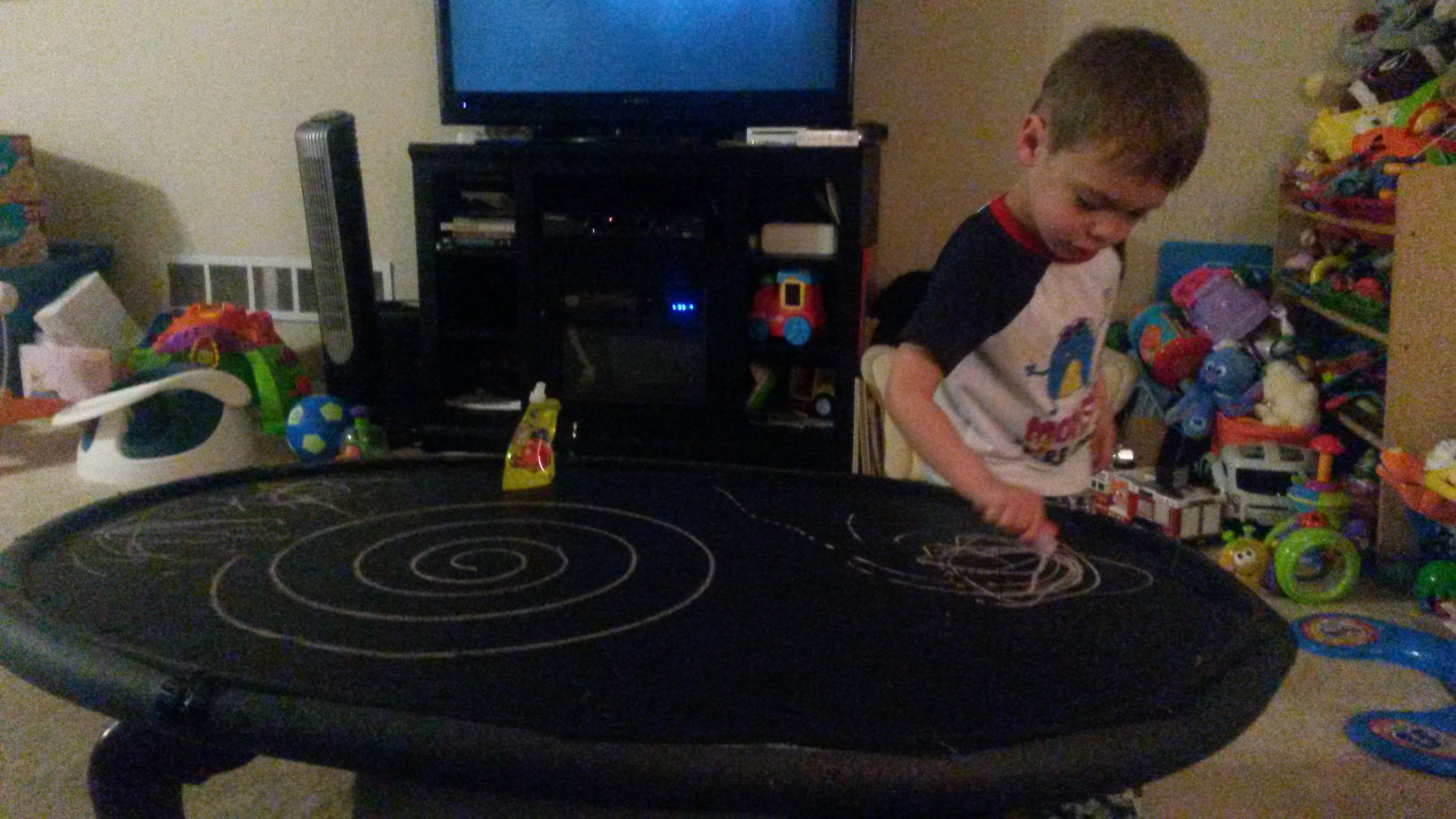
I’ve been sitting around for the past couple of days when I have a spare minute, watching my son playing with his new chalkboard table.

wpid-20150516_204505.jpg

Just a sidenote: if you have kids, and the kids are in any way artistically inclined, you owe it to yourself to make one of these. Just take any old crappy coffee table, go to Home Depot and buy a $15 can of chalkboard paint, lay down a couple of coats on top of the table, and let it dry overnight. Easiest and most rewarding DIY project I’ve ever undertaken.

Anyway, my boy has a dubious approach to the thing. He loves coloring but lacks any kind of… I don’t want to say the motor control, because he seems to be doing what he wants to do… what I’m trying to say is, the things he draws aren’t shapes I recognize from this universe. Everything looks like a sea urchin, or a squiggle, or maybe just one long shapeless line. He will draw these designs, over and over again, one on top of another, until the table literally looks like a bucket of chalk vomited all over it, then he will gleefully take a rag, wipe the table clean, and start anew.

The crazy thing is, he knows what he’s drawing. I can point to this squiggle, say “Sprout, what’s this?” And he will say, confidently, “apple.” Point to this two-foot-long wobbly line: “water fountain.” This wonky-looking unidentifiable polygon: “dinosaur.”

Which is, in itself, adorable and delightful; hours of fun just asking the boy what he’s drawn and trying to imagine how exactly he sees these things.

But it goes a level deeper.

Because sometimes, he’ll decide to draw something himself. “I going to draw a car.” Okay, sprout, go ahead. *scribble, scribble.* He works with such intensity sometimes that I find myself looking over his shoulder to see exactly how he’s going to describe the shape of a car. Of course he isn’t. It’s just a shapeless blob of color. But he will finish, stand back to admire his work, and say, “Oh, that’s not a car, that’s a banana.” And then go on drawing something else.

Or I’ll ask him to draw something. “Draw daddy,” I’ll say, and his eyes will light up with glee, and he’ll begin the painstaking, arduous work of outlining my bald head and bugging eyes and ha ha just kidding, he scribbles a little bug-splat of color, stands back and looks, and announces to me, “Oh, that’s not daddy, that’s blocks.”

This little game simultaneously cracks me up and creeps me out, because I know he knows his shapes from any of the myriad of little puffy books or kids’ youtube videos we’ve looked at together. He can identify a triangle without batting an eye, can tell the difference between a duck and a penguin, and knows his boats from his spaceships. He knows things. But he also has the ability to recognize his nonsensical artistic representations of these things as these things, despite the fact that the two bear no resemblance whatsoever to one another. And I know he’s not just making it up, because he can lay down five or six spaghetti-tangle pictures which he names as completely different things than he originally set out to draw, and then he can point to each one again and tell me what it is with 100% accuracy. And I’m sorry, if he’s just making this stuff up off the top of his head, I don’t think he has the wherewithal to piece together a fiction. I really think that to him, that squiggle somehow says, “dinosaur,” while this one says, “grocery store.”

It’s a nifty little parlor trick, I guess, for a three-year-old to be able to do, but I started thinking about the boy, and I started thinking about creativity and art in general, as is my wont, and then came the lightning strike moment. The moment where the mundane, not-at-all special and completely-by-accident whimsical actions of a toddler shake my preconceived notions of the world to the very roots.

How many times have I found myself banging my head against a moment in a story? A character who just doesn’t seem to behave the way I want him to? Or a fiddly bit of plot that just won’t jive with the pieces all around it? Or an element that I need for the story to move forward, but I can’t figure out how to work it into the story? Or, maybe, the problem is more intrinsic to the story: I’m trying to write a science fiction thriller but it detours into comedy, or I’m trying to write a lighthearted romantic-comedic bit, but suddenly things feel all melodramatic? I always talk about how stories have lives of their own, how the characters have drives and desires buried within them that are sometimes a surprise even to me, but I still find myself trying to force square pegs into round holes. No, the story is meant to be this way. No, I need to focus on this aspect of the plot now. No, I’m trying to send this thematic message.

But not my son. The art takes him in a new direction, he’s happy — even ecstatic — to detour and abandon the thing he thought he was working on. The story changes, he changes with it. He has no preconceived notions of what it should be, there is no consideration for creating the wrong thing. The thing he creates is fine by him, whether it’s what he set out to create or not.

And I think that’s pretty freakin’ awesome. Because when you don’t get hung up on the problems in your story, when you don’t wander off into the bog of unrealized expectations, you can process the project in front of you with the unbiased perception of… well, of a child. To a kid, things are what they are. And there’s nothing wrong with that.

The Long Con


I’ll be honest, as I’ve been in the past: I have no idea what I’m talking about. I’m making this all up as I go along. All of it. Life. Fathering, writing, teaching, running, husbanding… you will find no stores of expertise here, and precious few pearls of wisdom in a heap of dusty crumbs of idiocy. But you’ll also see that that doesn’t stop me from pretending.

I use this blarg all the time to talk about things I pretend to know a lot about. I dispense all sorts of marginally intelligible writing advice, I wax eloquent about the virtues of distance running, I tell funny stories about baby poop that hint at, but never actually deliver, profound lessons about life. Why bother doing all this, when I’m not actually a writing guru, not actually a running yogi, not actually a SuperDad?

Because I want to be those things.

But here’s the trick: you don’t get to flick a switch and start being those things. The road from where you are to where you want to be is beset on all sides by the iniquities of the weak and the tyranny of evil men. (Or maybe that’s only if you’re Samuel L. Jackson.) Oh, you want to write? There are thousands of writers out there. What makes you think you’ll make it? Good point, you think, and give it up, wisely saving your efforts for more productive endeavors. Oh, you want to start exercising? What’s the point? Most people fall short of their exercise goals and give it up anyway; you might as well hang it up now and save yourself the heartache. Too right, you think, and cancel your gym membership.

But where do those voices of doubt and dissent come from? Sure, there are haters out there that will poop on your dreams and ask you to thank them for it, but the louder, more convincing voices are the ones in our own heads. I know I can speak for myself when I say I’m my own worst critic. The voice in my head that tells me I can’t do things speaks like Morgan Freeman with a 50,000-watt station broadcasting down to the very marrow of my soul. It’s overbearing, constant, undeniable. How do I overcome it?

By pretending.

I’m not an expert writer, but I can pretend to be one. And I can bang out over 1,000 words a day on average despite my full-time job and part-time daddy duties as if I were an expert writer. And I can shovel out advice like a steamshovel about my experience and pretend to know what I’m talking about to give the illusion that I actually do know what I’m talking about. Because that’s what experts do. They look confident. They walk the walk and talk the talk. You wanna be that thing? You have to start doing the thing.

Nobody’s born a brilliant novelist. No athlete pops out of the womb running ultramarathons. The people that do those things have the same voices of doubt that you or I have. The human experience, for all its vast variations, striations, complications and salutations (whatever, I ran out of good rhymes), is actually pretty standard. We get a life, we get some challenges, and we either overcome them, or we don’t. If you want to get ahead, you have to learn to be a con man.

But not so that you can run a swindle on some unsuspecting rubes. (Though I guess that helps, too.) The con you want to run — the long con that you work for years and years — is on yourself. You have to fool that inner voice of doubt into believing that you’re not to be doubted anymore. You have to fake it til you make it. That means pretending to be the thing you want to be, every day, in public and in private, until one day it’s no longer a con and you are that thing.

Wanna be a writer? Write buckets of garbage. Drivel, drivel, drivel. Pile it on and pile it on and write boring stories and hackneyed narratives and cliched tripe and nonsensical dialogue until one day, when you’re not even thinking about pretending to be a writer anymore, you’re simply writing because that’s what you do now, you write something and it’s not half bad, and your inner voice of doubt will say, as if you’ve just demonstrated that the world is not, in fact, flat, as he previously believed, “oh. Well… I guess that makes sense, then.” And BLAM KAFIZZLE, you’re a writer.

Wanna be a runner? Get outside and run until you can’t anymore, and then stop and walk home. Then do it again. And again. And again and again and again, until you can run for a mile, and then for two miles, and then one day you’ll be out for your daily torture session, except you’ll realize it’s not actually torture anymore, it’s rather enjoyable, come to think of it, and you’ll start looking forward to those runs. And when people ask you what you’re doing this weekend you’ll respond airily, with a casual wave of your hand like you’re just going out for eggs, “oh, I’m going out for a 10k this morning,” and they’ll be all like “whoa, you’re running in a race?” and you’ll be all “no, that’s just what I do — I’m a RUNNER NOW.” And you’ll stomp on their toes for emphasis. Or maybe not. The stomping is optional, though it sends a good, strong message.

Point is, all the old adages are true. If you believe you can or you believe you can’t, you’re right. A thing always seems impossible until it is accomplished. You have to fake it until you make it.

The power of sticktoitiveness (not a word, but yeah, totally a word I love) cannot be overstated. If you wake up every morning determined to accomplish a thing, and then take the steps and do the work necessary to take one step on that journey EVERY DAY, you can get there.

But what do I know? I’m not an expert.

I’m only pretending to be.

This post is part of Stream of Consciousness Saturday.