
Metaphor Monday: Mr. Fix-It (Eventually)


How long does it take to fix a leaky faucet?

The google answer: About thirty minutes.

The real-life answer: Give or take, three to six months.

To elaborate, that’s: roughly a week to even properly notice the thing is leaking. About a month to get well and truly sick of it. An additional month (at least) to decide it matters enough to make time on a weekend to get around to fixing it. Half of a weekend spent watching youtube videos until you have enough confidence that you won’t flood the entire house to even begin the project. About thirty minutes to actually fix it. An additional couple of weeks to finish cleaning up the tools you used. (It might not actually be fixed, after all, and you might have to get back in there and re-fix it — so you might as well keep the tools handy.) And finally, an indeterminate number of months spent testing your repair every time you walk past it to make sure it’s actually fixed.

Or, if you ask my wife, how long does it take your husband to do a household project? Her answer will invariably contain the somewhat snarky, somewhat literal “does that include the six hours he spends watching youtube and staring at the thing to ‘think about it’?”

Okay, so I don’t set speed records for fixing things around the house. You could say I’m methodical. (You could say other things. I’m sticking with methodical.)

But the point is, for me at least, these things take time. Case-in-point: the slow drain in the bathroom. My sink was slow to drain. Had been since we moved in back in July. I noticed it immediately after my first shave in the new house, but it wasn’t that bad. In the intervening weeks, though, it got worse — to the point that the sink was taking close to a full minute to drain. Being the permissive sort, I was generally happy to let that go — it’s easy enough, after all, to just shave, pull the plug, walk away and get dressed, then come back to rinse out the bowl.

As much as I’m happy to let little things like this slide by in the day-to-day, on some basement sub-floor of my lizard brain, it irks me when things don’t work as they should. (Ask my wife how often I point out poor design — a drawer that opens into the path of another, or a cabinet hinged on the wrong side. Of course, I don’t do anything about it when I point it out — but I NOTICE!)

So for months, the piss-offs mount. I shave, it takes forever to drain the sink. Shave, drain. Shave, drain. It gets to the point where I have to rinse the bowl, then re-rinse to catch the stuff that backed up in the little water that was leftover from the rinsing. (Have I strayed into the verboten territory of too much information? I can never tell.)

Finally, something must be done. I get on google. Type in the problem. Read the likely culprits. Best advice: I need to get a plumber’s snake. Okay.

Four weeks later, I make the trip to Home Depot to pick it up. Ready to go.

Three weeks after that, on the afternoon of nothing in particular, I put on a pair of rubber gloves and set about it. Clear out the cabinet under the sink. Unscrew the trap thingy. (It doesn’t even take tools — that’s how easy this fix is.) Pull the plug up out of the sink. Send the snake down the drain.

I’m gonna be honest. What comes out of the drain is horrific. It damn near triggered my gag reflex, and that’s saying something — my wife is the sympathetic puker, not me. I’m not going to describe it, except to say that for a clog made of hair, the texture was entirely not what you would expect.

Much gagging and dramatic sealing-of-the-horror-in-multiple-plastic-bags later, I wipe out the sink, replace the plug, screw the trap thingy back in, and that’s that. Sink drains like a dream.

Two days later, I move the snake back down to the workshop where it belongs. About a week after that, I have most of the stuff from under the sink back off the bathroom counter and properly under the sink. (A few lotions and a shaving brush are still on my bedside table.) And now, two weeks after the fact, I’m still checking under the cabinet for leaks from where I re-sealed the trap.

Fixing the problem was easy, it just took me forever.

Or take our downstairs bathroom. We had a suspicion of mold behind the wall in there — a company came in, tore out the drywall, tested and gave us the all-clear. I have to replace the drywall and the sink myself.

Needless to say, that bathroom has been drywall-less and sink-less for the better part of (what month is it now? December?) going on four months.

Well, two weeks ago, it was time to fix it. (Why? Don’t ask silly questions.) Off to Home Depot to buy the panel and the drywall goop, and this time, I actually start the project that day.

Okay, FINE, the next day, but the same weekend.

Problem is, I mix the drywall goop wrong, it comes out too thin, and I have to lay a second coat on. Which means another trip to Home Depot. And you know what that means.

A week and a half later, I get over to the HD and pick up more goop, and finish the job properly.

Well.

One leg of the job.

It still needs to be sanded, then painted, and then I can re-set the sink and … long story short, if we have that bathroom back in order by next summer, it will probably be a victory. (Don’t let my wife read this post. She thinks I’m gonna have it done in another week, tops.) (No, she doesn’t. She knows as well as I do.)

So what’s all this metaphor for?

Writing is kinda like a house sometimes. It does the job it’s supposed to do, albeit often imperfectly. It takes maintenance, it takes some TLC — sometimes it takes putting on some gloves and digging some truly gnarly stuff out of the drains.

Unfortunately, I have the same relationship with my writing issues as I have with my around-the-house issues: I’m happy to let them slide as long as I’m still able to write somewhat. Sink drains slow? No problem, I can work around it. Words aren’t quite coming out the way or speed I want? No problem, I can write bare minimums, cut down on the blog, write something else.

But, in exactly the same way a poorly laid-out parking parking lot gives me a thudding headache, it irks me to my soul when the writing isn’t working. (Okay we don’t have souls, life is meaningless, and all our struggles, triumphs, and heartaches are contained within a blue grain of sand in a bottomless void, but YOU KNOW.)

The bad news is, it took me a series of months to admit to myself that the problem was there and it was worth fixing. And if my 3-6 month timeline to fix a problem holds accurate, it feels like I’m in month 4 or so. It feels — in an abstract way? — like the problem could be fixed, but my tools are still all over the place (in case I need to go back in and operate again), and the confidence that things are fixed is nonexistent.

I’m on the upswing, in other words — I’m writing again, feeling productive, but still in a flimsy, going-through-the-motions kind of way. Like the bottom could drop out at any moment. My sink could drain just fine, in other words, but only because it’s dumping the slurry of water and shaving cream and discarded beard into the cupboard under the sink. Which is, you know. Not precisely ideal.

This stuff takes time to work through, is what I’m getting at, and I’ll come back to that word again: methodical. I’m being methodical in my writing fixes. I’ll allow myself to tell myself that for a little while longer.

And, you know. Maybe you’re in the same boat, be it on something you’re writing or something else. I’ll share two things to close.

First of all is this tweet that landed in my feed today:

Which is the kind of encouragement I thrive on, and it was particularly uplifting today.

And then this:
fix it

So, you know. Fix up your stuff.

Maybe sooner rather than later.

(Yeah, I know. I didn’t even almost make Monday — I almost didn’t make Tuesday. I’m just gonna keep calling it Metaphor Monday. Alliteration trumps reality.)

Metaphor Monday: Breath of the Fall


Looks like Metaphor Mondays just come on Tuesday now. I guess that’s just the way it’s gonna be.

Fall feels like it’s arriving late this year. Seems like the summer, like a bad movie, has gone on and on and on — hot, sticky days without end. Days without a breeze. Weeks without rain. Doldrums. Ennui. The itch slowly settling in.

And then, one night, like magic, it changes. The damp, drab air gets swept unceremoniously out the door and in rushes that cool, chilly sting. You leave the windows open at night and wake up shivering. You leave for work in the morning bundled up in a sweatshirt you’re going to leave at work because it’ll still be eighty degrees when you get out. The summer’s not gone yet, but it’s on its way out, and the morning tingles with possibility.

Even the night skies get clearer as the haze dissipates. Stars hidden from view for months pop back into being: diamonds on a velvet backdrop. The air is cleaner, lighter, sweeter.

You step outside in the morning and you feel alive. You breathe it in and it lifts you up. You shiver, whether with cold or anticipation, and it really doesn’t matter, does it?

I like fall.

But there’s no telling when that first breath of the fall is going to come, is there?

I mean, sure, the seasons come more or less on schedule every year (but if you don’t like the weather around here, just wait five minutes, AMIRITE?). But you don’t get notice; you can’t mark it on your calendar: actual fall weather starts here. Circled in the ombre of falling leaves and scented with pumpkin spice deodorant. It doesn’t work like that; it’s rather more like the crappy toy on the back of the cereal box that you saved up for as a kid. You dutifully tore off all those UPCs, stuffed them in an envelope with your greedy, gooey kid fingers (seriously why are kids’ fingers always so gooey, brb buying stock in Purell). And you waited. You knew that, some day in the future, your prize would arrive, but there was no telling when — one day, when you’d almost forgotten about it, your dad would walk in with a weird little brown package, toss it on the table, and say “who the hell is sending YOU mail?”

Magic.

Which is basically how inspiration works.

Inspiration, I find, is largely a load of horse puckey in the commonly understood sense. Writers (and artists of all ilks) don’t wander around in fields holding radio aerials hoping their new ideas will strike from the heavens. The ones really getting inspired are the ones slavishly returning to the page day after day whether they feel inspired or not. You have to work for it. You have to sweat it out. Languish in the doldrums. Ripen and rot under the unforgiving summer sun…. and after a long enough sojourn into the word mines (as CW would put it), the lightning strikes.

And when it does: well. It’s like the first frosty breath of fall on a mid-October morning under a sky full of sapphires.

Chilly out there this morning.

Makes me hungry for the blank page.

Metaphor Monday: Carpet Conundrum


The new house has these great wood floors in it. They’re lovely — dark and smooth and soothing. A real upgrade over the carpet we had in the old house, if you like that sort of thing — and, as it turns out, we do.

There’s a problem with them, though. If you have similar floors in your house, probably you already know what I’m about to say: they are a bear to keep clean. With the little kids and the pets running around, our floors get (and pretty much stay) filthy.

It’s all manner of stuff. Crumbs. Dust. Pet dander. Hair. Little pieces of paper. Tiny gobs of this slime stuff the kids are playing with lately (god I hate toy manufacturers). Cat claws. Grass clippings and dirt from the yard. Dried-out bits of Play-Doh (god I hate toy manufacturers). Toenail clippings. Laundry lint. Scraps of candy wrappers. More crumbs.

Yesterday, I swear, we opened the back door and the little breeze stirred up a tiny cyclone of detritus. A tumbleweed rolled through the kitchen. And I’m thinking to myself: “I just swept yesterday!”

Turns out that, though we love the look of the wood over the comfort of the carpet, the carpet was comforting in other ways too: it hid the disgustingness of our existence from us. But now, if we don’t clean it up every day or two, that dust is gonna show out, and there’s no hiding it from anybody.

But here’s the rub: in the old house, with the carpets, sure — we could go a week or so without vacuuming. Most likely, nobody would notice — sometimes, not even we would notice. (“When’s the last time we vacuumed?” “I dunno, March?”) But that doesn’t mean that the gross stuff wasn’t there. It was just disguised. Camouflaged. Trapped in the fibers underfoot. Out of sight and out of mind.

Which seems like where you want it — out of sight — until you consider that the longer it lurks there, the more it piles up. And every step kicks that stuff up into the air, into every room in the house, into your lungs. Where it lurks and festers and crystallizes and congeals into gunk that’s got you coughing and sneezing and feeling cruddy year-round and you don’t even know why.

Not so good after all.

When it’s out on the hardwood, we can see it, so we can clean it — as unpleasant and tedious as that may be — before it has the chance to pile up and do damage. So the floors might look dirtier than ever, but on balance, I know that in reality, they’re cleaner than we’ve had in years.

So I wonder:

How much crap is hiding in the carpet in my headspace?

Well, a lot. Probably an unconquerable mountain of it, if I’m honest. These are troubling times we live in, and unfortunately, a lot of the feelings and thoughts and shock and awe and disgust and sorrow and anger and regret … all of that stuff gets swept under the carpet. Mass shootings. Bigotry out in the open. Injustice and indifference to the common man (and woman). Death and destruction and general bad behavior everywhere you look. (And that’s just the past weekend in Trump’s America.) To say nothing of the everyday stuff in my own neighborhood. Work. Parenting. Neverending effing yard work.

All of it piles up, and unfortunately, it’s got nowhere to go. So it just gets pushed around. Pushed out of sight and … well, in this case, decidedly NOT out of mind. It just sits there, grinding itself deeper into the fibers, suffocating the productive thoughts I want to have and making the air unpalatable for the new thoughts I haven’t had yet. Which probably explains the drought I’m in — have been in — during this terrible, awful, no good, very bad year.

And while I usually like to take a positive tack here in these posts, I’m not sure where it is in this instance. I don’t know how to rip up the carpet inside my own head.

It sure does seem like I could use some hardwood up there. Even if it’s a pain in the butt.

Little Things We Do


I was out for a run the other morning and I came across a gentleman walking in the other direction. Older guy, with a cane. Pants up a little too high, polo shirt that looks like it’s older than me. Not moving very fast, obviously, but not bothered by that — in fact, he had a big smile on his face, almost like the sunlight was just soaking in through his skin and lighting him up from inside.

“Morning,” I called as I approached, as is my wont. (Those of us out getting active at daybreak owe it to each other to salute our shared insanity.)

“I know you,” the man replied.

I pull up short. Not the response I was expecting. “Beg pardon?”

“You’re the guy going up and down the street before the sun is up, during the week. Bout five in the morning, right? With your dog, most of the time.”

“Yeah, that’s me.” Crap. Is his yard one of the ones my dog likes to stop and pee in?

“You run by my house three, four times a week, it must be.”

I nod. “That’s about what I shoot for, yeah.”

His grin gets a bit bigger. “You remind me that I need to be out here, moving around.”

“Oh, yeah?” (My vocabulary isn’t as impressive when I’m run-winded. I realize I’ve said “yeah” three times in a row. I wonder if he noticed it, too.)

“Sure. Doctor wants me to stay active what with my treatments. Always feel better when I do, but I don’t always remember to do it. The day gets on and it gets too hot and I can’t be out in that.” He waggles his cane for emphasis. “But I see you truckin’ past my house and I think, ‘well, I guess I’d better get out there, too.'”

Now I’m smiling, too. “No kidding. Good for you.”

“Naw,” he waves me away. “Good for you. Keep on doin’ what you do.”

I nod and fall back into step. “You, too.”

I finish the last leg of my run feeling a little bit stronger than usual.

This has been your friendly reminder that even the little things you do can inspire others. (As if you needed more reasons to do them.)

So, on this day, go forth and do.

Image result for running motivation

This post is part of Stream-of-Consciousness Saturday.

Metaphor Monday: Splinters


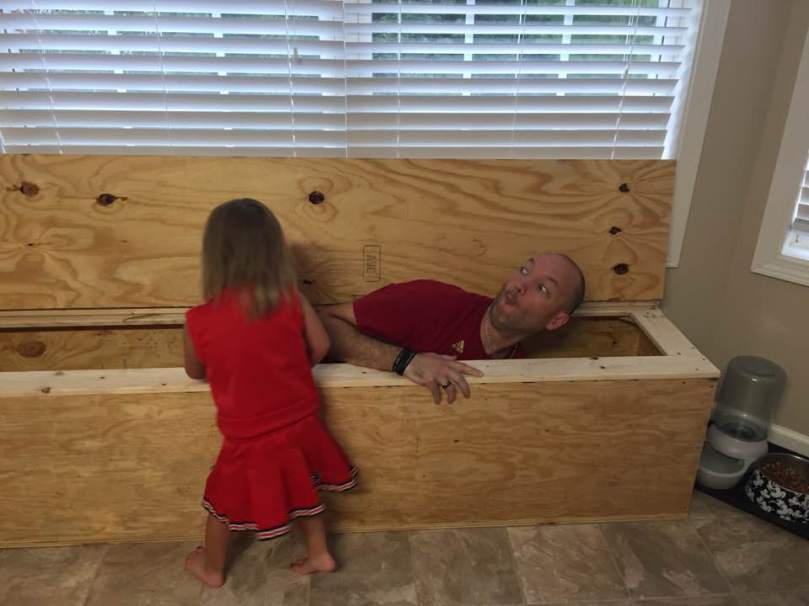
Over the long weekend, I built this kitchen bench.

Our old kitchen was enormous, you see. Cavernous, you might even say. And while our current kitchen is by no means tiny, it’s also definitely and noticeably smaller than our old digs. So we’ve been economizing the space in as many ways as we can: shelves over the backs of the doors. Stuff stackers on the tops of the cabinets. Racks and organizers galore. (Minimize, I hear you say. Pshaw, I say. This is America.)

Then, my wife had a great idea. We have this recessed window area in the kitchen. Why not put a thing in there that can hold other things and not look like just a pile of stuff?

Yeah, that’s cool, I think. I love a little weekend project.

So I build this bench. Heavy as a bale of bricks and long enough to store a dead body or two. And it fits pretty snugly under the window. It blends in well enough with the space, in fact, that despite having some family over during the weekend, nobody noticed it squatting there, disguising the economy bundles of water and diet soda we picked up in advance of the storm.

Thing is, it took me most of the morning to build it; a good three or so hours, to say nothing of the trip to Home Depot for lumber and screws and so forth. Lots of frustrating work by myself in the garage, balancing things on edges, leveling them off, toiling to make sure the thing came out even in my modest home-fix-it setup.

It’s a weird thing, building stuff. I know enough about construction to get myself into trouble, as they say; I know a little bit about carpentry principles and if I really work at it I can build stuff that’s sturdy, but forget about making it look particularly presentable from any closer than fifty feet away. (Incidentally, this makes me fantastic at building things for the stage, which — surprise! — is a not insignificant portion of my job.) And because I’m decent but not great at building things, I have this love/hate relationship with building things. I love it — for a while. When it comes to building the thing and making it structurally and functionally sound, boy howdy, I can jump in with both feet and work ’round the clock without even really noticing the passage of time. But once I reach the limits of my expertise? Once the thing is built, and functional, and it’s time to make it look pretty? I lose interest faster than a goldfish in a dark room.

But that’s the problem, innit? Because the thing’s done only when it’s done. Which the carpentry gods reminded me of, painfully, with my bench.

I build the thing. It’s sturdy. It’s functional. Its edges are square. Its lid goes up and down. It’s basically done. The thought goes through my brain: you should probably sand it down. But having just put the hinge on, and having seen that the lid fits just so perfectly, I figure I’ve earned a break. The plywood I built it with, after all, is sanded on the outside anyway. I go upstairs. Poke at the wife until she agrees to come have a look at it. She agrees with me: it’s not bad.

“Is it done?” she asks.

“Basically,” I say.

“What’s that mean?”

I perambulate through the garage, winding up extension cords, sweeping up piles of sawdust. Job’s basically done, after all. “Well, it’s almost ready for painting, but seeing as we don’t have the paint yet, I figured I ought to take a break. Maybe try it out and see how it looks in the space. Maybe we’ll see what color we want to paint it when we get it up there.”

So we haul it upstairs. Plonk it down in the corner. Sit on it, test it out. Yep, it’s a bench seat.

“Looks good,” she says. (Actually, she lays it on a little thicker than that. She strokes my ego a bit. I think she must’ve been reading some articles or something lately; I feel her psychologizing me.)

“Yeah,” I agree.

“So, what now?”

I ponder. What I really don’t want to do is haul it back downstairs, or work on it at all anymore right at the moment, or perhaps, ever. It’s functional, after all. You can sit on it. The lid opens and shuts. Case closed. (So to speak.) Finally, my answer: “I guess it’s not hurting anything here. We can just keep it over here until we get the paint; then I’ll prep it.”

She gives me a look that I should recognize by now, but I let it bounce off me.

Fast forward a day, and I’m sitting down with the Sprout to work on some sight words. He wants to sit in the kitchen while mommy cooks. Hey! I just made a brand new bench seat for exactly that purpose! So I sit down, scoot over to make room for him, and catch a dagger-sized splinter in the meat of my hand.

Needless to say, after a healthy bit of cursing and an unpleasant bout with some tweezers, I find myself out on the back porch doing the job I should have done to begin with: sanding down the damn bench. It takes all of twenty minutes, and at the end, the thing is well and truly safe and pleasant to sit on, painted or not.

You see where I’m going with this.

I left the project nearly but not entirely finished, and its rough edges caught up to me almost immediately.

The parallel to writing is striking: the thing is not done until it’s done. That means whatever it means for the stage of the project you’re in: the draft isn’t done until you actually write an end to the thing (and go back to write all the things you intentionally skipped over on the way). The edit isn’t done until you’ve been through every inch of the project with your fine-toothed editing comb and fixed all the little fitzy bits. The submissions aren’t done until you’ve written and perfected the query letter and delivered it to the inboxes of everybody you can stand to send it to.

I’ll admit, I’m somewhat of two minds on this topic; I’m acutely aware of the dangers of overcooking an idea. You work at a thing too long and it turns to mush. You break yourself trying to perfect a thing which will never be perfect. There’s a virtue in being able to say, nope, that’s enough, and let a Good Thing simply be good.

But there’s a difference between stopping before you overcook the thing and leaving it properly unfinished, covered in jagged little splinters or worse. (Mixed metaphors, for example.)

Make no mistake — it’s easy to get sick of a project. To want to slap the last chapter in place because you’ve been after it for months and you want desperately to think of anything else. But if you don’t knuckle up to the tedious work that comes with dotting the i’s and crossing the t’s and making sure that all of your plotlines properly resolve and don’t just wander off into the ocean or something, well…

Somebody’s gonna catch a splinter up their backside. Maybe even you.

21740043_10107688144857920_8127459376695806064_n