Word Wars: A New Hope


I’ve been in a writing funk for, gosh, let’s just go ahead and call it three months.

I’d been beating my head against the wall of the edit of my novel and… it’s just so exhausting. Reading the pages over and over again. Checking for continuity. Evaluating the language. Fixing this. Tweaking that. Blasting holes in the drywall and going back in with a blowtorch to re-weld the pipes. The most tedious and thankless of work.

Yeah, WORK. Who ever thought this writing thing would be WORK? It turned into such an ungainly mass of WORK that just like real work, I was hiding from it, finding excuses not to do it, stretching it out, and basically procrastinating myself into a corner, and teaching myself to hate it at the same time. Seriously, if I didn’t love it so dearly, I could almost say I hated the project right now.

But it’s out of my hands now. I’ve passed it on to a few beta readers and I have feelers out for a few more, so now it’s time to cut the cord and let that one fly away (birds have cords, right?). I started thinking about the other novel ideas I had kicking around in my head from a few months back. I stopped stressing about the details of the “finished” work. I began thinking about what sort of deadline I could impose upon myself for a new project; how many words a day I could write, how many months it might take. I started dreaming up characters and themes and plots and motifs and a hundred other little things I want to include in the next story. I cobbled together some notes and a ghost of an outline in Evernote (god I love Evernote, it’s like a personal assistant I don’t have to pay or buy lunch for).

And then last night, the craziest thing happened. I cracked the seal on a brand new word document, breathed in the heady aroma of that blank page, and started writing. Originally I only planned to get a couple hundred words down — just the introduction of a character and a place — but before I knew it I was back in top drafting form, slinging words with abandon, hastily leaving notes to myself, swearing at myself in the margins, in short having a ball of a time. Within just forty five minutes, I’d penned a thousand words, and it had felt as effortless as falling off a toaster. This, I reminded myself, is what it’s supposed to feel like. This is why writing is awesome. Creating people, giving life to worlds, unearthing plot devices from the raw soil of my cerebellum… ahh yeah, that’s the stuff.

The months of ennui fell away like a cobra’s skin. Underneath was the churning engine of creation that so wrapped me up and carried me away at about this time, one year ago. Still purring like a kitten, still snarling like a junkyard dog to chew up some words and spit out some copy. I felt glorious; I felt renewed. I guess this is the start of the next chapter.

When I started my blog last year hand in hand with my novel project, I had a simple system for organizing posts. Everything I posted about the novel here on the blarg last year, I tagged “the project” and/or “commitment 2014”. I had promised myself that I’d get the first draft written before 2014 was out, and I fargoing did it despite my own expectations that I wouldn’t. I’m on Twitter now, so I guess it’s only right that I start the tradition anew.

#TheProject lives.

#Commitment2015 is here.

Fasten your seat belts and hide your children.
Achievement Unlocked: First Edit Complete!


There’s a great moment in Hook, that early 90’s Peter Pan reboot, where Tinkerbell suddenly grows to human size and her house explodes around her as she embraces her true feelings for Peter Pan, confessing her undying and eternal pixie love for him.

Actually, that moment was a little bit weird. Creepy, even, somehow. But that’s off the topic. She unleashes a blast of magic she didn’t know she had, and with a demure little gasp of surprise, she yelps, “I did it!” Just as much in shock as Peter.

Well, that’s me right now.

Because I did it.

I bound up the sprained ankle I mentioned in my last post — you know, the one where I stepped in a literary pothole — and heaved myself bodily across the finish line. And that’s it. It’s over.

Well, not over over. But the first edit is over. Like really, legitimately, no-more-bullsharknado over. The only thing left now is one final pass for formatting, and then I can put the last nail in the coffin and decide who I’m going to burden with the first reading of this coalesced glob of proto-babble I’m tentatively calling a book. And for that step, I’m allowing myself no more than a week. One week — seven days — and then it’s time to figure out who I trust enough to tear my crazily crafted tapestry to shreds.

But here’s a dirty secret. I didn’t want to be finished. No, that’s not right. I was dying to be finished. No…

Truth be told, I was 50-50 split on whether I wanted to be finished with the whole thing or whether I was going to undertake another massive rewrite. It would have been easy to take the rewrite and stretch the process out for another month or more. So easy. I could still do it, in fact.

The fact is, I just slapped a band-aid on the problem of the disappearing character. She had disappeared without a trace, and I just wrote a magical exit from the narrative for her. (There’s magic in my story; I can totally do that.) Solving the problem she presented for me consisted of writing a single paragraph and changing a few sentences in the chapter at hand. That’s all.

But while I was writing the easy fix, a bigger fix crept into my head. A divergent fork in the road. The road overgrown with weeds and bramble and teeming with dark critters and glowing eyes floating in the mist. And this time… this time… I decided to let the harder road be.

You can bet dollars to doughnuts, though, that I wrote down the idea for the rewrite in case I need it later.

So, that’s that. The first edit is concluded. Or so nearly concluded as makes no difference. Concluded in every practical sense. Pat it on the head, send it on its way.

So what does that mean? It means it’s time to stop thinking of this novel as a pet project and get serious about the business of turning it into an actual book that you, reading this, can actually hold in your actual hands. Or, you know, into a collection of ones and zeroes that your handheld computer can belch up at you without the need for all that clumsy processed tree getting in the way. Either way.

And then…

And then, I guess, it’ll be time to don the greasy garb of the pit fighter to begin once again the dirty work of drafting something new. Because momentum matters, and just because the first edit is done is no reason to consider the work finished.

I was reading some notes by Stephen King about how he prepares to work on a story, and he wrote rather anti-eloquently that he gets the idea in mind and then just goes about his life until the muse — and I’m paraphrasing here, but the operative words are definitely his — shits on his head. Maybe I should start carrying a roll of toilet paper around in my man-satchel.

You know, just in case.

This post is part of Stream of Consciousness Saturday.

Get Up and Go (A Gramble About Gumption)


By the way, “Gramble” is just a word I made up. I wanted to keep alliterating with “G”s so I stuck one on the front of “ramble”. Don’t be afraid of my Frankenstein’s monster of a word. Its literary thirst for blood can only be satiated with ink.

Anyway. Gumption. Where does it go?

Some days the gumption is there; it burns away in your belly, it secretes its smoky certainty through your pores and fills you to the tippy top with vigor and optimism. Other days, the fire goes out, and all that’s left is the ashy residue of a bonfire, some empty beer bottles, and a few condom wrappers from where all the cool couples disappeared into the woods.

“Gumption” itself is one of those outdated words that you don’t hear much anymore, but there’s no word quite like it. We’ve got the newfangled Play-Doh lump of a word, “sticktoitiveness”, which is not so much a word as a philosophy. There’s “tenacity”, which has something to do with gumption, but isn’t the same thing. Then you can go and get all negatively-connotated and toss out “stubborn”, which, again, rubs up against gumption but doesn’t take the prize turkey home.

“Gumption” is homey and colloquial and down-to-earth. It’s a don’t-give-up mentality that somehow runs the gamut between boundless optimism and pigheaded refusal to back down. It’s a quiet, determined certainty that with hard work, anything can be achieved.

Maybe it’s one of those things that’s impossible to define, but you know it when you see it.

Gumption is a concept that has resonated with me since I read Zen and the Art of Motorcycle Maintenance by Robert Pirsig. I first read it in my senior year of high school, then again in my sophomore year at college, then again in my fourth year of college, then again shortly after graduating college, then again after I graduated college again, and it’s recently been in my brain that maybe I ought to read it again. It’s a fascinating little book that’s not actually very much about Zen or motorcycle maintenance, but rather about the world at large and how you choose to view it. If you’re philosophically inclined at all, you’ll probably get some mileage out of it. One of its defining moments for me is a scene wherein the protagonist fixes his buddy’s misfiring motorcycle with an old beer can. The protagonist is pleased with his ingenuity; the buddy is flustered and ultimately unable to live with the notion that a piece of trash could fix everything that’s wrong with his bike. He’s too caught up in the idea of what the bike should look like and what fixing it should entail to realize that the chemically-treated, rust-proof surface on the inside of the can provides all the fixing his bike could ever want at a fraction of the cost and time needed for a “proper” fix.

Anyway, I love the idea of gumption — that inevitable, inescapable quality within the self that just knows how to buckle down and get sharknado done — but I’m faced with a terrible truth lately. Mine is gone.

Like, a few months ago, I had it. I knew right where it was. In the left lobe of my brain, next to the wrenches and the repository of dangling participles. But now it’s gone. Misplaced? Stolen? Dried up?

I’m reminded of an Aerosmith lyric: “My get-up-and-go must have got up and went.”

Seriously. I’m behind on the novel. I wanted to finish the first edit by the end of January, and now it’s trailing off into March and I’m always “just a few weeks away.” I’m behind on grading papers at work and have been since… well… January. Even my posts on the blarg have been fewer and farther between since… ahem… January.

What happened in January?

I have no idea, but whatever it was ran my gumption right out of town. But, see, that doesn’t make sense. Because gumption is a part of who you are. Right? It can no more leave you than your wits, or your good looks, or… maybe these are bad examples.

The point is, my gumption is missing lately. If you’ve seen it, please tell it I would very much appreciate it if it would return home. I have a lot of work to get done. And a lot of get-ups that need to get going.

This post is part of Stream of Consciousness Saturday.

Stakes and the Blarg


Boy, oh boy, do I love a good stake. Charred crust, pink and bloody in the middle, melt-in-your-mouth flavor, rancid farts for the rest of the night…

What? Oh. STAKES.

Woo! Vampire hunters and silver crosses and garlic and…

Huh? Ugh. Okay, fine. Just stakes.

I guess there’s a lot to be said about stakes in writing, but today I’ve got the stakes of writing on the brain. Not least of which because I’m passively reading a book called The Right to Write by Julia Cameron. (“Passive” reading is my pleasant euphemism for “book-I’m-reading-on-the-toilet.”) And… well, for starters, I don’t think I’m this book’s target audience. Each chapter is essentially its own workshop and meditation on some aspect of the writing process, and much of it is the kind of rah-rah-rah-you-can-do-it stuff that would be more at home in a literal cheerleading squad than in a book aimed at burgeoning authors. For another, the tone of the book is through-and-through the sort of hippy-dippy, peace-and-love drivel that can give you a toothache if you swallow too much of it. It’s all “writing is a gift” and “the story speaks through me” and “anybody and everybody is a writer at heart”. Then there’s a lot of meditation on the sun rising over her private valley and rumination on her horses as they watch her through the kitchen window, and that’s about when I really want to induce vomiting so I don’t choke on her privilege. Now, okay, those ideas are lovely and all, but it’s all too Kumbayyah for me to ingest in anything other than the tiniest bites.

I don’t need that. I enjoy writing enough in its own right that I don’t need somebody pushing me to do it or ensuring me that it’s okay for me to do it. Whether or not anybody is truly “cut out” for writing is irrelevant, as any list of bestselling books will tell you. Horrible writers still write. This book is aimed at convincing somebody who’s perhaps too timid to leap into the pond that he might, in fact, have something worth writing about in his mind. It’s designed to invite you into the world of writing one baby-step at a time, by writing first about things in your house, then in the news, then about your family, and blah blah blah. If you’re a sometime reader of my blarg, it’s pretty obvious that I do that stuff on my own already.

That said, there’s something comforting in the way she puts her ideas forth.  And even among the platitudes and smug self-righteousness, there are gems of wisdom, little kernels of edible advice embedded in the stew of saccharine crap.

The one on my mind has to do with stakes, and what she has to say about it is this. When novice writers (and sometimes experienced writers, too) sit down to do their capital-W Writing — be it their novel or screenplay or short story or news article or whatever — there is this inescapable sense of pressure and dread surrounding the act. Because it has to be perfect. If I write something crappy, that’s all anybody will ever remember. It’s all will ever remember. Inability to achieve that perfection and to get all the things exactly right is paralyzing; it can lock up the mental faculties like a bit of chain snarled in the spokes of your bicycle. And this is a fear that I’m on a first-name basis with. (Its name is Todd. Like all horrible things.)

The well-hidden reciprocal of that fear is the fact that so many of us, writers and non-writers alike, engage in writing every day in which we feel no pressure at all to perform at some elevated level. These are your e-mails to colleagues about whatever projects you’re working on, your text messages to your spouse about what you need to pick up at the grocery store on the way home. Okay, it’s not Writing, but they are still words that you form for the purpose of communicating an idea to somebody else… and that’s writing, innit?

The trick, then, is to capture that free, unfazed, not-even-aware-of-any-kind-of-pressure feeling associated with e-mails and apply it to your capital-W Writing, to leap into your manuscript with the same abandon with which you fire off a scathing comment on a message board or a snarky response to your sister’s joke about your mom. It’s hard to do, but I’ve felt flashes of it when working on my novel.

It almost made me mad when I realized it. While I was having a chuckle at all the peace-love-dope sentiment in her book about writing, Cameron had thrown a literary dart and pinned my Id-Writer to the corkboard like a doomed insect. In her suggestion that writing doesn’t have to be this big deal that a lot of people (myself certainly among them) make it out to be, she had explained away the entire r’aison d’etre for this blarg. This is my low-stakes writing. It doesn’t matter what I write here; what matters is simply that I write. That I break apart the dam of mud and sticks clogging up the river of my faculties. That I pull the release valve on the hot-water heater of my brain. That I let the toddler out into the yard to run around in circles and scream its head off so that the adult in my Ego-Writer can get some peace.

This, then, is why we read; this is why it’s important to engage critically even when the subject matter seems like a laugh. You never know when the river of sharknado is going to belch up a hunk of gold. I’m going to keep reading Cameron’s book, even though it irks me, and even though I will no doubt find myself rolling my eyes like a hamster on a wheel at its pithy sayings. Much as it gives me the chuckles, there may just be a few more juicy tidbits in its pages.

Also, it was a gift, and I’d feel really bad about tossing it.

Thanks, sis.

No, not that sister. The other one.

Thanks.

An Idea is Born


The stream of consciousness prompt this week is “scene/seen”, and that feels like kismet. Because if you’ve spent any time around my blarg, you know that one of the things that’s been front-of-mind for me over the last year or so is my novel. And I think so much about what the novel is and what it may yet be that it’s easy to forget what it once was, which was a dumb little scene I wrote for a playwriting class I took in my fourth year at UGA. I say dumb not because I thought that scene was bad (though if I read it again I might have to reconsider that assessment), but because I wrote it almost as a throwaway. We’d been in the class for maybe three weeks, were still learning the ropes, and this assignment was an easy one to get us thinking outside of the box a bit.

“Have a character enter your scene from somewhere unexpected.”

Were you to give me that prompt now, I’d have a hard time deciding which outlandish entrance to use. I’d have somebody come crashing through the window or the ceiling. I’d have an escaped prisoner tunnel up through somebody’s living room floor. I’d have a reincarnated Elvis enter from the bathroom in a cloud of psychedelic lights and smoke. (Okay, so I stole that Elvis entrance from Steve Martin’s Picasso at the Lapin Agile). The problem would not be “how do I write this scene,” the problem would be “how do I choose?”

But at the time, the prompt stymied me. It wasn’t that I couldn’t think of strange entrances — I could — but I couldn’t think of a way to justify any of them. The idea would strike, but I wouldn’t know how to connect it to anything meaningful. Even as I write that, I find myself shaking my head — it was just an exercise scene, it didn’t have to connect to anything meaningful! — but I was stuck. Stuck, stuck, stuck. I sat in front of my computer staring at a blank page for the better part of an hour, unable to write this scene, too nervous to take a chance.

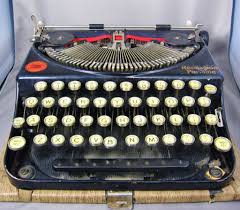
typewriter

The one piece of writing advice that everybody knows is to write what you know. Frustrated with the assignment and my inability to pen even a single word, I fell back on that old axiom. I’m blocked? Can’t crack this scene? Fargo it. And I wrote my character, a frazzled, frustrated guy, sitting white-knuckled and scruff-faced obstinately in front of a typewriter. (Yeah, yeah, I know, I have a thing about typewriters.) I had him struggle and hem and haw and make excuses and bang his head against the wall, and then, finally, he just gave up trying to be creative and wrote a crappy, cliched little scene. Nothing special about it. Except that it appeared out of nowhere (the unexpected entrance, such as it was) and played out right in front of him. Taken aback at first, he spoke to the characters that suddenly existed right there in his crappy apartment. The newly created characters shared their thoughts (this setting sucks! I would never read that book! Why would I even say that to her?), he took their advice, and in a matter of moments he had figured out that the best way to write was to get the fargo out of the way and allow the characters to explore their own situation.

I thought it was crap. I mean, really, I was almost ashamed of it. So ashamed that I almost didn’t go to class the next day. But crappy though it was, I had enjoyed the taste of writing it, so I went. Naturally, the teacher (the inimitable Stanley Longman) called on me as one of the first to present. With sheepish disclaimers, I handed copies of the scene to three of my classmates, who took a few minutes to read over it before assuming positions on the stage. I heard them giggling as they ran through it and thought, great, it’s as terrible as I feared and now I’m going to be exposed for a hack. Then they read the scene, and the laughter continued; little snickers here and there, even a stray guffaw. Finished, the actors took their seats and I sat on the feedback stool, red-faced in front of everybody, and waited to be verbally crucified.

First hand raised, I called on a girl whose name I didn’t know at the front of the room. I’m paraphrasing, of course: “First of all, it was really funny. I loved the interplay between what we expected from his characters and what they really wanted for themselves.” Nods from around the room. Next up, a guy who sat near me and whom I’d collaborated with on an earlier exercise. “I recognize that struggle when I write,” he said, “it was cool to actually see it on stage. And it worked.”

The workshop continued. I got critical feedback as well as praise. But my professor’s comment stuck with me more than any of the rest. He scratched his head and spread his hands like a big grandfather gorilla. “The concept needs a little work, just to polish up the how-is-all-this-happening, and the why. An audience wants that. But it’s funny, you’ve nailed that. Those comedic elements are the hardest to pin down, and you’ve done it. Don’t you think?” He inclined his head past me toward the class, and there were vigorous nods of assent. He chuckled. “I loved it.”

That class was my favorite experience in my undergraduate years. Much though I loved that class, I got distracted from that scene and didn’t think about it for a few years. When I graduated and moved back home, I had the opportunity to work with my old high school and ended up taking the core concept of that scene — an author at war with his characters — and expanding it into a full length production. It went over like gangbusters, and, shock of all shocks, it played a role in my meeting with my wife (her mother saw the show, knew me from my work with a community theatre, and kinda-sorta shoved her in my direction).

Now, eight years later, that stage play is becoming a novel. And I feel the same fears in its formation that I felt in those days struggling with that seedling of a scene: that it’s contrived, that it won’t be funny, that it’s ultimately utter crap. But somehow, this time around, I’m not nearly so fearful as I was. Maybe it’s that I’m older and jaded and I don’t care what people think like I used to. Maybe it’s because I’m more confident now than I was then in the concept and my ability. Maybe it’s because I’m older and losing touch with reality and don’t know well enough to be properly nervous. Whatever the reason, it’s a nice reminder to myself that I’ve had success with this story once, and there’s no reason why it couldn’t happen again.

This post is part of Stream of Consciousness Saturday.