The Weekly Re-Motivator: Cloistered In


When a nun pledges her life and her various other parts to God, she goes to live in a convent. Those convents have some fairly archetypal architecture, like what you see below:

File:Cloister of the monastery Unser Lieben Frauen Magdeburg.jpg

This covered walk is called a “cloister”, and this particular feature of religious buildings led to the expression of something being “cloistered”, or shut in and closed off from outside influences.

We won’t be going, today, into the particular irony of a religious institution requiring its most devout believers to live such a cloistered existence, or the fact that such an idea itself comes from religious ideology.

Rather, the metaphor of the cloister. It’s an important one, a powerful one, because so many of us live cloistered lives. We wake up at the same time, drive the same roads to work, see the same people, eat the same things for dinner. Our own footsteps mark the boundaries beyond which we dare not tread.

And there’s something to be said for that. Routine is important, and not only to the writer. (Just try moving naptime up by an hour on your three-year-old, for example.) But as much as time inside the box is vital for our comfort, well-being, and peace of mind, so too is time outside the box critical to keep us from living life in a rut. I realized the other day that I have some co-workers who are almost friends (as close, I guess, as a co-worker that you only ever see during work-related functions can come to being a friend) whom I have not seen in months. The reason? Their classrooms are on the other side of the building from mine.

You can find the cloister as deep down as you care to drill. I write at pretty much the same time every day, even down to the weekends. I park in the same parking spot at work, even though we don’t have assigned parking. I run the same routes over and over when it’s runday funday. We even try to have the same meals on the same nights of the week, just to cut down on that tiresome discussion: “well, what do YOU want to eat?”

It takes effort to break out of the cloister. We’re so closeted in with our routines, with what’s normal and easy, that we resist doing anything else. Our cloisters are climate-controlled, with blackout curtains and indoor plumbing. If we don’t make the effort to leave them behind now and then, they can and will swallow us whole.

So, how will you break out of your cloister this week? This month? This year? (Don’t wait to make a New Year’s Resolution — start today.)

This weekly remotivational post is part of Stream of Consciousness Saturday. Every weekend, I use Linda G. Hill’s prompt to refocus my efforts and evaluate my process, sometimes with productive results.

The Wikipedia and Wikimedia Commons image above is from the user Chris 73 and is freely available at //commons.wikimedia.org/wiki/File:Cloister_of_the_monastery_Unser_Lieben_Frauen_Magdeburg.jpg under the creative commons cc-by-sa 3.0 license.

The Weekly Remotivator: The Mission


We all suck starting out.
There’s an old saying about nothing worth doing being easy. That may be true, but I’d wager that a lot of people trying something new for the first time never get far enough to find out just how difficult the thing is. You pick up a guitar, plunk out a few discordant notes, maybe plug away for a week or two until your fingers get sore; then you listen to Freebird, realize you’ll never shred like that, and suddenly the guitar is gathering spiders in the attic. You lace up your shoes to give running a try, and you manage to power through some really painful stumbling outings; then it’s a few weeks later and you just can’t bring yourself to head out in the eighty-degree heat, and once you miss a workout, missing the next is easy.
You set out to write a novel, thinking (rightly) that anybody can do it.  You pound the keys for a good solid month before you realize that your characters are boring, your setting makes no sense, and your plot is as dead as a shark that doesn’t swim. Then your manuscript goes into the abyss of unfinished novels and you maybe start over, or you maybe just quit.
When you start something new, people say you should have a goal. Something to work toward, something achievable. And that’s well and good: you should have a goal. But there comes a point, when you’re up against that wall where the thing goes from hard to STUPID hard, when you need something even more than a goal.
You need a mission.
The difference is subtle.
A goal is something clearly defined that you want to accomplish.
A mission is something clearly defined that you MUST accomplish.
With a mission, failure is not an option. With a mission, obstacles are unable to stop you; they can only delay you. With a mission, it’s success or death.
The Blues Brothers were on a “mission from God.” NASA’s headquarters for space missions is called, unsurprisingly, Mission Control. Failure is not an option.
So, the next time you try something new, don’t set a goal.
Set a mission.

This weekly remotivational post is part of Stream of Consciousness Saturday. Every weekend, I use Linda G. Hill’s prompt to refocus my efforts and evaluate my process, sometimes with productive results.

The Weekly Re-Motivator: Stuff of Substance


I was going to write about the stuff-focused holidays we have here in the States (Christmas of course, Thanksgiving with its frankly embarrassing piles of food, and Black Friday, a de facto holiday with a surprisingly adversarial focus on buying as much stuff as you can’t afford) with this week’s prompt, but the moment I started kicking it around, I realized that even I couldn’t take any more of my bitching about holidays and special events… between my tirade about NaNoWriMo, my grumbling about Daylight Savings Time, and my sermonizing about the war on Christmas, I’ve sure been slinging the negativity lately.

That said, the picture is unrelated.

Today, a positive bent, a return to what I like to use SoCS for: to ruminate on writing.

I’m giving myself a break from Big Writing Projects lately — through the Christmas season, really, by the time all is said and done — and as a diversion, and to keep the grooves nicely greased, I’m working on some short fiction instead. You haven’t seen it around the blarg. It’s a SECRET.

Or rather, it’s in progress, which for writers means it may as well be as secret as the Coca Cola formula — we don’t like people sticking their fingers in our pies until we’re good and ready to have our pies finger-stuck.

Anyway, I went and enrolled in a free short fiction writing workshop hosted over at Holly D. Lisle’s site at How to Think Sideways. She lays out a three-step (with multiple embedded sub-steps, but y’know, that’s not as flashy as saying “3-step”) template to writing flash fiction that doesn’t suck. And what I quickly realized is that a lot of my stories kind of suck. Like, most of them have decent ideas at their cores, but they lack any sort of follow-through or intelligible raison d’etre. (I don’t actually know what that means, but I heard it before and it sounded fancy.) In short, stuff happened, but lacking were the reasons for said stuff happening, or an appreciable understanding of the consequences for the stuff happening.

And with the five stories I’m workshopping, there is a real focus on meaning and significance through brevity. It’s been eye-opening, like that air freshener commercial where they blindfold people in squalid rooms, wave air fresheners under their noses, then remove the blindfolds so they see the cloud of actual sharknado they’d been inhaling.

Anyway, I’m not going to detail the … well, details of the course. They’d be tiresome if you’re not interested, and if you are interested, it’s worth your time to roll over to Holly’s site and sign up for the course yourself. Suffice it to say that while this has been some much-needed down time from my big projects, I’ve not been idle, and that feels nice. Momentum matters and all that.

Which is, I guess, the point of the post this week: writing is something you can only ever get better at by sitting down and practicing at it. And a tremendous obstacle for many would-bes is the simple but enormous leap of faith that it takes to even start screwing up a perfectly good blank page with your awful, stupid words. There’s something to be said, then, for the virtue of just sitting down and banging out words week after week. But there comes a point where you feel safe enough in the habit, and you want to actually start refining your craft. I think, a year and a half into this adventure, I’ve more than established the writing consistently part, and it’s time to start worrying more about writing stronger, smarter, sharper stories. Stories where the stuff that happens is stuff that people will care about.

Stuff of substance.

This weekly Re-Motivational post is part of Stream of Consciousness Saturday. Every Saturday, I use LindaGHill‘s prompt to refocus my efforts and evaluate my process, sometimes with productive results.

Science Sunday with the Mythbusters


I’m a big nerd.

I dunno if you know this or not.

I love science fiction, astronomy, physics… I can’t get enough. I subscribe to Crash Course Astronomy on youtube. I am counting the days to the new Star Wars movie. So I guess it was inevitable that I would love a show like Mythbusters, which takes a scientific look at everyday turns of phrase and bits of movie magic to see if there’s any actual truth to them.

After filming their final season, the show’s hosts have been on a tour lately, doing speaking engagements and sharing some of their favorite moments about the show around the country.

Last night, they were in Atlanta.

And because my wife is awesome, she got me tickets to the show for my birthday back in July.

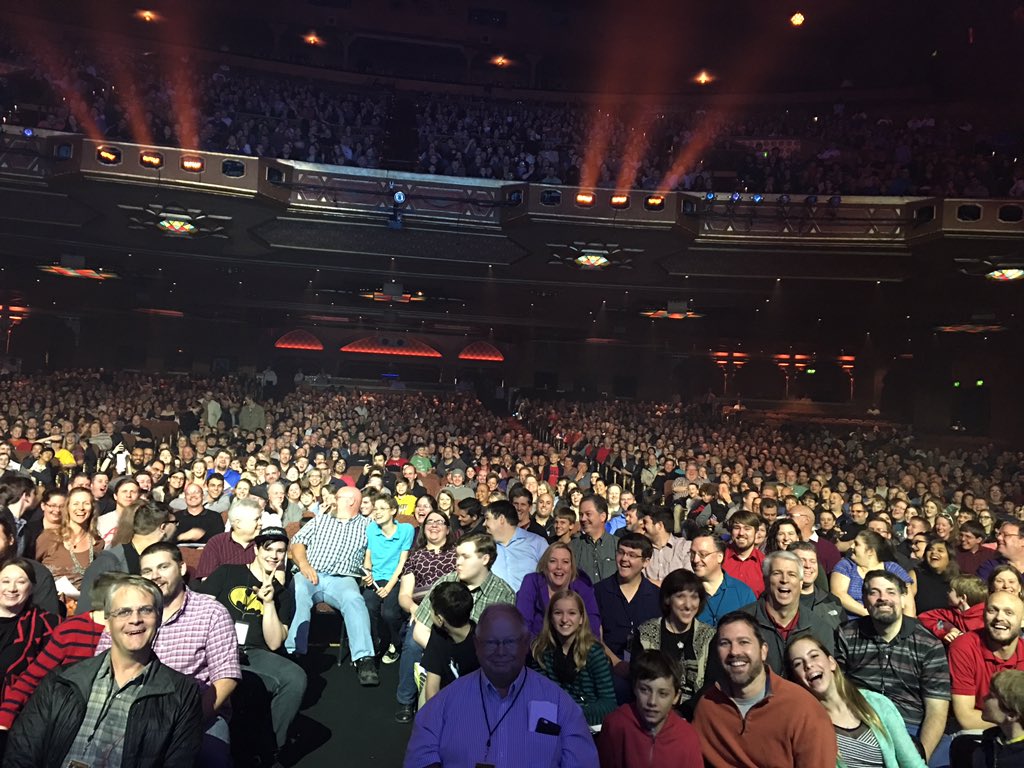
Now, I’ll be the first to admit that the show is a little nichey; that while it has its fans, it’s probably not widespread enough in popularity for most people to even be familiar with it outside of maybe seeing a rerun of it on the weekend. Still, they basically sold out the Fox theatre in downtown Atlanta. Further, the audience was wonderfully diverse: people of all ages and all ethnicities filled the rows, but maybe more impressive were the families, especially those with kids as young as six or seven. And I will happily admit that I spent the bulk of the show with a big dumb fangirly grin plastered to my face.

Still, I didn’t know exactly what the show was all about. I thought they’d show some clips from the TV show, answer a few questions, maybe do a few live demonstrations. But it was a lot more than that.

The show was full of lovely little moments. My heart warmed when they called their first volunteer up onto the stage — an eleven year old girl — who proudly proclaimed that math was her favorite subject in school. Adam talked about some experiments they had run but never been able to use on the show, like a ridiculously explosive, easily accessible chemical that they are forbidden to disclose, and a lab rat that turned cannibal during a food experiment. The usually stoic Jaime got emotional when asked about his most frightening moment on the show.

Simply awesome.

(My brother and I are about thirty rows back on the left.) You can tell based on my formless face-shaped dome head.)

But what I really want to talk about is Adam Savage.

Adam Savage is one of the nerdiest nerds around, putting a gusto and chutzpah into his geekiness that’s really enviable for a more low-key geek such as myself. While I expected to see a few neato science experiments and hear a few funny stories about being on the set (and there was certainly plenty of that), what really resonated with me was the opening moments of the night, wherein Adam told some stories about growing up geeky and what led him to the sort of thinking and experimentation and self-instruction that would eventually lead to a career doing special effects for movies and television and web series about science.

Being the big nerd that I am, I whipped out my pencil and notepad and began scribbling.

Out of the evening, I came away with a list of reading material that I need to look into (100 Years of Solitude, and the works of Raymond Chandler) and some lovely poignant aphorisms about science in particular and learning and being human in general. They were even, believe it or not, applicable to writing. So I thought I’d share a few of them here.

  1. The deeper you go, the harder it gets. Adam told a story about learning to juggle, starting with the absolute basics and eventually undertaking to learn tricks. At first, the gains and improvements came quickly and readily, and he was able to master new facets of the skill every couple of days. (As a fellow novice juggler, I can certainly identify.) But very quickly, you come up against a wall beyond which the improvements become harder to achieve. While he mastered basic juggling in under a week, it took him well over two weeks to master even a few simple tricks, and he found he simply didn’t have the drive or the time needed to undertake it further. As a result, he’s a decent if not impressive juggler. And, well, that’s like writing, or hell, like anything really, innit? Anybody can do it, anybody can undertake to string sentences together and even craft a narrative. But if you want to be good, if you want to impress people with your talent, well, you’ve got to slay a whole other sort of beast. You’ve got to live and breathe with your work for long months and years, you’ve got to study, practice, think about language, try and fail in a thousand different ways. In short, you have to put in the miles. I’d wager that most would-be writers don’t have the gumption to do that. It remains to be seen whether I do.
  2. The Champion of one notch above mediocrity. As a result of all this, he became just barely decent at a lot of things: he had fascination with tons and tons of different skills and ideas, but didn’t have the follow-through to devote himself to get really good at any one thing. As a result, he was seasoned in lots of areas and knew a little bit about a lot of subjects, but never became an expert in any of them. I think we could all take a page from that book. There’s value in trying lots of things, even things you don’t expect to plumb the depths of (see my collection of Flash Fiction for examples). Out of those tiny forays comes growth, comes a broadening of the experience.
  3. Failure is always an option. If you watch Mythbusters, you’re familiar with this little epithet already; rare is the episode that doesn’t feature an experiment blowing up — sometimes literally, often dramatically — in their faces. But this isn’t a setback. In fact, they seek this moment because if you simply skate through an experience and everything goes to plan, you maybe enjoy a bit of success, but you don’t really learn much. Failure, however, is a fantastic and ruthless teacher; nothing teaches you how not to suck like picking over the charred and smoldering remains of your failed forays beyond mediocrity. Unless you failed at skydiving. No second chances in skydiving.
  4. Art and science are just two different kinds of storytelling. This one shook me to my core. I like to think there’s something magical and even otherworldly about storytelling, in the artistry of a nicely turned phrase, the cleverness of a well-tuned plot. But as with so many things, the moment I sat down to think about it, the pieces started sliding into focus like a Magic Eye painting. Stories tell us why people do the things they do. Science tells us why the world is the way it is. We love art because it speaks to worlds and people and emotions that might be, and we love science because it shows us the magical things we never knew about the world we currently inhabit. Furthermore, I don’t think you can have a good story without science — even if it’s just the inexact science of human interaction — nor can you have good science without a bit of art — the elegant organization and tracking of variables, the spiraling recursion of repeatability.

I’ve gone on enough, but suffice it to say that while I went to the show expecting a bit of fun, I came home with a whole new respect for a show I once thought of merely as a diversion.


The Actor’s Nightmare


Why, nearly ten years removed from the stage, do I still get the Actor’s Nightmare?

If you’re not familiar, the Actor’s Nightmare is a simple but prevalent one among denizens of the stage, in which a performer finds himself thrust into a performance for which he is woefully unprepared.

Common tropes of the dream:

  • You learned all your lines, but have forgotten them and everybody stares dumbly at you as you “um” and “uh” your way through.
  • You never learned all your lines, but somehow made it to performance night anyway, and everybody stares dumbly at you.
  • You know your lines, but are unable to speak, and everybody stares dumbly at you.
  • Your costume is ridiculous or unfinished or ludicrously fails to fit you, and you must go onstage in street clothes, naked, or in the idiotic costume anyway.
  • The set is unfinished or worse, still in active construction, and your performance takes you through a minefield of sharply upturned tools, unsteady platforms, and other threats to life and limb.
  • Your performance is brilliant, but the audience is completely empty.
  • Your performance is an utter travesty, and the audience is completely full.
  • Your performance doesn’t matter, because the audience is full of T-Rexes who fall upon you and your fellow actors in a bloodbath of Shakespearean epithets.

Every actor in every performance ever has played out all the ways a show could go wrong in his mind multiple times throughout rehearsal for said show, and in the Actor’s Nightmare they all parade across the screen of our minds with the saucy abandon of a dog rolling in roadkill.

I’ve had the Nightmare ever since I started with theater. I will probably have the Nightmare my whole life, seeing as the theater was such an enormous formative element of my salad days. It’s just too much a part of who I am, I think, for me to ever be rid of it.

Still, why does it persist?

I don’t buy very much into dream interpretation, except in the broadest sense. If somebody tells you that because you dreamed you were falling from the 37th floor of an office building into a dumpster full of unicycles, you will soon find a new job at the office of Forestry under a supervisor named Shwampa or something… that’s garbage.

But the Nightmare, I think, is just another manifestation of doubt, of anxiety, of the rampant feelings of inadequacy that so many of us have. Notice in the list that a common thread is “everybody stares dumbly at you,” as if you’re out of place or you’ve wasted their time. Well, that’s a very real and present fear in the life of this particular writer. Also recurrent is that idea of things being “unfinished” or “unprepared,” which, well, yeah. I never feel particularly ready even to get out of bed in the morning, let alone to ply my trade as a wordslinger (though I did optimistically and automatically call what I do a “trade”, so maybe there’s something there).

Point is, there’s an undercurrent of doubt behind everything I do, no matter how brashly or confidently I brag about it. I don’t know, for all that I love my kids and my wife, how good I am at being a father or husband. I’m maybe a decent teacher, though I am regularly in class thrust up against the reminder that I don’t really know what I’m doing up there. I fancy myself a decent recreational runner, but I’m definitely not winning any trophies these days, and I’m always afraid I’m going to injure or re-injure myself. And as for my writing, well, I talk a good game, but no matter how many words I write, the Howler Monkey of Doubt is right there, with his empty eyes and his judgmental grin.

wpid-scragz.jpg

Of course, the upshot is that the Nightmare fills me not with the abject howling terror of being devoured by an audience of T-Rexes (okay, sometimes). Rather, I wake with the slightly bemused SOMETHING of watching a couple of cats wrestle for a moment and then lick each other’s butts. For a moment, it was scary, but now it’s just a weird thing that happened. The Nightmare is a reminder that, while that doubt can be crippling in the moment, it’s one hundred percent a creation of the mind.

The truth is, I’ve never gone on stage unprepared.

Or naked.

Or in front of a bunch of T-Rexes.

But maybe the thought that I may one day have to will help keep me sharp.