On Losing (or, why art competitions suck)


I teach Drama, and we’ve just wrapped up our first production of the year. Wrapping a show is sort of an emotional roller coaster in its own right, but this show in particular was a competition piece, which carries its own unique set of pressures and baggage. And being the new guy in the building and in the program, there was a sort of excitement and uncertainty hanging over the whole thing.

Well, we lost. So now there’s this big ol’ empty feeling hanging around the end of this show. I didn’t want that to be the last thing in my mind, or in the minds of my students, so I wanted to say something to them to sort of tie all this up. And while I could have ad-libbed it, there were a few things I wanted to make sure that I got right, so I decided to write down what I’m going to say to them.

And when I started doing that, I realized, hey howdy, it fits right in with what I’m doing here in my own life, trying to write novels and tell stories and all that. So I’m posting it here.

Maybe my fellow arters will find something useful here.

****

So we’ve been working on this play for the better part of two months. For some of you, it’s your first foray into the arts. For others — my seniors — this may be your last bite at the apple.

We all thought we had a chance. I wasn’t exempt. As much as I know to temper expectations in a situation like this, I still held out hope, down in the soft underbelly of my heart, that we might win. We took this weird little show and this weird bunch of actors and spun it like spider silk into a web of quirky jokes, bizarre moments, and puzzling profundities; we knew we had something special.

It wasn’t easy. We got on each others’ nerves. We struggled to keep our lives in order while it was all going on, and some of us succeeded better than others. You suffered car accidents, illnesses to yourselves and your families, arguments and fights and breakups, and I don’t even want to know what else. And despite all that, everything came together at the perfect moment, and you gave a performance I didn’t even know we were capable of.

But hanging over all this was the competition, and that means that at the end of the day, there are winners and losers. And we didn’t win. Didn’t place. Didn’t even merit an honorable mention.

We can’t mitigate that. That sucks. It feels like a great big thumbs-down from the heavens, like the disembodied voice of God asking, “why did you even bother?”

And it might leave you thinking, why did I sink so much time into this? Why did I give up my afternoons and evenings, all that free time, all that mental energy — to merit not even a mention when it’s all said and done?

This is the problem with competitions in art. With awards and plaques and trophies, with comparing the fruit of your labor to the fruit of somebody else’s. This isn’t like football, where the better prepared, better organized, stronger, faster team wins within the margin of error for luck. This is art, and art is subjective. It means different things to different people. For better or worse — and it’s usually for worse — winning an art competition is about appealing to the right person in the right way at the right time.

And we didn’t.

And again, that sucks.

I can’t sugarcoat it. Even though I was totally prepared for it, it still burns me up. I spent most of the ride home muttering to myself, gritting my teeth, trying to swallow the lump in my throat. I know what this means to you. I’ve been there. And my heart goes out to you, not because we “lost,” but because this feels like a rejection and a nullification of not only the performance, but of everything we all did to make the performance happen. It feels like we did something wrong, something that wasn’t “good enough.”

And if we focus on the trophy — on the “winning” and “losing” and the honorable mentions, then it’s easy to read this situation that way.

But that’s not how I choose to read it. And I hope it’s not how you’ll choose to read it.

Art is not about winning awards. It’s about making connections. It’s about finding those people in your audience who are ready to hear the story you have to tell them. It’s about the ring of the applause in your ears, the accolades from people you don’t know but for this momentary connection, the conversations people have on the way to their cars afterward. Art isn’t the trophy that gets locked in a case to gather dust. Art is the experience that lives in your heart, that warm, giddy glow that you’ll remember when you get down on yourself, that knowledge that you did something that made a difference, that you changed the way somebody thought about you, about the world, about life, even if only for a little while.

That’s what art is about.

We don’t take home a trophy, but they can’t take away the standing ovation you got (and let’s not forget, we were the only group to get one of those).

We don’t go on to the next round, but we delighted our audience. We made them laugh and smile and cheer when heavy and emotional was the flavor of the day; we gave them an afternoon rainstorm in the dead of a hot, stifling summer.

Sometimes audiences applaud out of politeness. Because they’re supposed to do it, because it’s what you do to pay a tribute, however small. But when somebody stands up and applauds? They do that because they have to. Not because they’re forced to, or expected to, but because they have no other choice: something you did moved them to the core. The art got into them, stirred up their insides, and had to be expelled before it tore them apart.

Art is visceral. Art is emotional. Art isn’t about tallying points on a sheet, it’s about scratching marks on your audience’s soul.

You went into this show with claws out. You affected that audience. And that means a hell of a lot more to me than any trophy.

Could we have done some things differently? Sure. Could we have done things better, scored a few more points, fenagled a better ranking? Maybe.

But that show wouldn’t have been this show, and this show is one that I will never forget. And that’s because of you, and the performance that you gave, and because of what we all felt in that auditorium when the curtain came down.

Never forget that feeling. Because that’s what art is all about.
 

The Weekly Re-Motivator: Soldiering On


A short SOCS post today, because I’m totally fried from this murderous week at work.

I’m back in the swing of my novel this week, despite the crazy hours at work. I got probably about 2400 words written — not quite what I aim for, but considering the loss of planning time and how scattered I’ve been, I’ll take it. But I’m not here to kvetch about word count (or lack thereof).

See, a few weeks ago I suffered what I could only, at the time, call a catastrophic setback: the loss of my un-backed-up flash drive, and hence the loss of a good twenty- to twenty-five thousand words on my latest project. That’s about two months worth of words, if you’re counting, AND I CERTAINLY WAS.

And, after the storm and the swearing and the self-abuse subsided, what was there left to do? Either quit the project, accepting the loss as too great to recoup, or soldier on and keep writing on the project anyway. And considering that this novel just happens to be one I’ve wanted to write for about three years, throwing in the towel was not a thing I was willing to swallow (argh, too many cliches).

So I took a day to outline the story I had written so far from memory, and then I started fresh with a blank page.

And man, that first day sucked, because returning to what was an essentially blank page was intimidating as hell (the perfect white expanse of the unblemished page — or, okay, word-processor window — is a thing you can only screw up with your first draft word-vomit). But a few days in, the momentum kicked in again, and all of a sudden I was churning along just like before I shot my foot off.

And the weird thing is? I actually feel really liberated. Losing the old project has allowed me to divorce myself from some of the preconceived notions and lame patterns that had cropped up in the writing. Now I can not only pretend they didn’t exist; they actually, literally don’t exist any more. I’m messing with new POVs, experimenting more with the narrative sequence, and generally having a lot more fun with the project than I had been for a while.

What’s that thing they say about relationships? Sometimes you have to lose something to learn what you really had? Maybe that’s a little too trite for the current situation, but one way or another, the project is moving ahead at a healthy clip again, and that’s damned encouraging.

Tomorrow: a third and final entry to the October horror flash-fiction challenge that’s kicking around over at Terrible Minds. (I hope.)

This weekly remotivational post is part of Stream of Consciousness Saturday. Every weekend, I use Linda G. Hill’s prompt to refocus my efforts and evaluate my process, sometimes with productive results.

The Weekly Re-Motivator: Panning for Gold


I remember, when I was in school, learning about how during the gold rush — you know, old west, Manifest Destiny times — people would pan for gold. Scoop some water out of the river, sift through it, see if any nuggets were floating in the runoff. Or they’d just take big handfuls of dirt, toss them on these screens, and slowly sift away the big rocks, then the little ones, and so on, in hopes of separating out something priceless from the junk.

And I always thought that was kind of BS. You dunk your little pan into the river, hoping to get rich off some crumbs floating downstream? You dig up your backyard, hoping that in there among the rocks and the sand, there’s a gold nugget, just waiting to be discovered?

It’s the sort of ridiculous hope that keeps people buying lottery tickets. The overwhelming odds are that not only will you not find gold, but you will have wasted hours — if not days or weeks or worse — of time which you could have used for, you know, useful things otherwise.

Not incidentally, one of my favorite snippets from Sam Harris (a prominent atheist/philosopher/neurologist and pretty smart guy) has to do with a guy who spends his weekends digging in his backyard for an enormous diamond. “It gives me great pleasure, seeking this diamond,” the guy claims, though there’s no evidence that the diamond exists, nor is there any good reason to believe that it might. And regardless of whether this diamond does exist, the believer “wouldn’t want to live in a world where there wasn’t an enormous diamond buried in my backyard.”

Panning for gold in that way takes something maybe even stronger than an act of faith.

But lately, that metaphor strikes me in another way.

If the first draft is the rushing mountain stream, then there are definitely some gold flakes floating in it, lost amid the smashing rapids and festering cesspools of word vomit. (This is, incidentally, why I’m not totally soul-crushed after losing about twenty thousand words of my latest project; because I know that most of it is crap.) Problem is, there’s no knowing where they are ahead of time. And there’s no guarantee that, if I dive into that stream of bland, meandering word salad, I’ll come away with anything approaching usefulness.

But I keep doing it. Every day I wade into the waters and pan for gold, screening the water and the dust and the lumps of calcified cow crap in hopes that somewhere among the detritus is a nugget that I might one day parlay into a car payment.

You know. The sort of blind, hopeless faith that I usually rail against.

But with one key difference.

The poor saps panning and sifting for gold or digging for diamonds in their backyards are putting their faith in things they can’t see or touch or know in any way. The gold is either flowing in the river, or it’s not. It’s either mixed in the dirt, or it isn’t. The diamond is either buried in the earth to be found, or there is no such diamond. But the words I churn out every day? It may not be much, but at least I’m in control of those words. And I know that, even though most of them may be crap, the potential is there, hiding behind fossilized feces or drifting downstream.

The faith a writer has to have is a faith in himself (or herself!). Some would argue that it takes a hell of a lot of faith to return to the blank page, day after day, to deface it with your imperfection. There’s certainly something of the devotional in it.

But I don’t think it actually takes much faith at all. The stories we’re sifting for are there, hiding just below the surface, winking at us from behind the river of crap.

We just have to have the patience to screen out the garbage.

This weekly remotivational post is part of Stream of Consciousness Saturday. Every weekend, I use Linda G. Hill’s prompt to refocus my efforts and evaluate my process, sometimes with productive results.

The Weekly Re-Motivator: No Such Thing as Coincidence


I posted earlier this week about my missing flash drive.

It’s now been a solid week since I realized it was missing, and having now cleaned the house and looked in every reasonable place three times (and the unreasonable places, once or twice), it’s hard to argue with the simple, impassive truth. It’s gone.

And because I’m an idiot, the missing little chunk of plastic and silicone has taken with it about 40,000 words of work — the bulk of almost three months daily wordhammering — on the latest novel.

Just gone. Not like somebody broke into my house and my TV, dvd player, and all my wife’s jewelry are missing — that sort of thing, while senseless and random, would at least make sense in a causal sense. There would also be the lovely spectre of somebody to blame. No, it’s rather like I went to the grocery store and came back to find my dog gone. All of her toys still strewn around the house. Sprouts of fur on her blanket and bed. Leash on the wall hook. But no sign of the mutt herself; just the back gate swinging in the breeze. The gate I forgot to close before I left the house.

It’d be tempting to think that it’s an awfully big coincidence that my entire project literally vanishes when I’ve been struggling so mightily with it over these past few months. Some of the days have been good, but most of them have been a bit too much like work, and as much as I like the central idea of the book, there’s just something … off about it. Maybe it’s the tone, maybe it’s the point of view, maybe it’s the setting; hard to pin down, but the idea just hasn’t caught fire with me the way I wanted it to.

So it disappears when I haven’t backed it up in months, and wipes out all those months of work.

But I don’t believe in coincidences; at least not in that cosmic, maybe it was meant to be kind of way. I’m furious with myself for losing it. I’m ready to throttle myself over the idiocy of failing to back up my project. And no matter how the project might have pained me, I don’t believe that simply throwing all that work out the window — literally, it turns out — would have been the best choice. Even bad writing sometimes reveals hidden gems, turns of phrase worth keeping, little narrative nuggets buried among the scree and scrap.

But I also don’t believe that it just happened. I think that, if I were really proud of this work, if I really felt it was worthy of my time, I probably would have safeguarded it a little bit better. I think if it mattered to me that much, I would have found the time to click a few buttons and back it up.

I don’t think me losing the flash drive and the project is the universe’s way of telling me that the project is wrong. I think that me losing the project was my own way of telling myself that the project was wrong.

Because here’s something I noticed in edits for my first novel: as much as I changed things, there was a hesitation to really deconstruct the thing, to shred it to pieces and rebuild the stuff I had spent so much time building the first time around. I did that deep rebuilding in places here and there, but a not insignificant portion of the first draft survived, coming through with only cosmetic changes.

With this project, though, I won’t have that option. I know the outline of what I wrote — the plotlines and the character developments that need to take place to get me to the middle — but I won’t have the fleshy bits, the meat of the story. I’ll have to rebuild all that.

Which is frustrating, but also kind of liberating. Not only am I not tethered by the shortcomings of the draft, but I can’t even see them in the rearview mirror. I’ve got no choice but to take this in an entirely new direction.

And the fact that I’m not filled with dread at the prospect tells me that, even though it burns worse than a throatful of rotgut bourbon, it doesn’t have to be all bad.

So maybe it’s just a coincidence that my project vanished into the ether when I was filled with so much doubt about it.

But I kind of don’t think so.

Maybe it’s just more likely that I’m devoted enough to this thing to turn this lemon — and man, is it a hell of a lemon — into something like lemonade.

Or maybe I have an alter ego who knows what’s best for my writing and chucked the thing in the garbage disposal while I thought I was asleep.

Either way, it’s time for a fresh start.

This weekly remotivational post is part of Stream of Consciousness Saturday. Every weekend, I use Linda G. Hill’s prompt to refocus my efforts and evaluate my process, sometimes with productive results.

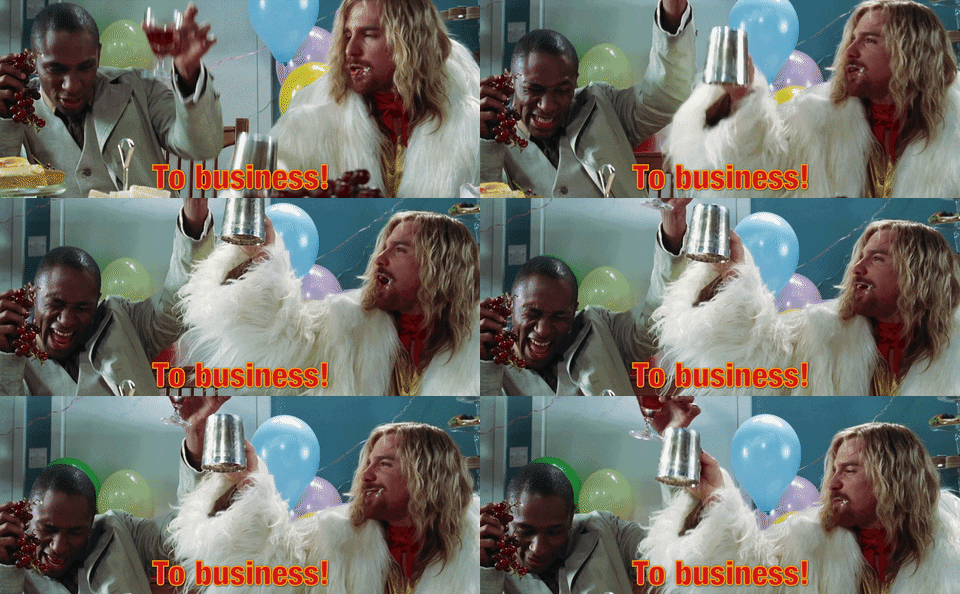
The Weekly Re-Motivator: To Business


If I could go back and give my previous self any advice about this whole writing thing, it’d be: treat your writing like a business.

See, I always thought I was the creative sort. And I guess I was, but for pretty much my entire twenties, I thought that creativity was this gift; this mystical, un-pin-down-able thing that I was just lucky to have. Now, I still believe that’s true — to a point — but I’m learning that there’s a lot more to creativity than the occasional kiss from the muse.

Because the problem with thinking that creativity is magic — that some people “just have it”, and others “just don’t” — is that one of two things happen. One: you don’t appreciate it, because, like a pile of cash from a wealthy uncle, it just fell in your lap, so you don’t really know its worth. Or two: if (but actually, when) it deserts you, you have no idea how to get it back. And while the muse may in fact carry a cell phone (she does in my as-yet-unpublished first novel), she certainly doesn’t give out her number.

But creativity isn’t magic. Or at least, it isn’t all magic. Creativity is like that kid who wanders around the neighborhood looking for other kids to play with. He doesn’t call in advance. He doesn’t send you a note to say he’s coming around. He just tools around on his bike looking for places to play and people to hang out with. And if you happen to be out in your yard playing when he shows up? Well, you’ll have the craziest afternoon of playing space baseball and ninja cowboys and Calvinball, until the kid has to go home and you have to go in to eat dinner. But if you aren’t out in your yard? That kid rolls right on by. He won’t knock on your door, he won’t peek in the window to see if you’re waiting for him — he’s got places to be and hell to raise with the other kids who are already outside.

Which is why, if you want to encourage him to visit, you have to spend some time playing in the yard, even when he’s not around.

This seems counter-intuitive. There’s no point playing in the yard by yourself, after all. The fun is in playing with a friend, in tapping into your collective imaginations and adventuring together through the boundless reaches of the imaginations of little kids. Playing by yourself is boring; what’s the fun in doing a backflip off a tree branch if nobody else is around to see it, or in throwing a ball over the house if you have to walk around the back to retrieve it?

But if the neighborhood kid doesn’t see you out there playing already, he isn’t taking time out of his day to see if you want to play. And creativity is just like that: if it doesn’t see you already working, already flexing your creative muscle, it’s not going to waste its time knocking on your brain to see if you want to make something awesome. The muse has places to be, novels and poems and stories and paintings and interpretive dances to inspire.

And that’s why we have to treat writing like a business.

mrw hd galaxy guide hitchhikers

You don’t do business when you feel like it: business needs doing with consistency, and pretty much all the time, or else the business dries up. When you treat writing like a business, you make time for it every day. You set aside time for it, and you protect that time like a mother bear protecting her young. You do the writing even when you don’t really feel like it, because if you don’t handle your business even when you don’t feel like it, you lose your business.

The unfortunate fact is, we don’t always feel creative. And it can be hard to force ourselves out into the yard to play when we’re just not feeling it.

But if this is a thing that matters — and I would argue that if you’re writing at all, or thinking about writing, then it matters to you at least a little bit — then we have to get out there anyway.

Because if we don’t? Well, the muse has plenty of other house calls she can make.

This weekly remotivational post is part of Stream of Consciousness Saturday. Every weekend, I use Linda G. Hill’s prompt to refocus my efforts and evaluate my process, sometimes with productive results.