I Write Like Awesome Writers


I was recently directed to a neat little corner of the web: a textual analyser designed to scratch the egos of fledgling writers everywhere by informing them that they write like this or that famous author.

Now, obviously, only James Joyce writes like James Joyce, but it’s fun to pretend. And testing a few of my samples in the machine, I got results that pleased me mightily.

First…

I write like
Douglas Adams

I Write Like. Analyze your writing!

Which just makes me smile, seeing as he’s absolutely, full-stop, make-no-exceptions my favorite author. But then, just for icing on the cake, I tried another sample and got this one:

I write like
Neil Gaiman

I Write Like. Analyze your writing!

At which point I stopped, because why keep playing when you’ve already won the game?

You can check it out at I Write Like.

The Button at the End of the Universe


Sak was exactly the sort of man you’d want to have his finger on the big, red button in the control room of the Omnilator, the Empire’s moon-sized death-ray that drifted in and out of hyperspace to annihilate entire planets at a whim. Sak was shortish, baldish, ever so slightly round around the middle, and perfectly boring. It was widely rumored that he had once talked an eternal stone tree on Naraloos Seven to death. It was also widely known that he was the best paid finger in seven galaxies. For that was Sak’s only task: to wait for the order of Commander Martock, confirm it, and push the button that would open a black hole at the planet’s center, sucking it away into infinite nothingness.

But the nights are long in space, especially in a tri-star system in a galaxy billions of light-years from home where there is no day nor night, just a constant, neverending noon, and eventually ways must be thought of to pass the time.

And over the course of several deployments, and a score of worlds evaporated away into the gaping void, a contest was concocted by the crew: get Sak to push the button early, and win a reprieve from all duties for the space of a full galactic month.

The Omnilator loomed in deadly orbit around a tiny, peace-loving planet named Pardala. The coordinates of its horrible assault had long been programmed into the targeting computer. Peace talks dragged on for months as dignitaries of the Empire wheedled with the elders of Pardala, and day by day, Sak’s finger floated over the button that would make Pardala into nothing more than a memory.

Lieutenant Loda thought to catch Sak unawares by sounding the alarm in the middle of the night and haranguing him into pushing the button on Martock’s authority, but it turned out that Sak didn’t even respond to an alarm, such was the power of his monotonous routine. The klaxon sounded for a full five minutes before Commander Martock caught Loda and sent him for a week of latrine duty.

Engineer Elara, she of the flowing hair and generous assets stuffed into a too-tight Empire-issued space skirt, wagered she could distract him with her wiles while Deckmaster Dervin imitated M’s voice to give the command. But Sak paid no more attention to her bouncing personality than to the flavorless sandwiches he lunched on, and Dervin’s voice broke in a way that Martock’s never would, and she swayed away, dejected, to cozy up with Dervin in a closet instead.

Navigator Norr decided that perhaps the way to Sak’s finger was through his heart, and invented all manner of truly horrible insults that the poor fated planet was purported to have leveled against Sak’s mother and sisters and any other women who happened to be in his life. But Sak, he informed Norr sadly, was adopted by a happy single man and had never had use for any women, and besides he wouldn’t feel right murdering an entire planet just because of some hasty words.

Dozens of schemes were hatched to try and budge Sak’s finger, but he shot them all down, deftly and without much interest. They finally admitted that Sak was, after all, the perfect man to man the switch.

And then, finally, the call came down from Martock himself. Peace talks had failed, and the Pardalans were doomed, by order of the Emperor. Martock’s voice barked out, rattling the far reaches of the ship, the order: destroy them.

But Sak’s finger did not budge.

Lieutenant Loda thought he must not have heard properly, and urged Sak to push the button, but his finger would not budge.

Engineer Elara thought perhaps Sak suspected another prank, and shook him and insisted that he push the button, but his finger would not budge.

Navigator Norr knew that Martock’s wrath would be terrible if his order was not followed, and pleaded for Sak to push the button, but his finger would not budge.

Then the door exploded in from the hallway, blasted to pieces by Commander Martock’s custom-made multi-phasing disruptor rifle. It smoldered with menace as Martock stalked into the control room, his face red and twisted with fury.

He saw Sak sitting by the button, his finger poised but still not pressing. Without a word of explanation, he shouldered his rifle and fired. Sak caught the red bolt of plasmic death in the shoulder, whirled, and fell from his chair, the bloodless wound hissing with smoke.

Who’s going to push the button?” Commander Martock’s voice rang in the silence like the calamity of two planets crashing together.

As one, they dove toward the big red button, clawing across Sak’s still smoldering corpse. Norr, through luck and lanky arms, was the first to touch it.

As the button clicked home and the wicked machinery of the Omnilator began to hum, Sak hopped up from the floor, throwing off the smoking, hissing trick jacket and howling with laughter. He and Martock flung their arms around each other in hysterics, pointing and cackling like madmen at the horrified expressions on the faces of the crew.

Their joy was short-lived, however; the black hole yawned open in the heart of Pardala and, with no more fanfare than an Arquillian Flea emerging from its egg, swallowed the planet, the Omnilator, and half of the surrounding galaxy in an infinite mass of inescapable gravity.

It had, Sak decided, been worth it.

##########

Chuck’s challenge this week is a Space Opera. I wrote a truly epic, philosophical piece of utter tripe before scrapping it entirely and writing this bit of fluff instead. Not exactly my usual style, but a fun time nonetheless.

This work was inspired more than a little bit by the collective works of Douglas Adams and the steady diet of Doctor Seuss I’ve been reading with my son of late.

Running and Writing: Two Great Tastes that Taste Great Together!


It’s been a long time since I had a running post, and I wondered if I was done with them. After all, this is primarily a blog about the writing of novels and the tribulations of a writer of novels learning that he doesn’t actually know very much about the writing of novels. What does running have to do with that?

Well, a lot, actually.

I take a bit of a Dirk Gently approach to life, always trying to keep in mind the interconnectedness of all things. A hummingbird flaps its wings in Taiwan and creates a hurricane in Florida, or an angry old man sends back soup at a deli and the next thing you know, skinny jeans are going out of style and cats are scooping their own poop.

And if there’s one thing I’ve learned about writing, it’s that it’s hard. Really hard. I’ve called it a Sisyphean effort before, and that’s not hyperbole: take your eye off the work and it can backslide on you, rolling your project and your will to work on it all the way back down to the bottom of the hill you spent five months climbing. And that’s when the wind is at your back, when things are going your way and you feel really truly in touch with what you’re writing.

But those are the rare days.

A lot of writing (the biggest part of writing, of late) is writing when your heart isn’t in it, when you fear the work is crap, that you’re crap, that every idea you’ve ever had or will ever have is crap, and that the paper that might have been used printing out your manuscript would be better used as paper that’s actually designed for cleaning up crap. Authorial self-doubt, the fear of rejection, an inability to find the time to focus or the right circumstances to concentrate… all these can add up to make the prospect of writing as daunting as an ant deciding it wants to cut a tunnel through the Rocky Mountains. On those days, you really have to be clearheaded, you have to train your mind to block out all that negativity and self-sabotage.

Which is where the running comes in. Say what you will about the dubious benefits of prolonged cardio exercise or how bad it is for your knees (or better yet, don’t, because I will just laugh at you), but any activity that gets the blood flowing to your body proper is by its very nature going to get the blood flowing to your brain. All that fresh, hot, oxygen-laced, endorphin-riddled blood hitting the brain is like a cool breeze in the middle of a Georgia July, like stepping into a heated storefront after being out in a New York winter, like the first pop in a fresh roll of bubble wrap. It gets you focused, it gets you clear-headed, it gets you calm.

Add to that, of course, the fact that with running in particular, it’s just you and the road (or trail or track or whatever) and the low, rhythmic shuffling of your feet. If zen masters advocate focusing on the simple infinity of the “om”, then there’s a wealth of universal truth to be found in the relentless slap slap slap of your feet on the pavement. There is no better way to get some alone time with your thoughts than to lace up your sneakers and go out for a few meditative miles.

If you’re a regular reader, you might know that I’ve been struggling with a foot injury for the last year and a half that’s made it difficult for me to fully enjoy my runs. It’s been impossible for me to cover long distances or to push my pace much above a brisk jog without setting myself back something horrible. But I’m muscling through, perhaps idiotically so (especially if you ask my wife) because of one thing:

I write better on the days when I exercise than on days when I don’t. I write better on days that I run than on days when I “work out”. I’m clearer, more at peace, less stressed, less consumed with doubt. If I can start the day with that one accomplishment under my belt, it makes any other goal — from writing a few hundred words to grading a stack of horrible essays — seem that much closer to my grasping hands.

Problem is, there’s only so much you can say about running, right? I mean, sure, every run is different: the melodies of the birdsong, the low lullaby of the cars rumbling past, the poemic abuse from passing motorists weaves itself into a unique symphony every time you step out. But by the same token, of course, every run is pretty much the same: laces on, one foot in the other, tromp stomp tromp stomp, have a shower, go on with your day.

So on the one hand, I hesitate to write too much about running, because I fear it gets monotonous. Then again, I wonder if I don’t beat the writing about writing horse to death, as I fear I may have done of late.

Nevertheless, running, as I said before, is a part of my process. Which means it belongs here.

Oh, and: I went for a run yesterday. It was good. Probably go for one tomorrow. I think that one will be good, too.

Image from Avicii’s Levels music video.

Time Out for Reading!


Weird circumstances the past couple days have seriously disrupted the routine, and as a result I’m getting virtually no work done on the novel, nor am I having any particularly useful things to post about here on the blarg.

That’s partly due to the honest-to-goodness fact that my daily schedule is all screwed up and partly due to the fact that there is some heavy sharknado weighing on my mind that I am literally not allowed to discuss.  More updates in a few days when the dust settles.

However, my activities the past few days have left me with some rather large gaps during the day which I’ve had to fill using no electronic devices at all, and since I plan ahead for these eventualities, I’ve gotten to do something I haven’t enjoyed in quite some time: sit down and read.  You know, from a book.  Like in the olden times.  Pages and all.  Bookmarks.  Dog-eared pages and jotting little notes in a notebook.  (Yeah, that’s how I read, I can’t help it.)

In particular, I’m sinking myself into the second in a series by Jasper Fforde, Lost in a Good Book.  The series in question is the Thursday Next series, which follows the titular heroine (a literary detective) as she gallivants in and out of various works of fiction, some renowned, others reviled, in pursuit of her duties tracking unauthorized changes to priceless manuscripts and verifying the authenticity of lost works of Shakespeare.

Now, “literary detective” is a job title which immediately makes me want to fall asleep, but these books are just flat out fun.  They detail a fantastically well-imagined alternate reality in which, to name just a few key differences, ownership of the Crimean peninsula is still in dispute, long-extinct animals have been genetically resequenced as household pets (Thursday keeps an adorable and rare second-sequence dodo bird, Pickwick, in her home), and Gravity Tubes allow anybody to travel to anywhere in the world in the space of just over forty minutes.  If that sounds whimsical, rest assured that I’ve only just slipped you the tip of the taco.  Fforde weaves the details of this fantastical world so thoroughly into his narrative that I never find myself questioning how things work; rather, I bounce happily along for the ride.  In fact, the alacrity and gusto and sometimes the offhanded way in which he creates the tiniest of details in this world is so charming and effective that it makes me feel woefully inadequate as a writer.

To wit, this passage from page 112 of Lost in a Good Book:

“Looping” was a slang term for Closed Loop Temporal Field Containment.  They popped the criminal in an eight-minute repetitive time loop for five, ten, twenty years.  Usually it was a Laundromat, doctor’s waiting room or bus stop, and your presence often caused time to slow down for others near the loop.  Your body aged but never needed sustenance.  It was cruel and unnatural — yet cheap and required no bars, guards, or food.

He tosses off this explanation like sluicing water off the hood of a freshly waxed car, deftly weaving the callous cruelty of the monstrous corporation together with the unfathomable scientific capabilities of the universe and, oh, just for fun, offers a clever explanation for why we always sit around checking our watches (sharknado, I just dated myself) or rather our cell phones in waiting rooms.  And he does this every three or four pages.

I’m not here today to offer a review of the entire book, let alone the series.  I haven’t yet reached the point in the book where somebody does get Looped, though it’s not necessarily an eventuality I expect.  It’s simply one example out of hundreds that detail the possibilities of an alternate universe that plays fast and loose with the laws of physics.  Fforde is also unrelentingly British and has that delightfully dry wit, so the books scratch that Douglas Adams itch that seems so untameable.  (Untameable?  Untamable?  Spellcheck doesn’t like either option.)

In short, if you’re a bookish sort, you should be reading Thursday Next.  Possibly you could read Thursday Next on Thursday next.  (I think the man must have been chuckling sideways at himself with just about every character name in the thing.)  And no, it’s not a particularly new series — Good Book came out in 2002 — but who cares?  It’s brilliant and clever and whimsical and ridiculous all at once.

The last several books I’ve read have been so heavy and dark and drear that these books have felt like a much-needed B12 shot.  Anybody else out there reading books that make you laugh?

That Kind of Morning


I usually don’t use the blarg to vent about little things; it’s not my jam to get overly worked up over the ticky tacky stuff that happens to everybody all the time.  Then again, sometimes things happen that just throw you so far off your stride it’s impossible to get past it.  Douglas Adams made a fantastic comparison once (and I’m paraphrasing heavily): It’s as if you’re going along happily in third gear, and feeling how wonderfully powerful you are and how smoothly everything is going, and then as you shift into fourth gear you miss the shift and throw the vehicle into reverse, and your vehicle vomits its engine out onto the highway.  I feel like that was in The Long Dark Tea Time of the Soul, but I can’t be certain.

There are just some things you take for granted in your day.  Some simple things that are so very simple they cannot fail.  The sky, for example, will hover merrily above your head.  Gravity will tug gently downward at you.  People will generally be decent, if a bit self-absorbed.  Doors will operate by the simple use of their handle.

But you can’t take all of those things for granted.

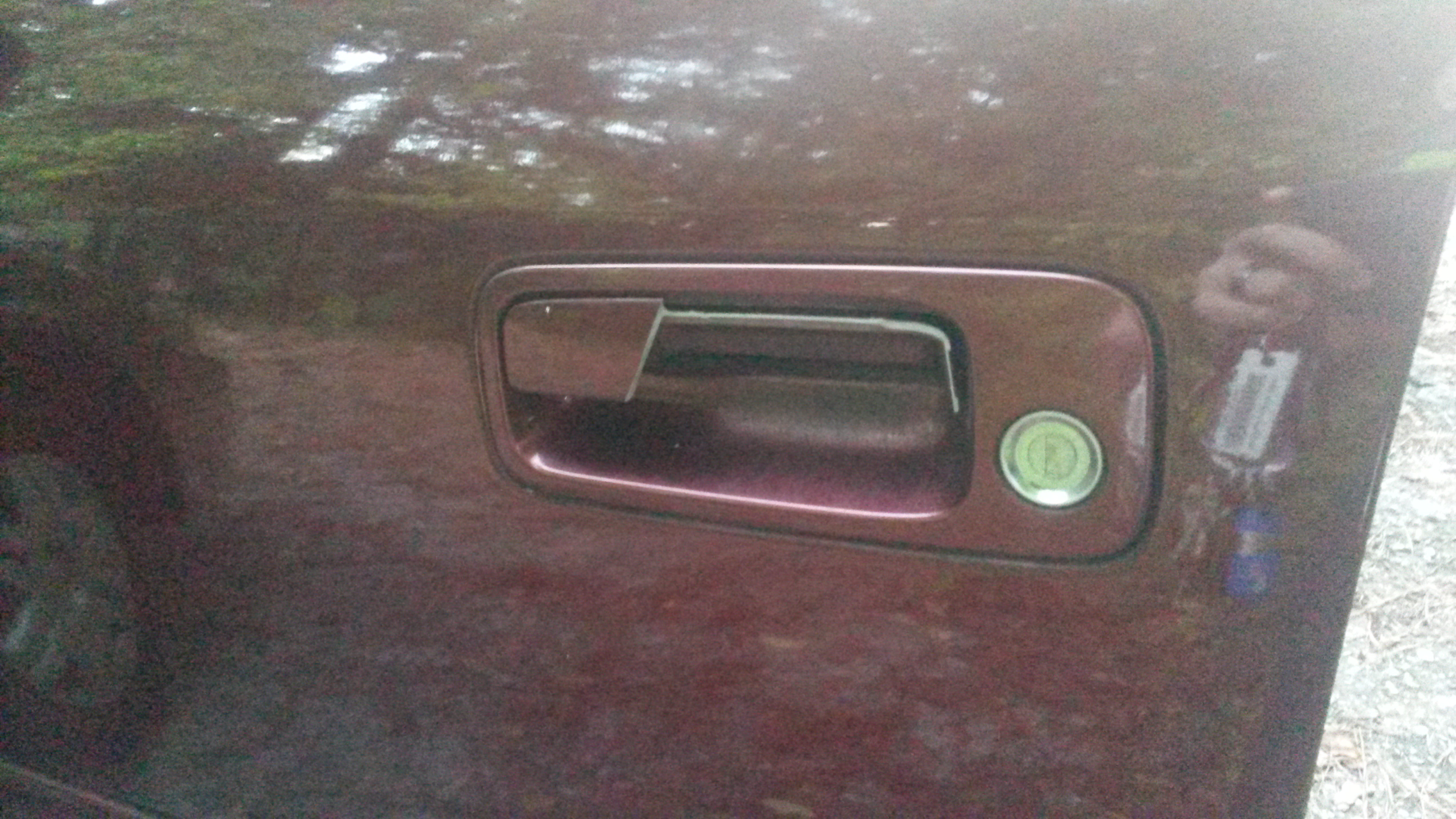
wpid-20140826_072051.jpg

That’s my driver’s side door, moments after I attempted to open it to go to work this morning.  I took hold of the handle and pulled it toward me in the proscribed manner, and then with a comically loud snap, it broke off in my hand, sending me windmilling wildly backward in my driveway.  (I wish I could have said windmilling wildly westward, but I don’t know if that’s true and it’s a bit aggrandized.)  I can still get it open, but I have to slide a finger behind that tab of remaining handle to lift up the metal bit which lies flush against the back of the handle well, and then get my other fingers under that to open the door.  So it’s about five times as much work as opening a door should be, plus it looks like absolute ass.  And okay, yes, first world problems and all that, but ugh.  Of all the things that can go wrong with a car, you don’t expect the door handle to be anywhere near that list, or in fact on the list at all, or even adjacent to the list.

I’m not one to ascribe significance where there is none.  The breaking of a door handle has no bearing on the rest of my day except for leaving me a little bit in doubt as to whether other taken-for-granted elements in the world will also cease to function as advertised.  Still, this strikes me as pretty odd.  I mean, I didn’t know this could happen through what I can only assume is normal use of the product.

Am I wrong?  Does this happen?  Are we all just in some long invisible queue waiting for the automatic certainties of the universe to decay on us?  Or is all my working out paying off, so much that I now need to be really careful when I handle delicate objects?

Ahem.  So this is Tuesday.