Interlude: Another Goodbye


The following is part eulogy, part lament, part wondered musing, part rant. I thought about streamlining it, focusing it, giving it a purpose of some sort. But at times like these, the thoughts don’t come out in an orderly, organized fashion. I *am* sad, and I *am* angry, and I think there’s space for all of that, even if it doesn’t make for good reading. Pardon the disclaimers. Read on if you dare.

I’ve got goodbyes on the brain, and there’s good reason for it:

We buried my wife’s father last week.

His passing was not unexpected — in fact it came after an agonizing series of weeks in hospice care, where despite repeated assessments that he might go “any day now”, he simply refused to give up. It was the sort of death that came as a relief, no matter how painful the loss was, because he had been in such a poor state for so dishearteningly long.

But the truth is, the man he was died months ago.

See, he had cancer. (Fuck cancer.) And the cancer had caused a tumor in his brain. (Multiple tumors throughout his body, actually, but the brain tumor was, for obvious reasons, the main worry.) That tumor was causing pressure and loss of function, so he was beginning to forget tiny details and taking a little bit longer to think about things than he was used to. Turns out, when my wife and her siblings got him in to get checked on for those symptoms, that this tumor may have been within days of killing him. A few more days of unchecked growth, and who knows?

But they spotted it, and thus began the end. The options in short were:

  1. Radiation treatment to shrink and manage the tumor. Not a preferred solution in his case because the tumor was already advanced and, of course, radiation has other harmful effects on the body. Further, the tumor wouldn’t “go away” — it would simply be, in my words, checked.
  2. Brain surgery to remove the tumor. Difficult, given the location of the tumor, but a better chance at a stronger recovery.

The family opted for surgery, knowing full well there was a chance he might not survive.

The truth is, he didn’t.

The surgery took longer than intended, and recovery did as well. While they expected him to return home and begin rehabilitation on his road back to normal, or near normal, within a few days, his stay increased to a week, and then beyond, and then beyond that.

Worse, his condition was not improved. In fact, he wasn’t speaking, and seemed confused about everything. “It’s normal after his procedure,” they were assured. “Just give it time.”

But time didn’t fix it. He only got worse. He began speaking again, but the words often came out slurred, slow, confused. He had to think for a *long* time before speaking, and even then, his responses were clipped, short, rote. He recognized everybody — he knew their names — but there was no flicker of recognition, no light in the eyes at seeing their faces. He regularly mistook my wife for her mother. Other times he would ask for his wife (who passed some years prior, also from cancer, which by the way can get entirely fucked). The family would have to tearfully remind him of her passing. At which point he would, understandably, get very upset. Again and again.

He didn’t remember having the surgery. He didn’t remember agreeing to it. He didn’t know why he was in the hospital. And he could barely express himself to ask about it all.

Needless to say, gone was his quick wit, his penchant for dad jokes and puns, his quiet bemusement at the goings-on around him. He couldn’t dream of playing the drums, which he had loved — the impulse wouldn’t even have occurred to him. He couldn’t conceive of going to a ballgame with his daughter, something they had both loved in the past years — he could hardly walk down the hall, or even follow the action of a game on TV.

You often hear the expression “he was a shell of himself” to talk about how disease or injury can diminish a person. But the man was, quite literally, a shell. He was there in body, yes, but the mind — and he had SUCH a mind — was gone. And it never returned.

He had gone in for brain surgery and come back as somebody different.

The intervening weeks were a futile procession of doctor’s visits, consultations with specialists, and eventually, a miserable stay in hospice care. All of it was awful, all of it an insult to the life he lived and the man he was, and I don’t write today to recount it. It’s not my story to tell beyond what I’ve already described.

But I can’t stop thinking about how my wife’s father went to sleep as himself — a slower, slightly less-capable version of himself, yes, but undeniably himself — and woke up as a person we couldn’t recognize.

Did the tumor, or the surgery, erase that part of him who we knew and loved?

Did the tumor and treatment somehow create a new, different person out of his damaged brain?

Or was he still in there? Trapped in a body that could no longer operate, or feel anything other than confusion and pain?

He wasn’t a particularly religious man, but his funeral was. The officiant, who didn’t know him particularly well, talked at length about god’s love and the glory of heaven and the peace we and he can feel that he is with god now.

It was offensive.

A loving god would not inflict suffering like this on good people while literal villains live to obscene old age (some of them even running entire countries). She wouldn’t inflict suffering on their families like this.

There’s no glory in what happened to him, and there’s no evidence that he goes now to anything like glory.

And the only peace anybody feels now is that his final, awful chapter is now finished. There’s no epilogue for him. And if there were, why should he want to spend even a moment of it with such a monster?

My wife’s father was a good man, who made the world a better place.

He deserved better.

She deserved better.

My kids – his grandkids – deserved better.

To reiterate, Fuck Cancer.
Optimistic Nihilism


A student of mine just dropped an H-bomb of a term on me: Optimistic Nihilism.

This is not a term (and yeah, okay, it’s two terms, but … just … I mean … come on) I was familiar with before this, and I don’t know how, because it sums up my philosophy perfectly.

I’m an atheist, if you didn’t know, and along with that atheism comes the sense that there is no grand, divine purpose for existence — mine or anybody else’s, up to and including the entire human race. There’s no “reason” why we’re here outside of the fact that somehow life got started on this planet and after a few billion years in the martini shaker, we popped out the other side. Once you embrace that idea, it is a very short step indeed to come to the conclusion that nothing we do matters. One needs only consider this image, famously called the “pale blue dot”, from Voyager I as it flew past Saturn into the outer reaches of the solar system in 1990.

Voyager 1's Pale Blue Dot | NASA Solar System Exploration
For further inspiration/soul-crushing despair (depending on your predisposition), read Carl Sagan’s take on this picture.

When you consider that, from another vantage point, even a relatively close one in our galactic neighborhood, the Earth is nothing more than a speck, it is hard to see how human actions could make any difference at all in the scope of the universe.

This is hard to stomach, for some. So difficult is it, that Douglas Adams used it as a form of mental torture in a device called the “Total Perspective Vortex” in his Hitchhiker’s series. (Please to be reading it if you haven’t already.) The TPV, when entered by a victim, would immediately demonstrate to that victim their utter insignificance in the universe and reduce them to a babbling, psychologically disintegrated wreck.

So, there’s your nihilism. Nothing we do matters, our lives will come to nothing and those who knew us will themselves die and be forgotten, and none of it will make any difference.

I can’t make a difference on the scale of the universe, or the galaxy, or the solar system, or even on a scale as (relatively) small as our planet or our home country. But I *am* here, and I’m alive *now*, and I have other people in my life who I love and who love me, and maybe for the little time I have, I can bring some happiness to them and they can bring some to me. And we can make this life, which we all seem to be sharing (let’s steer away from the murky waters of solipsism today), a little less meaningless.

So there’s your optimism.

Optimistic Nihilism.

It’s got a bit of a ring to it.

Bloody Great Shoes


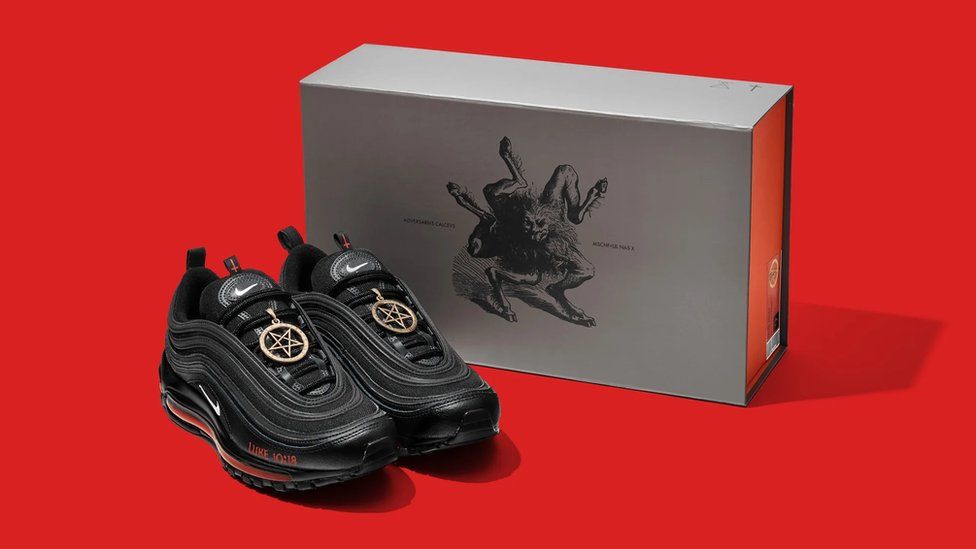
Would you wear shoes with a drop of human blood in the sole?

Nike sues over 'Satan Shoes' with human blood - BBC News

I mean, given the $1018 price tag, and the fact that they sold out in mere minutes, you almost certainly won’t get the chance. (Unless it’s your own blood. But that seems to miss the point a little bit. This is *somebody else’s blood* sloshing around in the sole of your shoe. Mixed with paint, of course, but it’s in there.

Note, also, the pentagram medallion on the laces. And the inverted cross on the tongue.

Nike is distancing themselves from the shoes, of course, saying they never manufactured them that way, and that’s fine. Lord knows they don’t need the religious masses picketing.

But that’s the thing, right? It is so easy to rile up religious people, and Lil Nas X has done it purely as a troll. Just because he can. There’s this big kerfuffle, now, over these shoes…. and if people could just chill out, recognize a troll for a troll and, you know, *not feed it*, the buzz about these shoes would disappear practically overnight.

But some people — and I’ll even go so far as to say some *types* of people — can’t leave it alone. This is symbology that *means something*, they cry, and out come the cries of blasphemy, etc etc.

There is nothing evil about these shoes, except for the backlash. These are man-made materials made by actual human beings to make a buck. There were no devils or demons involved. You can’t even argue that the blood is serving some nefarious purpose. It wasn’t harvested from unsuspecting children sleeping in their beds, or drawn unwillingly from a virgin sacrificed on an altar above a volcano. No, a bunch of shoe-designing nerds drew their own blood and mixed it with some paint and put it in the soles of the shoes to grab a headline.

The symbology is only as powerful as we allow it to be, folks. Yes, an inverted cross and a pentagram have connotations for those of us with religious backgrounds. But are we to believe that this kid — who comes from a few miles down the road from me, it turns out! — is really practicing Satanism here? Just look at what he’s said in response:

Nope, he’s trolling. And if you’re upset about these shoes, well, you were his intended target.

Godless Neighbor


We got one of those church mailers the other day. You know, envelope written out by hand, and inside there’s a brochure with a smattering of scripture and a blurb about the church, usually with a little note like “hope to see you there!” These I put directly into the trash.

At least, that’s what I thought this was. In this one, however, was the obligatory brochure, but also inside was a little handwritten letter. “in these trying times…” “need for community more than ever…” “God’s love will provide…” all that stuff.

And, I dunno, maybe because my neighbor went to the trouble of sitting down and writing out this letter (and for goodness’s sake, I imagine he wrote out hundreds — our neighborhood is huge), I felt compelled to read it.

And because I’m a godless heathen, I also feel compelled to respond.

Here is the letter I will not be sending in return.

Dear neighbor,

Thank you for your invitation.

I will not be attending your church. I do not think you should attend your church anymore either. You rightly point out that the world is in disarray and that we are isolated due to Covid. If you think that God is the answer to all these problems, I must ask you — where has God been up until now? Is it not Her will that all this should have transpired exactly as it has?

Are not the 200,000 American deaths from Covid part of God’s handiwork? If not, why has She not saved those who have died, or answered the prayers of those who have lost friends and loved ones? Is not the animosity so many Americans feel for their countrymen of a different political persuasion exactly as God intended? If not, an all-powerful God could surely unite us. Is our isolation due to the outbreak not God’s will? If not, why has She cursed us with such a deadly and highly contagious plague?

And is it God’s will that we now congregate, in an enclosed space and in great numbers, to aid in the transmission of this plague, to our entire community?

God is not the answer to our problems. Only we can help ourselves, and I will not bring my family to a super-spreader event to hear tales and celebrate the glory of an invisible creature who “loves us” but who also visits such terrible suffering upon us. I advise you likewise to abstain from such endeavors.

Yours,

Your godless heathen neighbor

Ahem.

My dad told me recently that I sometimes lack tact.

But if somebody’s gonna send me a hand-written letter, I feel like they at least deserve a response.

Rest assured, I will not send this letter. But it is what I will be thinking when I compose something a little less harsh.

Slightly off-topic: I know *I* see these things and simply toss them in the bin, and think no further about it. I imagine most people do the same. I wonder what the sentiment in my neighborhood would be if I put out an Atheist brochure of the same tenor?

Something tells me it would not be nearly as charitably received. In fact, I wager I might have some God-loving souls knocking on my door or complaining to the HOA.

No Thanks, We’ll Just Hope and Pray


They say that God laughs while you’re making plans.

What has been particularly frustrating to me in the United States over the past few months has been watching other nations not only not be affected as gravely as we have been by the pandemic, but watching them get the outbreak under control in relatively short order. This is actually painful to me. It paints the stark picture that things did not have to be the way they are… a thing that’s always true but which is thrown into particularly sharp relief when things in your neighborhood are, to put it bluntly, crap.

And let there be no mistake; things are crap, here. Cases and deaths are at their highest levels and show no signs of slowing. You can’t even say we’re in a second wave; the first wave never stopped, it only slowed down a little bit.

But worse than the way things are is the way people are acting.

I don’t know how it is in other countries, and I am well aware that jerks are in short supply exactly nowhere when humans are involved, and entitlement is by no stretch an American disease. But here in the States — and, I would argue, especially in the South — we have a lot of entitled jerks that are making things very hard for the rest of us, and making it impossible for us to get a handle on the disease, much less get the stranglehold on it that we need for life to go back to normal.

And that’s been the thing. We hear so much and talk so much about things going back to normal, but there are so many problems with that. Two major ones, as I see it.

One is, “normal” is subjective, and whatever “normal” we get back to is not going to be the same “normal” that we left. Yet so many people seem to think that we’re just going to go back to living our lives exactly the same way we were doing in 2019. But we can’t. Even when we get this disease under control (and I’m now convinced that, in America at least, “under control” means we have a reliable vaccine, but we’ll come to that), nobody’s going to forget how quickly and catastrophically things spiraled out of control. Even if you take the factor of the disease out of it, we now have a really good look at how fragile the economy is, how unstable several job classes are (look at all the restaurants closing their doors), and what a rift this has opened up between people socially. “Normal” post-COVID will not look like “Normal” pre-COVID. It just won’t.

Two is, we want to get back to normal, but apparently we’re not willing to work to get back to normal. This may be kind of obvious, but it’s the sort of thing I key in on as a self-proclaimed storyteller and student of character. Look at any story. The hero wants a thing, and that want causes them to do things. Luke wants off his backwater planet, so he leaps at the chance to leave it. The Dude wants a new rug, so he seeks out the other Jeffrey Lebowski for compensation. The progression is usually pretty straightforward, and it usually makes sense.

Here in America, and especially in the South, we want to get back to normal, but so many of us — too many of us — don’t actually want to do anything to make it happen. Again, this is perhaps more of an American problem than it is for many other places in the world, but we are especially concerned with “freedom”, and there is a subset of our population which is not only concerned, but obsessed with freedoms at the expense of anything else. So even though science shows pretty definitively that some measures can be pretty effective in halting the spread (wearing masks, staying home, etc), there are a lot of people (more than I would have guessed) who simply won’t be told what to do. And because these people vote, and mobilize others to vote, very aggressively, we have leaders who think the same way, or who at least perform as if they think the same way (which might as well be the same thing).

Which leaves us with a string of pathetic half-measures against this disease as opposed to forceful, definitive action. Here in Georgia, we don’t require masks to be worn out in public; we only strongly encourage” their use. But you don’t have to be a genius to know that if it’s not required, lots and lots of people aren’t going to do it. (Consider what the roadways would look like if the speed limit were not a legal requirement, but was only “strongly encouraged”. Or if stop signs were only a suggestion.)

And now we are on the precipice of opening schools up again (even though figures in virtually every state are worse than they were when we closed them down back in march). And we get more half-measures. I can only speak for my own area, where we are opening on-schedule, with virtual learning an “option” but not a requirement (most students will be in class a week from today). Masks are “recommended”, but not required. Social distancing will take place where it is “practical”. Fine Arts programs are essentially shut down — chorus classes are not allowed to sing, band classes not allowed to play instruments — but sports are going full-speed ahead. Contact tracing is limited and on the honor system (the county is not doing any testing; if a student feels ill, it’s up to them and their family to get tested — or not, if they don’t feel like it!)

But we are opening up regardless — because we are determined to get back to “normal.”

Problem is, this isn’t normal. School with all these caveats and hedges and limitations isn’t “normal”. This is a patchwork of half-measures, a cavalcade of procedures and guidelines which might sound good on paper or in a sound bite but which begin to fall apart under the slightest bit of scrutiny. Any teacher or parent knows that even under the best of circumstances, a school is a petri dish and students are walking bacteria.

We’re not doing the things that would help us to get what we actually want.

What we are doing is waiting for a miracle.

But I, as a teacher of drama, can assure you: waiting is not action.

Hoping and praying is not action.

Newton’s laws are definitive for describing motion in the universe, but they tend to be true for people too: an object at rest will stay at rest, and an object in motion will stay in motion, until acted on by an outside force.

Waiting, and taking half-measures, is simply wasting time until something bigger and stronger takes action instead of you.

They say that God laughs while you’re making plans.

But while we’re waiting for a miracle, this disease is cackling its head off.