Sidewalk (Lack of) Wisdom


I was out for a run yesterday when I did something I haven’t done in a long time.

I fell.

Not like a stumble where you catch yourself and you recover, a little embarrassed but otherwise unharmed,  or a slip on the ice that drops you to your backside, sore but at least safe in the knowledge that it could happen to anybody when it’s snowy and icy out and this is Atlanta, after all, who even knows how to deal with ice in the first place?

No, this was a full-on, sprawled on the ground, call-the-paramedics-because-that-old-guy-probably-busted-his-hip fall. A marionette with its strings cut. An AT-AT Walker foot-roped by plucky Hothian rebels.

Bad times. Seriously. Since you’ve been grown, when’s the last time you fell? Like really fell?

I’ve stumbled here and there on trail runs: a gnarled and angry tree root sticks up out of the trail like an angry old man’s cane and it snags your toe as you shuffle past. Luckily, on the trail, you’re either all alone for miles in every direction or accompanied by some like-minded lunatics who have taken their fair share of trail tumbles themselves, and who are therefore likely to be sympathetic if you go down.

And I’ve clipped my fair share of curbs on suburban jaunts, but somehow the physics of shorting a jump don’t seem to send you sprawling the way I went sprawling yesterday.

I was cruising down a very familiar route when I noticed a trio of benches in front of a restaurant I’ve run past close to a hundred times. “Huh,” I thought to myself in that weird self-reflective echoey whisper, “Have those benches always been there, or have I just never noticed them?” Next thing I know, my foot is arrested violently mid-stride and the concrete is rushing at me like that guy I owe money to for things we won’t be discussing here.

No escape. I’m going down. I try to tuck and roll, but the momentum is all wrong, and my toes feel like an elephant has stepped on them, so there’s no pushing off or changing direction. *Wham-scrape* goes the knee, *Bang-skid* goes the elbow, and I sort of weakly flop over onto my back.

Before I notice anything else, I notice the truck stopped at the traffic light not fifty feet away from me. I wonder if he saw me go down (virtually impossible that he wouldn’t), then ponder what would be worse: if he pulls over to offer me assistance, opens his window and laughs at me as he drives by, or simply drives off and leaves me wondering. Thankfully, he rolls off.

I lay there for a few minutes on my back, staring up at the really remarkably clear blue sky. Gorgeous day, actually. I curse at myself audibly, because fargo the delicate sensibilities of anybody who might be passing by. I mentally assess the damage. My left knee and toes hurt like the dickens, but I can move them, so that’s good. I feel like a right stupid idiot, but there’s no lasting damage in that. I sit up, dab at the blood pooling on my knee, prod at my toes. Hurt, but probably not broken. I rise and hobble to the bench — the one that distracted me just a moment ago, how convenient! — and sit there to ponder my life for a moment.

From here I can see clearly the tiny — and I do mean tiny — jag in the sidewalk. A tree overhangs the sidewalk, its roots scrambling out like the capillary roads in an atlas. The roots have obviously pushed the sidewalk up over time, about an inch and a half. My toes (and I was wearing my Vibrams at the time, which means for this particular purpose I might as well have been barefoot) smacked into that tiny outcropping, and that was that.

It occurs to me, too, while I’m sitting here, staring down the sidewalk like it stole my date for the prom, that this is something that should never have happened. I’ve run this route 50 or 60 times over the past few years — maybe closer to 100. Usually in the lazy half-light of sickly streetlights at 5 AM. What business do I have tripping on a plainly obvious imperfection in the sidewalk — one I regularly traverse without even thinking about it in the darkness — in the blazing light of day?

And there it is.

(Things always mean things, right?)

(Of course not, the universe is a whole sort of general mish-mash of unconnected events and meaningless coincidences. But it’s fun to pretend.)

(Where was I? Right. The blazing light of day.)

The lights were on.

I run this route about once per week, but always in the dark. It’s easy to get tunnel vision when you run at night (or in the stupidly early morning), watching only the ground in front of my feet — there’s nothing else to see. But Sunday, the lights were on, and here I was able to notice all sorts of things I never give second thought to: look at the ivy spilling over that fence like a bunch of intestines from an open gut! Check out that crack that runs right down the center of the street, like a subterranean city is pushing up from underneath! Look at that bench over there, I bet I could jump over it in one go if I — SMACK.

There’s a moral here about sidewalks, and that moral is: never look around. Always keep your eyes straight in front of you and never deviate from the sidewalk.

No, wait, that’s not right.

Watch out for sidewalks. They are tricksy and not to be trusted.

Er, that’s not it either.

Don’t take sidewalks for granted. They mark a path that’s cleared and generally trustworthy, but that doesn’t mean you can turn your back on them.

Yeah, that’s better.

Except change “sidewalks” for “life” and I think we’re closing in on something useful that can be taken away from all this.

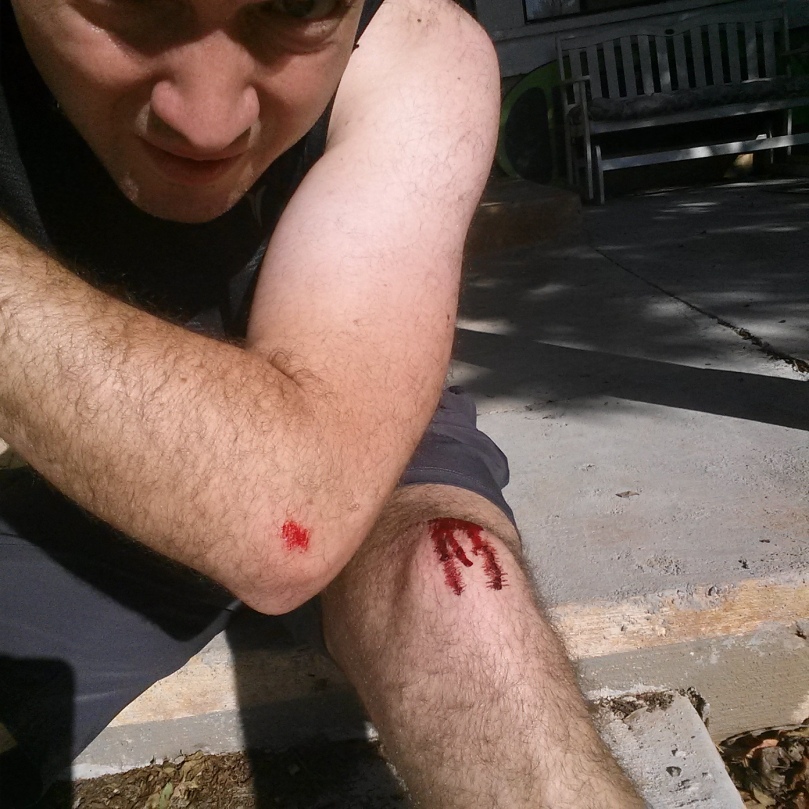
I took a sidewalk for granted, and ended up with a shredded leg and horrifically stubbed toe. And it’s making me wonder: what else am I taking for granted every day? What else is lurking there, just under my foot, waiting to put me on my ass if I lose focus for just a fraction of a second?
20160522_085949.jpg
Never mind the farmer’s tan and ridiculous amounts of body hair. Focus on the coagulated gore.

Oh, and in case you were curious: I finished the run.

On Graduation and The Accomplishment of Things


All around the country, high school students are graduating. Throwing off the shackles of childhood and becoming adults. Getting ready to take the next big steps in their lives.

As much as the graduation ceremony is a pain for teachers (we get to haul the chairs out, stay late after school, put on silly outfits, and smile at everybody we see), it’s kind of awesome, too. Far be it from me to attach symbolism where there is none, but there’s something about seeing the students dressed up in their caps and gowns and tassels and stoles that somehow washes away a year (or more!) of silly behavior in a classroom and makes you think they’re going to be all right.

Still, they’re not done yet. Like a cake being checked by an overzealous baker, they need to cook a little longer. And as anybody over the age of thirty can tell you (with no hint of doom and gloom at all, naturally), it only gets harder from here. Whether it’s college or the armed forces or an early entry into the school of Real Life, it will quickly become apparent that high school was a milk run.

So, a double-edged bit of advice for anybody on the cusp of a great thing: Don’t be afraid to brake, but don’t break.

First, don’t be afraid to break. The sharknado happens fast in this world, and as Ferris Bueller said, “if you don’t slow down and look at it once in a while, you might miss it.” It’s true: the time seems to constrict around times of great import. The last few weeks of the semester fly by. You just can’t stop writing (or reading!) when you get to the end of the novel. And deadlines never approach so fast as when they’re right on top of you. Before you know it, the next thing will be here, and while it’s easy to shift your focus from what you’ve just finished and go straight into worrying about the next thing, don’t forget that there’s life happening everywhere all the time, spilling out of the cracks and gaps in your schedule, oozing out around the corners of all the things you have to do to get ready. Pump the brakes. Slow down for a minute. Enjoy and appreciate the world around the outside of everything that has to be done.

Animal, Lioness, Lazy, Rest, Predator, Cat

If you don’t take time to slow down like this every once in a while, you’ll burn out and lose the drive to do even the things that matter to you. But that brings us to the second part: you can’t break for too long. This country is built on towns that sprung up when people headed out west broke down and never got started again. And don’t tell me your goal was to make it to Kansas. (Sorry, Kansas natives. Your state is even boringer than a blank sheet of paper; at least you can write or draw on a sheet of paper, or fold it into a totally sweet airplane. All you can do in Kansas is drive through it for hours, never sure if you’re actually making any progress.) Your momentum in life matters, and if you don’t get moving again soon, inertia will swallow you like a black hole and you’ll find yourself sucked into the gravity  of the same old path of least resistance. Pull over for the pit stop and look around, but know when it’s time to get moving again.

In short, enjoy the summer after your graduation — or a week or two of rest after finishing that big project — or whatever it is that you need to recharge your batteries before you move on to the Next Big Thing.

Road, Straight Road, Route, America, Usa, Freedom

But then, get moving toward the Next Big Thing, before it drives on down the road without you.

This weekly remotivational post is part of Stream of Consciousness Saturday. Every weekend, I use Linda G. Hill’s prompt to refocus my efforts and evaluate my process, sometimes with productive results.

You Can’t Fix It In Two Days


Once, there was this guy.

He taught high school, and he was at least passing average at it.

And for months he told his students that grades are cumulative, and that work left til the last minute would become unmanageable and impossible to finish on time and would make everybody’s life harder.

But as everybody knows, students of high school age have already learned everything they need to know about the world, and furthermore, they’re not interested in the half-baked school or life advice of a guy twice their age, thank you very much.

Then, when the last day of the semester drew near (as it inevitably does — time is insatiable and all that), the students realized that their grades were not what they wanted. And the time of the great panic began, as it does every year, and as it will every year without end, amen. The teacher’s door was beset in the wee hours of the morning by the very same students who had scorned him just a few short months ago. The teacher’s inbox was inundated with e-mails asking for details on that one project, um, I think it was on Antigone? The teacher’s phone rang non-stop as parents, suddenly realizing that their children might not pass and might not graduate and might therefore live in the basement forever, became infected with the panic as well; calling to beg, to plead, to cajole and to appeal to the goodness in the teacher’s heart.

Unfortunately, there was no goodness left in the teacher’s heart. It had burnt up like the last log on a Christmas fire, it had blown away like the leaves on an Autumnal wind, it had withered and rotted away like an overripe banana. After the months of banging his head against the wall, trying like hell to get the students to take an interest in themselves and their futures and maybe, I don’t know, just maybe, putting the cell phone down for a second, all that was left of the teacher’s good will was a shriveled husk, a sad, blackened, neglected scrap of cardial tissue.

And the cries of student and parent alike fell not upon deaf ears, for the teacher was more than happy to listen to their tales of woe and recount them over a glass of wine with his wife or to blarg about them anonymously on his tiny corner of the internet (being sure to omit all personal details and thus absolve himself of any legal liability, naturally). No, the teacher’s ears were not deaf to their pleas, but his ears were indifferent as the sunrise. For you can no more undo in a few days of frenzied work what you have spent an entire semester building.

Momentum matters.

So has it been for ever. And so, sadly, shall it be for all time.

…And that’s why I haven’t been posting a lot lately. Regular programming will resume when the summer gets here. If the apparent flow of time over the last few weeks is any indication, that should be in approximately three years.

The Power of “If”


If there’s one word that drives creativity, it’s if.

Wouldn’t it be cool if a mountain could come to life and tell you a story? 

What if evil space monkeys descended in little silvery spaceships and started grooming everybody for fleas and nits?

How about if your Math teacher were secretly a piece of sentient toast, and nobody knew it but you?

I was involved with the theatre (yes, that’s theatre with an -re and not an -er, you philistines) for many years, and as any student of the theatre knows, one of the most powerful and most basic tools in any actor’s toolbox is Stanislavski’s magic if. The actor must behave as if it is vitally important to him that he not upset his deranged disgruntled insurance salesman brother. The actor must act as if her next word might summon Cthulhu to destroy this universe.

These things are, of course, not true. (At least, not in this dimension.) Therefore the actor must construct similar circumstances to represent the appropriate mental and emotional state.

My brother is not a deranged insurance salesman, for example, but I  do have a brother-in-law who does classified work for the military,so it’s probably best to be careful what I say to him (or post about him on a public blog). And the wrong word might not summon Cthulhu, but the wrong word can most certainly send either of the sprouts into a screeching, banging-on-the-walls and flailing-like-a-cat-in-a-Christmas-sweater-fit, which is close enough to the same thing for my monry.

The magic if drives the actor, and in much the same way, it drives the writer.

The writer gets to imagine how the world would be if people were different. If the rules were different. If gravity were different. If biology were different.

And whereas the magic if opens up the entire range of the human experience to the actor, the writer’s magic if is greater still: it grants him the power to recreate reality itself.  To make world’s as big or as small or as strange or as perfectly normal as he chooses.

We are limited only by our imaginations, and perhaps even those limits are waiting to be broken as well.

idea-1296530_960_720

If only we have the courage to follow our minds and our pens.

(Okay, our keyboards. Jeez. You try to be a little poetic…)

This weekly remotivational post is part of Stream of Consciousness Saturday. Every weekend, I use Linda G. Hill’s prompt to refocus my efforts and evaluate my process, sometimes with productive results.

Lose Yourself on the Trails


I’m a creature of habit and routine. (As are we all.) The only way things work in my life is if they find a way to fit into the routine. That goes for writing, obviously (which is one reason I haven’t written much lately: because the school year is almost out and that’s basically like tax time for an accountant). But it’s true for running, too.

Any exercise routine needs … well, it needs routine if it’s going to work. You can’t just squeeze it in when you get the chance, because who ever really feels like running three miles just because? (Well, aside from lunatic runners like myself.) The routine is what keeps you honest on a day like today, when I shut off my alarm and laid my head back down instead of getting up to go run, and then 15 minutes later the guilt took over and I suited up for a couple of miles anyway. And my routine works because it’s simple and accessible: I just step out the front door and go. If it wasn’t that easy, I wouldn’t be a runner.

And I live in the suburbs, so the runs are routine, too, even if I change up my route. There’s no danger of getting lost. No chance I’ll be unable to find my way back. When you’re in town, even one that isn’t familiar to you, there are landmarks everywhere marking the safe path. Buildings. Street signs. Rusted out shopping carts in the ditch. You can see these things and construct the path that brings you back.

Which is awesome, but let’s agree, pretty boring, too.

Which is why every runner should take it to the trails every once in a while.

20160404_083206.jpg

I could go on about the physiological benefits to running on trails (dirt is softer, ergo easier on the legs and feet; the uneven surfaces force you to recruit more stabilizing muscles and result in a better workout; the roots and rocks in your path force you to be present and focused on what you’re doing), but that’s not why I like trails.

I could also extrapolate on the mental benefits of the trail (studies show that proximity to nature confers clearer thinking and reduced stress levels; the smog is replaced with the flowery, earthy scent of nature; and let’s not underestimate the value of not having to dodge traffic), and those are great, but they’re not my favorite thing about trails.

I like trails because you could get lost out there. Even on the well-cultivated, clear-cut trails at the parks and preserves near my house, there are side trails and detours and twists and turns not marked on any map that, were you to ignore good sense and plunge in unprepared, could turn your one-hour excursion into a two-hour one, at the very least, or a three-day-weekend surprise-camping-trip at worst. Landmarks are few and far between if they exist at all. What you’re left with is a boundless sea of green all around with a tiny ribbon of dirt that swerves off into the thicket. Not much way of telling where you’re going, nor of telling where you’ve been. One tree looks much like another, and when the canopy grows together over the top of the trail (as it does on most of the trails I frequent), you don’t even have the sun to help you navigate.

You’re lost, except for the blind trust that you’ve read the map correctly (which, let’s be honest, you probably haven’t).

wpid-20150509_091438.jpg

And this is the best part! Because this is when you realize that for all that humanity has tamed the world and the wilderness, there are still great stretches of it everywhere, just waiting to swallow you up. Which is — wait for it — just like writing.

You start your project with an idea. Maybe you map it out deliberately and painstakingly, or maybe you just jump in and start writing. One way or another, you take those first steps off the well-cultivated road and pretty soon it’s nothing but identical trees in every direction but for the tiny scrap of trail disappearing behind you and stretching off into more trees ahead. And your cultured, educated brain tells you that it’s not so far ahead that the trail should jerk hard back around to the right — the way back to civilization — but all of a sudden the path dips and bends off to the left.

Was that the way? Or are the woods playing tricks on you? Suddenly you’re filled with uncertainty, and you think you’re heading in the right direction, but all you really have is your hope. That, and the tiny bit of story you just wrote and the tiny bit you can see from where you stand. Every now and then you break through — the canopy parts and you can see for a stretch down the river or across the valley — but in moments, it’s all swallowed up again in the green maw of the forest.

As runners, I think we have to leave behind what we know and go get lost every once in a while. Partly for the benefits it confers, but mostly because running is one of the few sports that encourages us to enter and explore the world all around us in its natural state.

And as writers … well, I think as writers we should maybe spend more time lost than found.

Happy trails.