In short, a cleric asked his congregation (is it called a congregation in Islam?) if anybody did not love the prophet Mohammed. A young man, mishearing, raised his hand, and was called a blasphemer by the cleric. In response, the young man went home, chopped off his hand — CHOPPED OFF HIS HAND — and later presented HIS DISEMBODIED HAND to the cleric on a plate. All to prove the depth of his faith.
He is, apparently, being hailed as a hero by his community. The young man. Who cut off his hand. To add further insult to injury (pun seriously intended), apparently the boy’s father is proud of him.
Look.
Obviously this story doesn’t give all the details, but it’s hard to say that this is anything other than a young man who has willfully disfigured himself over a misunderstanding. He is now, and will forever be, crippled by his own hand because he felt so strongly about his religion.
But this is what we do to ourselves. And his community is calling him a hero.
Okay, seriously this time. I’ll get off the (anti)religion kick. Regular programming will resume.
I “came out” yesterday, but I didn’t tell the whole story.
I’m not here today to tell the whole story, either, but I do want to tell part of it.
I started this post once and then threw the whole thing out. I had hacked together a list of the big reasons why I believe what I believe and gave brief explanations and justifications. (Lack of evidence. Bible and other holy texts contradict themselves. Problem of evil. So forth.) But then I realized, there are other, better, cleverer sources out there for all the standard atheist talking points. Seriously, every atheist has a post like this. And not just because I didn’t want to overtly follow the crowd, but I realized that as much as all those well-stocked, off-the-shelf answers do apply to my beliefs, the big guns — the personal stuff — the story are maybe a little more interesting.
And I fancy myself a storyteller, after all. So.
I stopped going to church when I was a teenager, maybe partly because I started to catch the whiff of BS from the whole thing, but mostly because I was lazy and didn’t enjoy it. Thus was my belief put on an ice floe and set adrift to wither and die as I went off to college and began to really learn things about the world. Probably the near-daily occurrence of encountering a fire-and-brimstone street preacher pounding the bricks at the Tate Student Center at UGA fueled my growing doubts about the beneficent nature of religion in general; these guys (and they were always guys) would scream death and damnation on gay students, on sexually active students, on basically anybody who walked by. Not a good look for Christianity, even if, to be fair, those angry handful are a pitiful minority.
I guess that was when I became an agnostic; neither believing in nor disbelieving in god. Organized religion was right out, but inwardly I determined that maybe it was possible that a well-intentioned god had set the universe spinning and was unable to control it or interact with it much beyond that point, sort of like a kid who folds up a paper airplane and tosses it off the top floor of a skyscraper. I stayed there for a while, just sort of grinning and bearing the devout types while shaking my head and pitying the true atheists.
I think even then I felt it was better to believe in something than in nothing.
But then I had a kid. (To be fair, my wife had the kid … I mostly wandered around in the background and tried not to pass out.)
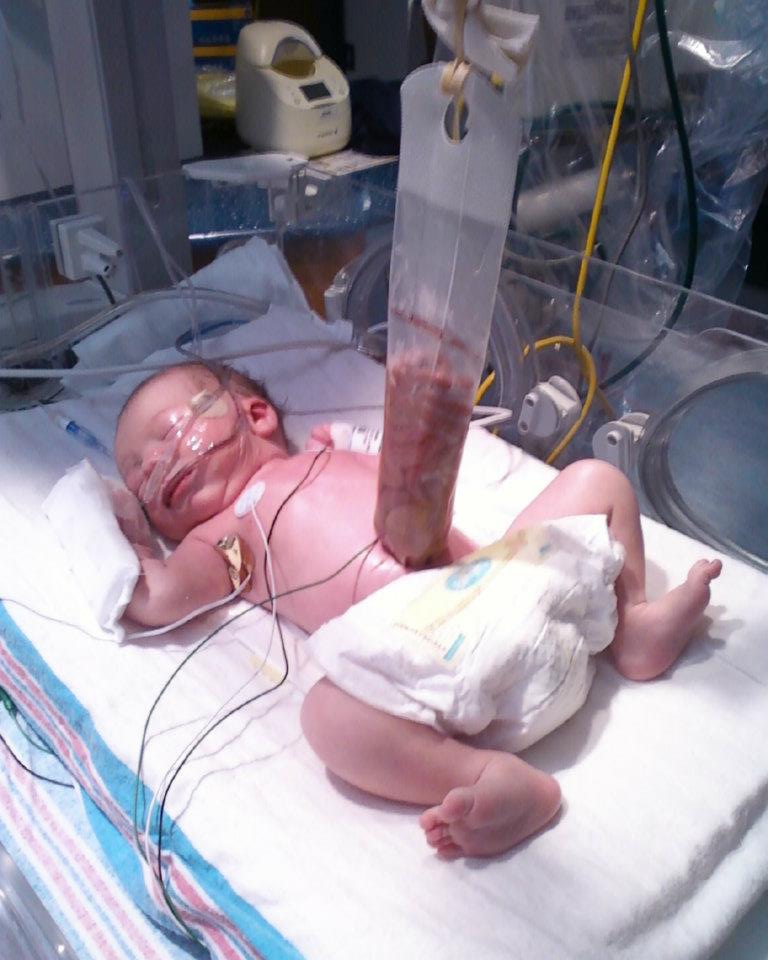
And our kid had a birth defect.
My son, 1 day old.
He had gastroschisis, which in short, meant that his intestines spilled out of his abdomen in utero and had to be, for lack of a better term, stuffed back in after birth. To be fair, on a sliding scale of birth defects, to quote our specialist, “this is the birth defect you want.” In the vast majority of cases, children with gastroschisis make full recoveries.
And he’s lucky. We live in the 21st century, where medicine is in many cases indiscernible from magic, and our son is now perfectly healthy and will likely never suffer any ill effects from this condition. Had he been born even forty years ago, even surviving would have been a long shot.
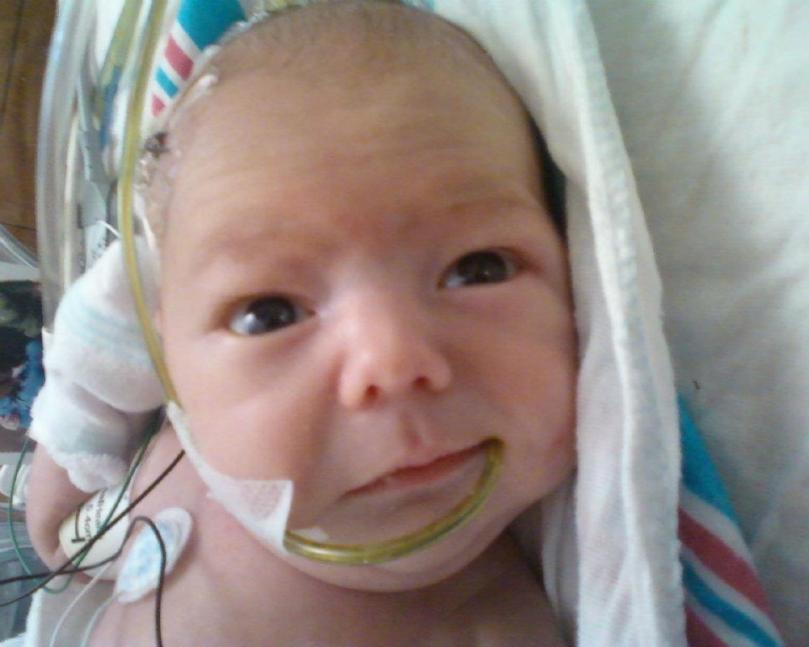
His defect earned him a stay in the NICU for the first twenty-six days of his life. If I needed proof beyond doubt that there was no benevolent god looking out for us, I found it in the neonatal intensive care unit. Here were children — infants, no less — innocent of anything save being born, suffering from all manner of maladies. Some were “minor” like my son’s (though it’s hard to view having your intestines in a bag and being unable to eat except through a tube inserted in your skull as a minorthing). Others were far worse. Birth defects run the gamut from immediately, horrifically terminal to survivable with lifelong care or disability to, as in our son’s case, merely inconvenient. Some of the babies who shared air and nurses and doctors with my son would not survive even the twenty-six days my son was in residence.
And that’s nothing short of tragic.
(Let me sidebar to say that the staff we interacted with were phenomenal. Their jobs put them in the least desirable of situations daily — people are not by and large happy to be spending their days like ghosts hanging around the dim corners of the NICU — but they were soldiers, and they made soldiers out of us.)
Somehow, in those early days, he learned to smile.
I didn’t think about it at the time; I was too focused on my wife’s and my grief and my son’s health during the whole affair. But looking back on it now, that time in the hospital was the nail in god’s coffin for me. I couldn’t — and still can’t — square the idea of a god who cares in any way about the humans he’s created after seeing all those infants fighting for life, breathing and eating through tubes, hooked up to machines — man-made machines, mind you — that gave them their only prayer at life, a prayer they would never have had if all were left in god’s hands.
Yeah, there’s the problem of natural disasters and evil and all of that, and I have trouble squaring those, too. But for me, the question of atheism is a lot more local. A lot more personal. A lot more visceral. And there’s maybe more to be said at another time. But the fact is, as many reasons as I have for what I believe, I only really need one reason.
If we had left my son’s life in god’s hands, my son would be dead.
Now, though, he’s a pretty awesome big brother.
For all that, though, I don’t view the world in a cynical way. Far from it. The world is an incredible place. We are lucky to have even the blink of an eye in which to appreciate it. I am lucky that my son was born in a time when the advances of medical technology could give him a chance at life. And no, I don’t claim to know where we came from. And only a fool would claim to know where we are going.
But we are lucky, and the world is incredible, independent of any god.
As Douglas Adams put it:
Isn’t it enough to see that a garden is beautiful without having to believe that there are fairies at the bottom of it, too?
In the spirit of my post yesterday — What Are We Waiting For? — it occurred to me that I’ve actually been sitting on something for quite a while, just waiting for the right time to say it. But as I pointed out in that post, there is no right time. Waiting around is worthless, it only means more of my time lost hiding something that deserves to be out in the open.
Let’s not bury the lede. I’m an atheist. That may not come as a shock to you if you’re a regular reader: I’ve never come out and said it, but I’m sure it’s bled out around the edges from time to time. But I’m an atheist, and I’m damned proud of it.
This is a weird thing to sit down and type out, not because it’s something I feel guilty about in any way, but because I fear it might make things weird for me. I live in the southern United States, for one — better known as the Bible Belt. I teach at a school where many if not most of my colleagues are outspokenly religious. My family, while they don’t attend services anymore, brought me and my siblings up in the church. (And I don’t think that reading this will surprise them, but that speaks to the weirdness of all this — we’ve never had a conversation about it.) I’ve got sisters and cousins and aunts and uncles and grandparents and a veritable host of in-laws who believe. Add to that that in recent studies, atheists are the most feared and distrusted of all subgroups of people (even more than Muslims!), and it’s no great surprise that I feel a little bit uneasy on the topic.
Let’s be clear. I’m not here to proselytize. (Though the idea of a proselytizing atheist does give me a chuckle.) I’m not what some might call a militant atheist. I know and accept that the vast majority of people aren’t going to have their minds changed by anything I have to say. And if you do believe, I still welcome you as a reader.
I’m just here to say that in the past, there have been things I was afraid to say for fear of offending another’s point of view. There have been things I haven’t said for fear of making others uncomfortable. There have been things I’ve done strictly to assuage other people’s beliefs.
More and more, though, I realize that while I’m trying like mad to respect other people’s beliefs, I am marginalizing my own. While I’m working to make sure I don’t make others uncomfortable, I’m twisting myself up into knots, or worse, just sitting there like a lump, saying nothing.
No more.
Atheism is the next great coming out. And I am proud to list myself among its members.
I’m here to say that I won’t be hiding this particular aspect of who I am anymore. I’m not going to shove it down your throats, either, but it’s too much a part of me to keep it locked up in a closet. It informs my moral decisions, it informs my interactions with the world, and it damn sure informs my thinking and my writing.
Seriously, every one of us has something in their lives that they are putting off. (Apparently the previous sentence is now grammatically correct; thank you, singular-third-person-they.) Whether it’s fear or doubt or uncertainty or perceived lack of ability, we have numerous and convincing excuses for not doing this thing. Those excuses, with the rare exception, are bullshit.
(The above is an absolutely terrible music video for a pretty on-point song.)
Your new year’s resolutions are in all likelihood floating face down in the kiddie pool by now. Forget about that. What’s the thing you really want to do, but haven’t yet? The thing you’re waiting for the right time to do? The thing that, if you had a little more time in your day, you could fit it in? The thing that terrifies you and entices you at the same time?
Sam Harris is responsible for a relevant quote:
Don’t you know that there’s going to come a day when you’ll be sick, or someone close to you will die, and you will look back on the kinds of things that captured your attention, and you’ll think ‘What was I doing?’. You know this, and yet if you’re like most people, you’ll spend most of your time in life tacitly presuming you’ll live forever. Like, watching a bad movie for the fourth time, or bickering with your spouse. These things only make sense in light of eternity.
The fact — and we know it, of course, even if we pretend we don’t — is that we don’t get that much time. Yet we sit around, not doing the things that we won’t admit really matter to us.
So what are you waiting for?
(Stop waiting.)
This weekly remotivational post is part of Stream of Consciousness Saturday. Every weekend, I use Linda G. Hill’s prompt to refocus my efforts and evaluate my process, sometimes with productive results.
Advice I’ve heard more than once says that you should give your projects time to breathe in between revisions. Like, ideally, you should be able to read it with objective eyes, as if you yourself didn’t slave over it for months.
And I laughed at that advice, because I thought it was impossible. And in a panoramic sense, it is. An author can probably never divorce himself so completely from a work as to not recognize it. (Sidenote: I think that may be the first time I’ve ever referred to myself as an author. Feels cozy.)
But that’s the work as a whole. The prose? Oh my god. I’m sixty pages into the edit and … yeah, it feels like some arsehole idiot who basically knows nothing about writing wrote this thing.
And that’s coming from an arsehole idiot who basically knows nothing about writing.
It’s not bad. But man… if it feels this unpolished to me now … I mean, I have to take that as a sign that I’m getting better, right?
Right?
I’m not saying I’m an expert or anything, but … even incremental progress, yeah?
Welcome. This is my page for sharing projects associated with my coursework in Media and Technology at the University of West Georgia. Assignments will be posted here as they are completed.



 Accidentally Inspired