To Extremes


This week’s prompt is “an emotion and its opposite.” Now, the obvious one is love/hate, and that would be an easy one to explore. As a writer, I swing back and forth between loving and hating my work like the tides. Hell, I swing back and forth between loving and hating the craft. But love/hate is obvious.

No, the dichotomy that seems most apt to me is confidence/doubt. These two phases, like the peaks and troughs of a ray of ultraviolet light, alternate with alarming alacrity (triple alliteration bonus, whee).

One minute, I feel at home in the me who is on this adventure. I know what I’m doing. I’m staying smart, looking sharp, making good decisions. Every new bit of text is a good one. Every cut makes perfect sense. Every edit improves the whole. There is no shaking me off the course I’m on as I work inexorably toward writing the best inaugural novel that’s ever been written.

Then the light goes out, and I remember that I’m miles deep in an unfamiliar jungle with the dark rustle of foreboding creatures of the night on all sides of me. That bit of dialogue I thought was scorchingly clever the first time around seems a bit hackneyed upon further review. The character arc I’ve worked so hard to create feels like a flamingo on roller skates; all awkward angles and feathers crashing everywhere. The cut that felt so necessary when I made it now looks like a gaping wound, and the patient is bleeding out.

Then I stop working for a while, and by the time I come back to the novel, I feel like I could drive nails with my forehead again.

Do any other writers suffer from the same up-and-down, hot-and-cold, bulletproof-then-made-of-glass feeling? Do all of them? I have a hard time believing that my sentiments on writing are unique, but by the same token, not every writer can be so schizophrenic.

In fairness, though, the ride is pretty fun. There’s something to be said for riding the roller coaster til you throw up the oversized cotton candy you just horked down while you were waiting in line. Then wiping the pink fizz from your lips and lining up for another turn. Some might call that crazy.

No, that would be me. I’d call that crazy. I’m too old for that sharknado. But the writing, okay. I can handle the swings of that ride.

This post is part of Stream of Consciousness Saturday.

Stakes and the Blarg


Boy, oh boy, do I love a good stake. Charred crust, pink and bloody in the middle, melt-in-your-mouth flavor, rancid farts for the rest of the night…

What? Oh. STAKES.

Woo! Vampire hunters and silver crosses and garlic and…

Huh? Ugh. Okay, fine. Just stakes.

I guess there’s a lot to be said about stakes in writing, but today I’ve got the stakes of writing on the brain. Not least of which because I’m passively reading a book called The Right to Write by Julia Cameron. (“Passive” reading is my pleasant euphemism for “book-I’m-reading-on-the-toilet.”) And… well, for starters, I don’t think I’m this book’s target audience. Each chapter is essentially its own workshop and meditation on some aspect of the writing process, and much of it is the kind of rah-rah-rah-you-can-do-it stuff that would be more at home in a literal cheerleading squad than in a book aimed at burgeoning authors. For another, the tone of the book is through-and-through the sort of hippy-dippy, peace-and-love drivel that can give you a toothache if you swallow too much of it. It’s all “writing is a gift” and “the story speaks through me” and “anybody and everybody is a writer at heart”. Then there’s a lot of meditation on the sun rising over her private valley and rumination on her horses as they watch her through the kitchen window, and that’s about when I really want to induce vomiting so I don’t choke on her privilege. Now, okay, those ideas are lovely and all, but it’s all too Kumbayyah for me to ingest in anything other than the tiniest bites.

I don’t need that. I enjoy writing enough in its own right that I don’t need somebody pushing me to do it or ensuring me that it’s okay for me to do it. Whether or not anybody is truly “cut out” for writing is irrelevant, as any list of bestselling books will tell you. Horrible writers still write. This book is aimed at convincing somebody who’s perhaps too timid to leap into the pond that he might, in fact, have something worth writing about in his mind. It’s designed to invite you into the world of writing one baby-step at a time, by writing first about things in your house, then in the news, then about your family, and blah blah blah. If you’re a sometime reader of my blarg, it’s pretty obvious that I do that stuff on my own already.

That said, there’s something comforting in the way she puts her ideas forth.  And even among the platitudes and smug self-righteousness, there are gems of wisdom, little kernels of edible advice embedded in the stew of saccharine crap.

The one on my mind has to do with stakes, and what she has to say about it is this. When novice writers (and sometimes experienced writers, too) sit down to do their capital-W Writing — be it their novel or screenplay or short story or news article or whatever — there is this inescapable sense of pressure and dread surrounding the act. Because it has to be perfect. If I write something crappy, that’s all anybody will ever remember. It’s all will ever remember. Inability to achieve that perfection and to get all the things exactly right is paralyzing; it can lock up the mental faculties like a bit of chain snarled in the spokes of your bicycle. And this is a fear that I’m on a first-name basis with. (Its name is Todd. Like all horrible things.)

The well-hidden reciprocal of that fear is the fact that so many of us, writers and non-writers alike, engage in writing every day in which we feel no pressure at all to perform at some elevated level. These are your e-mails to colleagues about whatever projects you’re working on, your text messages to your spouse about what you need to pick up at the grocery store on the way home. Okay, it’s not Writing, but they are still words that you form for the purpose of communicating an idea to somebody else… and that’s writing, innit?

The trick, then, is to capture that free, unfazed, not-even-aware-of-any-kind-of-pressure feeling associated with e-mails and apply it to your capital-W Writing, to leap into your manuscript with the same abandon with which you fire off a scathing comment on a message board or a snarky response to your sister’s joke about your mom. It’s hard to do, but I’ve felt flashes of it when working on my novel.

It almost made me mad when I realized it. While I was having a chuckle at all the peace-love-dope sentiment in her book about writing, Cameron had thrown a literary dart and pinned my Id-Writer to the corkboard like a doomed insect. In her suggestion that writing doesn’t have to be this big deal that a lot of people (myself certainly among them) make it out to be, she had explained away the entire r’aison d’etre for this blarg. This is my low-stakes writing. It doesn’t matter what I write here; what matters is simply that I write. That I break apart the dam of mud and sticks clogging up the river of my faculties. That I pull the release valve on the hot-water heater of my brain. That I let the toddler out into the yard to run around in circles and scream its head off so that the adult in my Ego-Writer can get some peace.

This, then, is why we read; this is why it’s important to engage critically even when the subject matter seems like a laugh. You never know when the river of sharknado is going to belch up a hunk of gold. I’m going to keep reading Cameron’s book, even though it irks me, and even though I will no doubt find myself rolling my eyes like a hamster on a wheel at its pithy sayings. Much as it gives me the chuckles, there may just be a few more juicy tidbits in its pages.

Also, it was a gift, and I’d feel really bad about tossing it.

Thanks, sis.

No, not that sister. The other one.

Thanks.

An Idea is Born


The stream of consciousness prompt this week is “scene/seen”, and that feels like kismet. Because if you’ve spent any time around my blarg, you know that one of the things that’s been front-of-mind for me over the last year or so is my novel. And I think so much about what the novel is and what it may yet be that it’s easy to forget what it once was, which was a dumb little scene I wrote for a playwriting class I took in my fourth year at UGA. I say dumb not because I thought that scene was bad (though if I read it again I might have to reconsider that assessment), but because I wrote it almost as a throwaway. We’d been in the class for maybe three weeks, were still learning the ropes, and this assignment was an easy one to get us thinking outside of the box a bit.

“Have a character enter your scene from somewhere unexpected.”

Were you to give me that prompt now, I’d have a hard time deciding which outlandish entrance to use. I’d have somebody come crashing through the window or the ceiling. I’d have an escaped prisoner tunnel up through somebody’s living room floor. I’d have a reincarnated Elvis enter from the bathroom in a cloud of psychedelic lights and smoke. (Okay, so I stole that Elvis entrance from Steve Martin’s Picasso at the Lapin Agile). The problem would not be “how do I write this scene,” the problem would be “how do I choose?”

But at the time, the prompt stymied me. It wasn’t that I couldn’t think of strange entrances — I could — but I couldn’t think of a way to justify any of them. The idea would strike, but I wouldn’t know how to connect it to anything meaningful. Even as I write that, I find myself shaking my head — it was just an exercise scene, it didn’t have to connect to anything meaningful! — but I was stuck. Stuck, stuck, stuck. I sat in front of my computer staring at a blank page for the better part of an hour, unable to write this scene, too nervous to take a chance.

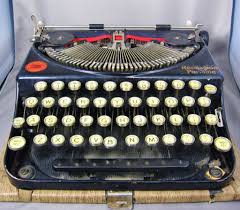
typewriter

The one piece of writing advice that everybody knows is to write what you know. Frustrated with the assignment and my inability to pen even a single word, I fell back on that old axiom. I’m blocked? Can’t crack this scene? Fargo it. And I wrote my character, a frazzled, frustrated guy, sitting white-knuckled and scruff-faced obstinately in front of a typewriter. (Yeah, yeah, I know, I have a thing about typewriters.) I had him struggle and hem and haw and make excuses and bang his head against the wall, and then, finally, he just gave up trying to be creative and wrote a crappy, cliched little scene. Nothing special about it. Except that it appeared out of nowhere (the unexpected entrance, such as it was) and played out right in front of him. Taken aback at first, he spoke to the characters that suddenly existed right there in his crappy apartment. The newly created characters shared their thoughts (this setting sucks! I would never read that book! Why would I even say that to her?), he took their advice, and in a matter of moments he had figured out that the best way to write was to get the fargo out of the way and allow the characters to explore their own situation.

I thought it was crap. I mean, really, I was almost ashamed of it. So ashamed that I almost didn’t go to class the next day. But crappy though it was, I had enjoyed the taste of writing it, so I went. Naturally, the teacher (the inimitable Stanley Longman) called on me as one of the first to present. With sheepish disclaimers, I handed copies of the scene to three of my classmates, who took a few minutes to read over it before assuming positions on the stage. I heard them giggling as they ran through it and thought, great, it’s as terrible as I feared and now I’m going to be exposed for a hack. Then they read the scene, and the laughter continued; little snickers here and there, even a stray guffaw. Finished, the actors took their seats and I sat on the feedback stool, red-faced in front of everybody, and waited to be verbally crucified.

First hand raised, I called on a girl whose name I didn’t know at the front of the room. I’m paraphrasing, of course: “First of all, it was really funny. I loved the interplay between what we expected from his characters and what they really wanted for themselves.” Nods from around the room. Next up, a guy who sat near me and whom I’d collaborated with on an earlier exercise. “I recognize that struggle when I write,” he said, “it was cool to actually see it on stage. And it worked.”

The workshop continued. I got critical feedback as well as praise. But my professor’s comment stuck with me more than any of the rest. He scratched his head and spread his hands like a big grandfather gorilla. “The concept needs a little work, just to polish up the how-is-all-this-happening, and the why. An audience wants that. But it’s funny, you’ve nailed that. Those comedic elements are the hardest to pin down, and you’ve done it. Don’t you think?” He inclined his head past me toward the class, and there were vigorous nods of assent. He chuckled. “I loved it.”

That class was my favorite experience in my undergraduate years. Much though I loved that class, I got distracted from that scene and didn’t think about it for a few years. When I graduated and moved back home, I had the opportunity to work with my old high school and ended up taking the core concept of that scene — an author at war with his characters — and expanding it into a full length production. It went over like gangbusters, and, shock of all shocks, it played a role in my meeting with my wife (her mother saw the show, knew me from my work with a community theatre, and kinda-sorta shoved her in my direction).

Now, eight years later, that stage play is becoming a novel. And I feel the same fears in its formation that I felt in those days struggling with that seedling of a scene: that it’s contrived, that it won’t be funny, that it’s ultimately utter crap. But somehow, this time around, I’m not nearly so fearful as I was. Maybe it’s that I’m older and jaded and I don’t care what people think like I used to. Maybe it’s because I’m more confident now than I was then in the concept and my ability. Maybe it’s because I’m older and losing touch with reality and don’t know well enough to be properly nervous. Whatever the reason, it’s a nice reminder to myself that I’ve had success with this story once, and there’s no reason why it couldn’t happen again.

This post is part of Stream of Consciousness Saturday.

Just Junk


In keeping with my realization and resolution yesterday (not a New Year’s Resolution, just a regular old un-arbitrarily-linked-to-meaningless-space-time-data resolution), I attacked the edit hard today. Lots of parsing, lots of tidying, lots of trimming and sweeping, but no reconstructive surgery. And I was flying. I got through twenty pages, wrote several new paragraphs that needed inserting and deleted a handful that were just cluttering up the joint. Twenty pages in a day!

And as I always do when I’m reading over my own writing, I realized another thing. My prose is lousy with junk language.

It’s a first draft, so I’m not mad at myself, but it was still shocking to see how much I lean on empty modifiers and redundant qualifiers. Prime example? Just.

Not just as in right, but just as in only just. This is a word that’s practically invisible to me in speech — I knew that already — but in my writing, it flows out just as invisibly (see? Just there. AND AGAIN.) To be honest, I didn’t even spot it until I was thirty minutes into my work, and then only because just appeared twice in the same sentence. I’d carelessly used it twice by mistake, but the sudden jolt of reading it twice gave me pause. Then I pondered.

An invaluable tool during the edit has been the “find” feature. I can search for swear words (which need editing out), chapter titles (to track down errant plotlines and quickly navigate the document), and goofy little symbols I’ve thrown in to mark trouble spots. It’s a great tool for making quick work of pervasive problems and finding my way around, but today it found a new task: Seek and destroy.

“Just” went into the finder. Actually, “just ” with a space went into the finder, to weed out any fancy words like justice or justified or Justin (all Justins should be removed from all books, just on principle, but that’s a topic for another post). The result? I had written “just” into the book 358 times. The number as a number doesn’t do itself justice. That’s three hundred, fifty eight times I used the word “just” as a modifier in the course of a book that’s 175 pages in Word. Two per page.

An epidemic.

Out came the scissors and the “just”s began falling to the ground like my hair, back when I used to have enough hair to necessitate going in for haircuts. Fifty of them got cut with no other modification to the lines they appeared in, another fifty got removed with minor modification, and the other two hundred fifty are slated for summary destruction tomorrow. Now, don’t get me wrong. Adverbs have their place. But for me, this junk language is as obvious a crutch as you could hope to see.

I usually like to dig below the surface and make extra meaning out of my issues, but there’s nothing extra in this one. There’s something to be said for conversational tone here on the blarg and in, y’know, conversation. But that junk language creeping into “proper” writing is bad news, and I have a feeling that much like roaches in your kitchen, there are a hundred hiding in the walls for every one that you see in the open.

Too Much Think


There comes a point all things significant in my life wherein I find myself thinking way too much. I thought too much about marrying my wife, about buying our first house, about having kids… and I am definitely thinking too much about the edit of my novel.

I started out, if anything, not thinking enough. Not really wanting to tackle the tough choices, not really wanting to rejigger the narrative, not really willing to tear out the skeleton of the thing to make the changes that are necessary. But it grew on me, and I started to realize that not only are there tough choices to make, but that I often needed to take the harder of the two paths for fixing the problems in the story. And I started hunting down the problems in the narrative like  Indiana Jones seeking golden idols in the depths of Mayan temples. Each new problem solved gave rise to another, bigger conflict I could fix. Each prospective fix, not necessarily right for this situation, took on new significance, grew wings and started looking for problems to apply itself to. And then, a little stymied after a hectic work week, I threw myself at the edit again yesterday and spotted a white whale just lazing about below the surface of the waves on the horizon. A prize so massive, catching her and bringing her in could alter the trajectory of the narrative like a moonshot. It was a job too big for a single day, so I put it on the EPOS and marinated on it overnight.

And I realized something. Drafts of a story are like prototypes before a product launch. None of them is perfect, but each one gets polished to a point where it at least looks and functions more or less as intended. There may still be bugs on the inside, but to an outside observer, it looks like a complete thing. And my edit of this story resembles not so much a prototype as a cluttered workshop after a hurricane and a flash flood. The narrative is in pieces. Loose ends like frayed wires are protruding out of the armholes, eye sockets, fingertips. Entire limbs of the story are disjointedly stuck on with duct tape while other vestigial bits are still cluttering the margins like piles of unswept sawdust.

I’ve been so focused on fixing every little problem along the way that I never bothered to stop, clean up, and see if the thing as a whole is still working as intended. There’s been so much thought about making this little thing fit into its niche that I’m not paying attention to the fact that I’ve stitched an alligator arm onto a panda bear torso. I fear that there’s been so little big picture focus that I’ve created a Frankenstein’s Monster doomed to self-destruct in a boiling froth of unresolved plots and half-baked new characters. In short: I fear that I’ve somehow managed to make this second draft worse than the first.

But you know what? Maybe it is, and maybe that’s okay. If nothing else, it’s time to stop making huge conceptual changes, clean up the dust and debris, and see if this thing can even stand on its own two feet. The first draft did. It was shaky, but it stood up. This second draft? I honestly have no idea. I think it will, but I haven’t tested it properly with a read-through to see.

So it’s time to stop thinking so much. Time to stop trying to fix everything and start making sure that the fixes I’ve made already actually work. Which means no more breaking the story into pieces. No more new characters. No DELETING existing characters. No more rearranging story elements. I need less chainsaw, more chisel. Less dynamite, more sander. Time to sweep up the workshop, put the tools away, and just sit and have another good look at this thing I’ve built. Get a second opinion. Take a bird’s-eye view of the whole scenario.

And then, you know, with fresh perspective, maybe it’ll be time to lop its arms off.