Fear for the Future: Evolution Edition


While discussing current events (specifically the primaries) with my students today, things took a shocking turn.

Students were asking me about Trump, because they’re nervous about what his presidency might mean for the country, and for them personally. Now, I’m really careful to remain as objective as possible, but I also think it’s important to be honest. So I told them why I don’t think Trump could be elected, even if he wins the primary. (I don’t believe he can appeal to moderates, and I think he’ll anger enough Republicans along the way to ensure victory for the democratic candidate, whoever that may be.)

All fine and good. Then another student asked if there were any black candidates in the race. I mentioned Carson, but also pointed out that I don’t think he can win. Naturally, they asked why. And I spoke about how, for better or for worse, the Republicans have amassed behind the three frontrunners, and anybody else — Bush, Carson, Fiorina, et al — are basically muddying the waters at this point.

“But is Carson a good candidate?”

“I don’t know enough to say for sure.”

“Would you vote for him?”

“Probably not.”

“Why not?”

“Well, for one, he doesn’t believe in evolution.”

Silence in the classroom for a moment. Then: “What, you mean like that stuff they teach in science class? That we come from monkeys?”

“Well, that’s oversimplifying a little. We didn’t come from monkeys. But yes, evolution like you learned in science class.”

“Oh. I don’t believe in that either.”

My turn to be silent. A handful of students begin to nod their heads in agreement.

Me: “You guys don’t believe in evolution?”

About a third of the students are shaking their heads at me.

“Darwin? Natural selection?”

Now several talk at once. “That didn’t happen,” or “We didn’t come from monkeys,” or “I believe in God.”

I paused. I’m not a science teacher, so it’s not really my job to go straightening them out on the finer points of evolution. Further, I’m not about to stand up in front of a classroom full of young, impressionable minds, and begin hammering away at their religious beliefs. I like having a job too much to go getting tangled in that debate.

Luckily, another student asked a question and pulled us onto another (less sensitive) topic, for which I was thankful. Not because I don’t want to have difficult discussions in my classroom, but because I really didn’t know how to proceed. I want to foster critical thinking, but I don’t want to offend. And I don’t see critical thinking behind “that didn’t happen” and “I believe in God.” Belief, in that sense, is the absence of critical thought. It stopped me cold. Even some of the smartest students — and when I say “smart,” I’m saying “capable of independent, out-of-the-box thought” — were nodding along in agreement with the roadblock that was thrown down.

This frightens me. I teach a class which has, as some of its primary concerns, the structure of argument, the support of said argument with evidence, and the thoughtful communication of said argument. And this — their knee-jerk, casual and offhand dismissal of a well-researched, scientifically documented theory — well. It frightens me.

The Weekly Re-Motivator: The Anchor


So, you’re a writer.

And you have this project.

It’s a project that you’ve had for months, or maybe even years. It’s a project you return to time and time again, when inspiration for other work deserts you or when a bolt from the blue strikes and you just have to, have to, go work on that project again. Maybe it’s your first project, maybe it’s your latest one, maybe it’s a project you started and forgot about and go back to every few months. When your mind goes blank, inevitably your thoughts turn to that one project, and even if you’re not actively working on it, your brain is always bent toward it.

This project is the anchor.

anchor-954927_1920

Like a security blanket, you need this project. It comforts you in times of need, it fills you with nostalgia; even just opening the file (or turning the pages, or unrolling the parchment you scribed it onto, you insane purist) makes you smile. Like a true anchor, this project keeps you moored. Keeps you grounded. Keeps you from getting off course, keeps you true to yourself — or at least true to the self you were when you started the project. Without the anchor project, you wouldn’t be the writer that you are, you wouldn’t write the way you do.

The anchor project is a good thing.

But the anchor project can’t stay forever.

Like a security blanket, it works wonders for you for a while, but eventually, you start to outgrow it. People stare if you’re still dragging it around in public. It gets threadbare and worn-out, and not even functional for its original purpose beyond a point. Like a true anchor, well, it keeps you from drifting off during the storm, but it also keeps you from letting down the sails and exploring the ocean.

Comes a time when you have to cut the anchor loose, when you have to accept the fact that you’ve outgrown it and move on. When you have to drop the anchor and sail out into the wild blue. When you realize that the anchor is not the project that needs your time, your effort, your constant thought anymore.

Accidentally Inspired has been my anchor project since I was in college, which is to say, for about fifteen years. The idea was born in a scriptwriting class in 2002, I expanded it into a full-length play by 2004, when it actually saw production with my old high school. Then I mothballed it for almost a decade, though I always hung onto the idea of turning it into a novel, and there it nested in the depths of my brain, ripening on the vine.

Well, I’ve followed through on that seed of an idea, finally. I wrote the novel. I’ve revised and edited it through several iterations. I’m working on one last edit now.

And somewhere along the road in this last edit, I realized it’s time to cut this anchor loose.

I love this project. I always will. but the longer I keep reworking it, the more I’m neglecting other stories I want to tell, the more I give in to the fear of putting it out there and letting it walk on its own, like a wobbly-kneed colt.

I’ve got about one more month left in this phase of the work, and then it’s time to pull up roots and let this puppy go.

Bittersweet, to be sure, but the time is right. It’s time to move on.

Am I alone in this, or is there an anchor holding you back, too?

This weekly remotivational post is part of Stream of Consciousness Saturday. Every weekend, I use Linda G. Hill’s prompt to refocus my efforts and evaluate my process, sometimes with productive results.

It’s ALMOST Time


So a weird thing happened.

I was sitting here, working on the novel (you know, that thing I NEVER talk about), and it struck me. I’ve enjoyed the work over the last few days. Really enjoyed it. Story’s pretty good. Like the dialogue. Love the plot. It’s starting to feel pretty close to finished.

So on a lark (literally, I mounted a lark) I googled literary agents in Atlanta.

I’ve done this once before, years ago when I wrote a play that I thought was good. It filled me with faceless dread and mindless terror then, because I knew (or maybe only feared, it was impossible to tell) that the work was … I won’t say bad, but it certainly wasn’t everything it could be. I googled and then I cowered in fear and self-doubt, and I never submitted anything.

But now, I’ve put in the time. I’ve slaved over this book. It feels ready. So I googled for agents, and it didn’t fill me with terror.

It filled me with purpose.

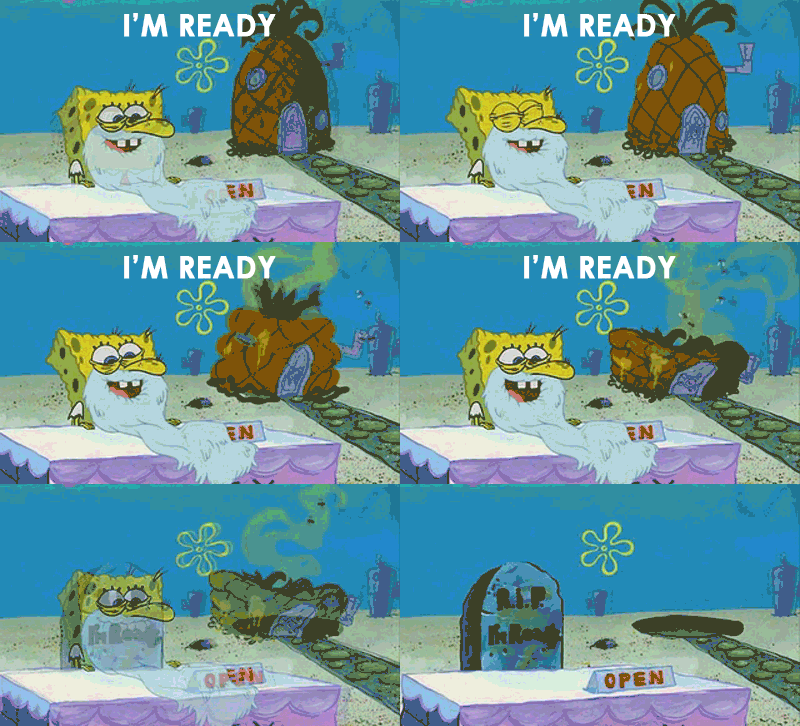
I think the book is ready. I think I’m ready.

I'm Ready

Well, almost ready. Another ninety pages to edit.

But then I’m ready.

So … uh … how the balls do I find a good agent?

Glimpses of Non-Suckitude


I was beginning to get a little fatigued with this latest edit. Cleaning up the junk language, tightening up all the moments, trimming out the unnecessary. It felt like most of what I had written was crap; that it all needed serious work before it could be “ready”.

But I reached a few passages today that absolutely crackle with life and energy. Passages that had me laughing to myself while I sat in my darkened room reading jokes I myself had written, even though I already knew all the punchlines. Passages possessed of a sort of self-evident, unconcerned eloquent beauty, the like of which I would not attribute to myself. Passages that make me think maybe I’m not so bad at this writing thing after all.

This novel (and this blog for that matter) is keenly interested in the question of inspiration: where it comes from, how useful it is, what it can do for you when you have it. And by and large, I have come to believe that inspiration is just a bunch of baloney sandwiches. You either work or you don’t, but some days are better than others.

Still.

As I read my own work of the last year and a half, it’s encouraging — and kind of awesome — to see those flashes of inspiration peeking out through the cracks.

I like to liken (like to liken, tee hee) writing to a long, arduous slog through vine-darkened jungle, or to a hopeless trek in a desert. And it damn sure feels that way a lot of days. But every now and then, light penetrates the canopy and wakes up the critters on the jungle floor, and the rare flowers open their petals to the light. Here and there, water bubbles up to shape an oasis amid the scorching sands.

For now, though, it’s back into the caves.

Save


I’m just gonna say this. Not that it needs saying.

But save your work. Save early. Save often. Save like you’re tapping out the drumbeat of a Bantu dance. Autosave is a lifeline, but that lifeline may or may not be looped around your neck or your genitals.

At least I only lost a day’s worth of work.

Ugh.

Which reminds me… I need to make some backups.