Air Bubbles of Happiness


I remember in the old-school Sonic the Hedgehog games, in the underwater levels (every game back then had an underwater level or six, didn’t it?), there was this great little mechanic. The levels were far too long to make it through on one breath of air (however long an animated supersonic hedgehog can hold its breath), so interspersed throughout the zone were little fizzing fissures that would occasionally burp up a hog-sized bubble of air. You’d jump into it, get a bubble-popping noise, and your little blue guy would have another lungful of air to press onward with.

The game design was great, too, there’d be a little number flashing next to his head to show you how much time he had left, and when the timer was almost out, the music sped up and got all panicky.

But you’d catch an air bubble, and it would sustain you until you could get back above water, or to the next bubble.

Or you wouldn’t, and you’d drown.
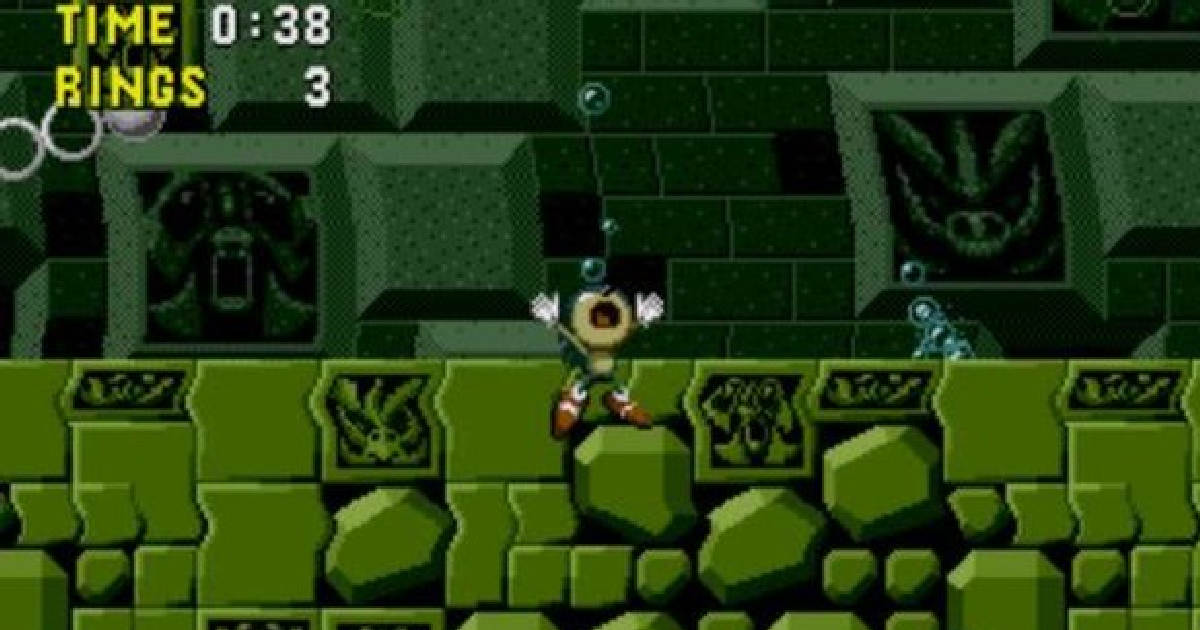
If Sonic Water Levels Gave You Lifelong Anxiety, You May Be Entitled to  Compensation

Anyway, in the few weeks since we’ve been back at school, I’ve had more than one student tell me that my class is the only thing making school enjoyable for them right now.

And I don’t tell them how much it helps to hear things like that, that I’m drowning, that the music is speeding up in my head and I’m panicking that I might not make it to the next bubble fissure.

But they tell me that, and I think of old video games.

My brain is weird.

(Edit: Turns out that anxiety over the Sonic the Hedgehog drowning sequence is a thing!)

Little Things


A reminder that, when things spin out of control and the world is in flames outside your door, the little things can help keep you grounded, keep you sane.

For example:

I had a run this morning, and caught a high off it like I haven’t in a while.

My first sip of tea this morning was at just the perfect temperature.

I re-read my first two chapters to kick off one last editing pass in my book, and I didn’t totally hate them.

These are tiny things — absolutely inconsequential in the scheme of things, and probably totally unimportant in the teeth of 2020 — but they gave me a lift today.

Black Coffee, Coffee, Cup, Desk, Drink, Espresso

We deserve every lift we can catch just about all the time, but that goes doubly and triply for 2020.

A Quickie about Evolution


I teach theatre.

Because I teach theatre, I also teach a fair bit of psychology and sociology.

Because I teach a fair bit of psychology and sociology, I also teach a little bit about evolution.

Why, you ask?

Because it’s useful to know, as an actor, not only that a quick movement is more likely to draw the audience’s attention than a slow one, but to internalize the reason why (because we evolved, as all predators do, to zero in on movement). Or why the audience’s attention naturally shifts to the actor closest to them (because the person closest to you is the one who poses you the greatest threat — so it’s best to keep your eye on them). Or why it’s so important to use the body when telling stories (because we understood pantomime and gesture long before we developed language). Or any number of other curiosities of the brain.

And two things occur to me, every time I go down this road of teaching evolution in a theatre class:

  1. I am very likely teaching these students more about evolution than some science teachers ever will.
  2. There are almost certainly students sitting in my seats rolling their eyes because they have been indoctrinated to believe evolution is not real.

Both of which are pretty shocking. But because 1) is true, I think it’s vitally important that the kids hear it from somewhere. And because 2) is true, it’s important to expose kids to voices that don’t agree with them.

Plus, I just love to get on their nerves.

“Wait, I thought this is theatre — why’s he on about evolution?”

Because my job is to teach the whole child, kid.

A Quickie about a Clippie


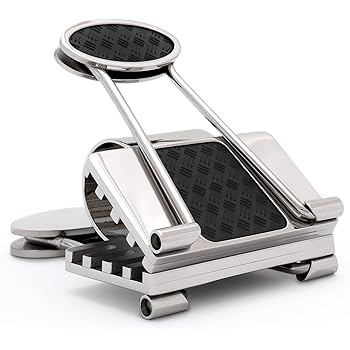
Apropos of absolutely nothing, here is a $100 binder clip.

Put aside for now how you spell the word “clippie” (here I’m talking about a “clip-type-thing” and not an adjective meaning “cliplike” — for which “clippy” would almost certainly be correct).

I don’t really have anything to say about it. I just wanted you to know that it exists.

Speidel Mens Money Clip, Business, Credit Card Holder Engravable Stainless Steel

Okay, so Amazon claims this is a money clip, but, come on. You can’t fool me. That’s a tricked-out binder clip.

I mean, I love binder clips as much as the next guy. Probably more. In fact, I’ll go so far as to say that binder clips are my #1 favorite office supply. (The fact that I care about office supplies enough to have favorites should be enough to tell you that when I say binder clips are my favorite, I’m not just fargoing around.)

And don’t get me wrong. It’s clearly a very nice binder clip.

But — and I feel pretty confident in saying this, too — I am not sure there is a circumstance under which I would pay $100 for a binder clip.

But if one were to procure said $100 binder clip, one would have to feel strongly enough about it to give it a name.

A name like Clippie.

A Quickie about Curves


This pandemic is a lot of things, but one thing it isn’t is confusing.

Viruses are designed (and I use “designed” in the loosest possible sense, i.e. not actually designed but rather shaped by their environment and by evolution) to replicate and spread themselves as efficiently as possible. Some are very good at this and stay widespread and contagious for a long time, others are not so good and die out or are easily contained.

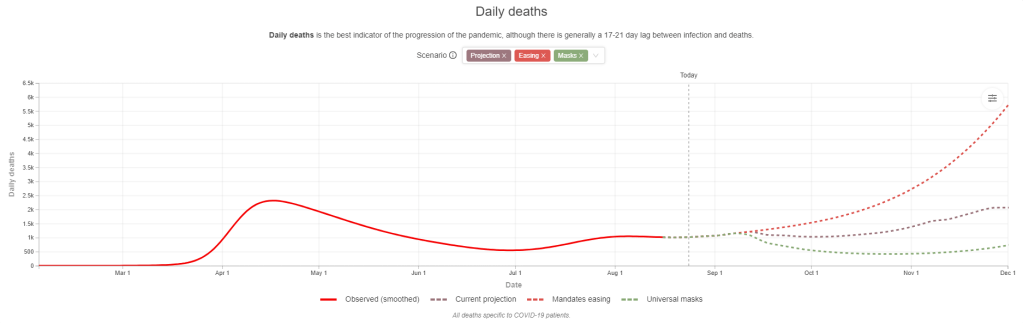
COVID-19 is pretty good at spreading itself. And once you know how good it is at spreading itself, then how it spreads becomes a pretty simple math problem. When plotted out geometrically, patterns emerge in the form of lines and curves.

Blatantly stolen from https://covid19.healthdata.org/united-states-of-america/

These lines and curves are not confusing. As more people are exposed, more people contract the disease, and then those infected move on to expose even more people.

Again, these lines and curves and concepts are not confusing.

And yet so many people you meet in the world seem not to understand these simple concepts at all.

The pandemic is not confusing.

What is confusing is the way people react to the pandemic. Because it is very easy to pretend that it’s not a big deal when it’s not affecting you, but rather those people, over there.

But suddenly, when the pandemic affects somebody close to you, it becomes a lot more serious.

I guess some of us have forgotten that we all live in the same fishbowl.

Fish Bowl, Fish, Glass, Water, Bowl, Goldfish, Aquarium