I am a teacher, runner, father, and husband. I am an author-in-progress. I'm bad at jiu-jitsu. I know just enough about a lot of things to get me into a lot of trouble.
“Did I listen to pop music because I was depressed? Or was I depressed because I listened to pop music?”
To dumbify it a little bit, it becomes:
Does the music we listen to set the mood or does our mood dictate the music we pick?
And to generalize it a bit further, it becomes:
Does our mood dictate our circumstances, or do our circumstances dictate our mood?
I like to think that mood dictates circumstances: that we can choose to think and feel a certain way and thus to take control over how things affect us and how we move through the world. That seems to be mostly true, most of the time.
But it’s not entirely true. Sometimes you can’t put a smile on your face no matter how much you tune up your facial muscles. Sometimes you can’t force yourself to tough it out when you’re totally tapped out.
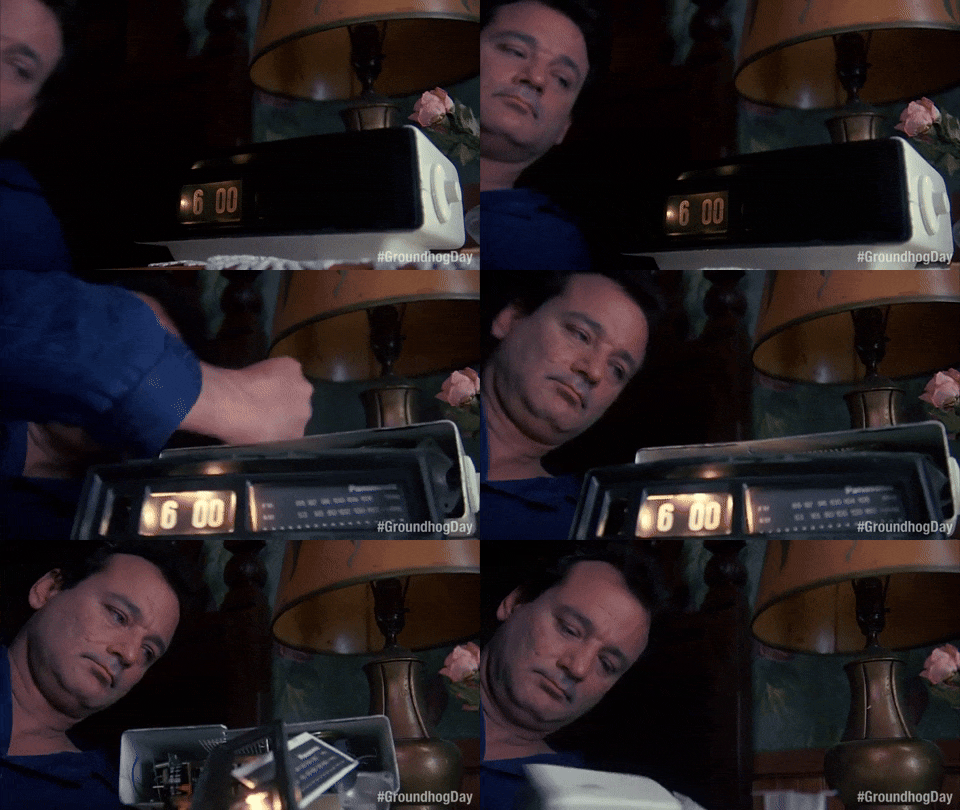
These thoughts fought for dominance this morning as I pressed the snooze alarm instead of getting out of bed to go on my regular 3-mile run. Days when I run are better days. I’m clearer, calmer, better able to deal with whatever comes. Days I don’t? Less so. So to choose not to run — when I’m awake on time, especially, and just feel like sleeping in — is to choose against the rest of my day.
I know this. And yet I snoozed. Because while I recognize that not running is a mistake, I also know that forcing the effort when you’re tired and beaten down beyond reason and it’s only three weeks into the school year is a mistake.
Was I unjustly and wrongly lazy? Or was I righteously claiming a few precious minutes of recuperation?
Did I let myself snooze because I was too tired to run? Or was I too tired to run because I let myself snooze?
“It’s a wonder you’re not in more pain,” my dentist said.
I nodded around a mouthful of q-tips and numbing agents, staring vacantly up into a blinding fluorescent ring. “I guess I’m lucky like that,” I meant to say, but it came out more “ahh gehh ahh luhee li fhaaa”.
(I wonder if dentists ever understand anything we say with all their instruments crammed in our mouths, or if they’re just good at pretending to. Or, maybe more likely, we’re so desperate for any semblance of normality and human contact in such a vulnerable moment that we greedily interpret their disinterested nods and “mmhmm’s” for deep empathy. Either way, the dynamic is very strange.)
He nodded absently and went to work with the drill, while I listened to the music of the vibrations inside my skull.
They say that God laughs while you’re making plans.
What has been particularly frustrating to me in the United States over the past few months has been watching other nations not only not be affected as gravely as we have been by the pandemic, but watching them get the outbreak under control in relatively short order. This is actually painful to me. It paints the stark picture that things did not have to be the way they are… a thing that’s always true but which is thrown into particularly sharp relief when things in your neighborhood are, to put it bluntly, crap.
And let there be no mistake; things are crap, here. Cases and deaths are at their highest levels and show no signs of slowing. You can’t even say we’re in a second wave; the first wave never stopped, it only slowed down a little bit.
But worse than the way things are is the way people are acting.
I don’t know how it is in other countries, and I am well aware that jerks are in short supply exactly nowhere when humans are involved, and entitlement is by no stretch an American disease. But here in the States — and, I would argue, especially in the South — we have a lot of entitled jerks that are making things very hard for the rest of us, and making it impossible for us to get a handle on the disease, much less get the stranglehold on it that we need for life to go back to normal.
And that’s been the thing. We hear so much and talk so much about things going back to normal, but there are so many problems with that. Two major ones, as I see it.
One is, “normal” is subjective, and whatever “normal” we get back to is not going to be the same “normal” that we left. Yet so many people seem to think that we’re just going to go back to living our lives exactly the same way we were doing in 2019. But we can’t. Even when we get this disease under control (and I’m now convinced that, in America at least, “under control” means we have a reliable vaccine, but we’ll come to that), nobody’s going to forget how quickly and catastrophically things spiraled out of control. Even if you take the factor of the disease out of it, we now have a really good look at how fragile the economy is, how unstable several job classes are (look at all the restaurants closing their doors), and what a rift this has opened up between people socially. “Normal” post-COVID will not look like “Normal” pre-COVID. It just won’t.
Two is, we want to get back to normal, but apparently we’re not willing to work to get back to normal. This may be kind of obvious, but it’s the sort of thing I key in on as a self-proclaimed storyteller and student of character. Look at any story. The hero wants a thing, and that want causes them to do things. Luke wants off his backwater planet, so he leaps at the chance to leave it. The Dude wants a new rug, so he seeks out the other Jeffrey Lebowski for compensation. The progression is usually pretty straightforward, and it usually makes sense.
Here in America, and especially in the South, we want to get back to normal, but so many of us — too many of us — don’t actually want to do anything to make it happen. Again, this is perhaps more of an American problem than it is for many other places in the world, but we are especially concerned with “freedom”, and there is a subset of our population which is not only concerned, but obsessed with freedoms at the expense of anything else. So even though science shows pretty definitively that some measures can be pretty effective in halting the spread (wearing masks, staying home, etc), there are a lot of people (more than I would have guessed) who simply won’t be told what to do. And because these people vote, and mobilize others to vote, very aggressively, we have leaders who think the same way, or who at least perform as if they think the same way (which might as well be the same thing).
Which leaves us with a string of pathetic half-measures against this disease as opposed to forceful, definitive action. Here in Georgia, we don’t require masks to be worn out in public; we only “strongly encourage” their use. But you don’t have to be a genius to know that if it’s not required, lots and lots of people aren’t going to do it. (Consider what the roadways would look like if the speed limit were not a legal requirement, but was only “strongly encouraged”. Or if stop signs were only a suggestion.)
And now we are on the precipice of opening schools up again (even though figures in virtually every state are worse than they were when we closed them down back in march). And we get more half-measures. I can only speak for my own area, where we are opening on-schedule, with virtual learning an “option” but not a requirement (most students will be in class a week from today). Masks are “recommended”, but not required. Social distancing will take place where it is “practical”. Fine Arts programs are essentially shut down — chorus classes are not allowed to sing, band classes not allowed to play instruments — but sports are going full-speed ahead. Contact tracing is limited and on the honor system (the county is not doing any testing; if a student feels ill, it’s up to them and their family to get tested — or not, if they don’t feel like it!)
But we are opening up regardless — because we are determined to get back to “normal.”
Problem is, this isn’t normal. School with all these caveats and hedges and limitations isn’t “normal”. This is a patchwork of half-measures, a cavalcade of procedures and guidelines which might sound good on paper or in a sound bite but which begin to fall apart under the slightest bit of scrutiny. Any teacher or parent knows that even under the best of circumstances, a school is a petri dish and students are walking bacteria.
We’re not doing the things that would help us to get what we actually want.
What we are doing is waiting for a miracle.
But I, as a teacher of drama, can assure you: waiting is not action.
Hoping and praying is not action.
Newton’s laws are definitive for describing motion in the universe, but they tend to be true for people too: an object at rest will stay at rest, and an object in motion will stay in motion, until acted on by an outside force.
Waiting, and taking half-measures, is simply wasting time until something bigger and stronger takes action instead of you.
They say that God laughs while you’re making plans.
But while we’re waiting for a miracle, this disease is cackling its head off.
I turn 40 in a week, and I can’t form a coherent thought.
We can put some of that down to the usual summer doldrums — being a teacher, the summer months sort of naturally take on an empty quality, to be drifted through until, in the Fall, the students return, and with them purpose. But I think it’d be a foolish proposal to pretend that the bulk of my ennui isn’t due to all, well, this.
You know. *Gestures around non-specifically*
So instead of trying to put together a big comeback post exploring the vast depths of some weighty topic, I’m gonna dip my toes in lots of pools that have occupied my thoughts over the past month or so since I peeked out of my cave.
In no particular order, then:
We have a new cat. To be specific, we have a new kitten, which is different from having a cat. A cat lies around the house, looks for sunny patches, and generally ignores you. A kitten is a terror in the household: it attacks anything that moves, including but not limited to: the other animals, the kids, the edge of a blanket stirred by the lazy breeze from the oscillating fan, or the piece of fuzz caught in my scalp stubble. All of us have suffered scratches, some of us have lost blood. In particular, the cat loves to lurk under our bed and to pounce on my toes as I walk past, a habit I cannot endorse but which I seem unable to break the little bugger of.
Adorable, but vicious.
My wife has had back surgery. This is not a sudden development; it’s something she’s (and we’ve) been thinking about for years. The surgery repaired a chronic issue she’s had, possibly for her entire life, but which in the last five years or so began to cause her immense pain and discomfort. So they replaced a spinal disc with a composite of stem cells and fused her vertebrae with screws, an operation both staggeringly high-tech and low-tech at the same time, and I reiterate my oft-invoked refrain that modern medicine is magic. During her stay in the hospital, thanks to COVID-19, I was unable to visit her. This was very strange and unsettling for us both; we are rarely out of each other’s company like that. But she’s home, and recovering, and hopefully she will bounce back better than she’s been in years.
Apparently my Harry Potter tattoo is problematic now. JK Rowling just keeps getting herself in hot water, apparently not familiar with the old adage that sometimes the best thing to say is nothing at all. Generally I’m of the opinion that art can and should be considered as independent from its creator, and thusly whatever reprehensible comments a creator makes or thoughts a creator has should not retroactively damage the warm feeling one may have derived from their works, especially when those works were consumed in childhood and well before said creator said or thought such things or even knew they thought them. But Rowling is sort of unique in that she is so hands-on, and keeps reinventing the canon after the works are long finished. I hate cancel culture as much as anybody, but at the same time, Rowling has had a hell of a time in the spotlight, and maybe it’s time we moved on from her and her too-loud, too-political, too-problematic presence. There are other authors writing similar — and in many cases better — stories after all, she just happened to catch the cultural wave at the right time to become something of a god-emperor to so many. And now I have to have mixed feelings about the fact that I have what I thought was a relatively benign symbol from her books permanently affixed to my skin.
I guess I should have waited until she was dead and thus incapable of opening her mouth and polluting the discourse. I feel decidedly less conflicted about my Hitchhiker’s Guide ink.
I donated blood a few weeks ago. This is something I enjoy doing, as — in the words of Christopher Hitchens — somebody else gets something, and I don’t lose anything; and goodness knows, the time may come when I need to drink from the pool, if you’ll pardon the gruesome metaphor. Giving blood is one of the most immediate and visceral ways to remind oneself that we’re all ultimately the same, and giving blood is in the communal interest.
Into the bargain, though, they tested me for COVID-19 antibodies. My wife and I are teachers, and our kids are both in elementary school, and both of our kids were very sick (cough, fever and general malaise lasting for several days) back in February, with my wife and I getting a whiff of what they had. Never diagnosed exactly what we had, but it wasn’t the flu, and it wasn’t strep, so we just assumed that, with all the time we spent in schools (aka simmering petri dishes on a good day), that was our brush with COVID, and we came through it more or less unscathed. But my antibody test was negative. Which means we either haven’t been exposed or the test was faulty, though I like to think that the Red Cross is using reliable testing. Point is, I had been navigating all of this with the back-of-my-mind consolation that we’d already had it and didn’t need to worry very much, and now, that’s taken away.
On that subject, I’m wearing a mask almost everywhere. Even when I pick up food — even going to a drive-thru (yes I know if I have concerns I shouldn’t be going to drive thrus, I get it, sometimes I just don’t want to cook) — I will put on a mask. No matter how short the interaction (unless some door-to-door salesman deposits himself on my doorstep — that’s his lookout) I put on the mask. Why? Because having all this time at home the past several months, and watching so much news (bad idea, I know, let’s not talk about it), I can’t help but take the global view, the communal view. And I try hard to be internally consistent. If wearing the mask is about protecting everybody else, then I feel I ought to protect everybody else all the time, and not fall victim to thinking “oh I’m only going to share space with this person for a few seconds, no need for a mask”. No, if you’re going to wear the mask when you go out, you should be wearing the mask every time you go out. I don’t think there’s a lot of wiggle room here.
Everything is political and I hate it. This is not a new phenomenon, but it does seem worse over the past, oh I dunno, three and a half years. You can barely express a view on something without being assumed to be a mindless soldier for some cause or another. Every day you wake up and read on social media about how some prominent person has said some questionable thing — now or even in the past — and we all have to hate them now. (See JK Rowling, above.) Even the fact that I wear the mask in public is seen by some, I have no doubt, that I’m a brainless libtard. And I admit I harbor equally unsavory thoughts about the people in grocery stores not wearing masks. And that’s just one issue. In a better society, wearing a mask or not would only be a sign of how informed you are on an issue and how you feel about that particular issue. Unfortunately, that’s not the society we’re living in. It’s exhausting and I hate it.
Work on the novel is spotty. When all this started, I was secretly happy for the extra time at home: extra time to work on the novel! That lasted for maybe a month. Since then I’ve been stalled, coming back to the project in fits and starts, working for a while then losing hope and conviction and abandoning it for great stretches of time, then feeling guilty about not making use of the time and forcing myself back to it. Part of the problem is the super-prevalent feeling of overwhelm. Part of it is that my little superhero story seems downright silly in the face of everything going on right now and to work on it seems somehow, I dunno, disrespectful to the real issues that are happening. I don’t know how to fix that feeling.
I’ll close today with this. I just listened to a podcast from Malcolm Gladwell (anything by Malcolm Gladwell is basically guaranteed to challenge your beliefs in one way or another), and it is worth your time. Especially if you are one of those who thinks, of all the people in the country, we have to choose one of THESE TWOfor president? The central conceit is one I live by: nobody really knows anything.
I mean, what he talks about isn’t going to happen, but it sure is interesting to think about.
Anyway, it’s Friday, and that’s good for something, I guess.
Our house is this beautiful thing. Not too old. Paint that makes you think of breakfast. The smudges on the walls, knee- and waist-high to an adult, from years and years of kids putting their grubby hands on everything. You know; lived in. Home.
But there’s this crack near the floor. Kind of in the back by the kitchen, on this back wall. It’s hard to even notice it if you don’t go looking for it, but I noticed it a year ago and didn’t think much on it. Walls get cracks, don’t they? I pointed it out to dad, and he told me “don’t worry about cracks.” So I didn’t.
But a little later I noticed it again, and it looked like it had grown. Out from that corner, like a jagged bolt of lightning creeping out from the corner in slow motion. I asked dad again, and he said “why are you even looking for cracks in the wall? You’ve got this great big beautiful house, and you’re worried about a little crack.”
And he’s right, of course. This little crack isn’t gonna bring the house down. Just to make the point, he painted over it, but the paint was so bright and new it didn’t match the walls anymore and it looked weird. Sort of drew the eye in a way the crack alone hadn’t done.
A few months later, I had been away from the house for a while. I wasn’t even thinking about that crack in the wall; to be honest, I had forgotten about it. But dad had painted the whole wall, which seemed strange to me, and when I went to look for the crack again, there it was — even bigger than before, as long as my arm, snaking up toward the window. It was hidden under several layers of paint, but you couldn’t miss it anymore; it stood out like the veins on grandma’s legs.
I mentioned it to dad: “don’t you think you ought to get it fixed?”
Dad got mad. “I’ve been telling you for months, there’s no crack in that wall. Don’t do nothin’ but complain. Never mind the fresh paint I put up there from where you kids messed it all up. That wall looks better than it has in years, and you’re fussin’ ’bout a crack that’s not even there.”
It seemed like a sensitive subject, so I left it.
It’s been a few years now, since I went away to school and came back. That crack covers the whole wall now, like a skeletal tree from floor to ceiling. Dad quit painting it; it’s out there for all to see. The roof even looks like it sags a bit. I never worried about the crack actually damaging the house before, but now I’m not so sure.
You can’t talk to dad about it though. You even glance at that wall out of the corner of your eye and he’ll blow his top, ranting about everything he’s done for us and shouting that the house has never looked more beautiful.
I’m worried about him. And about the house.
On the one hand, dad’s probably right. That one crack probably won’t bring the house down.
But there’s a new crack out by the garage. And I’m afraid to even mention it to him.
Welcome. This is my page for sharing projects associated with my coursework in Media and Technology at the University of West Georgia. Assignments will be posted here as they are completed.



 Accidentally Inspired