Trail Fail Becomes Trail Win


The wife and kids have been out of town for almost a week, and daddy has been able to get a lot of things done. Lots of writing (on the novel, if not so much around here), lots of things around the house (knocking a few things off the ol’ honey-do), lots of things I don’t normally get the chance to do.

Like trail runs.

Living in suburbia and working a more-or-less typical 9-to-5 schedule, then coming home and being a daddy, I don’t have a lot of time to get away. I love running for its simple step-out-the-front-door-and-go nature, but of course, stepping out the front door gets me to only a limited number of possible routes I can run. There’s the mall loop, which I’ve completed more times than even bear counting. There’s a slightly longer circuit that takes me around the local strip malls. Then, on the weekend, I stretch that loop out and roll through downtown, over to the train tracks and past a bunch of mom n’ pop businesses over closer to the railroad tracks.

But I’ve run all of those routes dozens, if not hundreds of times. My feet practically slide into their own custom-made grooves in the pavement. Not much adventure there, outside of dodging the traffic, of course. So the chance to switch things up without having to hurry home for my daddy responsibilities is too tempting to pass up.

We have some good parks and good trails around here, and I’ve run several of them during races and the occasional weekend sneak away, but not nearly regularly enough. There’s nothing quite like trading in your roadside stomps for covered bridges…
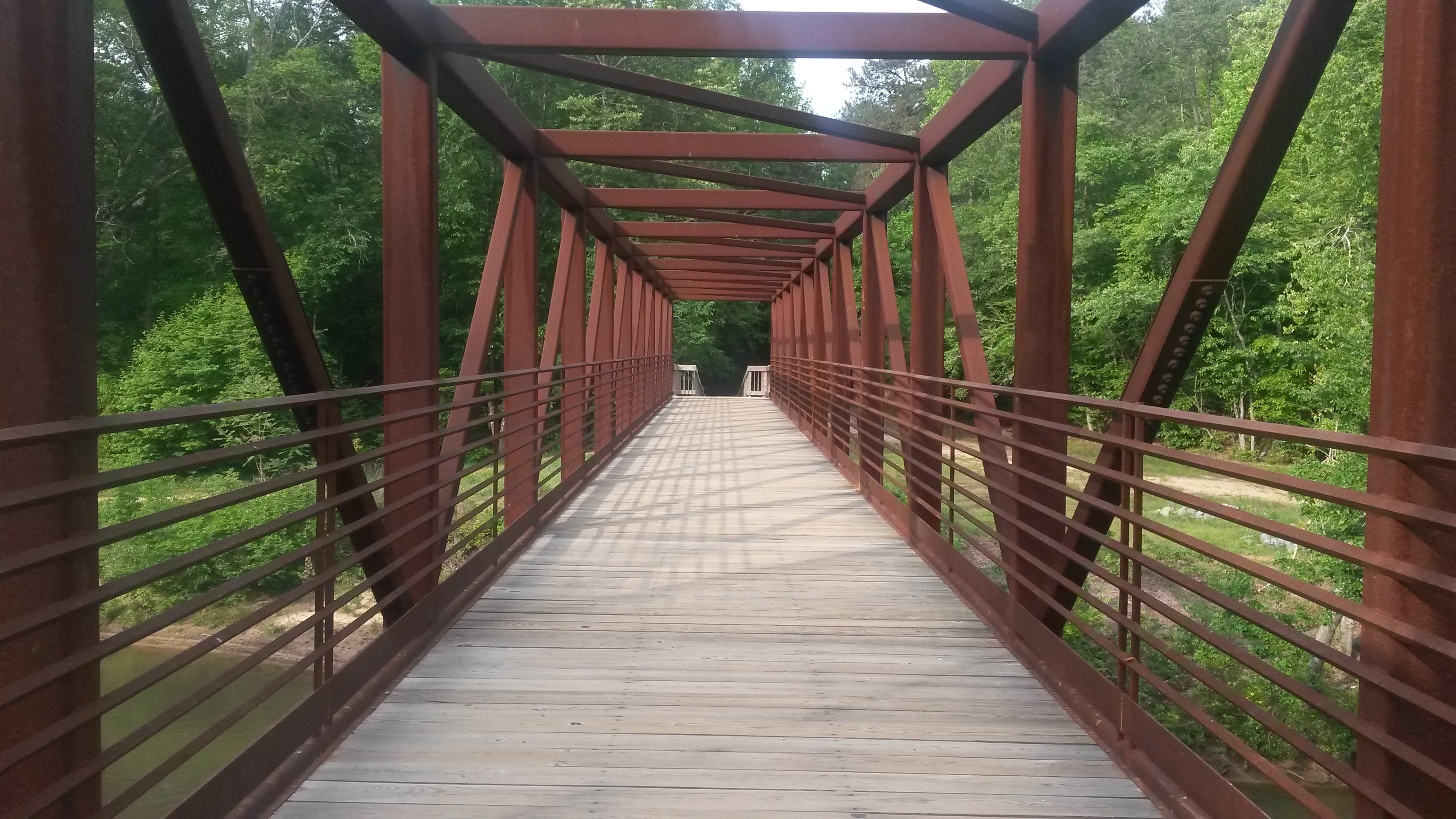
wpid-20150509_091144.jpg

Cascading rapids…

wpid-20150509_093858.jpg

And enough greenery to make you feel like hugging a tree, or maybe eating one:

wpid-20150509_091438.jpg

So I’ve set off for a few of them over the past few days. And I’ve learned a few things.

First of all, trails are hellish and heavenly on your feet. Hellish because you hit all kinds of rocks and roots and bumps and sudden drops and hidden steps and any number of obstacles that you don’t hit on the roads. I’m embracing my minimalist shoes again when my feet feel fit (which has been a lot, lately), so I really feel all the bumps in the road. The trails are leaving me with hot spots in my feet — not pain, but soreness and tenderness — which is actually rather a good feeling despite the discomfort. Like a scar after a knife fight, sort of a badge of pride, a proof that I was there and I went through something. Then again, the trails are heavenly, because there’s none of that non-compactable asphalt or concrete underfoot. It’s all dirt or grass or a lush, springy bed of fallen pine needles and leaves pillowing my feet along, like the fingers of angels ferrying me to happiness. Sweet and sour.

Second of all, and more importantly: with trails, you have to know what you’re doing. I checked out maps beforehand and figured I knew pretty much what I was looking out for — the trail goes in such and such general direction for about a half mile, then follows the river for a bit, then cuts back inland toward the rocks shaped like a couple of donkeys humping — but the problem is, when you’re out there surrounded by nothing but green, one donkey hump rock looks pretty much like another, and judging distance is about as easy as cross stitching blindfolded. (Is that hard? It sounds hard.)

Long story short, I got lost. Day 1 I got a little lost and increased my estimated distance by about a half mile, running 3.7 when I meant for a little 5k. That’s no big deal. Saturday, though, I was aiming for 4 miles and ended up running almost six. Which is fine if I’m in shape, which I’m not, because I’ve been nursing my plantar-fasciitis beset right foot back to health. Not only did I increase my mileage spontaneously, but I did it over some of the toughest terrain around: the riverside trails of Sweetwater Creek State Park. Now, there’s beautiful scenery to be seen, and in fact, you’ve probably seen some of the terrain I was running on…

That’s the New Manchester Mill Ruins, and Katniss and what’s-his-beak make an appearance there when they’re in District 13 in Mockingjay, Part 1. (Let’s not talk about the nonsense of splitting any of the books in that series into two movies. Let’s just not.) The trails at Sweetwater go past this relic and up and down some sheer rock faces as they follow Sweetwater Creek past rapids and on into lonely meandering stretches of the river. Really, really gorgeous area.

And I got so lost. My first warning sign was these stairs:
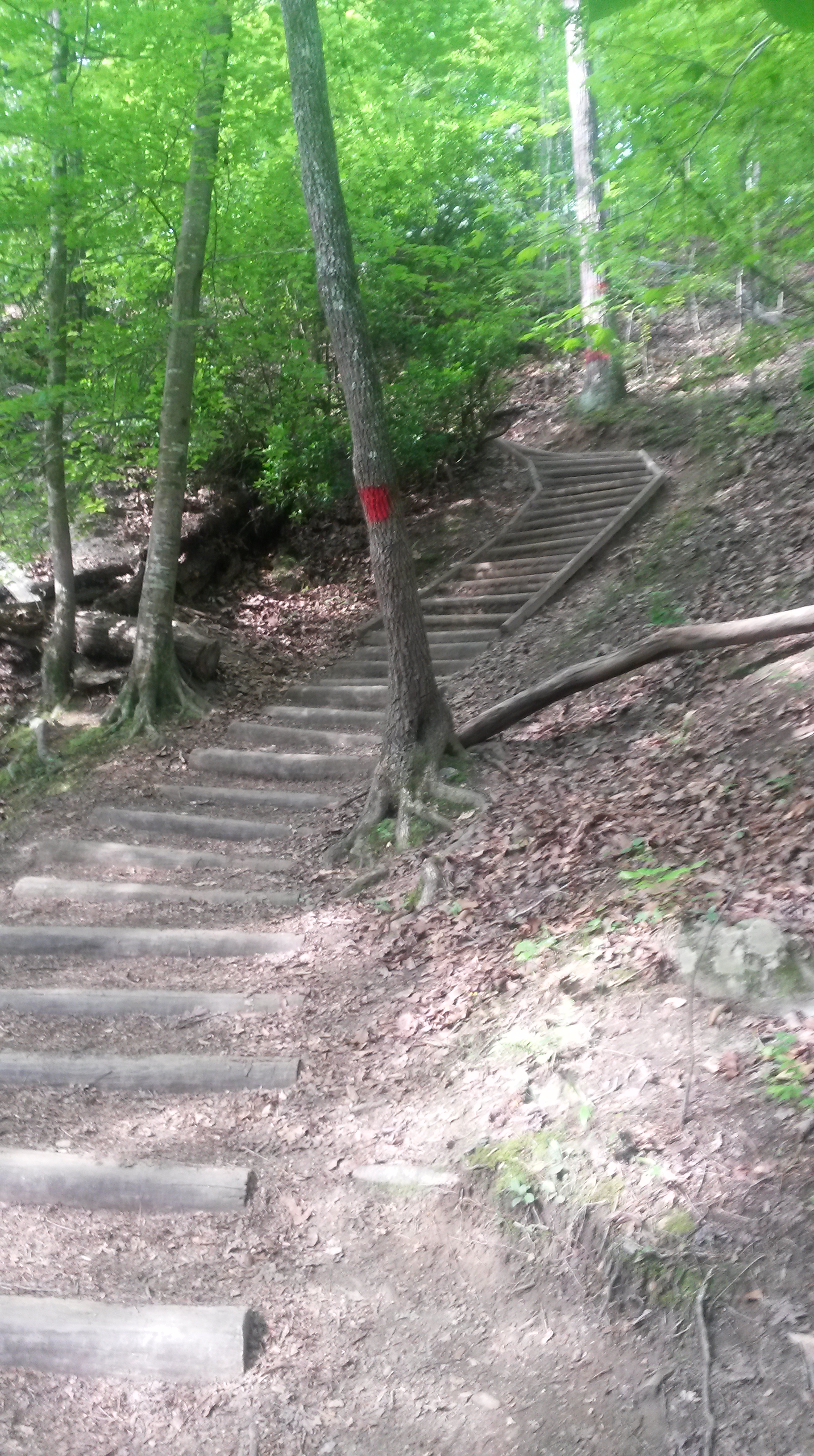
wpid-20150509_093003.jpg

It’s hard to get a sense of scale, but I’m pretty sure those stairs are equivalent to a seventeen-story building.

I had just gotten finished climbing what felt like a 30 degree incline for about a quarter mile up — so steep and so long I was literally pushing my knees down with my hands to keep going — when I realized I had absolutely no idea where I was or which way was back. Luckily, about that time, a guy and his dog (seriously) came running through a field of brilliant sunny daffodils. He and his pup are regulars, and he was able to point me back to relative civilization: “Oh, just go that way for about two miles, and you’ll see the signs guiding you back in.” This, when I was already at the 4 mile mark for my 3-and-a-half-mile run.

Well, not to belabor the point, but I did make it back. My feet were trashed from six miles in my minimal shoes and I was sweating like the traditional whore in church, but man, there’s something to be said for the journey. I ran almost six miles and did some serious hiking for at least an additional mile in there, and it was simultaneously the toughest workout and most rewarding and enjoyable running experience I’ve had, maybe since I ran my first half marathon. Just pure fun and happiness, despite how beat-up I was afterward. I’ve heard the term “runventure” before, and I always thought it was a little dumb and ridiculous, but this particular run, I think, qualifies.

Anyway. Point is, if you’re going to go running a trail — especially if you don’t usually go running trails — maybe bring a map.

Or, if you’re feeling adventurous, maybe don’t.

Dead Obvious


Chuck’s challenge this week: the Subgenre Mash-up. My mixed up genre? Zombie Whodunit.

I can remember, once in my youth, reading an Agatha Christie book, and I am sure it was nothing like this.

Dead Obvious

It’s all anybody can hope for in this world, to leave it without knowing whence the end comes. A surprise, like breakfast in bed on Mother’s Day or something. Surprise! You’re dead. And in that way, I was fortunate, because I didn’t see it coming. Middle of a dinner party. Excused myself for two minutes, and then it was lights out.

But here I am. Dead. And Alive. Which means two things.

One, somebody I know is a zombie. And two, that somebody didn’t exactly do an outstanding job covering his tracks. Just a nibble, I’m sure he thought (or she, I guess, the virus doesn’t discriminate, but it just feels like a guy’s lack of consideration), and then a total failure to kill me properly. You know, to ensure I didn’t come back.

I can feel it now, the bite on my shoulder, burning like a brand, spreading out like a fiery web. My head could be splitting open for the pain I feel; somebody must’ve clubbed me but good, to try to kill me before I came back. Nice job, that. My heartbeat sounds like the thumping bass at a rave right inside my ears. The burn is spreading. Whole body on fire. On fire with hunger.

I find myself wondering: Why the shoulder? Seems like too much sinew and bone up there to really get a good bite. Somehow, I feel like an expert in anatomy. The thigh is what I’d target, lots of muscle and fat and blood, inches of it before you tangle up in bones. Nice and soft, too, chewy and moist and…

They’re staring at me. I know this because I can feel their heat, smell their blood, hear their hushed whispers and slightly panicked breathing. All of them shocked. How could this happen? At our dinner party, no less? Right before the dessert course? Well, guess what, idiots? I may be dead, but there’s another zombie out there waiting to get you, too. It could strike at any moment.

I open an eyelid with a tiny squishing sound and they all jump. Not astute enough to catch wise to the zombie in your midst, but you don’t miss me sneaking an eye open, do you? Bunch of short-sighted jerks.

Okay. Everybody’s here. The biter is hiding in plain sight.

Could it be James? The snot-nosed trust-fund baby who’s here in a suit that costs twice the average monthly salary for a blue collar worker? He’s clinging onto the waist of his date, Barbara, like he’s more scared than she is. And she, the daughter of a hotel empire, wearing more furs than a snowbound wolf, screaming vacuously into his ear, like I’m about to get up and eat her face. Actually, that sounds rather tempting. I try not to think about how her skin would disintegrate between my gnashing teeth, how her blood would cloy in my throat, how…

Man, the bug works fast. All of them look delicious, in fact, especially tubby Vera, who’s crammed herself into a dress three sizes too small to accentuate her curves for her date, a man she hopes to ensnare in order to rescue her from the one-bedroom flat she shares with her sisters. Too bad he’s gay. Tobias there, lending her his elbow in order to keep up the charade even though he keeps sneaking glances at Francis, stands to inherit millions if he’d only marry a nice girl like Vera and give his mother some grandchildren. Poor woman knows she’s got a better chance of being eaten by zombies now than of seeing her son breed — there’s not much hiding his condition with the spangly tie, the perfectly coordinated pocket square, and swooshing sashay of his walk — but it’s nice to hope. Much like I hope to suck the meat from his fingers, slurp slurp slurp like chicken wings, and…

I slam my eye closed again to shut out the visions of devouring my ex-friend, and collectively they sigh in relief. Dead after all, they say, and shuffle from the room. Francis, the one Tobias has been eyeing, comes over to check my pulse — I know it’s him because he reeks of his cologne, smelling like cut grass and musk and cognac and spinal fluid and… maybe I’m just daydreaming a little, but he smells intoxicating — and determines that I am, in fact, dead. He announces it to the rest of the guests and they sigh in relief and move the party to the parlor. No sense hanging around in here while I lie in a pool of my own blood, going bad like the hors de’ouvres, ruining the evening the way my murderer has ruined my three-piece suit and my skull.

But wait. Francis. He’s the internet dynamo who founded a dozen different companies before he was thirty, and has been married almost as many times. Could he be my killer? It’s almost too much to imagine: as much as he’s been in the tabloids for dating this or that supermodel, that he might be the country’s highest-profile zombie to boot. How salacious. Everybody knows you can’t tell if somebody’s a zombie by checking their pulse, after all. Well, everybody except the people at this party, apparently.

Or maybe it’s Carol, who, after everybody else leaves, stands in the door frame hugging herself tightly, like all the heat’s been sucked out of the room. That’s not the room, dearie, that’s me, going cold over here on the Spanish tile. She thinks she loves me — or rather, loved me — but everybody here knows she could have done better than a third-rate investments agent. I could have bought her the mansion and the yacht, sure, but not the vacation home on the coast that she really has her heart set on. But I don’t think she could have killed me. She’s too innocent, and sweet, and delectable, and her face just looks like it would melt in my mouth, and… And there she goes.

All of them gone. Maybe now I can sneak to my feet and…

Arnulfo. The butler, of course. Pretending not to speak English so that he can simply nod and serve our drinks without a word. That ever-so-subtle limp that we all assumed was a scar from his troubled life in the third-world country of… wherever he claimed to be from. He lingers by the door, his smarmy, faintly clouded eyes lingering on me, and wipes a drop of my blood from his lip. His lip falls off, and he quickly replaces it, tamping it into place with clumsy fingers. That sneaky son of a bitch. His face contorts like he’s trying to giggle at me, or maybe he’s just moaning with the eternal torment of the living dead; it’s hard to tell which. He slips out the door toward the others.

I have to stop him before he kills again.

Shit. Did my blood congeal into glue or something? My face is stuck to the floor with sticky crimson, my limbs feel like they’re strapped with lead sleeves. I haul myself to my feet, but I feel shaky, unstable, like my body is made of jenga blocks balanced on a rope bridge. I splay my legs unnaturally to better hold my balance, throw my arms out in front to counterbalance my ungainly torso. That works. I hobble to the next room, throw the door open —

They all gasp at the sight of me, even Arnulfo, that treacherous swine. In a flash, Carol collapses in the corner with Francis, Vera starts screaming at a high C with Barbara in perfect harmony, Tobias grabs a chair and brandishes it like a medieval greatsword and James draws a little pistol from his coat pocket quick as a cobra. But that’s okay, I’ve figured it out, and I can explain it all to them in an instant, and we can kill that prick Arnulfo together.

I hold up my arms, take a shaky step toward them, and state my case: “Grrraaaaaaaaaarrrgh. Uuuuuuuuhhhhh… HmmmMMMMMMMMaaaammmmfffff.”

That’s odd. I try again: “Rrrrroooooooooooorrrrrrzzz. Nnnaaaarrrrssssshhhhhhhhhhh. Ffflllllllleeeeeeeeeeeccchhhhhhh…”

Dammit, dammit, dammit. Out of the corner of one eye, I see Arnulfo’s hand fall off. I scream at them all to look (“Blaaarrrr, BLLAAAAAAARRRRRR”), but he grabs it and shuffles out of the room, unnoticed, while they’re all staring at me like I’m some kind of monster or something.

Everybody’s shouting at me now. The girls are crying, the guys are advancing on me with their weapons, and it’s all a big mess. Still, all I can think about is eating their brains to save them from their own stupidity. I figure it’s worth a shot, so I lunge at Francis, he of the sweet cologne and flesh smell, and that’s when I hear the meat of James’s finger tighten on the trigger.

I hope he hits my brain this time.

Not By Any Other Name


For so long I struggled with a question of identity. Actually, struggle is the wrong word, because I wasn’t thinking about the issue at all, but by virtue of not thinking about the issue, I was missing out.

Okay, that’s vague as hell. Let me try again. Self-perception is a big deal. Not so much in thinking of yourself as a big deal (although I guess that’s maybe not a bad thing now and then), but I mean just the way you think of yourself in general. The way you define yourself matters.

Sounds obvious, right? But it’s the simple truths that are the most powerful. For a long, long time, I thought of myself in a really negative way. Not actively — I didn’t sit around thinking to myself: “I’m a loser, I’m never going to amount to anything, I might as well just not try.” But that perception was lurking in the back of my mind nonetheless. I hadn’t amounted to anything, so I didn’t know that I ever would amount to anything. I had aspirations, but I had no confidence that I could achieve them, so I didn’t bother even thinking of myself as being on that track.

Case in point: Writing. I always wanted to write, but the idea of actually writing a book felt so insurmountable I just took it for granted that I could never get it done. Without really thinking about it, then, I named myself not-a-writer. By the same token, I could define myself by virtually any yardstick you could think of. Not-an-astronaut. Not-a-millionaire. Not a super-genius. But there’s only so much you can learn about a thing by determining what it isn’t, and that goes for yourself, too.

So, a little over a year ago, I decided to try something different. I told myself, you’re going to try being a writer. And so I started thinking of myself as a writer. And lo and behold, I suddenly found myself more committed than ever to writing well and productively and regularly. Well, that was pretty cool, so I started thinking of myself as other things, just to see what effect it would have on me. I never thought of myself as much of a dad, but now and then lately I remind myself, you’re a dad now, and I find myself being just a little more conscientious with my kids.

I’m willing to bet that this works with almost anything, because as good as we are at fooling ourselves about life in a direction that hurts us (I’ve got plenty of time for that project, or a few extra cookies won’t hurt), we can fool ourselves in a positive direction, too.

So, this post is to remind myself that I’m a writer. And a runner. And a dad and a husband. And a teacher. And a thinker. And a goofball and a nerd and a reader and a slew of other things. Positive things.

The names we give ourselves, I think, become the names we make for ourselves. So pick good ones.

This post is part of Stream of Consciousness Saturday.

Little Victories Fuel Big Victories


If you’re like me, a wannabe writer trying to figure out how to make the dream happen, you might be struggling to write every day. I know I did; writing the first draft of my first novel was as challenging as pulling the teeth from an enraged baboon while whistling “Happy Birthday” backwards. Sure, you start off full of chutzpah, ready to slay dragons and save the world every day, but the honeymoon only lasts so long. After a few weeks, you find yourself tasked with churning out more and more words, even though you’ve already used up your good ideas — or even though you don’ t know how to get to the good ideas.

That blank page stretches out in front of you like a wasteland, cruel and without end.

Some days are better than others, but every day is hard. Not just because you have to claim your time from the jaws of your enemies with blood and fire, but because you have to keep the creative engine churning, you have to keep the cursor moving, you have to keep that word counter ticking over like the odometer on a road trip.

Now, I’m not an expert. I’ve yet to make a dime off of anything I’ve written creatively, so I can’t claim to know any better than anybody what you should do to make any money at this endeavor. But I do know that if you aren’t writing, every day, you’re handicapping yourself before the race has even begun. Momentum matters, and if you keep the ball rolling a little every day, you don’t have to kickstart it from a dead stop again. To that end, if there were one piece of advice I’d offer to anybody trying to start writing, it’s this:

You need a daily goal. A set amount of progress that you will, one way or another, put to “paper” one way or another before today turns into tomorrow. Momentum matters. Achieving this goal every day will keep you sliding forward like a glacier. You can’t set out to say you want to write eighty thousand words by November and hope to get there by focusing on the eighty thousand. It’s too big. You might as well be thinking about climbing the summit of Mount Everest when you haven’t even left base camp. It’s a good goal to have, but you’re not going to achieve it today. Or tomorrow. Or next week. And when you fail to achieve that goal, you will lose gumption, you will lose drive, you will lose the confidence that you can achieve this thing. What you need is to focus on what’s in front of you and achieve that, however big or small that goal is. What’s your daily goal? 100 words? 300? 2000? It depends on the kind of time you have available in your days (or, more correctly, the amount of time you can prise from your day’s cold, dead fingers).

I find that, on a normal workday, I can usually find about 45 minutes to write, and that tends to be enough time for about 900 words.

Now, 900 words assumes I’m able to write productively and without pauses for almost the entire time, and that’s not always the case. So my “on paper” goal per day is 600, even though I’m really trying for 900. 600, therefore, is what I want to accomplish so that I can feel I’m not neglecting my writerly duties. 900, however, makes me happy.

How does it go, writing 900 words a day?

A little something like this:

0-100 words: Man, this is hard. Why did I decide to do this, again? I’m not sure what I should be writing at all. (re-reads yesterday’s work.) Okay, maybe this can happen, or maybe this character can set this trap… I dunno, it sounds lame. But if I don’t get to work, I’m not getting my words. Whatever. Just write something.

100-300 words: Well, I guess this is happening. I’m not sure I love what’s happening, but it’s happening. Make sure to keep that character involved. Think about what this character is thinking. Where is this heading? Just keep writing.

300-500 words: Okay, I like what’s happening now, and I see where it’s heading. Maybe, though, it doesn’t make sense for this character to say this thing now, or to take this action now, but I’m not sure how else it could go. Don’t think about it, don’t think about it, don’t think about it… fix it later.

500 words: SHARKNADO. I just realized the perfect thing that should have happened earlier to set up the thing I just realized needs to happen now. Do I go back and fix it? Press on and make a note? (This is usually where I get up and walk around for a minute to rearrange my thoughts.)

500-700 words: I’m either going back and inserting an alternate text to something I already wrote, or I’m forging ahead full-speed with today’s beats. Either way, at this moment, I’m in a state of flow, just letting the words come on their own and keeping up with the narrative as quickly as it’s unspooling in my head.I don’t even check word count during this step. It just happens.

700-900: Flow continues and the possibilities for future events are exploding like popcorn, one after another, each one showing a road to the rest of the novel that might develop into something or that might wither on the vine. There’s no telling which one is the right one, though, so I grab hold of one and ride the wave while it’s high. At some point in this range I realize that I’m almost out of time for today, so…

900-1???: I use my remaining time to find a stopping point. I used to try and finish a beat, but now I like to either stop right in the middle of one or just at the beginning of a new one. That way, when I come back to write next time, I still have fresh in my mind some semblance of where this scene is going. I don’t usually want to stop writing at this point, but by this time there are other responsibilities banging on my door, either literally or figuratively.

So that’s pretty much every day. I push through five days a week like that when I’m drafting. I aim for a blarg post about every other day or when I can manage it, but I don’t stress about the length of the posts anymore (I used to shoot for 1000 words… yeah, this post is over 1000 already, but sheesh, that’s a lot in a day).

900 words might seem like not very much to you. Or maybe it seems so lofty as to be insurmountable. Point is, it’s been a sweet spot for me: It’s a challenge to get there, but not so daunting that I have to struggle every day to make it. But it’s not so easy that I can do it without any effort at all. It’s significant enough to give me a pick-me-up when I meet the milestone, but not so significant that I feel I can’t make it. Pick a goal that stretches you a little bit, but one that you can realistically reach from where you are. Little victories fuel big victories.

I’ll admit I’m feeling somewhat at sea with my current story. There are loose ends all over the place, I’m still getting a feel for the characters, and I’m not even 100% sure where I want the story to go. But what I do know is, I’ll be writing about 900 words a day every day for the next few months. If I can keep to that schedule, then long about September, I’ll have my second novel drafted.

How do you eat an elephant? One bite at a time.

I Don’t Know What I’m Writing


I mentioned a few posts back the struggle I’m having with telling the current novel; how I’m trying to figure out perspectives and pacing and flavor and all that other stuff. The story is there, and sound, I said, but the voice is missing. And I thought that everything was cool aside from that — that it’s no problem not having the “exactly right” words to tell the story I’m trying to tell, as long as the story I’m trying to tell is the right one.

And I still think that’s right. To a point. Because the story is what matters; the story is what resonates. Everything else fits in around the story, like the transmission and the axles and the fans and the tubes all fit in around the engine in a car. Sort out the engine, and build the rest of the stuff to fit, right?

Except that’s not the whole story, either. A solid engine is great, but an engine does nothing without the rest of the car. The engine puts force behind the vehicle, but without the axles in place, without the wheels to drive the car forward, without the gas tank and the transmission fluid and all the wiring and tubes, the engine just sits there and putters away. It’s all connected; it all works together.

So it is with story. The right story might purr like a kitten, but it’s incomplete without the wheels of the proper setting, the transmission of a proper tone, and the fuel injection system of the perfect characters.

What does that mean?

Well, I’m figuring that out, but I’m also realizing something. I can allow myself to forego any concerns about the “other stuff” and just focus on the plot, the story, but if I do that, I’m going to have to build all that other crap after the fact. And what happens when you build all the different elements of a thing separate from the whole? If I build first an engine, then a body around it, then the wheels to propel it, then the axles to drive it… I’m going to end up with a Frankenstein’s monster of parts that I scavenge from the depths of my brain based on what suits my needs at the time. It’ll work, maybe, and it’ll look generally like the novel I have in mind, but it’s not going to drive real smooth. It’s not going to have clean lines. It won’t win awards.

I’m not much of an outliner by nature. I’m a procrastinator, a figure-it-out-as-it-comes kinda guy, a pantser, as I think the industry calls us. And I think there’s something to be said for taking an organic approach to storybuilding, to letting characters to an extent drive the story, to allowing the story to develop its own twists and turns and energy without meticulously planning it out in advance.

But that doesn’t mean there shouldn’t be any plan. Just as you build a car with an overall design in mind (headlights here, this shape to the body, this kind of seat); just as you plant a garden with the preferred outcome in mind (carrots over here, tomatoes in this aisle, luminescent cabbage here); a story needs guidelines to grow. Even if you’re not a plotter, you have to know some things before you take the first steps.

Who is my character? What drives her? What is she afraid of? What obstacles will harry her? Where does the struggle take her? What should her story teach a reader? How should the story “feel”?

A story can, will, and probably should grow organically to fill in gaps and create surprise in the mind of the readers (and the author!). But for a gap to exist, you have to have the substance around the gap. The story isn’t going to build skeleton and muscle and blood all on its own. The framework has to be there to be built upon. And that means taking a hard look at the planning that’s gone into the story so far.

If I’m honest, I’ve sold short the preparatory work on this project. The story, as a result, is looking more like the Frankenstein’s monster than the smooth, sharp Cadillac I want. The good news, though, is that it’s never too late to start; never too late to turn the floodlights on and take the hard look at the story that it needs. And, seeing what it needs, the only thing left to do is to keep writing. Rather than just letting the story shape itself, shape it with the end in mind. Start taking stabs at the tone-setting language, start planting now the seeds which must blossom by the end.

Yes, you can fix it all in post. But that’s a lot of work to shrug off on your future self.

Time to face facts and start doing the legwork this story deserves.