Dreams Don’t Mean Things


So I had a dream the other night in which I was playing pickup football (because I totally do that) at a friend’s party (because I totally go to those). Usually I don’t remember much about my dreams, but for some reason this one stuck with me after I woke up. Now, I don’t put a lot of stock in dream symbolism, aside from obvious metaphors (oh, you were fighting with a seven-headed bear-monster with the body of Chuck E. Cheese? That means you have a struggle to overcome in your life). I do, however, think that the brain works on its issues buried beneath the surface (or even slathered all over the surface like butter on a stack of pancakes) through dreams, which is why I think that dreams are some of those situations where THINGS MEAN THINGS.

Anyway, in the dream, it’s just a couple of guys noodling around tossing a pigskin, but then the scene shifts a little in that funny way that dreams do (one moment I’m licking cupcake batter off a giant spatula and the next I’ve got my arms and legs wrapped around the leathery neck of an alligator and somehow this makes perfect sense). Suddenly it’s like the warm-up game before a for real Georgia game. UGA being my alma mater, this isn’t particularly strange. Then, for whatever reason, I look up into the stands and notice a friend of mine. Somehow, amidst all the hubbub before the game, she looks down at the field and sees me, too.

With that, the pickup game is over and the proper game is about to start, so I head up into the stands and manage to track her down. She’s sitting with an old, grumpy, obese woman in a wheelchair and a friend of hers from work and the theater group they founded. (This friend, who is a touch over five feet in real life, somehow towers a foot over me when we are standing shoulder-to-shoulder in this dream.) So we chit and we chat, about life, none of which came back with me from the dream. The old woman, it turns out, is dying of cancer and griping about a time in her life when 40 degrees was warm (she apparently can’t feel any warmth at all now and is always cold, thus all the blankets covering her up in the wheelchair).

And as is often the case with dreams, there’s no narrative. The conversation doesn’t go anywhere, nothing really happens, and that’s pretty much where it ends… next thing I remember is the plaintive wails of my not-quite-1-year-old irritating me into wakefulness.

Now, the thing that resonates is this friend of mine. This is a friend who’s always sort of existed in my periphery. We went to rival high schools but met through theater events and competitions. We went to college together, but never shared any classes. We both still live in the Atlanta metro area, but not really close enough to ever get together. I’m sorry to say that she’s one of those legions of people who I only really keep up with on facebook, which is a shame, but as any parent knows, trying to keep up social relationships outside of home and work can be like trying to pull a starved, insane badger off your face… much easier said than done.

Do things mean things? The last time I had a dream about this friend, I ended up getting in touch with her and getting involved in her local theater group, which was among the funnest experiences of my adult life.

Oh, and I forgot to mention one other thing. She works — or at least, worked — at a small publishing company here in Atlanta. Which means that this dream is probably my subconscious way of telling myself that it’s time to stop flerping around and get my novel into the hands of somebody who can do something about it. But casually. You know. Like at a pickup football game.
To Extremes


This week’s prompt is “an emotion and its opposite.” Now, the obvious one is love/hate, and that would be an easy one to explore. As a writer, I swing back and forth between loving and hating my work like the tides. Hell, I swing back and forth between loving and hating the craft. But love/hate is obvious.

No, the dichotomy that seems most apt to me is confidence/doubt. These two phases, like the peaks and troughs of a ray of ultraviolet light, alternate with alarming alacrity (triple alliteration bonus, whee).

One minute, I feel at home in the me who is on this adventure. I know what I’m doing. I’m staying smart, looking sharp, making good decisions. Every new bit of text is a good one. Every cut makes perfect sense. Every edit improves the whole. There is no shaking me off the course I’m on as I work inexorably toward writing the best inaugural novel that’s ever been written.

Then the light goes out, and I remember that I’m miles deep in an unfamiliar jungle with the dark rustle of foreboding creatures of the night on all sides of me. That bit of dialogue I thought was scorchingly clever the first time around seems a bit hackneyed upon further review. The character arc I’ve worked so hard to create feels like a flamingo on roller skates; all awkward angles and feathers crashing everywhere. The cut that felt so necessary when I made it now looks like a gaping wound, and the patient is bleeding out.

Then I stop working for a while, and by the time I come back to the novel, I feel like I could drive nails with my forehead again.

Do any other writers suffer from the same up-and-down, hot-and-cold, bulletproof-then-made-of-glass feeling? Do all of them? I have a hard time believing that my sentiments on writing are unique, but by the same token, not every writer can be so schizophrenic.

In fairness, though, the ride is pretty fun. There’s something to be said for riding the roller coaster til you throw up the oversized cotton candy you just horked down while you were waiting in line. Then wiping the pink fizz from your lips and lining up for another turn. Some might call that crazy.

No, that would be me. I’d call that crazy. I’m too old for that sharknado. But the writing, okay. I can handle the swings of that ride.

This post is part of Stream of Consciousness Saturday.

Stakes and the Blarg


Boy, oh boy, do I love a good stake. Charred crust, pink and bloody in the middle, melt-in-your-mouth flavor, rancid farts for the rest of the night…

What? Oh. STAKES.

Woo! Vampire hunters and silver crosses and garlic and…

Huh? Ugh. Okay, fine. Just stakes.

I guess there’s a lot to be said about stakes in writing, but today I’ve got the stakes of writing on the brain. Not least of which because I’m passively reading a book called The Right to Write by Julia Cameron. (“Passive” reading is my pleasant euphemism for “book-I’m-reading-on-the-toilet.”) And… well, for starters, I don’t think I’m this book’s target audience. Each chapter is essentially its own workshop and meditation on some aspect of the writing process, and much of it is the kind of rah-rah-rah-you-can-do-it stuff that would be more at home in a literal cheerleading squad than in a book aimed at burgeoning authors. For another, the tone of the book is through-and-through the sort of hippy-dippy, peace-and-love drivel that can give you a toothache if you swallow too much of it. It’s all “writing is a gift” and “the story speaks through me” and “anybody and everybody is a writer at heart”. Then there’s a lot of meditation on the sun rising over her private valley and rumination on her horses as they watch her through the kitchen window, and that’s about when I really want to induce vomiting so I don’t choke on her privilege. Now, okay, those ideas are lovely and all, but it’s all too Kumbayyah for me to ingest in anything other than the tiniest bites.

I don’t need that. I enjoy writing enough in its own right that I don’t need somebody pushing me to do it or ensuring me that it’s okay for me to do it. Whether or not anybody is truly “cut out” for writing is irrelevant, as any list of bestselling books will tell you. Horrible writers still write. This book is aimed at convincing somebody who’s perhaps too timid to leap into the pond that he might, in fact, have something worth writing about in his mind. It’s designed to invite you into the world of writing one baby-step at a time, by writing first about things in your house, then in the news, then about your family, and blah blah blah. If you’re a sometime reader of my blarg, it’s pretty obvious that I do that stuff on my own already.

That said, there’s something comforting in the way she puts her ideas forth.  And even among the platitudes and smug self-righteousness, there are gems of wisdom, little kernels of edible advice embedded in the stew of saccharine crap.

The one on my mind has to do with stakes, and what she has to say about it is this. When novice writers (and sometimes experienced writers, too) sit down to do their capital-W Writing — be it their novel or screenplay or short story or news article or whatever — there is this inescapable sense of pressure and dread surrounding the act. Because it has to be perfect. If I write something crappy, that’s all anybody will ever remember. It’s all will ever remember. Inability to achieve that perfection and to get all the things exactly right is paralyzing; it can lock up the mental faculties like a bit of chain snarled in the spokes of your bicycle. And this is a fear that I’m on a first-name basis with. (Its name is Todd. Like all horrible things.)

The well-hidden reciprocal of that fear is the fact that so many of us, writers and non-writers alike, engage in writing every day in which we feel no pressure at all to perform at some elevated level. These are your e-mails to colleagues about whatever projects you’re working on, your text messages to your spouse about what you need to pick up at the grocery store on the way home. Okay, it’s not Writing, but they are still words that you form for the purpose of communicating an idea to somebody else… and that’s writing, innit?

The trick, then, is to capture that free, unfazed, not-even-aware-of-any-kind-of-pressure feeling associated with e-mails and apply it to your capital-W Writing, to leap into your manuscript with the same abandon with which you fire off a scathing comment on a message board or a snarky response to your sister’s joke about your mom. It’s hard to do, but I’ve felt flashes of it when working on my novel.

It almost made me mad when I realized it. While I was having a chuckle at all the peace-love-dope sentiment in her book about writing, Cameron had thrown a literary dart and pinned my Id-Writer to the corkboard like a doomed insect. In her suggestion that writing doesn’t have to be this big deal that a lot of people (myself certainly among them) make it out to be, she had explained away the entire r’aison d’etre for this blarg. This is my low-stakes writing. It doesn’t matter what I write here; what matters is simply that I write. That I break apart the dam of mud and sticks clogging up the river of my faculties. That I pull the release valve on the hot-water heater of my brain. That I let the toddler out into the yard to run around in circles and scream its head off so that the adult in my Ego-Writer can get some peace.

This, then, is why we read; this is why it’s important to engage critically even when the subject matter seems like a laugh. You never know when the river of sharknado is going to belch up a hunk of gold. I’m going to keep reading Cameron’s book, even though it irks me, and even though I will no doubt find myself rolling my eyes like a hamster on a wheel at its pithy sayings. Much as it gives me the chuckles, there may just be a few more juicy tidbits in its pages.

Also, it was a gift, and I’d feel really bad about tossing it.

Thanks, sis.

No, not that sister. The other one.

Thanks.

An Idea is Born


The stream of consciousness prompt this week is “scene/seen”, and that feels like kismet. Because if you’ve spent any time around my blarg, you know that one of the things that’s been front-of-mind for me over the last year or so is my novel. And I think so much about what the novel is and what it may yet be that it’s easy to forget what it once was, which was a dumb little scene I wrote for a playwriting class I took in my fourth year at UGA. I say dumb not because I thought that scene was bad (though if I read it again I might have to reconsider that assessment), but because I wrote it almost as a throwaway. We’d been in the class for maybe three weeks, were still learning the ropes, and this assignment was an easy one to get us thinking outside of the box a bit.

“Have a character enter your scene from somewhere unexpected.”

Were you to give me that prompt now, I’d have a hard time deciding which outlandish entrance to use. I’d have somebody come crashing through the window or the ceiling. I’d have an escaped prisoner tunnel up through somebody’s living room floor. I’d have a reincarnated Elvis enter from the bathroom in a cloud of psychedelic lights and smoke. (Okay, so I stole that Elvis entrance from Steve Martin’s Picasso at the Lapin Agile). The problem would not be “how do I write this scene,” the problem would be “how do I choose?”

But at the time, the prompt stymied me. It wasn’t that I couldn’t think of strange entrances — I could — but I couldn’t think of a way to justify any of them. The idea would strike, but I wouldn’t know how to connect it to anything meaningful. Even as I write that, I find myself shaking my head — it was just an exercise scene, it didn’t have to connect to anything meaningful! — but I was stuck. Stuck, stuck, stuck. I sat in front of my computer staring at a blank page for the better part of an hour, unable to write this scene, too nervous to take a chance.

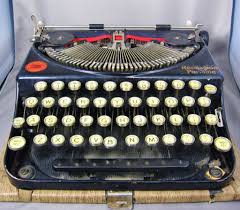
typewriter

The one piece of writing advice that everybody knows is to write what you know. Frustrated with the assignment and my inability to pen even a single word, I fell back on that old axiom. I’m blocked? Can’t crack this scene? Fargo it. And I wrote my character, a frazzled, frustrated guy, sitting white-knuckled and scruff-faced obstinately in front of a typewriter. (Yeah, yeah, I know, I have a thing about typewriters.) I had him struggle and hem and haw and make excuses and bang his head against the wall, and then, finally, he just gave up trying to be creative and wrote a crappy, cliched little scene. Nothing special about it. Except that it appeared out of nowhere (the unexpected entrance, such as it was) and played out right in front of him. Taken aback at first, he spoke to the characters that suddenly existed right there in his crappy apartment. The newly created characters shared their thoughts (this setting sucks! I would never read that book! Why would I even say that to her?), he took their advice, and in a matter of moments he had figured out that the best way to write was to get the fargo out of the way and allow the characters to explore their own situation.

I thought it was crap. I mean, really, I was almost ashamed of it. So ashamed that I almost didn’t go to class the next day. But crappy though it was, I had enjoyed the taste of writing it, so I went. Naturally, the teacher (the inimitable Stanley Longman) called on me as one of the first to present. With sheepish disclaimers, I handed copies of the scene to three of my classmates, who took a few minutes to read over it before assuming positions on the stage. I heard them giggling as they ran through it and thought, great, it’s as terrible as I feared and now I’m going to be exposed for a hack. Then they read the scene, and the laughter continued; little snickers here and there, even a stray guffaw. Finished, the actors took their seats and I sat on the feedback stool, red-faced in front of everybody, and waited to be verbally crucified.

First hand raised, I called on a girl whose name I didn’t know at the front of the room. I’m paraphrasing, of course: “First of all, it was really funny. I loved the interplay between what we expected from his characters and what they really wanted for themselves.” Nods from around the room. Next up, a guy who sat near me and whom I’d collaborated with on an earlier exercise. “I recognize that struggle when I write,” he said, “it was cool to actually see it on stage. And it worked.”

The workshop continued. I got critical feedback as well as praise. But my professor’s comment stuck with me more than any of the rest. He scratched his head and spread his hands like a big grandfather gorilla. “The concept needs a little work, just to polish up the how-is-all-this-happening, and the why. An audience wants that. But it’s funny, you’ve nailed that. Those comedic elements are the hardest to pin down, and you’ve done it. Don’t you think?” He inclined his head past me toward the class, and there were vigorous nods of assent. He chuckled. “I loved it.”

That class was my favorite experience in my undergraduate years. Much though I loved that class, I got distracted from that scene and didn’t think about it for a few years. When I graduated and moved back home, I had the opportunity to work with my old high school and ended up taking the core concept of that scene — an author at war with his characters — and expanding it into a full length production. It went over like gangbusters, and, shock of all shocks, it played a role in my meeting with my wife (her mother saw the show, knew me from my work with a community theatre, and kinda-sorta shoved her in my direction).

Now, eight years later, that stage play is becoming a novel. And I feel the same fears in its formation that I felt in those days struggling with that seedling of a scene: that it’s contrived, that it won’t be funny, that it’s ultimately utter crap. But somehow, this time around, I’m not nearly so fearful as I was. Maybe it’s that I’m older and jaded and I don’t care what people think like I used to. Maybe it’s because I’m more confident now than I was then in the concept and my ability. Maybe it’s because I’m older and losing touch with reality and don’t know well enough to be properly nervous. Whatever the reason, it’s a nice reminder to myself that I’ve had success with this story once, and there’s no reason why it couldn’t happen again.

This post is part of Stream of Consciousness Saturday.

A Little Trim


I can’t be trusted with my own story.

In making a last push to work on the edit, I found myself thinking some truly troubling thoughts. In the past month, I’ve struggled through editing an entirely new character into the innards of the story, and doing so required some deft slices of the scalpel and some not-so-deft whacks of the axe to make room for. And now, like a maniac who’s tasted blood and now needs to slice open jugulars nightly just to feel some semblance of normal, I find myself eyeing that axe again and thinking… I could cut more.

Just a little more. Shave a little off the top. Clip the ends off, neaten this bit out. Trim the dead weight. Sure, the novel as a whole could probably use more trimming, but that’s not what I’m talking about. No, what’s caught my eye is a prize hog. One of the supporting characters looks positively ripe for harvesting.

I had this thought in the first stages of the edit, regarding another one of the supporting cast, but I didn’t pull the trigger. Couldn’t bring myself to wipe her out. Maybe because I was too cowardly to axe a major part of the work, maybe because I didn’t have the confidence to pull it off. For some reason, now, though, I find myself weighing the decision and seriously thinking it over… not because I feel the character needs to go — she’s been a part of the story since the first iterations, back when it was a stage play. No, I’m sizing her up like she’s some challenge, like that ancient fish lurking in the depths of the pond, the twisted ends of dozens of anglers’ hooks adorning its lip. I could cut her out like she never existed, I think… which, as Criminal Minds plays in the background here while I sit on the couch with my wife, sounds like an extraordinarily psychotic thing to say.

No, I think this is more editing loopiness setting in. Cabin fever is snaking its slimy tendrils up my spine after all the time I’ve spent with this story and it’s making me hallucinate. Making me think I see blood pooling behind her eyes, a dead albatross around her neck. She’s probably not so much cursed as I am looking for ways to drastically improve this story amidst my fears that it’s utter crap.

She’ll live, for now.

But I need to keep making progress, finish this edit, and get this thing off to some impartial readers. That axe is looking awfully sharp and awfully inviting.