Dreams are Useless


Many times I’ve read the nugget of writing advice: “keep a notepad by your bed, so you can jot down the ideas that come to you in your dreams!” Which is the sort of nebulous, tree-hugging crap that sounds good at first. We don’t know where inspiration comes from, and we don’t know where dreams come from, so obviously they must come from the same place, right??

I’ve tried it. My results are less than stellar. Less than atmospheric, really. The trajectory of my success with this method is more like a Greyhound ride to Denton: disappointing, a little smelly, and at the end of the day, you’re in fargoing Denton.

But my best ideas come from my dreams! I hear you cry. If I hadn’t kept that little notebook next to my bed, I wouldn’t have ever remembered the idea that became the seed for my 7-part fantasy saga based on my life, The Rainbow Riders of Regulon 7. (btw, you can’t have that title; I made it up as a joke but I’M KEEPING IT.)

Sure. Maybe. But dreams are boring as hell to anybody who isn’t you and who isn’t bound by genetics or marriage vows to listen to you. And dreams aren’t compelled to make sense or be coherent at all.

Here, I’ll show you. (Feel free to skip this next paragraph, because it’s absolute garbage.)

I dreamed early this morning of a sort of Titanic-esque love story. Two people from different worlds collide on this boat that’s going away forever. Romance. Goofy frippery. Elaborate costumes. But the dude is found out as a fraud by a snooty guy who goads him into a fistfight and gets him thrown off the boat. Dude is losing his mind with love and the thought that he’ll never see his girl again. He tries desperately to get back on board, and ends up swimming out into a shipping lane in hopes of getting scooped back up. He does — by the Coast Guard, and his persecutor takes great pleasure in locking him up for international crimes or something. But our dude manages to win over the persecutor’s grandmother with the power of his love, and she convinces her grandson to stage an elaborate shenanigan (shenanigans can be singular, can’t they?) to stop the boat and allow the dude back on board, where he is tearfully reunited with his love.

Terrible. And that’s a salvageable dream, with a beginning, middle, and end, kind of. Never mind how the guy got out into open ocean to swim into a shipping lane, although that’s arguably the best part — maybe he could get mauled by the propellers of a cargo freighter hauling prosthetic limbs. As dreams go, this is a masterpiece of continuity.

It’s awful, but it’s vivid, and because it’s vivid, and because that little turdlet of writing wisdom is still kicking around in my brain, I wrote it down. So, now, I can ignore it as I flip past it when I go plumbing the depths of my drivel looking for inspiration for my next work.

But here’s the real problem with waiting for inspiration from your dreams (though it’s more of a skeptical hangup than a problem). If it’s kicking around in your dreams, that means it’s already banging around in your subconscious, which means on some level it’s something you’re already thinking about. The dream just brought it to front-of-mind for a fleeting moment while you were unconscious.

With that in mind, it’s hard to say that just because I dreamed something, it’s automatically worth writing down. Like most of the thoughts that pass through my head, anything I dream is actually probably not worth writing down or remembering at all.

Dreams shouldn’t get preferential treatment over any other old crusty idea that drops into your brain. If anything, they deserve more skeptical treatment by dint of being disjointed incoherent heaps of hot garbage. Dreams, just like any other idea I have, go through a rigorous screening process. Just like I don’t pick up the phone for phone numbers I don’t recognize, I don’t write down an idea as worth keeping just because it popped in there.

Most ideas are crap; dreams, doubly so. But you’ll know the good ones when you see them: The good ones will stick around, call back, or even show up on your doorstep to make sure you pay attention to them. The good ones will stick in memory whether you write them down or not.


The Weekly Re-Motivator: Never Ask a Word Guy to Math Something


The prompt for the week is “no.” Not “no” as in, “no, don’t eat that piece of chalk” or “no, don’t dump milk all over your baby sister,” but “no.” as in short for number.

Which is a dangerous topic for me, because I’m like that guy who does a few oil changes on his own car and then decides he’s capable of fine-tuning the engine, or the one who successfully builds an IKEA side table and then tries to build his own back porch complete with gazebo. I know a little bit about numbers, and I’m kind of fascinated, but I haven’t taken any math classes since high school.

Mathematics, Formula, Physics, School, Mathematical

Nevertheless, you can count anything, right? And numbers matter, don’t they? There’s the old bit about needing ten thousand hours of experience to get “good” at something that I heard somewhere. If that’s true, how long should I expect to have to plug away at this writing thing?

MATH TIME.

I aim for an hour of writing a day. That’s theoretically 365 hours a year, which means it’s likely to take … ugh … something like 28 years to log 10,000 hours that way. But I only do my capital-W project-related writing on weekdays. So make it more like 37 years.

Sharknado.

But surely, I can count writing on the blarg toward those hours, too, yeah? Well, I’m not as regular there (needs me some blogging fiber, which is a joke that only somebody over thirty could appreciate), but maybe I can claim about two-three hours per week. Which reclaims the years I had to add to make up for the weekend. So we’re back at 28 years.

But wait, do those 10,000 hours have to be dedicated to becoming better at the thing, or can they just be hours spent doing the thing?

If it’s just the doing and not the actively trying to improve that matters, then I logged a heck of a lot of hours writing assignments in college and high school. Has to be enough to get that 28 years down to 26.

And then I wrote a cough-splutter fantasy novella in high school (180 pages in number-two pencil on college-ruled paper, now that was dedication), not to mention a bunch of crappy stories. (These are all lost to the mists of time now, which may in fact be evidence of a benevolent God.) Let’s be generous and give me another two years. 24.

Oh, and there were the plays I wrote a few years back. Hard to quantify that time because I worked when the mood struck me, but surely it’s good for another couple if not trio of years. I’m liking the optimistic feel here, so call it 21 years.

Which is maybe not so bad.

But wait again! With a mental task such as writing, surely time spent planning and plotting and pondering my stories counts. I think it’s safe, then, to double my time over the past two years and bump the timer down to 19 years.

And if time plotting and pondering counts, then surely time reading writing advice counts — that’s learning after all. But at that rate, if reading counts, it’s impossible to argue that reading stories that have inspired me to write wouldn’t count.

And then the floodgates open. Reading has got to be good for at least 5,000 hours of my life, and that’s a conservative estimate, to be sure. And that means I’m just a thousand hours or so short of Mastering Writing Forever.

Geometry, Mathematics, Cube, Hexahedron, Body

Which is nonsense, of course.

Measuring these things is a mug’s game. It’s like asking how many birds are in flight right this moment in the world. Surely it’s a question with an answer. A correct answer, even — one that could theoretically be measured. But it’s a nonsense question just the same, because the means for measuring such a thing simply don’t exist. And you can no more measure the actual productive time you’ve spent in an endeavor than you can measure all the people in the world whose eyes are closed. The information is there, but we can’t know it.

And that means we can’t live in fear or doubt or frustration at the information. There’s no finish line. There’s no ticker-tape parade when you reach 10,000 hours of practice, or 5,000, or 1,000, or five. All we can do is keep plugging away, keep practicing, keep doing.

Math may be an intrinsic part of everything, but these things we do are much, much bigger than math.

This weekly remotivational post is part of Stream of Consciousness Saturday. Every weekend, I use Linda G. Hill’s prompt to refocus my efforts and evaluate my process, sometimes with productive results.


The Weekly Re-Motivator: Nothing Halfway


There’s a mantra I regularly preach, scream, whisper, write, and otherwise fling at my soccer team: Nothing Easy. I’m sure it’s not original to me, though I can’t say I got it from anybody outside of my own skull. I like it — and I encourage my players to repeat it, internalize it, live it — because it can be taken several ways and it works several different ways.

First, the external: the other team wants the victory just as badly as you do. They owe you nothing, and they’ll give you nothing, so don’t make it easy for them. Control the ball so you don’t give them any easy turnovers. Get good position so you don’t give them any easy passes. Mesh on defense so you don’t concede any easy shots. Nothing easy.

Then, the internal: in soccer, more often than a lot of players would like to admit, speed beats talent. Hustle and hunger beats technical know-how. You might have the best touch, the most precise passes, the most devastating shot, but if you can’t beat the other man to the ball, all that skill goes for a big fat goose egg. So, you have to play hard from the opening whistle. Fight for every ball. Run on every play like it’s the one they’re going to break away and score on. Nothing easy.

Point is, if you play easy — if you give the match a halfway effort — you’re giving the opposition an advantage in every phase of the game. Which means, you’re putting victory that much farther away (if not entirely out of reach).

Well, soccer season is almost over, and I’m sitting here really analyzing my writing process, because I’m in a transitional time. I’m almost done with the final (for now) edit of the novel, which means it’s time to start considering what I’m going to dedicate my writing time to next. That means setting new goals, planning a schedule, determining how I’m going to approach the project.

In all this analysis, I realized that, among other things I haven’t been doing in my writing of late was writing short fiction — those 1000-word-or-so stories that I was pretty religious about posting for a long time, those little pressure-release valves for the creative energies I was bottling up while I worked within the confines of the overarching Project. So last night I embraced the prompt and wrote one. And I’ll admit — it may not have been my best work, but what was different about it — what worked about it — was the approach. I didn’t fine-tune the idea to death. I didn’t plot it out meticulously before I put keys to board. I didn’t sit back and wait for it to be perfect before taking my shot (much like the protagonist in the tale). I leaned into the uncertainty and I wrote it full-steam ahead.

I haven’t written like that in a while. I’ve tried out some new approaches (and liked them a lot, to be fair!), honed my craft, become a bit more exacting in terms of how I build stories. But what I realized is, that approach has me operating at half capacity. Throwing myself halfway into the work, keeping one foot on the edge of the pool as I dunk my toes in and test the water. It keeps me from making as many mistakes along the way, but it also keeps me so focused on the road that I forget to enjoy the view along the way.

Like my soccer team working easy in a match, making things easy for the opposition, I’m working halfway and making it easy to get distracted, easy not to finish, easy to pretend I’m working when really I’m just hiding behind excuses.

Now, the only absolute is that there are no absolutes. I’m not going to say that there’s not a time for the methodical, measured, relaxed, easy approach. Sometimes if you rush the work, you make foolish errors that cost you. But if you embrace the easy approach too much — if you work halfway all the time — well, first of all you never get anything done, and second, you don’t make the mistakes that make the work interesting.

When it comes to writing, you have to throw yourself into it the way you’d run out into the road after your kid. You have to give yourself over to it like jumping out of a plane. You can’t keep one foot on solid ground while you let the other foot acclimate. You can’t do it halfway.

Combat Diver, Special Forces, Sonderkommando, Frogmen

So the mantra for my writing — for a while, at least, until I think of a new one — is: Nothing Halfway.

This weekly remotivational post is part of Stream of Consciousness Saturday. Every weekend, I use Linda G. Hill’s prompt to refocus my efforts and evaluate my process, sometimes with productive results.

On Cliffhangers and the Season Finale of The Walking Dead


Spoilers below for the finale of The Walking Dead season 6. Be warned.

Stories are like missile launches. Somebody, somewhere, gets pushed out of their comfort zone, so they push a button. The symbol of their hurt feelings, anger, frustration or desperation goes sailing through this liminal space, there’s maybe some doubt about whether or not it will actually hit its target, then it either hits the target and blows it to holy hell … or it doesn’t.

That’s a story. Problem, struggle, solution.

Stories play with this simple but fundamental structure all the time, especially in the contemporary age of sequels and sagas and ten-book series and multi-season television dramas. Harry Potter, for example, hasn’t beaten Voldemort by any stretch at the end of Sorcerer’s Stone (or Philosopher’s Stone if you must) — that problem remains to be solved. He has, however, halted Voldemort’s plot in its tracks, found a long-lost magical artifact, and established himself as at least a passable wizard. Book one of Harry Potter sets up a lot of problems (is the stone real? what’s up with that weird professor? who were Harry’s parents and why did they leave him with the most horrible people in the world?). And Book 1 answers something like 90% of those problems (the answers are “yes”, “he’s possessed by Voldemort”, and “they were crackshot wizards themselves who died saving the world”).

To return to the missile metaphor, Rowling aims at the problem of becoming a wizard and finding out what’s up with this stone, fires, and obliterates her targets. Out of the rubble arises a new problemthough. The cliffhanger here is: Voldemort is not actually killed in the encounter with Quirrell, and he escapes to fight another day.

This is an acceptable cliffhanger. The critical moment has passed. Answers have been provided, and the cliffhanger establishes a new question that doesn’t need an answer right now, but rather gives us something to think about in the space between the book and its sequel (how will Voldemort strike next?)

Then, you have the unacceptable cliffhanger, like the one we saw at the end of The Walking Dead earlier this week. (You have seen it, haven’t you? This is the part where I cry SPOILERS and wave my hands frantically as you read on into the abyss.)

The entire season has revolved around a couple of questions: namely, can Rick’s group survive in their new community, and who the balls is Negan? Well, here comes our missile metaphor again: the writers take aim at these problems and push the button to deliver annihilation. Midway through the season, it seems the missiles have found their mark: a man claims to be Negan and the group kills him, and life seems to be stable (if not entirely safe) in the compound.

But then more threats are discovered, and we learn that the compound isn’t safe at all, and that Negan is probably still out there. This is well and good — we don’t mind that our missiles missed the mark, as we can always adjust mid-stream and launch again.

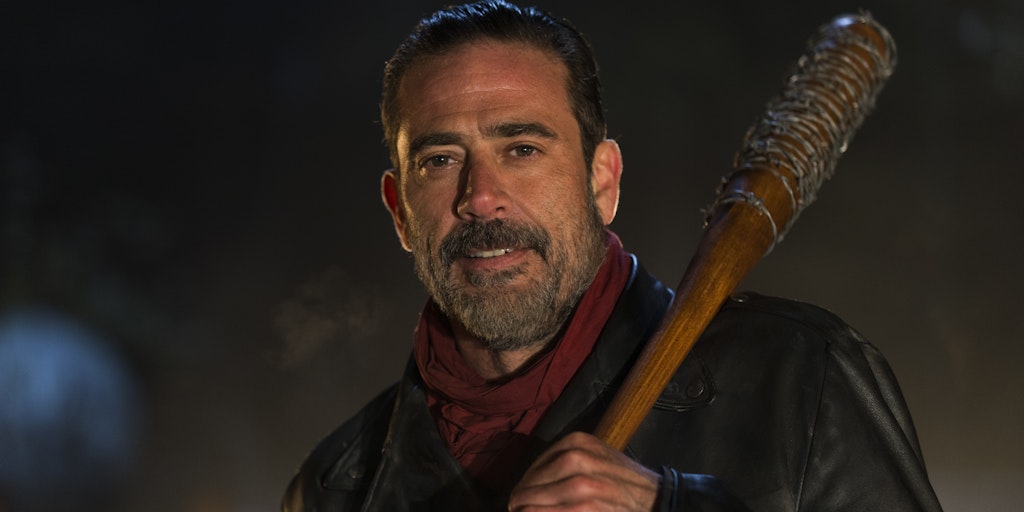
Which brings us to the finale. It answers our two questions, and thanks, at least, are due for that. Is Rick’s group safe in Alexandria? No, not even almost. Who the balls is Negan? He’s a leather-jacket-wearing, barbed-wire-wrapped-bat-wielding, ruthless but cultured sonofabitch. Okay, great, awesome. Targets fired at, and we have the answers to our questions, yay!

But then.

The ending.

Image is the property of AMC.

Negan beats the everloving hell from somebody, and presumably that somebody dies from his or her wounds (hard to argue otherwise from the camera angle that showed blood flowing into the victim’s eyes, not to mention that a blow to the top of the head like that — and I’m not a doctor or anything — seems like it would almost certainly shatter some vertebrae, if it didn’t simply split the skull like a vat of cottage cheese dropped from a tall building).

And we don’t get to see or know who it is. The show works really hard to establish that it could in fact be anybody who’s present at the encounter, except for Rick himself, who must bear witness.

That’s not a cliffhanger. It’s a cheap shot at the end of a boxing match. The critical moment is interrupted.

With the introduction of Negan, and the dire predicament that Rick and co. find themselves in, we have both the answers to the questions that got us here, and a question that will drive us forward into next season (now that they are so clearly outclassed, outmanned, and out-ruthlessnessed, how will Rick’s gang survive this?).

But then, the attack.

It pretends to be one of those questions that carries over to next season, but it isn’t. Because it’ll be answered in the opening minutes of episode 1 (or episode 2, the way this show goes — they’ll join some new ancillary character derping around in the woods for 90% of episode 1 then cut back to Rick and co. for two minutes before the credits). It isn’t a driving question, it’s a sucker punch to frustrate us and keep discussion alive through the off-season.

And I guess, at that, it’s functioning as intended.

Still, for a show that really handles itself well when it comes to surprising its audiences, this cheap shot feels especially cheap. Because you don’t need it. In fact, cut the episode either thirty seconds longer — showing us who dies to end the season rather than start the new — or thirty seconds shorter — leaving the attack as a shocker to open the new season — would be immeasurably more powerful, narratively speaking.

It feels like a flub, or worse, it feels like a calculated measure to frustrate the audience and get them trading enraged tweets on the net. It follows the Donald Trump election strategy — just get people talking about you, who cares if they’re saying good things or bad?

It sucks. It’s exploitative.

But I shouldn’t be surprised. They did the same thing earlier in the season, showing the apparent death of a beloved character and then cutting to alternate storylines for two episodes only to reveal that what we thought was that one guy getting devoured by zombies? Yeah, no, that was just sneaky camera angles exploiting our viewpoint, and it was the guy that our guy was hiding underneath that had his intestines ripped out, not our guy.

Shameful. Cheap. It insults the intelligence of the audience. I remember watching that moment and thinking, “I see intestines, and I see our character, but I don’t see the actual intestines coming out of his actual body. The show doesn’t shy away from stuff like that. What are they trying to pull?”

Audiences expect things from their stories. You play with those things at your own peril. And a cheap cliffhanger like this … that’s one you use before a commercial break to make sure folks sit through all the DiGiorno ads so they don’t miss the reveal. It’s not something you leave sitting on our stomachs for six months while we wait for the new season.

That’s long enough for audiences to decide they’re tired of your crap and move on to stories that don’t suck.

Like Star Wars VII. It’s out this week, did you know? I bought it twice, once for home and once for the office.

The Weekly Re-Motivator: Damn These Eggs!


Is there a better metaphor for a writer’s head than a basket full of eggs?

Basket, Egg, Quail Eggs, Natural Product, Small Eggs

You have all these ideas rattling around up there. Poorly formed, fragile little things, each one the seed of something incredible and amazing; each one the proto-soup that can — through a process indistinguishable from literal magic — turn into either a living, breathing, existing thing or your overcooked, barely-edible breakfast.

Consider.

The chicken squirts the egg into the world, full of goop and the building blocks of a fuzzy little baby chick, something it in no way resembles. This is your story at first conception: a seedling, a possibility, an otherwise inert lump of fats and possibilities.

Then it goes into incubation: the mother cares for the egg, shields it from harm and from the elements, warms it with the heat of her own body. So, too, must you protect your fledgling idea. A stiff breeze can scatter it like ash, a judgmental word from a friend can shatter it to pieces (that would never work!), and even your own self-doubt can cause the hapless critter to wither and die (I just don’t have the time, I don’t know how it would work, It’s too big/stupid/much-like-this-other-thing/cliche). It needs nurturing. It needs shelter. It needs to live in the secret heart of the writer for a while before it comes to light.

But one day, the incubation is over, the alchemy of life has worked its magic on the bundle of plasma and protein, and the egg begins to jolt. To judder. The chick within stretches and grows and pushes outward against the walls of its prison — walls it has outgrown — and goes casting for daylight. And it succeeds! First the beak comes thrusting through, then the whole head, and soon it’s nothing but wings and feet and feathers, and hey holy carp, the little monster is walking on its own. That moment comes with the story too: one day it can hardly abide the sunlight and your own doubts about it, the next it’s got legs of its own and it’s not only walking without support, it’s running in its race to be told, and it’s all you can do to keep up with it. Sure, it still stumbles, and sure, its wings aren’t fully-formed enough to fly, its feathers not developed enough to insulate it. But it’s alive, and there’s no stopping it.

Chicks, Babies, Black, Beige, Animal, Domestic, Chicken

With time, it grows; it learns to walk without stumbling, it learns how and where to find food, it even learns to fly (awkwardly) a little bit at a time. This, too, is your story: the longer you work with it, the more you get a feel for what works, the more it feels like the story is doing much of its own heavy lifting. It tells you when things aren’t right. It can solve problems for itself if you let it.

And eventually, that little baby chick gets to the point where she can have eggs of her own, and the whole process begins anew. And just like that, your own story will spawn ideas of its own; ideas related not just to the squawking, squalling storyworld it lives in, but worlds unto themselves, ideas to be incubated and saved for another time, another place.

But what if your idea isn’t meant to be a chicken? Well, some ideas aren’t cut out for it. And those ideas are food. Crack them open, extract the useful bits, stir them into a bowl with some other stories, cook off what results, and see if any of it is edible. Because an egg — or an idea — that goes unhatched and uncooked will pretty soon start to stink up the joint.

Egg, Eggshell, Broken, Yolk, Shell, Yellow, Egg Beater

And now, just because I enjoyed it last week, a list of egg-related writing metaphors.

If you want to make an omelet, you’ve got to break some eggs. Applies for characters in the story — sometimes you’ve just got to kill one or erase him completely — as well as ideas you thought were awesome at the beginning and that have turned into dog vomit along the way. Let ’em go.

Don’t put all your eggs in one basket. Commit too fully to one idea — or even to one aspect of an idea — and you will inevitably be disappointed, because it doesn’t always work, and it definitely doesn’t always work out the way you expect.

Walking on eggshells. Sometimes you proceed with reckless abandon, sometimes you have to slow down and measure every step. Nothing wrong with this every now and then, as long as you don’t write the whole story like that.


And finally, my favorite egg-related moment in literature. From A Raisin in the Sun, by Lorraine Hansberry:

Ruth: How do you want your eggs?

Walter: Any way but scrambled.

Ruth: (Scrambles eggs.)

And later in that scene:

Walter: Man say to his woman: I got me a dream. Woman say: eat your eggs. Man say: I got to take hold of this here world, baby! Woman say: eat your eggs and go to work. Man say: I got to change my life, I’m choking to death, baby! And his woman say: your eggs is getting cold.

A lovely snapshot of the dreamer against the pragmatist.

How else is an idea like an egg? Let me know in the comments!

This weekly remotivational post is part of Stream of Consciousness Saturday. Every weekend, I use Linda G. Hill’s prompt to refocus my efforts and evaluate my process, sometimes with productive results.