The Weekly Re-Motivator: The Fickle Finger of Fate


We are all touched.

The fickle finger of fate bestows on us through random chance a series of affinities, of likes and dislikes, of urges, of callings. I’m going to wager that, if you’re reading this, you’re called in some way to write, to tell stories. And that’s magical.

Michelangelo, Abstract, Boy, Child, Adult, Background

Not everybody has such a calling. Most people don’t. Everybody thinks they can write a novel, or a screenplay, or a memoir about their “amazing” life, but they can’t. Or, more importantly, they won’t. Writing is a lot of work, after all, and pretty thankless work at that (and that’s coming from a high school English teacher … I’m an authority on thankless work). And without the spark, without the calling, without the need in your bones to work at your writing, to learn how to tell a story, to sit in front of the screen for hours and days and months on end, writing becomes as impossible as flying a manned mission to Jupiter.

The calling makes it sufferable. The calling makes it possible to grind out the time in solitude, knowing that writing is not just something we do to pass the time; it’s an investment, if not in future windfalls and book deals and legions of adoring fans, then in the self. The writer is at peace when he writes; perhaps not outwardly (because some writers certainly do suffer with their product, and I’m no exception), but some small piece of the writer’s soul is only quiet when he practices his craft. Some ever-screaming facet of the self will only cease its torment when it’s given rein and allowed to stretch its legs once in a while.

Problem is, we don’t want to believe the calling. It’s all too easy to think I shouldn’t be doing this, or this is a waste of my time, or somebody else could do this so much better than me. And the subproblem is that on some level, those doubts are true. There are probably more immediately productive things we could be doing. It may, in fact, be a waste of our time. There are almost certainly others doing what we’re doing better than we’re doing it. That’s how the Howler Monkey of Doubt works — it takes something that’s true in one way and screeches at us until we believe it’s true in all ways.

wpid-scragz.jpg

But the fact is, we should be doing this. There are seven billion people in the world, and they need to hear our stories — that’s why we invented language, after all. This isn’t a waste of our time — on the contrary, writing makes us better people. We learn more thoroughly what we truly think about things, we exorcise the demons of doubt and exercise our grey matter. And, sure, okay, somebody else might be better at doing what we do than we are — but that’s true for all disciplines, and it only changes if we work at what we do.

The truth is that the world needs storytellers, even if we think it’s saturated with them. If we have stories to tell, the world has audiences waiting to hear them — my crappy little middle-of-nowhere blog is a perfect example. Here I do nothing but blather on about whatever’s in my head, and somehow I’ve attracted almost 400 followers, and I even have some who read my work (and I even laugh at calling it “work”) almost every day. This makes me confident that when my novel is finished, though the likelihood is that it will land with a whimper rather than a mushroom cloud, it will find readers. It’ll find fans. The story I’m telling is the perfect one for somebody out there; for somebody, it’s exactly the story they need to hear.

Fate’s fickle finger touches us all differently. (Yeah, that sounded wrong.)

To embrace what the finger gives us (did it again) is to embrace who we are.

tumblr_mg9p3wt2xu1rwir03o1_1280

This weekly remotivational post is part of Stream of Consciousness Saturday. Every weekend, I use Linda G. Hill’s prompt to refocus my efforts and evaluate my process, sometimes with productive results.

The Weekly Re-Motivator: The Anchor


So, you’re a writer.

And you have this project.

It’s a project that you’ve had for months, or maybe even years. It’s a project you return to time and time again, when inspiration for other work deserts you or when a bolt from the blue strikes and you just have to, have to, go work on that project again. Maybe it’s your first project, maybe it’s your latest one, maybe it’s a project you started and forgot about and go back to every few months. When your mind goes blank, inevitably your thoughts turn to that one project, and even if you’re not actively working on it, your brain is always bent toward it.

This project is the anchor.

anchor-954927_1920

Like a security blanket, you need this project. It comforts you in times of need, it fills you with nostalgia; even just opening the file (or turning the pages, or unrolling the parchment you scribed it onto, you insane purist) makes you smile. Like a true anchor, this project keeps you moored. Keeps you grounded. Keeps you from getting off course, keeps you true to yourself — or at least true to the self you were when you started the project. Without the anchor project, you wouldn’t be the writer that you are, you wouldn’t write the way you do.

The anchor project is a good thing.

But the anchor project can’t stay forever.

Like a security blanket, it works wonders for you for a while, but eventually, you start to outgrow it. People stare if you’re still dragging it around in public. It gets threadbare and worn-out, and not even functional for its original purpose beyond a point. Like a true anchor, well, it keeps you from drifting off during the storm, but it also keeps you from letting down the sails and exploring the ocean.

Comes a time when you have to cut the anchor loose, when you have to accept the fact that you’ve outgrown it and move on. When you have to drop the anchor and sail out into the wild blue. When you realize that the anchor is not the project that needs your time, your effort, your constant thought anymore.

Accidentally Inspired has been my anchor project since I was in college, which is to say, for about fifteen years. The idea was born in a scriptwriting class in 2002, I expanded it into a full-length play by 2004, when it actually saw production with my old high school. Then I mothballed it for almost a decade, though I always hung onto the idea of turning it into a novel, and there it nested in the depths of my brain, ripening on the vine.

Well, I’ve followed through on that seed of an idea, finally. I wrote the novel. I’ve revised and edited it through several iterations. I’m working on one last edit now.

And somewhere along the road in this last edit, I realized it’s time to cut this anchor loose.

I love this project. I always will. but the longer I keep reworking it, the more I’m neglecting other stories I want to tell, the more I give in to the fear of putting it out there and letting it walk on its own, like a wobbly-kneed colt.

I’ve got about one more month left in this phase of the work, and then it’s time to pull up roots and let this puppy go.

Bittersweet, to be sure, but the time is right. It’s time to move on.

Am I alone in this, or is there an anchor holding you back, too?

This weekly remotivational post is part of Stream of Consciousness Saturday. Every weekend, I use Linda G. Hill’s prompt to refocus my efforts and evaluate my process, sometimes with productive results.

The Weekly Re-Motivator: It Even Snows in Atlanta


The world is not equitable. The playing field is not even.

Sure, most of us start with more or less the same genetic code, and people are generally people wherever you go, but there’s no telling who’s going to be naturally gifted at this thing or that thing. Some great writers languish, undiscovered, for their entire lifetimes, while the Stephanie Meyers and the E.L. Jameses of the world spread their cancerous tripe like a brush fire. Some of the best athletes the world will ever know have never set foot on a proper field or court.

All of which makes it pretty darn reasonable to throw in the towel. Getting discovered is a mug’s gameIt’s who, not what, you knowProbably, you’re too old anyway to take up anything new. Old dogs and all. Right?

And that’s the problem with our culture. We think that we’ll never get to the top, so we give up on our dreams before we even take the first step. I’m never going to lose the thirty pounds I’d like to, so let me chomp down on this pile of cheeseburgers and watch reruns of House all day. This or that measure won’t solve every single problem with gun violence, so let’s not even bother disrupting the status quo.

We have such a distorted view of success that we’re afraid to reach even for the hem of its garment. We might not be perfect, so let’s not even try to be decent.

But that’s bullshit. Kids know it.

Give my kids a couple of crayons, and they will gladly launch into a whirlwind of artistic expression. They’ll branch out from doodling on paper to scrawling on the walls to decorating the family cats, then bring their work to you with a face-splitting smile saying “look what I did!” They take pride in their work, even though it’s crap, because they have no conception of what good work is. They have no idea — and are therefore not concerned — that there could possibly be somebody else out there doing anything better than what they are doing right here, right now, at this moment.

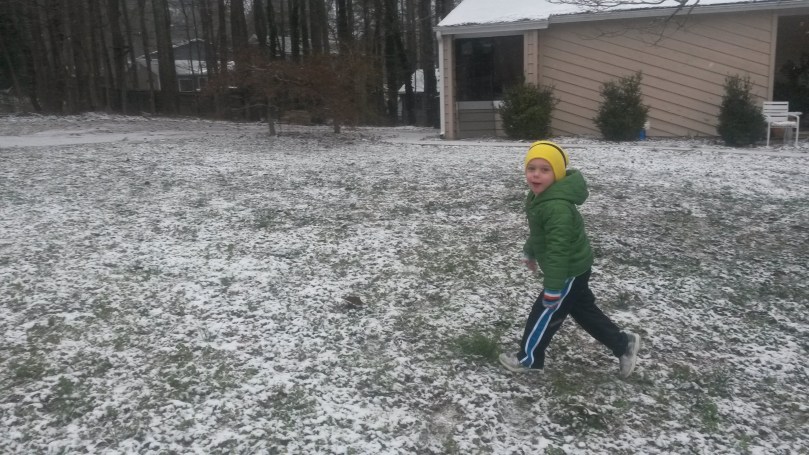
And that’s where this insecurity stems from, isn’t it? The constant comparison, the inescapable knowledge that while I’m sitting here tying myself in knots to bang out a few more words on my novel, Stephen King is somewhere in a mahogany study probably twenty pages deep into today’s copy. Every word better than mine, and by dint of that betterness, more valuable, and once we start talking about value, well. Steve’s words have value and mine don’t. It is as unlikely as a blizzard dumping two feet of snow in Atlanta that my words will ever be as valuable as Stephen King’s.

So why bother?

When we focus on the prizes that the things we could do bring — publication, wealth, an adoring audience … or a slimmer waistline, or a smaller number on the scale, or a promotion at work, or a new car in the driveway, or a medal or a trophy — we take our eyes off the road at our feet. Now, having a goal in mind is great. You have to dream big and aim high or you really won’t have a shot. But the prizes we’re aiming at — or the prizes we’re told we should aim at — aren’t the only prizes out there.

You can run for the serenity of it rather than to be the fastest. You can play pickup basketball for the distraction and the exercise and never have to worry about getting picked for a team. You can write for the sheer joy of it, or for the rush of playing god with the lives of the tiny beings you’ve created, or because it relaxes you, or simply because you have a story to tell.

I may never get published, or never reach the audience I hope to, or never make a dime off my writing. But I think I’d be okay with that. (I mean, it’d be a bummer, but I like to think I’d be okay with it.) I’m having a damned good time telling stories, even if it’s just to myself. Even if I’m never even a patch on Stephen King.

Then again, every now and then, it even snows in Atlanta…

20160123_093316.jpg

This weekly remotivational post is part of Stream of Consciousness Saturday. Every weekend, I use Linda G. Hill’s prompt to refocus my efforts and evaluate my process, sometimes with productive results.

The Weekly Re-Motivator: What Are We Waiting For?


What are we waiting for?

Seriously, every one of us has something in their lives that they are putting off. (Apparently the previous sentence is now grammatically correct; thank you, singular-third-person-they.) Whether it’s fear or doubt or uncertainty or perceived lack of ability, we have numerous and convincing excuses for not doing this thing. Those excuses, with the rare exception, are bullshit.

(The above is an absolutely terrible music video for a pretty on-point song.)

Your new year’s resolutions are in all likelihood floating face down in the kiddie pool by now. Forget about that. What’s the thing you really want to do, but haven’t yet? The thing you’re waiting for the right time to do? The thing that, if you had a little more time in your day, you could fit it in? The thing that terrifies you and entices you at the same time?

Sam Harris is responsible for a relevant quote:

Don’t you know that there’s going to come a day when you’ll be sick, or someone close to you will die, and you will look back on the kinds of things that captured your attention, and you’ll think ‘What was I doing?’. You know this, and yet if you’re like most people, you’ll spend most of your time in life tacitly presuming you’ll live forever. Like, watching a bad movie for the fourth time, or bickering with your spouse. These things only make sense in light of eternity.

The fact — and we know it, of course, even if we pretend we don’t — is that we don’t get that much time. Yet we sit around, not doing the things that we won’t admit really matter to us.

So what are you waiting for?

(Stop waiting.)

This weekly remotivational post is part of Stream of Consciousness Saturday. Every weekend, I use Linda G. Hill’s prompt to refocus my efforts and evaluate my process, sometimes with productive results.

The Weekly Re-Motivator: Die Hard


So the prompt for the week is “movie titles”, and the movie that’s front-of-mind right now is Die Hard. (Actually, who am I kidding; the movie is Star Wars VII, but I’ve talked that one to death around here of late… even I kinda want to lightsaber my own face if I bring it up at the moment.)

So, Die Hard. I hadn’t seen it until about a week ago.

I know. I know. I’m sorry. How I was ever carrying a man card before that, I don’t know. But it’s been remedied. Movie seen. Balance in the universe restored.

But my weekly re-motivator is about writing, right? So how is Die Hard about writing?

Maybe the better question is: how is it not?

McClane faces an impossible task: take down a squad of international terrorists. The writer faces many: stare down and overcome the impossibly intimidating blank page, stay focused and driven enough to finish his projects, and eventually, swim out into the open waters chummed with the manuscripts of his fallen comrades.

McClane is hamstrung (literally by his bare, and eventually, his ruined feet; metaphorically by an inept police chief and FBI agents who only make the situation worse), having to overcome obstacles that a normal person in his situation really shouldn’t have to. So, too, the writer: he must conquer his usually over-inflated sense of self-doubt about his abilities, his lingering and ever-present fear of rejection, even his lack of simple time in the day to do the thing he wants to do.

McClane is actually not trying to save the day for everybody; he’s trying to save his wife. (Disclosure: I’ve only seen the first two movies. I know. I’m working on it.) The thing everybody thinks he’s doing — defeating the terrorists, saving the civilians, foiling international intrigues — is secondary to the immediate need to save something that matters to him. Writers? I’ll posit that people think anybody trying to write is trying to become the next J.K. Rowling or whoever wrote Fifty Shades of Grey (shudder). In reality, though? Basically every writer I’ve come across — myself included — is a person who feels he must tell stories; who needs the creative outlet and the meditative focus that writing can bring like he needs oxygen. Not that we would eschew widespread acclaim (nor would McClane turn up his nose at saving buildings and planes full of people), but it’s not necessarily the primary goal.

And then, of course, just like action movies, writing is a thing best punctuated by the occasional bout of gratuitous explosions.

Nah, that’s not a metaphor; that one’s delightfully literal. Because every writer is a little bit of an action hero in his own mind, I think. John McClane saves the day because it’s just what he does. Writers write because that’s just what they do.

Write Hard.

This weekly remotivational post is part of Stream of Consciousness Saturday. Every weekend, I use Linda G. Hill’s prompt to refocus my efforts and evaluate my process, sometimes with productive results.