You Can Always Start Again


How many times can I do this?

Abandon this site, forget it even exists, come back to it, think “gosh, I should really write something,” write a few sentences, hate it, hate myself, abandon it, abandon any hope of writing, abandon all hope, dissociate, hate myself for THAT, at some point feel the tickle in the back of the brain that signifies an idea wanting to be written, rinse, repeat.

I’ve even written, and abandoned, THIS VERY POST more than once over the years. Hell, I may have actually posted this post before, but if I did it’s far away enough in memory that it might as well have been written by somebody else. A different guy, hating himself, feeling something like inspiration again, feeling guilt over neglecting his practice for so long, vowing to come back to it, or at least not to forget about it for a while, only to forget about it again.

It’s happened enough that I’ve thought more than once about discontinuing the site. Feels like a monument to another life, a guy I can’t be anymore. I think back to the early days of this place, about a guy who was somehow teaching full time, and writing something like 2000 words every day — 1000 words or so in a novel and just about that much again on this site about any damned old thing. Good or not, insightful or not, tortured and faux-poetic as it may have been, it came out.
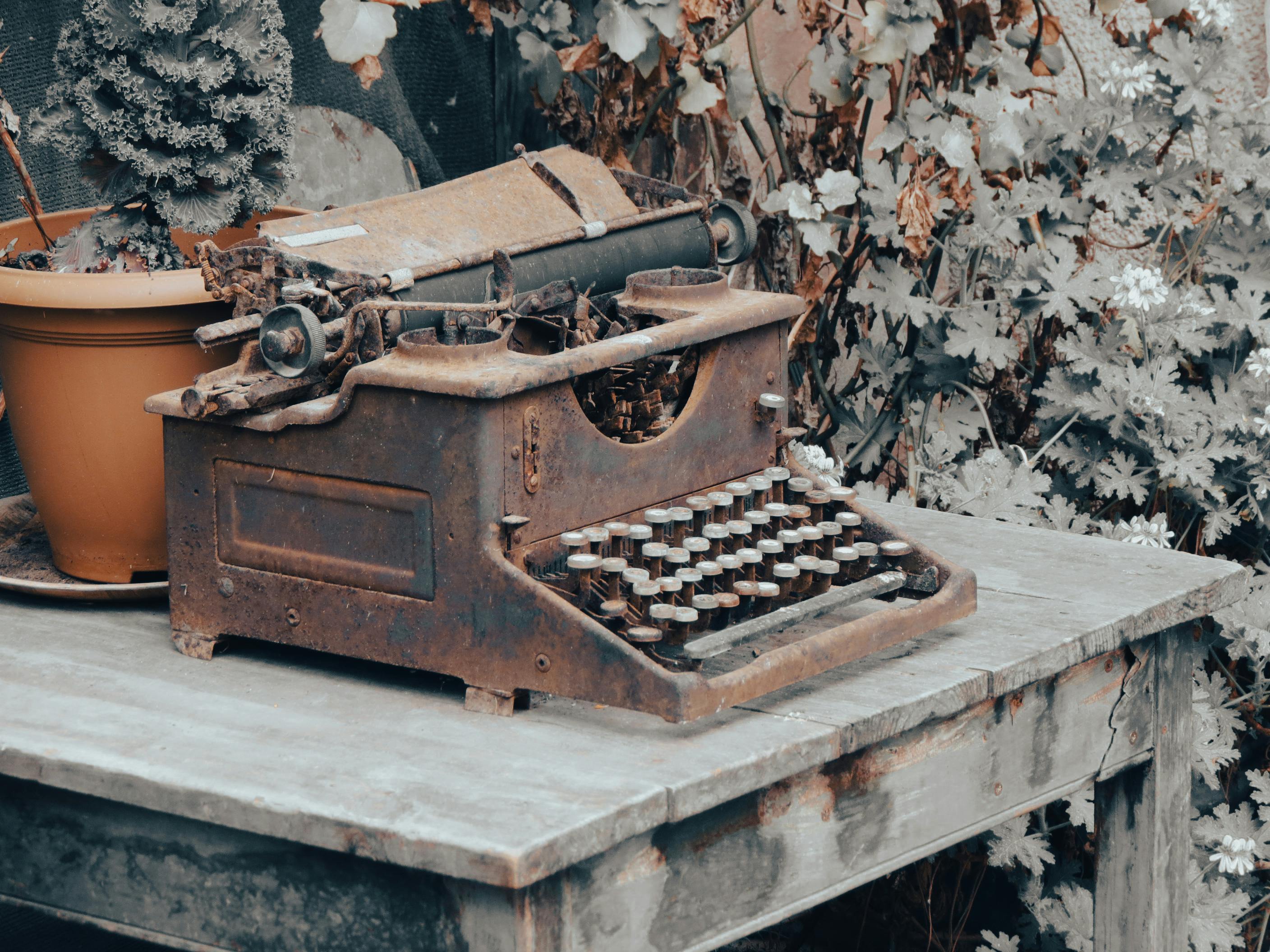
A dusty, rusted typewriter on a desk, also derelict.
Actual photo of my writing habit.

And every re-attempt to get back to that, or something like it, has only made me feel bad. I feel like I’m living in that guy’s shadow. I was feeling it then, I knew what I was doing, or even if I didn’t know what I was doing, I could fake it.

I read a book recently. (I know, I know. Foolish to think I’m getting my life — my writing life or any other kind of life — back on track just from reading a book.) (Also, second sidebar — I guess I haven’t lost THAT particular peccadillo — I didn’t technically READ it so much as I LISTENED to it over a couple of my regular 3-hour sojourns to visit with my wife and daughter in this crazy, de-tuned and de-synced year I’m living. But that counts, and I think my experience with the book may have been better for it. More on this in a moment.) The book was “Big Magic,” by Elizabeth Gilbert. She, the author of “Eat, Pray, Love.” (I know, ok? I KNOW.) In it, Gilbert talks a lot about the artistic life — yes, often the writer’s life, but the artistic life in all its forms: dancers and figure skaters and painters and screenwriters and travelers and teachers and creators of all stripes — and advocates a frankly wholesome view on the act of making art. And it’s like…

Ok, so I don’t have the greatest memory, yeah? Put that down to the long years drinking or, y’know, experiments with other things, or (god it hurts to say it but I can’t pretend otherwise) old age, but also bear in mind the fact that I have never in my life been particularly good at remembering things that are actually important (yet my head remains rife with useless movie quotes, fantasy novel trivia, and knowledge of my favorite old video games). So a thing I’ve started doing in the last couple years is taking notes. Digitally. I use Obsidian for this, and I might write about it sometime, but the point is, when I come across something I think might be important, and when I, y’know, REMEMBER TO DO SO, I make a note so I can find the important information again. I particularly take notes on books, because 1) I love reading, 2) I never remember what I read except in broad strokes, and 3) reading is time-consuming, so I would rather not spend my time re-reading books over and over just because I vaguely remembered they were good. So: when I read a book, I do it with pen, highlighter, or dog-eared-pages in hand, and when I get to the end, I note my thoughts on the book, pull out my favorite quotes, and catalog it. There’s a satisfaction to this process that’s hard to quantify, but needless to say, this method is best with a book I can mark up. Audiobooks, I can’t highlight or underline a passage. I can bookmark a moment, if I can be bothered to futz with the phone at the moment, which usually I can’t, because I was listening to the audiobook in the first place so that I could be focusing my hands on DRIVING or washing dishes or swing while I’m on a run or whatever else.

Ok, that was a long way to walk to tell you that Big Magic was a book that, had I been properly reading it, would have gotten a hell of a lot of markups and dog-eared pages, but because I listened to it, I had to sort of let it wash over me. Like lying on the beach as the tide comes in. Little by little, broken up by stretches where I would space out or get distracted, Gilbert’s observations just sort of lapped at my edges in her calm, reassuring tone, and after about six hours of driving, I realized something weird.

I wasn’t hating myself about the abandonment of my art.

This was a wholly unique feeling. I’d gotten so used to the low-simmering disappointment with myself over drifting away from this craft that to not feel it was a little like the first time I shaved my head and stepped outside on a windy day. What a refreshing absence.

Suffice to say, much of the book resonated with me, and maybe I can find more to say about it sometime. For now it’s enough to say that I wanted to return to the site here, not out of a sense that I *had* to, or that I needed to try to *recapture* what it once was, or to do so with any sort of goal in mind at all. I could’ve started a new one, but I figure, for better or worse, that this, too — even this sporadic period of barely anything over the past several years — is a part of the journey that this website is all about. And maybe I’ll turn it into a regular practice, and maybe I won’t. Tonight, at least, it feels nice to let my fingers dance on the keys, to spray these words onto the void of the blank page, to not worry about WHAT IT MEANS or whether it’s THE START OF SOMETHING NEW or whether it MEASURES UP TO WHAT I USED TO DO. Comparison is the thief of joy, etc, etc.

Tonight, at least, it feels good to open the spigot on my brain and let the thoughts drip out.

Tonight, at least, I’m here.

But…

There’s something else, too.

In “Big Magic,” one of the things that clicked with me was when Gilbert said you should treat your art like a new relationship. You spend your time thinking about it. You keep it secret from people, because you’re not sure about it yet. You sneak away to send it a quick message — to get a few more words down.

I may have (perhaps foolishly) started on a new project. I’ve written two and a half scenes so far, and y’know, it’s fun. I don’t know if it works yet, or if I’ll like it even if it grows up into a full-fledged thing, but I can fall off that bridge when I get to it.

But that’s not the thing. The thing is: I told my wife about it. Sheepishly. Ashamedly. Too early, to be sure. The concept is barely formed, the clay still damp and lumpy. “It’s probably dumb,” I think I said. “I dunno if I can do it,” I KNOW I said. “But I’m gonna try it.”

“Really?” She said, with something like a smile.

“Yeah, but who knows if I’ll finish it.”

She thought for a second. “I like it when you write.”

At least, I think that’s what she might have said. As I mentioned above, I don’t remember things so well. (My hearing isn’t great either, while we’re on the subject.) It’s possible she said “I like you when you write.” Or maybe it was just “I like when you write.”

Thing is: I also like when I write.

I forget that too often and too easily. If nothing else, I’m going to try to remember THAT.

A Buffet on Cheat Day


I used to steer away from nonfiction books the way you steer away from cliffs or angry moose. What, read something that isn’t about story? Something from which I can’t learn about character and plot and structure and all things writerly? Nonsense. I only have so many hours in the day; that’s time wasted.

And, well, I used to be a lot dumber than I am these days, too. (Which is not, by the way, to say that I am not currently dumb. I am currently very dumb about a great many things. But not, I think, as dumb as I used to be.)

Because if fiction books are good (we hope!) for learning about all those things in that top paragraph — awesome, deep characters, twistedly perfect plots, etc — nonfiction books are infinitely better for learning what your stories are really about. The world we live in. The private worlds that exist inside our heads. The nuts and bolts of reality. The often harrowing stranger-than-fiction stories that have really happened to real people.

I can’t believe I used to turn my nose up. Thanks to my re-discovery of the stunning awesomeness of libraries, I’m diving into nonfiction with a passion.

But the time! I hear my former (and current) self crying. Reading a book is such a significant investment of time and mental energy — how do you pick?

Well, here’s another secret I’ve learned about nonfiction: you don’t have to read the entire book. (This goes for fiction, too, but the sense of commitment to characters is a lot harder to overcome.) In fact, it’s a rare nonfiction book that I’ll read cover-to-cover, unless the writing is just dynamite (in which case there are things to learn there outside the subject matter of the book itself).

I treat my nonfiction books like a buffet on cheat day. Sure, the salad bar is there. And I’m welcome to fill up a plate with the leafy greens of statistics and deep technical jargon of astronomy or sociology or the mechanics of religious faiths. But what I really want are the slabs of steak and greasy chicken with piles of mashed potatoes and everything that’s fried: the raw, personal anecdotes and shocking first-person accounts and fascinating glimpses into the invisible.

So when I pick up nonfiction, the first thing I do is scan the chapters like I’m scoping out the buffet on the way to a table. Ooh, I definitely have to have some of that. Maybe a nibble from over there. Not going anywhere near those. And I’ve got to save room for dessert.

Not only does this make reading nonfiction — which has a bad rap for being a bit dry and tasteless — more fun and mentally engaging, but it paradoxically encourages me to read even more widely on things I might not have bothered with. I know I’m not making a week-long commitment before I even crack the cover; I know I can put the book down and move on to something else if it isn’t moving me.

All of which leads me back to one of my personal axioms not just as a writer, but as a teacher and a human as well:

All reading is good reading.

At best, you’re learning new things and improving yourself in the process. At worst, you’re learning what not to do and what to avoid. Win-win, baby.

Pass the mashed potatoes.

(Actually, don’t. Tomorrow is cheat day — I’ll just take them in a doggy bag.)

Don’t Forget Your Library


Writers are supposed to read, right?

And we’re supposed to read widely and prolifically, right?

Here’s the truth: in years past, I haven’t read enough. Not as much as I liked, and certainly not as much as I should. Why? Because books are fraggin’ expensive. And a major commitment. You go and drop forty bucks on a handful of books, not knowing if you’re going to enjoy them. But because you’ve spent the money, you feel obligated to read through the whole thing, whether you’re enjoying it or not.

Now, I’m not saying you shouldn’t be buying books. (As a guy who very much hopes you may buy his books when they become available, that would be pretty much anathema.) But for whatever reason, I had forgotten about the most obvious alternative: the library.

My wife recently started her specialist’s program, and had to do a bit of research. So off she went to the library. And because, you know, libraries are good for kids books, she took the kids along, and I went, too. And so I got a chance to browse around as well. And, hey, here’s a John Scalzi book I’d been thinking about reading — I read Lock In and loved it, but wasn’t sure about his other stuff. And there, some Neil Gaiman — somehow I haven’t read much of his work, but I’ve heard very good things. And then over there in nonfiction, a bunch of titles by Malcolm Gladwell — I’ve been listening to his podcast, and it’s excellent, so why not?

I went home laden with a bunch of titles I wouldn’t have read otherwise, feeling basically no commitment or obligation to any of them. Which is really the best way to read a book — with no expectations.

I read a few, and it was good — but I quickly became a little disillusioned. Our local library is pretty tiny, and the selection isn’t much to speak of. But — what I didn’t know until recently is that basically all the libraries in the state are networked, which means that you can browse the entire selection of books in all the libraries (which is quite a lot.) Then, if some library carries a book that your branch doesn’t, you just put in a request and within a week or so, the book shows up at your library.

This changed everything.

I’ve now got a queue of books ten deep and a stack of five or so on my bedside table. I’m reading books on philosophy and sociology and nuclear weapons and all kinds of things that I just couldn’t pull the trigger on before, for whatever reason. (The fact that it’s summer helps.) You might even say I’m reading so much it’s to the detriment of my writing, but that’s a discussion for another time. (It’s easier to pick up and put down a book at will than it is to pick up and put down your novel.)

Point is, I’m shoving words into my facehole at an unprecedented rate lately, and it’s entirely because I’ve rediscovered the library.

So, you know. Visit yours. Check out a book. Learn something new.

Page-Turner


Chuck’s challenge this week: Must Contain 3 Things. My three things: Library, Survival, War.

Ever gotten totally lost in a really good book? So did Elloree. Her story is below.

Page-Turner

In the flickering light of her dying candle, Elloree resembled nothing so much as a praying mantis in smudged plaid and oversized glasses. Her spindly fingers tracked like machines across the typeface, barreling toward the bottom of the page, then flicked it over with robotic efficiency. Her radiant eyes bounced from side to side as they drank in the words like so much water down the throat of a man dying of thirst. Her papery lips alternately pursed with puzzlement or curled up with satisfaction or opened just slightly to gasp with surprise. In a matter of moments, she had finished the book and tossed it on the pile of its brethren; another stripped-down carcass added to a growing pile of bones.

She rose, dusted her knees, and ghosted her way through the aisles. They towered over her diminutive frame like guardians, shielding her from the crimson light streaming through the windows, the streaked and scorched sunlight invading her fortress as it did for only a few times every day. She floated through fiction, bandied around the biographies, and reveled past the reference section, landing at last in her favorite section: Romance. She picked out a thick volume with a strapping bare-chested man on its cover and hummed dreamily to herself as she carried it back to her nest.

******

Rast’s shrill whistle pierced the evening, and Nell lifted her gaze from her bedraggled footsteps.

“Up ahead,” Rast whispered, as if afraid of breaking the dusty silence. “See it?”

She did. And as it always did when they approached another town, her throat tightened. Most likely it was just full of more of the same: smoldering corpses, shattered buildings, the haunting echoes of an entire community’s tortured final moments lingering in the air like poison. Occasionally, despite all the festering death, there would be some supplies. It had to be risked.

Nell straightened her pack on her shoulders, brushed an errant strand of soot-smeared hair from her face. “Let’s go.”

******

The sun was almost down, but Elloree hardly noticed. She never did, as the sunset looked the same as sunrise and much of the rest of the day. With the never-breaking columns of acrid black clouds streaming overhead, only an occasional ray of burning light would streak through, and then only briefly. The rest was darkness and smoke, and her candle was guttering. She lit another and continued her story.

******

The extermination here had been methodical and absolute. The roads were pulverized and difficult to walk on; Rast and Nell found their footing much more easily several feet off the road in the mud and weeds. The buildings were hollowed and skeletal, their shells weird misshapen silhouettes against the fading red light. No food. No survivors. Nothing left.

“Sun’s down soon,” Nell said. “Time to go.” She hated making camp in towns; you never knew when a sentry would pass over. They were better off when they could find a copse of trees or a rampant untended cornfield. But Rast wasn’t listening. He was squinting against the fading light, his three-fingered hand needlessly visoring out the sun. “There’s a light.”

“Don’t be stupid. I don’t want to get caught out here.”

“Nell. That building. Over there. It’s intact.” he pointed with his five-fingered hand. “And there’s a light in its window.”

Nell sighed and humored Rast with a look. He was daft as a post, but loyal, and he tried to help, bless him. He was also absolutely right.

The Septids razed every building they declared “tactically useful,” which included food storage, weapons repositories, residences, schools, churches, and offices. Occasionally you’d find a squat untouched, a shed or a low-slung warehouse. This building was small — probably too small to hold anything useful — but it was also definitely illuminated from within. Not by much. A light too faint to be mistaken for anything other than the reflected glow from the scorched sun burned at one window at the nearest corner. But that one window glowed while the others were dark. Rast’s sharp eyes had picked out something useful after all.

She turned to him and nodded, drawing her pistol. “Quietly.”

******

The cracked and smoke-stained door opened soundlessly as Rast leaned into it, and on practiced, stealthy footsteps, they stole into the wide open space.

A library.

For a moment, Nell simply gaped. She couldn’t believe the building was so intact, but it didn’t take long to figure out why. Books had long ago gone obsolete. They’d been digitized and collected into virtual storage, which was easier to police and took up less space. Most libraries had been decommissioned, but in some outlying towns it hadn’t been finished before the overthrow. And here they were, in a library.

With somebody else. At the end of the room, a shuffling of feet, a clatter of books. They edged around the shelves and aimed their guns at the tiny girl hunched over a novel in front of a ludicrous pile of books. Her eyes peered at them curiously through the thick lenses of her glasses.

She blinked at them, and they at her, for a few tense moments.

“How are you alive?” Nell finally asked.

Elloree shrugged.

“How long have you been here?”

She shrugged again.

The girl seemed so carefree, so unimpressed by them. Nell felt foolish. “How did you survive the war?” She demanded, her voice growing shrill.

“The war?”

Rast giggled foolishly. Nell scowled. “The war,” she explained, “that wiped out most of humanity. The war,” she continued, “that destroyed this town. The war,” she finished, “that somehow left you untouched. You didn’t know?!”

Elloree shrugged, looking a little sheepish. “It’s just… well… I’ve been reading.”

Rast began cackling. “Bookworm read right through the end of the world!”

“It’s just,” Elloree said, “that they were really good books.”

Time Out for Reading!


Weird circumstances the past couple days have seriously disrupted the routine, and as a result I’m getting virtually no work done on the novel, nor am I having any particularly useful things to post about here on the blarg.

That’s partly due to the honest-to-goodness fact that my daily schedule is all screwed up and partly due to the fact that there is some heavy sharknado weighing on my mind that I am literally not allowed to discuss.  More updates in a few days when the dust settles.

However, my activities the past few days have left me with some rather large gaps during the day which I’ve had to fill using no electronic devices at all, and since I plan ahead for these eventualities, I’ve gotten to do something I haven’t enjoyed in quite some time: sit down and read.  You know, from a book.  Like in the olden times.  Pages and all.  Bookmarks.  Dog-eared pages and jotting little notes in a notebook.  (Yeah, that’s how I read, I can’t help it.)

In particular, I’m sinking myself into the second in a series by Jasper Fforde, Lost in a Good Book.  The series in question is the Thursday Next series, which follows the titular heroine (a literary detective) as she gallivants in and out of various works of fiction, some renowned, others reviled, in pursuit of her duties tracking unauthorized changes to priceless manuscripts and verifying the authenticity of lost works of Shakespeare.

Now, “literary detective” is a job title which immediately makes me want to fall asleep, but these books are just flat out fun.  They detail a fantastically well-imagined alternate reality in which, to name just a few key differences, ownership of the Crimean peninsula is still in dispute, long-extinct animals have been genetically resequenced as household pets (Thursday keeps an adorable and rare second-sequence dodo bird, Pickwick, in her home), and Gravity Tubes allow anybody to travel to anywhere in the world in the space of just over forty minutes.  If that sounds whimsical, rest assured that I’ve only just slipped you the tip of the taco.  Fforde weaves the details of this fantastical world so thoroughly into his narrative that I never find myself questioning how things work; rather, I bounce happily along for the ride.  In fact, the alacrity and gusto and sometimes the offhanded way in which he creates the tiniest of details in this world is so charming and effective that it makes me feel woefully inadequate as a writer.

To wit, this passage from page 112 of Lost in a Good Book:

“Looping” was a slang term for Closed Loop Temporal Field Containment.  They popped the criminal in an eight-minute repetitive time loop for five, ten, twenty years.  Usually it was a Laundromat, doctor’s waiting room or bus stop, and your presence often caused time to slow down for others near the loop.  Your body aged but never needed sustenance.  It was cruel and unnatural — yet cheap and required no bars, guards, or food.

He tosses off this explanation like sluicing water off the hood of a freshly waxed car, deftly weaving the callous cruelty of the monstrous corporation together with the unfathomable scientific capabilities of the universe and, oh, just for fun, offers a clever explanation for why we always sit around checking our watches (sharknado, I just dated myself) or rather our cell phones in waiting rooms.  And he does this every three or four pages.

I’m not here today to offer a review of the entire book, let alone the series.  I haven’t yet reached the point in the book where somebody does get Looped, though it’s not necessarily an eventuality I expect.  It’s simply one example out of hundreds that detail the possibilities of an alternate universe that plays fast and loose with the laws of physics.  Fforde is also unrelentingly British and has that delightfully dry wit, so the books scratch that Douglas Adams itch that seems so untameable.  (Untameable?  Untamable?  Spellcheck doesn’t like either option.)

In short, if you’re a bookish sort, you should be reading Thursday Next.  Possibly you could read Thursday Next on Thursday next.  (I think the man must have been chuckling sideways at himself with just about every character name in the thing.)  And no, it’s not a particularly new series — Good Book came out in 2002 — but who cares?  It’s brilliant and clever and whimsical and ridiculous all at once.

The last several books I’ve read have been so heavy and dark and drear that these books have felt like a much-needed B12 shot.  Anybody else out there reading books that make you laugh?