Why Morning Pages Are Working For Me (And They Might Work For You, Too)


So I’m back on the journaling thing again.

I know, I know! I start these things and go off them, and start and go off, like a chronic yo-yo dieter with short-term amnesia, like a kid climbing on and off the high dive pretending he’s really gonna do it this time. I’ve tried bullet journaling (god, I hated it so much) and plain ol’ page-a-day, write-about-what-happened-today journaling (not bad but felt more like a chore without a payoff than anything beneficial). They only lasted for a few weeks each. But I actually think I might stick with it long term this time, and I think it’s because I found a journaling system that seems to be working for me.

Here’s that system.

What I’m doing for my daily journaling (well, 5-6 days per week journaling, a man deserves his weekends off, don’tcha think) are Morning Pages, popularized by Julia Cameron. Some time ago I actually wrote a post about how I was given one of her books about process and creativity: I got frustrated and annoyed with her endless romanticization and frippery about writing and gave it up. But the more I read into the habits of the successful (and especially of the successful creative), the more I heard Morning Pages mentioned. So I re-looked them up and gave them a try. I’ve been doing them for a solid six weeks, and I’m pretty sure I read somewhere that you need thirty days to form a habit, so obviously I’ve got this one sorted.

Anyway, a brief explanation. Morning Pages are not journaling per se.

Sorry for the detour. WordPress apparently doesn’t recognize “journaling” as a word so it’s underlining it in red all over my draft, which is really futzing up my zen for this particular session. I’m irked, but I hereby release the irkitude. Carry on.

You know how when you wake up in the morning and the first thing you have to do is head to the bathroom? Me, (not that you asked but I’m in that kind of mood) I like a nice feisty deuce in the morning. Partly because physiologically it has to be done, partly because I guess I’m conditioned. Anyway, I like getting it out of the way early. Cleans me out, lightens the load, I can go on with my day. Morning Pages are like that, but for your brain.

In short, you wake up, do your bathroom thing, and before you let too much time pass, you sit down and write. You can write about whatever you want, whatever’s to mind, but you have to write three pages. And you have to write longhand. No typing.

It’s a brain dump. And it’s working for me.

Now, I’m not hyper-adherent about it. I do mine when I arrive at work, when I have a little time to myself. I’ve gone for a run, gotten the kids off to school, kissed the wife goodbye. (Technically you’re not even supposed to do all that stuff — you’re just supposed to roll off the mattress and embrace the blank page. Fargo that, I say. You take a thing and you make it work for you. I’m already waking up before 5 AM on run days, I ain’t waking up thirty MORE minutes early.) I come in, set my stuff down, start a bit of music on the computer (https://www.youtube.com/watch?v=hHW1oY26kxQ is my playlist of choice the last few weeks), start the electric kettle for my cup of tea, then I crack open the notebook, ready my pen, and set about writing.
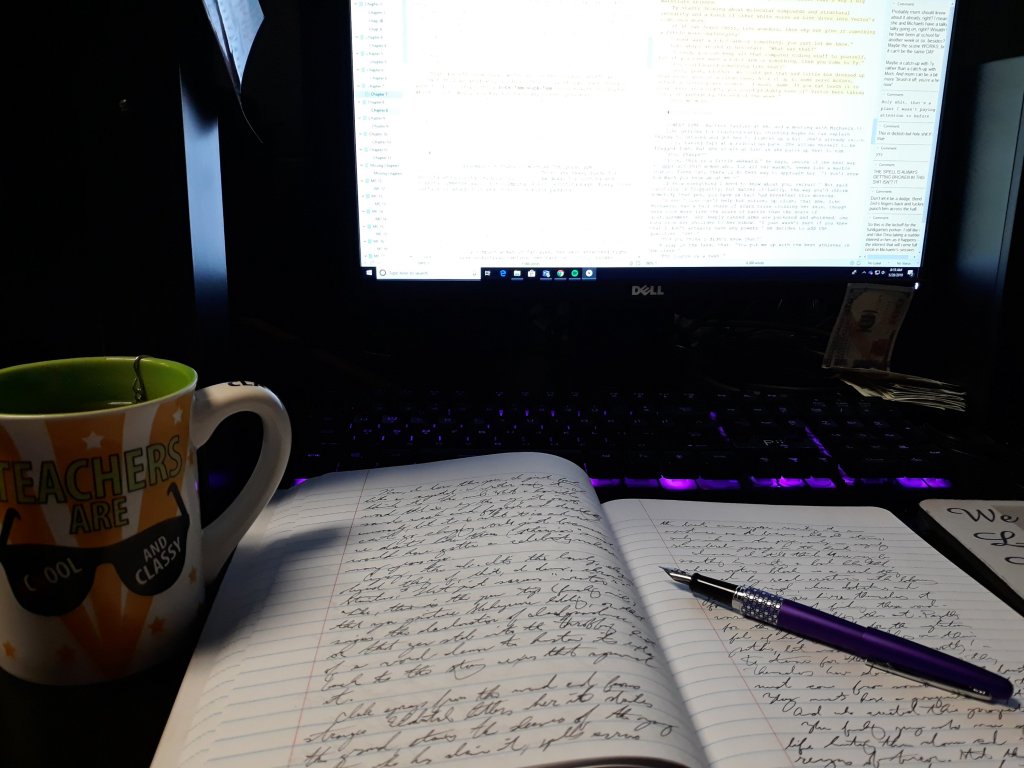
Pictured: A cuppa tea, my Morning Pages, my new fountain pen, my project ready-to-go in Scrivener, and a fat stack of (fake) cash because it’s still hanging around my office for some reason even though we closed our show a month ago. THIS IS WHERE THE MAGIC HAPPENS.

I write about my worries for the day (and boy do I have a lot of those! Speaking of which, I’m still scaling back on the meds. That’s going great. Maybe I can post about that later). About what I’m thinking about. What irks me. What excites me. Sometimes a story idea will bloom in the middle of writing and I’ll noodle that around, invent a character and let her splash around in the tidal pools of my brain farts for a few lines. I’ll roll in other journaling ideas, like jotting down things I’m thankful for, things to focus on for the day.

You notice that the things I write about are diverse. They sort of have to be. Because to just sit down and write three pages without having a central topic to write about is … well. It can be tough. Inevitably one starts to doubt one’s self: This is dumb. Why am I even thinking about this, much less writing about it? Who even cares about this? I’m literally just vomiting words onto the page. Blah blah blah blah blah blah blah. (I’m pretty sure I actually wrote two lines of just the word “blah” once — that’s how stuck I got.) But that’s kind of the point. One of the only rules about Morning Pages is that you’re not supposed to stop writing. Don’t stop to think about what you’ve just written. Don’t stop to think about what you’ll write next. Just press on. And in that regard, Morning Pages become a mighty tool.

When you take away the ability to stop, to pause, to critique and evaluate, then you must embrace the necessity of writing literally whatever comes to your mind. Mind’s a blank? Write about how your mind is blank. Distracted by an odd smell coming from the next room? Write about how it makes your nose wrinkle in disgust. The process is meditative, in its way. You express what’s front-of-mind and tune out the rest. And when you have to fill three handwritten pages, well — your mind tends to wander a bit. Morning Pages allow you — nay, force you — to wander with your thoughts, to explore what’s lurking in the subconscious brain, to get down on paper what’s clanging around in your skull so you can move on from it.

Further, there’s a concept in exercise called “greasing the groove”. In short, it entails working out at a capacity significantly below what you’re capable of to improve muscle memory, so that when you do go hard, the muscles are better tuned-up. Morning Pages are that, all over. The stakes couldn’t be lower, as I’m certainly not sharing them with anybody for proofreading. It doesn’t matter if I make grammatical mistakes or swear my entire face off on the page (something I actually try to be careful about here on the ol’ blarg). Writing a whole bunch where the stakes don’t matter gets my brain tuned up for the more important writing where my plot, characters, and general goodness or badness of the story do matter.

The first few times I did Morning Pages, it took me about half an hour. I kept stopping and starting, second-guessing myself and the process, allowing myself to get distracted and zone out. Lately, I crank ’em out in about fifteen minutes, which is basically as fast as I can reasonably write them. And yeah, I could certainly finish faster by typing, but there’s something that’s almost, but not entirely unlike, magic about actually creating words through the motion of your hand. It’s slower, but I like it. (Especially since I got my new pen.) It forces you to connect with the words more than typing does. It’s hard to explain.

Anyway, I write my three pages, then close the notebook and don’t think about it again for the rest of the day.

And it’s incredibly freeing! For one thing, the process triggers that same “I DID SOMETHING” dopamine rush that exercising first thing in the morning does. You get that zing of having written three pages, and hey, the rest of the day seems that much easier to face. Plus, it stimulates the brain like hooking up jumper cables to a dead battery. Writing about my worries, my to-do list, my whatever — it forces me to focus thought on those things, and often, answers and motivation are the result. More than once has it happened that I poured out a problem into my Morning Pages — a snag in the story, something that was bothering me about a colleague, a messed-up situation that was driving me nuts — and an answer takes shape just from writing about it.

I feel better immediately after writing my Morning Pages. And that helps me set a good trajectory for the day.

In that vein, I want to posit: it’s no mistake that I’m back to working full-steam on my current novel in the weeks since I started doing Morning Pages. Just reminding myself that, yes, I’m capable of the physical act of writing, seems to have, if you can believe it, reminded me that I’m capable of writing, of fixing this story, of pushing through a roadblock.

In short, writing my daily Morning Pages sets the stage for a good writing day, and anything that does that is welcome in my world. Julia Cameron may be a bit of a ridiculous hippie but I think she’s got something with this practice.

Have you tried Morning Pages? Do you journal in a similar way? I’m always curious to see how other people are making it happen.


The Blank Stage, The Blank Page


It’s as inevitable as the sunset when you work in the theater — for every show that opens, the show must close. As the curtain goes up, so must it eventually come down. And as the stage was once a hurly-burly mass of activity and energy and joy, so it must revert to a hollow, silent room.

We’ve just finished the run of our spring musical, and if you hadn’t noticed, I’m feeling a little empty. I’m a lot relieved and a lot satisfied and a heck of a lot tired, but with all of that comes a little bit empty. You give so much of your life and your time and your thoughts to this one endeavor until finally, over one whirlwind weekend, it’s over.

But that doesn’t sum it up entirely. Theater is this ephemeral thing, fleeting and fragile and magical and then, suddenly, gone. It’s not like most other art forms. You write a book, or a poem, or a story, and the words are there basically forever. Whether they’re scrawled on the page or stored in the digital guts of a computer, the words — the fruit of your effort — remain. Write and record a great song? You can play it back as many times as you want, record as many versions as you want. Draw? Paint? Sculpt? Those things persist. But with the theater, you’re building a moment, a moment in time that must by its nature pass and leave no trace. The only evidence that the thing was ever there is in memory (and in the admittedly massive cleanup afterward).

I’ve had students coming up to me all week saying they’re so sad the show is over, that they don’t know what to do with themselves now. Some of that is in jest — with all the extra time, what can’t you do with yourself now — but a lot of it is genuine. Logging all these extra hours with these people, in this place, working together on this project … it’s the quintessential example of a whole being greater than the sum of its parts. So when it’s done, and the final bows have been taken, it’s no great shock that, for these kids especially, it’s a bit like losing a loved one. Even on the shows that are kind of a train wreck (and I’ve been involved in a few of those, let there be no doubt), the cast and crew become a family, develop a bond that’s a bit unlike anything else. And this show, to state it with humility, was far from a train wreck.

A colleague of mine when I was coaching soccer put it in perspective for me as we were bemoaning our near miss at the playoffs that year. The squad was all understandably disappointed, bordering on depression. And so was I. And he said,

“Sometimes you have great years, and sometimes you have not-so-great years. Every once in a great while you get the chance to catch lightning in a bottle, and those are the really great years. But what matters to the guys isn’t so much the win-loss record. It’s what they go through as a team. Are we teaching them the right things, win or lose? Are we making them better men? That’s what matters. And we’re teaching these guys the right things, coach.”

I left that job — and that coaching position — sooner than I would have liked for the sake of that team, in pursuit of another, deeper dream of mine — teaching theater. But I saw those guys again a few weeks ago, under some truly unfortunate circumstances.

One of our players from that season had died, passed away while on vacation. He was 22. And while the sadness and the hurt of that moment was still seeping in, I was greeted by his teammates — or, as they had taken to calling themselves, his brothers. In my grief, my players — my students — they comforted me. They reassured me that life goes on, that we have to live right and be strong for each other in the absence of those that have passed away.

My team of boys had grown into a crew of men, showing me exactly what we’d been trying to teach them back then. We did catch lightning in a bottle, then — I just didn’t know it at the time.

This show was one of those lightning-in-a-bottle experiences, but I think it became that — in part, at least — because of the culture we’re building at my school. We’re teaching the right things, forming the right kinds of relationships, showing these young people how to chase after what matters and how to be good brothers and sisters to one another in the process. And that’s what really matters, regardless of how good the show was or how many tickets we sold.

(Of course, it helps that the show was also excellent.)

So now, the blank stage, and the emotional vacuum that swirls in its wake. I’ve been telling my students that it’s okay — perfectly normal, in fact — to feel a bit sad. The set has come down, the costumes have gone home, the props are all back in storage. The stage is empty, and it’s not wrong to feel empty with it.

But I’m also pointing out to them how full of potential an empty theater is. All that space, just waiting to be claimed. All that energy, waiting to be tapped. The blank stage is just like the blank page — a world of possibility unsullied by past mistakes or fears of the future.

It’s there, an empty vessel, waiting to be filled.

Just like our hearts.

Productivity Porn Pays Off Sometimes


I made the mistake of listening to a Tim Ferriss podcast this morning.

I say mistake because, as is often the case when I read or listen to something by Tim it tends to take over my brain, the way the moon drifting in front of the sun turns day into night for a few minutes. The difference is instead of lasting for minutes, the effect tends to last for days or weeks.

The problem with listening to Mr. Ferriss, or with any so-called “productivity porn”, is that it tends to create a feedback loop, a sort-of hyped up fugue state. You read this thing and you think “HELL YES, this thing is going to change my life” and your brain drowns in the dopamine flood caused by the visions of success, and while you’re high on that you notice that the thing you just read references this other thing and hey, you’ve got a few minutes before you have to get back to real life, so why not check that out while you’re at it, and wouldn’t you know it the new thing hits you with the “HELL YES” effect again and the cycle repeats. (Full disclosure: when I started writing this post I visited Tim’s site — for the first time in months, I might add, because I know what happens when I do it — and fell victim to the same cycle. I also signed up for his new newsletter. And may or may not have copy/pasted some material onto my desktop. Stop judging me.) Point is, you have to be judicious with this sort of thing, which is why I’m probably not going to dip my toes into Tim Ferriss land for several months again. Still, this morning, I think, was beneficial.

The material in question was a recent episode called Tea Time with Tim, which covers a lot of ground but left me with a couple of things clanking around in the ol’ noggin: something he calls “fear-setting” and a few quotes from ancient Greece.

First, fear-setting. You’ve heard of goal-setting, where you set down your goals, enumerate the steps to the achievement of said goals, and more or less plan your vision for success. Well and good, but for us anxious types, who dwell on fears perhaps more than we should, there’s a tendency to let those fears paralyze us to the point of inaction. (See for example my writing productivity over the past several months.) Fear-setting is designed to take the positive visualization of goal-setting and turn the full artillery of that framework on the anti-action fear center of the brain. In a (woefully inadequate) nutshell, fear-setting entails writing down all the things that could go wrong and enumerating the opportunity cost if all those things did go wrong, then weighing those costs against a (harshly conservative) estimation of the possible benefits if the things don’t go wrong. For the anxious sort like me, it seems like a good way to short-circuit the “thing is scary so maybe just pretend it doesn’t exist and it’ll go away” paralysis I tend to fall into over stuff.

Then, quotes from Greek guys. First, this one:

Which is one I’m going to share with my classes today, because my students tend to be sick with the germ of “well I want this thing really badly, and things tend to work out for me, so on performance day it’ll all just come together”. You and I, of course, know that kind of thinking is what makes starving artists waiting tables for their whole lives, or worse, a phalanx of creatives who never took up the dream at all because a single performance didn’t live up to the hype in their head. So I’m going to remind them, today, that their training, today, matters for the performance a month down the road, and, well, for most of ’em it’ll bounce right off but at least I’ll have done my part for the day.

It applies for me personally, too, of course. Suffice it to say I’m not particularly well trained-up at the moment in a number of domains, and, well, that needs some attention.

Then, this:

And, yeah, Seneca was Roman, not Greek, but the Romans were basically Greeks with better tech, so let’s not get too hung up on the details. I’ve actually seen the quote more often with the first clause as “we are often more frightened than hurt,” but I prefer this one with fears and dangers. The important part, at any rate, is the second part. The thing we’re afraid of is always worse in our minds and the reality is almost never as bad as we build it up to be. For evidence I offer the example from Louis C.K. (and yeah, quoting Louis C.K. is problematic these days but his personal faults don’t change the poignancy of his words) of the average description of a trip by airplane. The person is likely to complain about the length of delays or the slowness of service or the lack of wi-fi and less likely to dwell on the fact that they literally FLEW THROUGH THE AIR and crossed the country in a matter of hours. We make things out, in other words, a bit worse than they really are in the scheme of things.

So, yeah, my brain is basically on fire this morning.

I hope it doesn’t burn out.

On the Rebound


I had this great metaphor going about the word “rebound”, in the vein of a golf ball rebounding around in a tile bathroom — unpredictably, chaotically, terrifyingly. Of course, that golf ball ultimately goes nowhere — at best it smashes some things up, causes a heck of a lot of havoc, maybe dings and dents if not outright destroys the floors and the walls. But it sure does make a lot of noise while it’s about it.

Why that metaphor? Because that’s what my creativity feels like, of late. (I’ve taken to personifying it as this “other”, this entity that rides along with me; the proverbial angel/devil on my shoulder, whispering inspired idiocy in my ear.) I’m heavy on ideas but light on product. Writing a fair bit but with not much to show for it. Feeling a little, myself, like I’m bouncing off the walls, unable to really get anywhere.

Really got into it. Sat down to write, then rechecked — and the prompt wasn’t “-ound”, like I thought — for which I was pretty proud of the word “rebound”. No, the prompt was “round”.

So, yeah.

Guess that’s that.

Happy Saturday.

This post is part of Stream-of-Consciousness Saturday.

Write Club


I was listening to an interview with Chuck Palahniuk, and it made me realize – I have no idea what kind of writer I am.

I know I’m some sort of writer. Here I am, after all. These words aren’t creating themselves. But I don’t really know how I’m doing it. Or rather, I don’t know if I’m doing it in the best way.

Best, of course, is relative, but it must be said – I’m constantly eaten up with doubt over whether I’m doing it right, where right means in a productive, creative, efficient manner. Whence springs the doubt? Well, to begin, I have no idea how I want to write. My head is full of these conflicting romantic notions about process and product. On the one hand, I revere the idea of going away in a dark corner (literally – one day I’ll photograph my writing corner) to let my fingers tap dance the story to life. On the other, I hold this fondness for the written word – a fondness which has filled up my home and work space with notebooks and pencils of all sorts, and whose marble-statue grip on my soul compels me, always, to wander down the office supply aisle are the Target or the Kroger, “just to see” if they have any neat writerly tools I might need to stock up on.

But, see, then I realize – when’s the last time I really wrote longhand? The answer, it turns out, is about three months ago. (this I know because opposite the page on which I’m now madly scribbling is the last journal entry I wrote, back when I was forcing myself to the habit even when my heart wasn’t in it. It was about Canada, on June 8. So much green.)

So I romanticize writing longhand, but (it’s impossible not to notice) I don’t actually do it. When I’m writing, almost all the time, it’s at the computer, sat behind the keys, a hammering monkey. In the interview, Palahniuk quotes Kerouac or somebody to say, “that’s not writing, that’s typing.” There’s derision there, for sure. A hipsterish scoffing at a process which, at core, is just another way to do it. But Palahniuk prizes the written word in a sort of sacred way, and so, it turns out, do I.

After all, when I embarked on this adventure, I did it, not from behind a computer screen, but from the pages of a notebook basically identical to this one. And when I am struck by my best ideas – my sweet Jesus get that on the page before you forget it and, by its omission, make the universe a sadder place ideas – it’s basically never when I’m sat at the computer, typing. No, those ideas strike like lurking cobras, when I’m just on the precipice overlooking dreamland, when I’m caught at a stoplight, when I’m brushing my teeth, when I’m out for a run, when I’m watching my kids bounce basketballs off each other’s heads.

And what do I do then?

I don’t dash to the computer, wait for it to boot up, open a word processor, open a blank file (or worse, navigate to an existing one). I don’t reach for my phone, swipe to an app, open it, create a note, title it and punch away with my thumbs. No! When the idea strikes, I’m reaching for pencil and paper, because there is nothing simpler, there’s nothing in the way of that.

And yeah. I’ll go hippie-dippie and affirm that there’s still something magical about the scratching of my papermate 0.7 on a sheet of clean, lined paper.

It doesn’t escape my notice that my tone, of late, is full of resolve and enthusiasm: things I want to try, things I want to do, ways I want to be better. Maybe it’s the hint of fall in the air in these recent mornings – it feels like we’re about to shrug off the heavy sweat-cloak of summer. Maybe it’s just the right stimulus striking at the right time, like lightning forking through the primordial ooze and spawning a brand new genesis.

Or maybe it’s just Chuck Palahniuk’s word-seeds falling on fertile soil between my ears.

Whatever it is, I’ll take it. And when it’s time to write in the days and weeks to come, I’ll be considering my notebooks first.

This post is part of stream of consciousness Saturday.