Write Anyway


Some days, the writing sucks.

Like today. The kids were up way too early. The sun hasn’t come out all day, so it’s like the world never really woke up. It’s literally obscured by smoke that has blown in across the country from wildfires in Alaska. The house is a wreck and I have no drive to clean it.

In short, I feel like crap, though there’s nothing physically wrong with me.

When I got the kids down for a nap, all I wanted was to close the light-filtering curtains, crank up the white noise machine to drown out the noise of the cats crashing around in their midday shenanigans, and join them in dreamland for a blissful hour or so. I was feeling completely exhausted, bone-crushingly uninspired, will-sappingly unmotivated, and in short like a total waste of space. (I won’t call it Writer’s Block, because I firmly believe that Writer’s Block is just a fancy way of saying that I am not responsible for my creative ability. Writer’s Block can last for years. It’s a crutch. It’s a way of hiding from the work you really want to be doing. Fargo Writer’s Block.)

But I wrote anyway.

6281142155_cf33c5be64_z

And I felt better.

It damn sure wasn’t my best work, but upon reflection, it probably wasn’t my worst, either. And the house is still a mess, and my son is cranky because he peed the bed, and my daughter is clinging to me like a tick to the underside of a particularly furry dog because she fell asleep way too late. And there are dishes to do and toys to pick up, and the world still feels kinda sharknado-ey today.

But there are always these days. The kids are always going to find reasons to be cranky or jittery or whiny or loud or awful. The house is always going to be messy or in need of repair or stinky from last night’s dishes I didn’t wash or the trash I didn’t take out. There will always be days when the weather sucks, when my mood sucks, when the world itself seems to want you not to write. Or, you know, whatever your thing is. Life and the world will get in the way of your thing.

But today I wrote anyway, and I feel a little better.

Because I really want to be a writer. And if I’m not writing, then I’m not a writer.

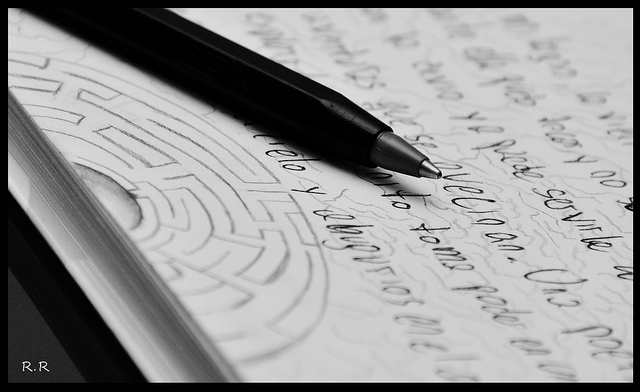
Photo by Ramiro Ramirez @ Flickr.

Weekly Re-Motivator: Summary Stew


I can’t stand the summary.

You know, you crack the book open, and on the inside fold or the back cover or wherever, you get the blurb that tells you in a nutshell what the story is all about.

Karl Wisenberg is a mild-mannered office worker hiding a secret: his radioactive toenails. But there’s something more sinister than glowing fungus afoot…

Alice Klepper sells jewelry by day and state secrets by night. But will an unexpected purchase by an eight foot tall stranger provide her with the biggest secret of all?

The summary is supposed to give you a taste for the story without spoiling it for you; it’s supposed to whet your appetite and get you to crack the book and keep on cracking it until the end.

And I hate it. Because it gives the impression that the story is all about plot, that the narrative is a simple math equation with all these different elements — character, setting, tension, conflict — that add up to something. But a story is more than the sum of its parts. Because holding it all together is a fumy glue all the stuff you can’t fit in the summary: the creeping sense of dread you get every time a character opens a door in the story, where you don’t really know whether behind the door will be a harmless delivery man or a hatchet-wielding trans-dimensional wasp-man. Or the biting irony that infuses every word, wherein you can feel the author’s arched eyebrow and hear the sardonic twist behind every turn of phrase.

You can’t get that in a summary, and that’s the most important part of the story, I think. Because really: whatever you’re writing, the story has been told before. No matter how unique, how original, how unexpected your twists and turns are, somebody, somewhere has twisted and turned down that road. The only difference, the only thing that makes your story unique, is the way you tell it, the specific blend of spices you drop into the mix, the character that you build the story into.

Because a story is a living thing. It’s not just a chain of events, one thing leading into another like a dull-witted chain-gang of tromping inevitability. The story itself, just like the characters, has a flavor; the narrative itself has a feel about it that is much more than just the things which happen in it. And that flavor is what makes the story unique, that flavor is the thing that sticks with you after you’ve finished the book and brings you back, like the unbelievable egg rolls at your favorite restaurant.

Which is what I’m struggling with in my current project. I’ve got a decent chain of events, I’ve got decent characters and reasonable tension and a good smattering of conflict. But I haven’t found the right flavor for the brew. And the story, and my motivation for working on the story, is suffering as a result. I haven’t found the right feel for the story, and the story feels wrong as a result. Feels bland, uninteresting. Luckily, writing isn’t like cooking. You want a good solid stew, you have to get all the spices in at just the right moment to release their flavor and bring out the best in the dish. In writing, though, you get as many chances as you need. Screw up the flavor and you can add more salt at the last minute, or strain out the bad spices and replace them with new ones, or even toss the whole dish and rebuild it from the ground up.

But the flavor will come. The thing with writing is to keep plugging away at it, keep working, keep creating. The more these characters simmer in the narrative stew I’ve created for them, the more the subtle notes will come out, the more I’ll be able to tell what flavor is right for this tale.

So, as you’re writing, don’t stress about the summary. Focus on the flavors, focus on the interplay between elements, focus on the parts between the “important” story elements, because those are what keep readers coming back for more.

Am I wrong? Is the summary more important than I give it credit for? What flavor do you most appreciate in a story?

This weekly Re-Motivational post is part of Stream of Consciousness Saturday. Every Saturday, I use LindaGHill‘s prompt to refocus my efforts and evaluate my process, sometimes with productive results.

The Toddler Wobbles (or, the Tripwire of Self-Doubt)


My daughter is this close to walking.

She’s been doing the “cruising” thing for about a month now, where she’ll grab the edge of a table, or the couch, or the leg of my shorts, and just sort of shimmy along, one shaky step after another; but of course, she can only go where whatever she’s clamped onto can take her. And she’s been walking assisted for several weeks beyond that, holding gleefully to the hands of whoever has the patience and the dorsal fortitude to bend over and escort her around the house. Again, of course, she can go only where her guide takes her.

There is an unmitigated joy about her as she does any of these things. Her little stumpy legs clomp along not unlike those of the imperial walkers in Star Wars, stable enough only if everything goes according to plan. She laughs, shrieks, smiles. Then tumbles.

But she won’t walk on her own.

And I know, I know. She’ll get it in time. But there’s something frustrating and heartbreaking in seeing her shuffling along, a wobbly snowman on stilts, and knowing that she could walk if she would only decide that she had the capability.

She’s done it before.

She’ll cruise along the table for a minute, then pick up a toy and turn and totter over to the sofa — a yawning gulf of two steps or so, but a moonshot in the scope of toddlers. I’ll stand her up in the floor across from her mother, and she’ll hold my hands until she’s within a step of her mother, then detach in time to fall forward into her mom’s loving embrace. She has the strength. She has the balance. What she doesn’t have is the knowledge that she’s perfectly capable.

Now, she can crawl with the best of them. In fact, she can muster so much speed on her hands and knees that it’s a little startling: she can cross a room in just a couple of seconds, and be sitting there angelic as ever when you come back in from getting a glass of water. This, paired with her propensity (and joy) for grabbing things and sticking them in her mouth is enough, almost, to keep you from leaving the room at all when she’s around (what if she pulls the TV over on herself, or what if she swallows the dog, or what if she goes into the garage, fires up the pneumatic hammer, and takes out the retaining wall?). An inability to walk isn’t, in other words, keeping her from getting around.

But when she starts walking, she’ll be so much better off — she’ll be faster, she’ll be able to take things with her, she’ll be able to reach her hands up and hug your knee when she walks by. She needs to walk. She just won’t.

I can’t say it’s fear, because she isn’t afraid of falling. She’ll gladly pitch herself sideways while my wife or I holds her, despite the five-foot drop to the ground that surely awaits if she manages to escape. It’s as if she simply doesn’t grasp the idea that walking instead of crawling might be a better way to do it. Like cave dwellers who won’t take the ipod that’s being proffered to them, believing instead that eating worms and running from daylight is better than the natural next phase in human evolution (selfies and social media, of course). She just doesn’t realize that she’s hamstringing herself by keeping to all fours, doesn’t understand that her muscles and her sense of balance are ready for her to walk, doesn’t get how much her world is going to open up for her when she begins to walk.

She’ll get it eventually. One day — maybe tomorrow, maybe next week — she’ll shuffle off on her own and then my wife and I will really be in trouble — but until then, she’s stuck crawling, cruising, and being escorted everywhere she goes. Which works, but when you consider the alternative, is a bit lousy.

But then it got me thinking. (As such things often do.)

If my baby has the capacity to walk, but lacks the knowledge of that capacity, what am I capable of that I just haven’t grasped yet? If she’s only holding off on taking her first steps because she doesn’t realize that she can, what am I keeping myself from just because I lack the belief in myself?

How much more could we be, if we could only believe we were capable?

Are you crawling, when you should be walking?

Not a Creative Bone in Your Body…


Creativity is innate.

Some of us, some lucky few, are chosen by whatever gods may be to be the storytellers, the artists, the performers… and those few are born with the talent and creativity that will last the rest of their lives. And they won’t have to work at it nearly as hard as the rest of us, and they’ll infuriate the rest of us while we silently bash our heads against the glass ceiling we’ll never crash through. We are born with creativity as much as we’re born with the bones in our bodies.

Right?

Well… that may be a little bit true. Just like some of us are born taller or cleverer or more musically inclined, there is probably something to the supposition that creativity is innate, that it’s luck of the draw, and that some people have an easier road to walk in creative endeavors. But you can’t change your bones, you can’t change the fact that you’re colorblind, you can’t change a sweet tooth. You can, however, change your creativity.

Creativity is a muscle, not a bone. It strengthens and tightens with use, atrophies and withers when neglected. Lots of creative types don’t bother creating because they aren’t properly motivated to do so. And, of course, lots of people who aren’t naturally creative become very creative indeed by virtue of the fact that they went out and created anyway, cultivating creative muscle through sheer force of will and sheer tenacity of repetition.

Here’s the thing: just like virtually anything in life, creativity is there for the taking if you’re willing to work at it. Creative genetics are great if you’ve got them, but if you don’t, you’re not blacklisted from the club. We have a saying in coaching: hard work beats talent when talent won’t work hard. So many people sit back and say I wish I could write stories, or I’d love to write a screenplay, or I’m going to write a song one day, but then they just sit back and wait for that day to roll around. Naturally creative types do the same thing, of course; they take for granted their ability to put stories together or craft brilliant sentences or whatever, and they don’t practice their craft — or worse, they just don’t follow through and never finish anything. So, if you can finish what you start, and you have a desire to be creative, you just have to jump in and do it.

You may be crap when you start out. But who picks up a guitar and immediately starts cranking out “Freebird”? Who picks up a paintbrush and tosses off a Van Gogh at one pass? Remember, if you’re trying, and if you’re being consistent and finishing what you start, you are ahead of the vast majority of people out there, because most people will never bother undertaking a creative endeavor in their life. They’ll sit back and consume and read and watch and dream, but they won’t work for it. They could have all the creative bones in the world making up their skeleton, but they won’t take the time to cultivate the muscle needed to make the machine work.

So the next time somebody tells you that you’re not creative enough — even if that somebody is you — remember that you don’t have to be born creative. You can become creative.

If it matters to you.

This post is part of Stream of Consciousness Saturday.

The Buzzing of Flydeas


I don’t always start my blargs by writing a title first, but when I do, I tend to immediately recognize the problems with the title. For example, I just titled this blarg “The Buzzing of Flydeas” (sticking with that, totally), and I realized that in that context, it might read more like Flydeas is a person perhaps of pseudo-Greek descent (Flid-E-es, or like Darth Sidious for you Star Wars berks out there) and not the mashup of flies and ideas (Fly-deas) that I intended. Incidentally, I’m setting aside “The Buzzing of Flydeas” (pseudo-Greek mythological hero) as a potential story idea. Trademarked, copyrighted, no takesy-backsies. If that’s even how you spell takesy-backsies. Takesie-backsies? Doesn’t feel right.

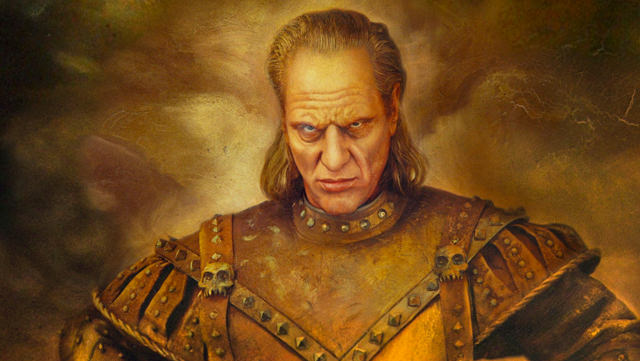
Anyway. I love Ghostbusters. Both of them. And one of my favorite moments of both movies is in the second film (is it pretentious to call Ghostbusters a “film”?) is when Yanosh (Janos? I dunno) is telling the ‘Busters, who have just busted up the museum and screwed up Lord Vigo’s resurrection attempt: “He is Vigo! You are like the buzzing of flies to him!” and he turns to see that Vigo has vanished completely. The confidence in his project that Yanosh has is so complete and inspiring, and then his despair when he sees that his master has (apparently) deserted him is priceless.

So, yeah. When I saw that the week’s SoCS prompt was “onomatopeia,” I thought immediately of Lord Vigo and the buzzing of flies. Here’s a guy with the power of the cosmos at his control. Survived multiple assassination attempts, harnessed the dark spirits of the underworld, bound his spirit into a painting so that he could come back from the dead in the new millenium, and rocked a freaking mullet. He had his sharknado together, even if his sharknado was all about building his throne of blood. And he was so focused on his sharknado that even the best resistance the world could muster against him (the Ghostbusters) was only as the buzzing of flies to him. So focused he saw his obstacles only as blurs in the side of his vision, tuned them out like static on the radio.

Where’s this metaphor going? Well, writing, of course. Because I’ve got the new novel on my mind in a big way. I started it with goals and portents in mind, but it’s been a bit of a slow start… I’m waffling on my protagonist a bit, I’ve agonized over the point of view, I’ve kvelled over the themes and tones and structures in the book. But this past week, that magic thing is happening; that thing where, like Frankenstein bunging a fork of lightning into the cerebellum of his reconstructed monster, the story flickers to life and starts to move of its own twisted accord. Characters have started doing things I didn’t expect. Unforeseen twists and deviations are sprouting up on all sides. The thing is getting seriously fun to write.

Which is awesome.

But. (There is always a but.)

The surge in creative energy (and creative determination: the writing is going well, so I’m more determined to get the writing done, which makes the writing go well, which…) has my head buzzing with ideas all the time. Some of them great for the story, lots of them not, scads of them completely unrelated to the story. Just a week ago I tossed off a really delightful (I felt) short story about a door-to-door salesman for vampires, and for whatever reason, it seemed to resonate with people. Whether it soaked up some of the creative juice from the novel or whether I just hit on something else good at the same time, it worked. And it worked so well, it got me thinking, “what if I extended it? Could this short about a solicitation by a wandering con man turn into a full short story rather than just a flash fiction? Could it grow into a novel?” And all of a sudden, I felt that story — that side tale, that deviation, the buzzing of flies — pulling me off my goal for the current novel.

The navicomputer was failing. I was drifting off target. (In much the same way I’m mixing my filmic metaphors now.)

But here’s the thing. When I’m in the flow, when I’m writing well and really enjoying the work, this kind of thing happens all the time. The ideas spew out like a pipe has burst in the wall: liquid inspiration pouring out of ceilings, drywall, light fixtures, electric sockets. Paradoxically, the project that generates the inspiration becomes really, really difficult to focus on for all the flydeas buzzing around (see, I finally got there). And it’s hard to say that this is a bad thing, because it gives me more material to think about for the Time that Comes After, that dread expanse of time after writing and editing the novel when it goes out for reading to various folks whose opinions matter when you have to start work on the next big thing.

Still, it gets frustrating dealing with all the buzzing of the flydeas when they’re all in your ear while you’re trying to get something done. What to do?

Make notes. I always keep note cards handy so that I can jot down any idea when it strikes me. I keep a notebook now, (one that I will not lose again, like I totally did about eight months ago) for more long form exploration of those ideas when I have a bit more time to sit with them. And I’ve started using Evernote, which is a fancy way to keep notes in a virtual space that’s accessible from any computer. Point is, if you’ve got all these flies buzzing around your head, ignoring them isn’t going to make your life any easier. You’ve got to either smash them (shut the idea down completely, which — just like swatting a fly — good freaking luck) or open the window and let them out (which means getting up from your work for a moment — stepping aside from the project for an instant to make a note — so that you can come back and resume your focus).

The Flydeas are a curse for pulling me off the project, but they’re a blessing too — they remind me that my creativity doesn’t live and die with the project I’m working on.

Let ’em keep buzzing. But they’ll do it in the tiny little jars I’ve trapped them in.

This post is part of Stream of Consciousness Saturday.

How do you deal with your off-topic ideas when they strike?