The Weekly Re-Motivator: Never Ask a Word Guy to Math Something


The prompt for the week is “no.” Not “no” as in, “no, don’t eat that piece of chalk” or “no, don’t dump milk all over your baby sister,” but “no.” as in short for number.

Which is a dangerous topic for me, because I’m like that guy who does a few oil changes on his own car and then decides he’s capable of fine-tuning the engine, or the one who successfully builds an IKEA side table and then tries to build his own back porch complete with gazebo. I know a little bit about numbers, and I’m kind of fascinated, but I haven’t taken any math classes since high school.

Mathematics, Formula, Physics, School, Mathematical

Nevertheless, you can count anything, right? And numbers matter, don’t they? There’s the old bit about needing ten thousand hours of experience to get “good” at something that I heard somewhere. If that’s true, how long should I expect to have to plug away at this writing thing?

MATH TIME.

I aim for an hour of writing a day. That’s theoretically 365 hours a year, which means it’s likely to take … ugh … something like 28 years to log 10,000 hours that way. But I only do my capital-W project-related writing on weekdays. So make it more like 37 years.

Sharknado.

But surely, I can count writing on the blarg toward those hours, too, yeah? Well, I’m not as regular there (needs me some blogging fiber, which is a joke that only somebody over thirty could appreciate), but maybe I can claim about two-three hours per week. Which reclaims the years I had to add to make up for the weekend. So we’re back at 28 years.

But wait, do those 10,000 hours have to be dedicated to becoming better at the thing, or can they just be hours spent doing the thing?

If it’s just the doing and not the actively trying to improve that matters, then I logged a heck of a lot of hours writing assignments in college and high school. Has to be enough to get that 28 years down to 26.

And then I wrote a cough-splutter fantasy novella in high school (180 pages in number-two pencil on college-ruled paper, now that was dedication), not to mention a bunch of crappy stories. (These are all lost to the mists of time now, which may in fact be evidence of a benevolent God.) Let’s be generous and give me another two years. 24.

Oh, and there were the plays I wrote a few years back. Hard to quantify that time because I worked when the mood struck me, but surely it’s good for another couple if not trio of years. I’m liking the optimistic feel here, so call it 21 years.

Which is maybe not so bad.

But wait again! With a mental task such as writing, surely time spent planning and plotting and pondering my stories counts. I think it’s safe, then, to double my time over the past two years and bump the timer down to 19 years.

And if time plotting and pondering counts, then surely time reading writing advice counts — that’s learning after all. But at that rate, if reading counts, it’s impossible to argue that reading stories that have inspired me to write wouldn’t count.

And then the floodgates open. Reading has got to be good for at least 5,000 hours of my life, and that’s a conservative estimate, to be sure. And that means I’m just a thousand hours or so short of Mastering Writing Forever.

Geometry, Mathematics, Cube, Hexahedron, Body

Which is nonsense, of course.

Measuring these things is a mug’s game. It’s like asking how many birds are in flight right this moment in the world. Surely it’s a question with an answer. A correct answer, even — one that could theoretically be measured. But it’s a nonsense question just the same, because the means for measuring such a thing simply don’t exist. And you can no more measure the actual productive time you’ve spent in an endeavor than you can measure all the people in the world whose eyes are closed. The information is there, but we can’t know it.

And that means we can’t live in fear or doubt or frustration at the information. There’s no finish line. There’s no ticker-tape parade when you reach 10,000 hours of practice, or 5,000, or 1,000, or five. All we can do is keep plugging away, keep practicing, keep doing.

Math may be an intrinsic part of everything, but these things we do are much, much bigger than math.

This weekly remotivational post is part of Stream of Consciousness Saturday. Every weekend, I use Linda G. Hill’s prompt to refocus my efforts and evaluate my process, sometimes with productive results.


The Weekly Re-Motivator: Nothing Halfway


There’s a mantra I regularly preach, scream, whisper, write, and otherwise fling at my soccer team: Nothing Easy. I’m sure it’s not original to me, though I can’t say I got it from anybody outside of my own skull. I like it — and I encourage my players to repeat it, internalize it, live it — because it can be taken several ways and it works several different ways.

First, the external: the other team wants the victory just as badly as you do. They owe you nothing, and they’ll give you nothing, so don’t make it easy for them. Control the ball so you don’t give them any easy turnovers. Get good position so you don’t give them any easy passes. Mesh on defense so you don’t concede any easy shots. Nothing easy.

Then, the internal: in soccer, more often than a lot of players would like to admit, speed beats talent. Hustle and hunger beats technical know-how. You might have the best touch, the most precise passes, the most devastating shot, but if you can’t beat the other man to the ball, all that skill goes for a big fat goose egg. So, you have to play hard from the opening whistle. Fight for every ball. Run on every play like it’s the one they’re going to break away and score on. Nothing easy.

Point is, if you play easy — if you give the match a halfway effort — you’re giving the opposition an advantage in every phase of the game. Which means, you’re putting victory that much farther away (if not entirely out of reach).

Well, soccer season is almost over, and I’m sitting here really analyzing my writing process, because I’m in a transitional time. I’m almost done with the final (for now) edit of the novel, which means it’s time to start considering what I’m going to dedicate my writing time to next. That means setting new goals, planning a schedule, determining how I’m going to approach the project.

In all this analysis, I realized that, among other things I haven’t been doing in my writing of late was writing short fiction — those 1000-word-or-so stories that I was pretty religious about posting for a long time, those little pressure-release valves for the creative energies I was bottling up while I worked within the confines of the overarching Project. So last night I embraced the prompt and wrote one. And I’ll admit — it may not have been my best work, but what was different about it — what worked about it — was the approach. I didn’t fine-tune the idea to death. I didn’t plot it out meticulously before I put keys to board. I didn’t sit back and wait for it to be perfect before taking my shot (much like the protagonist in the tale). I leaned into the uncertainty and I wrote it full-steam ahead.

I haven’t written like that in a while. I’ve tried out some new approaches (and liked them a lot, to be fair!), honed my craft, become a bit more exacting in terms of how I build stories. But what I realized is, that approach has me operating at half capacity. Throwing myself halfway into the work, keeping one foot on the edge of the pool as I dunk my toes in and test the water. It keeps me from making as many mistakes along the way, but it also keeps me so focused on the road that I forget to enjoy the view along the way.

Like my soccer team working easy in a match, making things easy for the opposition, I’m working halfway and making it easy to get distracted, easy not to finish, easy to pretend I’m working when really I’m just hiding behind excuses.

Now, the only absolute is that there are no absolutes. I’m not going to say that there’s not a time for the methodical, measured, relaxed, easy approach. Sometimes if you rush the work, you make foolish errors that cost you. But if you embrace the easy approach too much — if you work halfway all the time — well, first of all you never get anything done, and second, you don’t make the mistakes that make the work interesting.

When it comes to writing, you have to throw yourself into it the way you’d run out into the road after your kid. You have to give yourself over to it like jumping out of a plane. You can’t keep one foot on solid ground while you let the other foot acclimate. You can’t do it halfway.

Combat Diver, Special Forces, Sonderkommando, Frogmen

So the mantra for my writing — for a while, at least, until I think of a new one — is: Nothing Halfway.

This weekly remotivational post is part of Stream of Consciousness Saturday. Every weekend, I use Linda G. Hill’s prompt to refocus my efforts and evaluate my process, sometimes with productive results.

Pegasus Intelligence


Beer, Beer Garden, Thirst, Glass Mug, Drink, Beer Glass“Ernie Collins.”

“The name doesn’t ring a bell. Then again, I’ve only been working here for six months or so.”

“Oh. Well. He’d have been here back in ’07.”

“I see.” Lana, feeling that the conversation had reached that inevitable point where things peter out and the bartender and patron go on with their individual existences, began polishing glassware, and only when she noticed Eddie gesturing at her did she realize that he had continued speaking.

“And from there, it’s on to Melbourne, to a little hole-in-the-wall joint called Dingo Lingo.”

She angled back into the conversation as best she could. “I’ve never heard of it.”

“Of course not. Very few people who haven’t cracked the top-10 bestseller list have.”

Lana squinted at him, still turning a glass in her hand. It was impossible to tell if he was putting her on. The crazy ones never seem crazy. “And you’re going there to …?”

“To drink it all in, man.”

“What, Dingo Lingo serves some proprietary drink?”

“No. What? No. Look.” Eddie pulled out his phone and opened his notes app. He tapped on a file, zoomed in on a maniacal-looking spider web diagram dotted with pictures of towns and bars and faces she didn’t recognize, clicked and zoomed and scrolled a few more times, and finally stopped and shoved the phone toward her. On the screen was a picture of an absolutely normal-looking guy. Slightly unshaven, slightly frumpy, a below-average intelligence gasping for help in his faraway stare as he sat at a Starbucks street table. “Because of him. Haven’t you been paying attention?”

“I fear I may have lost the thread.”

Eddie sighed. “He’s a Pegasus.”

“A what, now?”

Eddie sighed again, harder this time, to make clear that he was explaining something he shouldn’t have to explain. “In Greek myth, Pegasus was said to strike springs from the very ground where his hooves touched.” He smiled at Lana as if this should have meant something to her, but it obviously didn’t. “Pegasus was the personal transport for the muses. Like Uber, but, you know, a horse.”

Lana gave an ever-so-slight shake of her head. “Muses?”

“The Greek goddesses of inspiration.”

“Okay, and you want a drink from the bar because –”

“It’s a metaphor, man! It’s not a literal spring. Ernie Collins is not a goddamned winged horse. But he’s a Pegasus in spirit. He travels the world on his parents’ retirement fund, and every so often:” here Eddie rapped his fingers on the tabletop and made a clop-clop noise with his tongue. “Inspiration springs forth.”

“So you think,” Lana said, studying the freshly polished bar as if it might offer some insight on how to deal with a clearly deranged individual, which it did not, “that just by being in these places, you’ll … what, soak up some inspiration?”

“Exactly.” Eddie folded his arms and leaned back from the table as if he’d just solved a two-hundred item crossword puzzle. He raised his eyebrows at her, again, as if he expected her to be impressed.

“And that’s why you haven’t ordered anything but that one beer, then?” She tried to keep the edge out of her voice, but he’d been nursing the one drink for three hours. It wasn’t like she needed him to vacate the stool — it was a Tuesday night, after all — but principle dictated that a bar tab should at least exceed in dollars its length in hours.

“Nothing personal, you understand.” He picked nervously at the label which had already been thoroughly picked at. He came away with bits of glue under his fingernails. “But I’ve got quite the itinerary ahead. Atlanta. Seattle. Toronto. Melbourne. Tokyo. Gotta make every dollar count.”

“You can afford travel to all these places, but you can’t afford another drink?”

“I’ve got a GoFundMe page set up. I’ll move on when I can afford airfare.”

Won’t hold my breath for a decent tip, Lana thought. “You’re a writer, then?”

“Trying to be,” Eddie replied, a sort of self-satisfied smirk tugging at the corners of his mouth.

“What have you written?”

“Well.” He scratched the back of his neck. “Nothing yet.”

“Oh, a work in progress?” Lana returned to wiping glasses. “I had a roommate in college who always had about a dozen works in progress. Never did get published. Wrote like a demon, though.” She glanced sideways at Eddie. “Ordered more than one drink at happy hour, too.”

“Thing is, I don’t want to just write anything. When I actually sit down to write, I want it to be the best. Hence: following in the footsteps of Pegasus.”

Lana frowned thoughtfully. “I suppose there’s intelligence of a sort in that.” Then her thought caught up to her frown. “Wait. You mean to tell me you haven’t actually written anything yet?”

“Er.” More glue, more fingernails. “Not as such, no.”

“Not a draft, not an outline, nothing?”

Eddie shook his head.

“I mean, you at least know what you’re going to write about, though?”

“Well, kind of. I mean, I have some ideas.” He jabbed at his phone again, and showed her the picture of Ernie Collins. “Truth be told, that’s kind of what I was hoping this whole Pegasus thing would help me out with.”

“Let me make sure I understand clearly,” Lana said. She set her glass and rag down and leaned in close. “You want to be a writer, but you haven’t written anything. Instead, you’re going on a trip around the world, on the dime of internet strangers, hoping to sponge up some inspiration … from a man you feel is the embodiment of a winged horse?”

“To be honest, the GoFundMe only has fifteen dollars in it so far.” He eyed the last swig in the bottom of his bottle, felt the moment was right, and swallowed it. “From my mom. Actually –” he waggled the empty bottle — “how much did you say this was, again?”

######

Chuck’s challenge this week: The random title challenge. My title for the week was “Pegasus Intelligence,” which was the fanciest bit of nonsense I’d heard in a while. A little bit of research, though, led me to a place I didn’t entirely hate. It’s more of a vignette than a story, but, well, that’s life, innit?

Also, about halfway into the writing, I realized that I have here the seedling for a … not exactly a sequel to my first novel, but for another story in the same universe as that one. Dammit, Chuck. These short stories are supposed to let me vent pent-up creative energy, not spawn entire novels to go clanging around in my skull.


The Weekly Re-Motivator: Humans Being


I’ve just finished reading Christopher McDougall’s latest offering, Natural Born Heroes. (Review forthcoming.) The central tenet is: you can’t always tell a hero just by looking at him. The strongest fighter? The girl who can outrun everybody in the field? The guy who can traverse a forbidding mountain range in the dead of night on nothing to eat but weeds and acorns? They don’t look like much. They become who they are and capable of what they can do out of necessity, innovation, or sheer bloody-mindedness.

You can’t build resolve like that. You can’t engineer ingenuity. You don’t unlock the secrets of human potential on a whim or by mistake. These things only happen when we eschew the trappings of the modern world, when we cut through the nonsense of our capitalist culture, when we tap into what makes us who we are, what we evolved to do.

Which is, to survive.

Girl, At Night, Running, Cloud, Silhouette, Freedom

But it’s more than that, more than just being. We are human beings, but it isn’t being that makes us human; it’s our doings.

Each of us has within ourselves vast, untapped reservoirs of potential and energy. Everybody knows (or at least suspects) that they could do this or that unbelievable thing. (I could write the next great novel. I could run a marathon. I could quit my job and go herd goats. I could go and ask that girl/guy out.) But most of us don’t do those things. We allow them to remain unbelievable and go on just surviving. Which is easy! But it doesn’t put our names in the history books.

So let me stop myself before I get carried away on a tidal wave of my own ego. I’m not saying my name is going into the history books thanks to anything you might read around here. But there’s a slew of sayings on this particular subject:

You miss one hundred percent of the shots you don’t take.

You can’t hit a home run without swinging the bat.

You can’t hit a target that isn’t there.

Darts, Dart Board, Bull'S Eye, Game, Playing, Target

And with that in mind, this is me taking this opportunity to remind myself that this blarg, this past two years of writing novels and letting the voices in my head take the reins and spill over onto the page, of exploring the vast uncharted recesses of my storyteller brain, is me trying to tap into my inner hero.

Did I actually say that? Yeah, sure. Storytellers are heroes of a sort. We connect through stories. We live expansive alternate lives through stories. We learn to appreciate others through stories. And at their core, stories tell us about who we are.

We can be heroes.

We just have to take that chance on ourselves.

This weekly remotivational post is part of Stream of Consciousness Saturday. Every weekend, I use Linda G. Hill’s prompt to refocus my efforts and evaluate my process, sometimes with productive results.

Lucky Bastard, or A Glitch in the Matrix


No re-motivator this week, because holy carp am I tapped out. Long week at school. Long week at the novel-writing game. Wife is hella sick. No time to muse on creativity and motivation and inspiration and the darkly wonderful things that happen in the writer’s lizard brain.

But, dude. You guys. GUYS.

I am thirty-something years old, and I have never in my life found a four-leaf clover. And there were times that I looked. I can distinctly remember a younger, high-school aged or maybe even collegiate version of myself spending entire minutes in weedy fields searching for one.

Never happened.

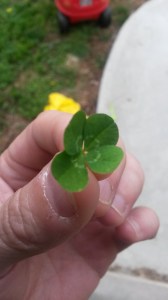
Then, today, this:20160326_185018.jpg

That’s totally my hand; you can tell by the horrible cuticles. I was gobsmacked. We hopped out of the car after a long day visiting with family, and I happened to glance down at my feet, and there it was.

But wait. WAIT.

Not even an hour later, I’d been to the grocery store and come back, and I was reflecting on how strange it was that I should find a four-leaf cloverin my own front yard. I glanced at my feet as I stepped over a totally different patch of clover. And I glanced again.

NO WAY.

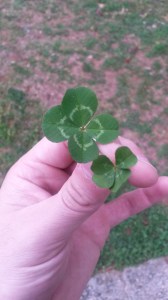
20160326_193643.jpg

But yes way. A second four-leaf clover.

You guys.

Either I’m really, really lucky, or my front yard is a glitch in the matrix.

*skitters off to wait for Morpheus to unplug me*

This weekly remotivational post is part of Stream of Consciousness Saturday. Every weekend, I use Linda G. Hill’s prompt to refocus my efforts and evaluate my process, sometimes with productive results.