Cleansing the Stream


stream-1973015_1280

A writer’s brain is something like a mountain stream. It rollicks downhill, cascading in gouts of churning white foam over razor sharp rocks. It meanders dreamily around lazy bends in the riverbed. Sometimes it hurls itself off cliffs and pulverizes the stones below with its immense gravity. And eventually it dumps itself out into an ocean or lake brimming with the contents of other streams, other minds.

The stream also plays host to a panoply of life: the fish swimming upstream in their scaly mail, the bears whose merciless jaws slam shut on the hapless fish, the infinitesimal specks that feed upon everything else. All of which is lovely and poetic and whatever. Ideas are living things, is the point, and the current that beats at them and bears them along is fueled by the work the writer is willing to put in to those ideas. A flowing stream is a healthy stream. A stream that does not flow stagnates and rots.

But a stream also collects anything that falls into it. Dead critters. Tin cans. Toxic runoff. These things can poison the waters and taint everything that comes from it.

And there is a lot of poison threatening our streams, of late.

A lot of writers — in my circle, at least — are the liberal sort, and it’s hard to view the daily news, living in Trump’s America, as anything but a literal toxic cloud. (And I imagine even non-liberals are feeling a little more heartburn than they expected, these days.) It becomes very hard to write coherently and fulfillingly when you’re living in existential dread for the future of your country, of your loved ones, hell, even the planet.

junk-977603_1280

But the stream only purifies itself by flushing the toxins out. We have to keep writing, even when we’d rather not, because we’ll never get clear of this stuff if we don’t let it in, process it, and then purge it. That means writing every day, even just a little. Not letting the stream stagnate. The writing is like a stream. A few words becomes a sentence. A sentence flows into a paragraph. Paragraphs pile up and become pages.

And while we’re at it, we can also protect our streams. Limit our exposure to the whirling crap tornado, walling ourselves off from it where and when we can. Build a chamber — metaphorical for most of us, unless you’re one of those Neil Gaiman types who can indulge in a literal chamber of solitude — into which we allow only so much poison. Cut back on the news. Don’t go rage-reading every story pointing out incompetence and malevolence. Don’t go hate-sharing every link on facebook, every subversive tweet.

Don’t simmer, in other words, in the toxic stew that threatens your stream.

Stay plugged in — because what they really want is for you to give up and stop paying attention — but don’t try to grasp at every thread of the fraying tapestry. Grab hold of one or two strings. Engage enough to get good and angry and motivated. And then stop the flow of the poison. You can’t fix it all. You can’t properly get upset about every little thing that happens. And that, too, is a source of poison: the feeling that it’s all too big. Luckily, there are others of us out there picking up the slack.

We can’t avoid the pollution, but that doesn’t mean we have to drown ourselves in it. Stay afloat. Keep the waters flowing. Keep writing.
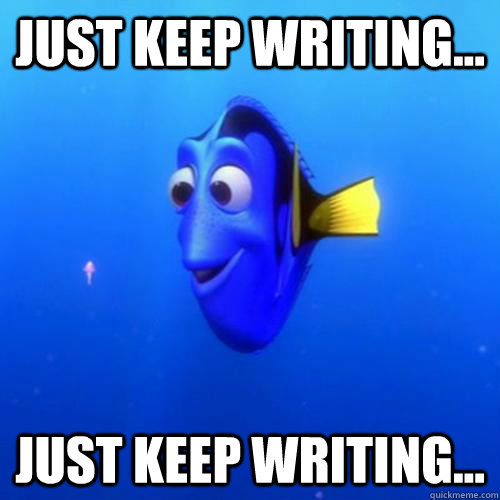
dory

This weekly remotivational post is part of Stream of Consciousness Saturday. Every weekend, I use Linda G. Hill’s prompt to refocus my efforts and evaluate my process, sometimes with productive results.

Hirsute Spheroids, née Hairy Balls, and Your Story


I’m a bit of a physics nerd, by which I mean I love physics oddities and learning macro concepts about how the universe works without actually getting my hands dirty in any of the intractible numbers involved. That fascination often leads me down rabbit holes on youtube, whence I arrive hours later, head buzzing with cosmic understanding or mind shattered from inability to process.

Today’s SOCS prompt is “hair”, and while it’d be easy for me to write again about my lack thereof, my mind immediately leapt to the hairy ball theorem (which is, if nothing else, a perfect example of how badly scientists need help naming things — the “hirsute spheroid theorem” would prompt no more than 1/5th the giggles). In short, the theorem states that if you have a hairy ball (*snicker*), there is no way to comb it in such a way that all the hair lays flat. (And there’s nothing worse than a hairy ball with a cowlick.) The math proves this, though I don’t care too much about the math (that’s the department of my sister and her husband, both Georgia Tech grads who do the rest of us the favor of making sure that the numbers support the buildings that stand up around us and the rockets that put our fancy things up in the air or shoot other countries’ fancy things out of it). What I care about is concept. Hairy ball. Can’t comb it flat.

Here’s a brief explanation of the theorem, if you want a better explanation of it (and Minute Physics is worth the subscribe, by the way):

But this is a writing blog, not a maths blog, so why the hockey sticks am I blerping around, getting all hot and bothered about a physics conundrum?

Because writing stories is a bit like the hirsute spheroid theorem. (Nope, still makes me giggle, if only 1/5 as much.) Stories are these weird little hairy balls. The ball (giggle, snort) is the world of the story, where the characters frolic and screw up and alternately threaten the safety of the world or rescue it from deep-sea humanoid squid monsters. The hair (chortle, cackle) is the characters and their frolics. And like the follicular matter in the hirsute spheroid theorem, there’s no way to have those frolics or those characters line up perfectly. Like a lump in the carpet or, well, like the hair on a ball (okay, seriously, I’m done laughing at that), when you flatten it down in one spot,  it springs up anew somewhere else. Lay a perfect plotline that neatly traverses the entire surface and you arrive back at the beginning to find a bizarre cowlick sticking up.

For a writer, this seems like a problem, but it’s not. Note that the hairy ball theorem is stated as a theorem, not a problem. An observation of reality, not a lament of the way reality ought to be. It’s only a problem if you assume that your hirsute spheroid must somehow attain a measure of perfection, which it never will anyway — the perfect being the enemy of the good, as it is.

Stories have flaws, in other words, and it’s a fool’s errand thinking we can iron them all out. Instead, embrace the flaws, iron out what you can, and accept the odd fact: bed-head is, for some reason, in style.

Image result for bed head

Also, a note: careful with your googling if you go searching the hairy ball theorem. Also, just for the lolz, the Wikipedia entry for the hairy ball theorem cheerily points out that, on Wikipedia at least, “‘hairy balls’ redirects here.”

This weekly remotivational post is part of Stream of Consciousness Saturday. Every weekend, I use Linda G. Hill’s prompt to refocus my efforts and evaluate my process, sometimes with productive results.
Endings and Beginnings


Writing only works if you devote yourself to it, day after day, week in and week out, month after agonizing month. You park yourself in front of the screen again and again and again, wondering every day if what you’re doing is going anywhere, or if it’s coming to anything, or if the pieces you’re punching out of the drywall will ever fit together in a shape that fits known geometries or not again. The words pour out and pour out; some days it’s all hey this is pretty fun and cool and exciting whee I’m weaving stories and making magic like a rainbow-skating elf and other days it’s like it’d be easier to self-castrate than type a single word, why do I do this to myself, I have invented a new masochism.

By necessity, I find myself not thinking about the finish too much. In the beginning it’s too far; I might as well be thinking about the end of the Trump presidency for all the good it does me to think about the end of my project today. In the middle it’s a torture — I know it’s getting closer, but like a mirage floating over the horizon, it just never seems to get any closer. And at the end, the nearness of it is distorting, like a haze of summer gnats flittering in your face — close enough to touch, yet dancing just out of reach.

Instead, I watch the ground under my feet. Follow the path where it leads, occasionally stop to check the map, and mostly just focus on not getting stuck in the mud or wandering off into the undergrowth. Think about today’s 500 words today, worry about tomorrow’s 500 words tomorrow, and as for yesterday’s 500 words? Forget them, lest ye be sucked down in the quicksand of self-satisfaction or devoured by the litera-demons that hound your every step. Eyes always ahead — but not too far ahead. Sure, there’s a prize out there in the shape of a finished story (well, “finished” is more like it — you still have to edit the thing, after all). But the real prize is another day walking the path, another day weaving stories out of nothingness, the next 500 words that you haven’t written yet.

In this way, a novel gets written. In this way, a story gets told. In this way, another 8 (or nine? or maybe ten? Who even knows, this journey warps spacetime worse than a singularity) months pass. In this way, another cast of characters struts and frets its hour upon the page.

And then, holy carp, one day you’re working away — faithfully, dutifully, painfully hammering out your daily words, when the fog lifts. The trees thin out. The mirage resolves itself.

The loose ends of the story are tying themselves into neat little knots, your word count is knocking on the door of that 85,000 mark, and you realize: it’s almost over.

On the one hand, it’s gratifying as hell — you’ve worked away these months, not knowing what, if anything, it was all going to come to, and now you can look back at the trail you’ve blazed. It was all leading somewhere, after all: to this moment, right here, this patch of virgin earth under your battered boots. The sun seems to shine a little brighter here; the rain passes a little quicker; the breeze is a little sweeter. It’s nearly over. Mission accomplished. C’est finis. (Are those even words? They feel like they might be words.)

But there’s a dissatisfaction, too; equal and opposite to the fullness of accomplishment. The story’s not done yet, not really. You’ve blazed the trail, but you have to go back and mark it out so that your readers can follow you down it. And that’s a lot of work ahead.

canyon-1209287_1280

But more so than re-treading this trail you’ve just carved — which will be its own adventure, no doubt — is this: Here you stand, in the midst of the wilderness. The ending point for one journey. And the starting point for the next one.

Make no mistake, finishing a novel is a sweet, sweet feeling. But it’s not a fullness that lets you sit back and unbuckle your belt like you’ve just polished off five pounds of Thanksgiving turkey before you slip into a tryptophan coma. It’s a fullness that scatters like ice from the spoon (I stole that simile from somewhere, but I’ve no idea where), that leaves you hungry again the moment it clears your palate.

There are more trails to blaze, more strange and wonderful characters to meet, more dangers to face, more MacGuffins to MacGuffin.

And though this particular page may be full, you can already hear the next blank page calling.

What else can you do but answer?

Carved Outta Wood


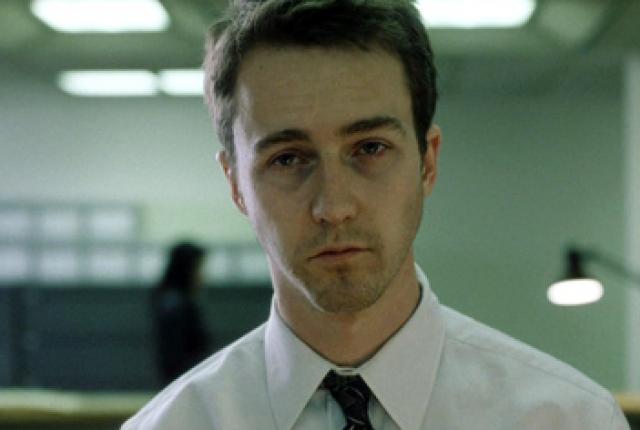
A guy who came to Fight Club for the first time, his ass was a wad of cookie dough. After a few weeks, he was carved out of wood.

jacks-boredom

That’s a line from Fight Club, which, since I saw it early in college, has sat comfortably in my top five all-time favorite films. I love it mostly because I’m a man and RAH RAGE VIOLENCE BLOOD FARGO THE SYSTEM. Well, not really. There is that, but mostly I love it because it’s about a guy in a rut who pulls himself out of a rut in catastrophic fashion. No half-measures; the characters in this film go all-out for the things they want, and for the things they don’t even know they want.

The narrator and Tyler Durden get into a fight in Fight Club, not because they hate each other or because they disagree, but because they’ve never done it. Then other people join up and start fighting for the same reason, and soon Fight Club has evolved into Project Mayhem, with multiple chapters around the country and designs against the very pillars of society. These guys (well, spoiler alert, this guy) starts a thing for the hell of it, and like the proverbial snowball rolling down the hill, it gains a momentum of its own. Then it all goes sideways, of course. Great movie.

But the quote above, in particular, sticks out to me, because it’s at the core of the movie, but like all good movies and all good quotes, it’s really about life. Getting in a fight, handling one’s self mano-a-mano against another human, is the sort of thing that most people probably think they could do reasonably well at. I know I’m guilty of thinking I could handle myself if it came to it, not that I ever expect it to ever come to it (insert obligatory I’m a writer not a fighter cliche here!). But a fight has the immediate power to rectify your worldview by dint of the other guy’s boot crashing into the side of your skull. Training aside, athleticism aside, general awareness and savvy aside, there’s no substitute for stepping into the arena and facing the blows. However prepared you might be, however capable and willing, you can’t know how it’ll go until you actually get in the ring. The only thing that really teaches you is the trial.

Which is, I think, why there are so many would-be novelists out there, and why gym memberships spike in January but the gyms themselves empty out before February dawns. It’s why instead of trying the thing that intrigues and frightens us, we head for the couch and the reruns of Law and Order. It’s why instead of getting up with the early alarm and braving the cold to work out, we retreat to the warm, fluffy confines of our beds. The couch  and the bed are easy on our cookie dough asses. It’s easy to sit back and talk about how we could do the thing if we decided we wanted it. Just not today.

But that’s why I do get up and run before the sun, when it’s freezing outside and I’d rather be asleep. It’s why I park myself in front of the blank screen every day and pour the words forth, even when it feels like it doesn’t mean anything. Because my ass feels a little too much like cookie dough, and I’d rather be carved outta wood.

Of course, to get carved, you have to take the leap. You have to hold your breath and plunge into the icy water. Take off your shoes and walk across the coals. Jump out of the airplane.

self-ko

And yeah, sure. You’ll get knocked on your ass. Maybe more often than not.

But if you can master the fear and get used to giving yourself the lumps, day in and day out? And then stepping up to the bar and asking for just one more? Maybe you’ll actually stand up to the task when the real world comes calling.

Or, you know. You could just sit back and cookie-dough-ify yourself.

This weekly remotivational post is part of Stream of Consciousness Saturday. Every weekend, I use Linda G. Hill’s prompt to refocus my efforts and evaluate my process, sometimes with productive results.

A Burp of Inspiration


Writing is an act of discovery as much as it is an act of communication. I forget that sometimes, but then there are days when it comes crashing back into my consciousness: like today.

My current WIP has been struggling forward on lame legs for a while — I love the idea in general, but it has failed to stand up under its own weight for some time. Like a newborn calf, it struggles to stand, it collapses and has to be helped up. And since I’ve never quite been able to figure out how to keep it steady, I’ve struggled to find a groove with the project. It’s been tough going, tougher than I would like and certainly tougher than I sometimes make out.

So today I kicked back and let a few of my characters talk some sharknado out, and holy carp. Out of the conversation sprang the solution to the problem that’s been plaguing this story from the start. It gives shape to the entire narrative, gives motivation to the protagonist, gives foreshadowing and tension to the early chapters and closure to the late chapters.

I haven’t gotten there in eight months of thinking about this story, and finally — while in the midst of a perfectly ordinary writing session, I might add — it just pops out, when I’m not even thinking about it. Which probably means it was clunking around in my dome the whole time, I just didn’t know how to let it out. And it almost certainly means I would never have found the solution if I hadn’t set my shoulder against the problem and worked forward anyway.

One of my favorite quotes on creativity comes from Pablo Picasso: Inspiration exists, but it has to catch you working.

Today’s session was a perfect example of that. I needed this today.dory