Apparently, the pollen bombardment in Georgia isn’t moving along as speedily as the trees would like. Abandoning the “dusting” campaign which is usually the norm, they have opted instead to fling entire branches of the stuff down on our hapless cars.
No re-motivator this week, because holy carp am I tapped out. Long week at school. Long week at the novel-writing game. Wife is hella sick. No time to muse on creativity and motivation and inspiration and the darkly wonderful things that happen in the writer’s lizard brain.
But, dude. You guys. GUYS.
I am thirty-something years old, and I have never in my life found a four-leaf clover. And there were times that I looked. I can distinctly remember a younger, high-school aged or maybe even collegiate version of myself spending entire minutes in weedy fields searching for one.
Never happened.
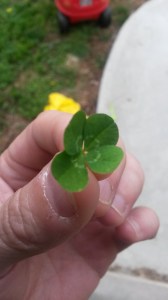
Then, today, this:
That’s totally my hand; you can tell by the horrible cuticles. I was gobsmacked. We hopped out of the car after a long day visiting with family, and I happened to glance down at my feet, and there it was.
But wait. WAIT.
Not even an hour later, I’d been to the grocery store and come back, and I was reflecting on how strange it was that I should find a four-leaf cloverin my own front yard. I glanced at my feet as I stepped over a totally different patch of clover. And I glanced again.
NO WAY.
But yes way. A second four-leaf clover.
You guys.
Either I’m really, really lucky, or my front yard is a glitch in the matrix.
*skitters off to wait for Morpheus to unplug me*
This weekly remotivational post is part of Stream of Consciousness Saturday. Every weekend, I use Linda G. Hill’s prompt to refocus my efforts and evaluate my process, sometimes with productive results.
One of my favorite moments from Jeannette Walls’ The Glass Castle comes around the end of the first third of the book. The dysfunctional family, composed of an alcoholic engineer father and a tree-hugging lunatic religious mother and their four kids, inherits a relatively palatial house in Phoenix. (I’ll point out that the mother is a lunatic who happens to be religious, rather than a religious person who is, by extension, a lunatic). The house has termites, though, and before long the floors become unstable, to the point where a misplaced step results in somebody’s foot going through the floor. This proceeds until it can’t any longer, at which point the father enacts a fix which is simultaneously brilliant and idiotic. He buys a six-pack of beer. Downs one. Uses his tin snips to turn the can into a little metal tile. Then hammers the can down over the hole. This process repeats anytime the family kicks a new hole in the floor, which is often. It’s the height of pragmatism — he’s going to drink anyway, so why not use it to fix the floor — and ridiculousness — picture the lovely parquet floor pockmarked with Budweisers and PBRs.
And I have a similar favorite moment in Robert Pirsig’s Zen and the Art of Motorcycle Maintenance. Dude’s hog has a problem with its steering. They know that the repair that’s needed (some sort of ionized stripping installed around the axle or whatever) will be prohibitively expensive; several hundred bucks. The narrator points out that the repair can be effected — not as a stop-gap measure, but well and truly fixed — by snipping a beer can open, cutting it to fit, and wrapping the strip around the steering bits (I don’t cars, sorry NOT SORRY). The beer can, which is oxidized (or un-oxidized or whatever) on the liquid side so as to safely contain the beer, serves as a perfect insulator that won’t break down or rust over time. But the dude isn’t about to have his brand-new motorcycle, the epitome of engineering, repaired by a lowly can of beer. He doesn’t accept that it could work. So he drives it with the janky steering until he can overpay for a “proper” repair.
Why are these moments banging against each other in my head like literary pinballs? Well, I’m nearing the end of the edit on my first novel, and I’m ironing out the last few problems. Spoiler-free, the problems are: I’ve got some characters who pull a disappearing act when they shouldn’t, and others who don’t pull a disappearing act when they should. I’d been mulling the problem for a few days when a startlingly simple solution struck me.
And then today it struck me that maybe the solution was too simple. Too pat. Too surface-level. Maybe I was patching my busted floor with a spent beer can. So I find myself wondering whether I’m fixing these last few problems “properly”. Whether, a la The Glass Castle, I’m using ridiculous if not trashy easy fixes for problems that need deep, structural focus and foundational repair. Or, whether, a la Zen, I’m overthinking things and the beer can is not only adequate, but more elegant and simple than a highfalutin ground-up rethink.
At this point it’s probably impossible for me to know. I mean, I didn’t catch this mistake on my first read-through (nor did one of my readers, actually). My wife caught it. (Thanks, wife!) So the fix probably will look equally fine to me.
There’s only one thing that’s actually clear in all of this.
(Allow me to disclaim that I’m not particularly educated or bothered with the differences between turtles, tortoises, terrapins, and the like. I am sure they are all different and not interchangeable. I will nonetheless be interchanging them today. I have at least one friend who will be very upset by this.)
What is it with me and thought experiments? Last week, the Prisoner’s Dilemma. This week, Zeno’s Paradox. Maybe it’ll be my next “regular feature” that burns out after a month or so.
Zeno’s Paradox is one of my favorites, in that it seems to defy all common sense, yet when you look at the premises of the argument, it is inescapably logical.
We imagine a footrace between Achilles and a tortoise.
Since Achilles is a sporting chap, and clearly runs faster than the tortoise, he spots the tortoise a significant head start. This is only fair.
So, after Achilles runs for an indeterminate amount of time, he will have reached the point that the tortoise started from. However, in the same amount of time, the tortoise will have moved forward some smaller amount, so Achilles still has ground to make up. Again he moves forward, arriving rather quickly at the point the tortoise previously occupied, and again he finds that the turtle has crept a bit further ahead.
This process repeats for as long as you care to repeat it. Due to the fact that measurements are a human construct and therefore infinite, we will never reach a point whereat Achilles overcomes the tortoise.
It follows, then, that logically, Achilles can never overtake the tortoise.
In practice, of course, Achilles sprints right past the hapless terrapin.
I absolutely love this. It is simultaneously as self-evident as a stone and as incomprehensible as consciousness itself. Achilles, in the mind, seems paradoxically never to gain ground; in fact, the closer he comes to his goal, the farther he has to go.
I’ve noted previously around here (though I can’t be arsed to track down where at the moment) that Andre Agassi, one of my more favorite athletes (we bald guys have to stick together), has expressed a similar psychological phenomenon. He describes the end of a tennis match as a magnetic force: one that, the closer you get to it, catches you in its field and pulls you in. But like a reversed magnet, the closer you get, the harder it becomes to actually make contact.
You can get closer and closer, but you can never quite catch it.
And that’s kind of like writing, innit?
You begin with this vast tract of land in front of you: the blank page and the faraway goal of a completed story, be it 3000 words or 93000. You start to work. The finish line is way up there, but who cares? You’re making progress day by day, easily measurable progress, and you have the word counts to prove it. And you close and you close and you close and the turtle gets bigger and bigger in your vision, and one day: you finish! The story is written, the narrative arc resolved.
But the turtle has moved. You still have more work to do, in the form of re-reading, re-outlining, editing, proofreading. You’re closer than you were to start the exercise, but it took you a long time to cover all that distance, and the turtle isn’t holding still, either (and why would it, with an ink-stained, caffeine-addled word-herder on its tail?).
So you lower your head and off you go again. This time it’s not such a long road to catch the turtle — you’ve already written 90,000 words after all, what’s the big deal revising or re-ordering 30,000 of them — and before long, you’re there. A story edited, improved, fixed!
LOL I’m still ahead.
But where’s the turtle? Sonofabitch, it’s another thirty turtle-miles up the road. (Which is, I dunno, five hundred feet? What’s the ground speed of a turtle anyway?) You’ve got some beta-reads to do, now, and the receiving of notes, and probably another read of the work yourself, and then a subsequent edit…
And just like Achilles, you keep chasing the turtle, and just like the turtle, your project creeps inexorably forward, staying ahead of you by distances which are too small to be properly measured, let alone explained to anybody who isn’t a writer.
“You’ve been working on it for how long?” your friends ask, with confusion and maybe a bit of pity in their voices. “I thought you finished the draft months ago.”
“Yes,” you explain, straining to keep the desperation from bleeding in, “but then I found a major problem with the protagonist’s backstory on page thirty, so I had to go back and fix it, and when I fixed that, I realized I had taken away the whole motivation for the antagonist to –”
And by this point, your friends are simply nodding and smiling and backing away, the way they might with a foamy-mouthed dog. (Little do they know you’ve been subsisting on nothing but Cool Whip for the past two days because you’re eyeballs-deep in edits and can’t bring yourself to leave the house.)
And despite all the progress you’ve made, that farkarkte turtle (and yeah, I had to look up how to spell “farkarkte,” and I don’t care what you think — it’s in my personal lexicon for some reason and it bubbled to the surface like a dead fish and I love it) is still bobbing along the road ahead of you, evading reach even though it looks like it’s right there.
The fact is, if you think of a novel as the sum of its requisite parts — the draft, the editing, the revising, the crying, the drinking, the smashing of computers with hammers, the dark nights of doubt, the … well, you get the idea — then the whole equation begins to look very much like the mathematical side of Zeno’s Paradox. No matter how close you might ultimately get, you will never actually get there.
Which is why it’s a good thing we writers don’t live in a mathematical world. (Most of us, anyway. Actually, who am I kidding, MATH IS EVERYWHERE.)
We live in the delightfully creative, whimsical world where expectations exist only to be reversed, where up can be down if we bloody well feel like it. We live in the world where, paradox or not, Achilles keeps on pounding away and leaves the tortoise in the dust.
We keep on writing and we (eventually, one day, maybe, please?) cross the finish line.
Welcome. This is my page for sharing projects associated with my coursework in Media and Technology at the University of West Georgia. Assignments will be posted here as they are completed.





 Accidentally Inspired