The Weekly Re-Motivator:An Accumulation of Oddities


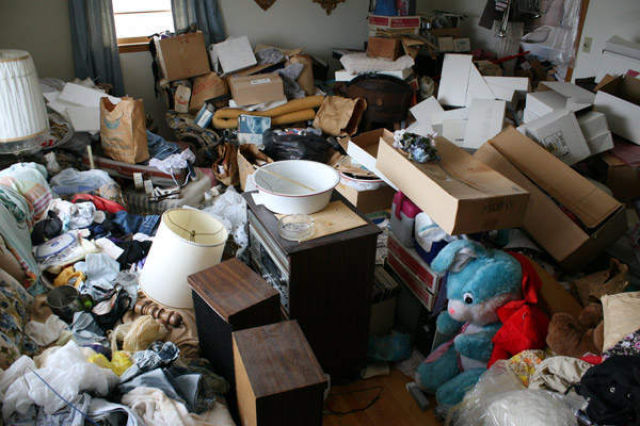
If your house is anything like mine, the stuff just sort of seems to accumulate. (Doubly or maybe exponentially true if you have kids, and doubly exponentially if those kids are particularly young.) You see this or that shiny doodad, and you think, gosh,the kids would just love that, and because we live in America we buy the thing. Or a loving and well-meaning grandparent will make a gift of some battery-powered monstrosity that belches out Christmas music if it detects movement within a square mile. Or the kids themselves will bring home toys covered in foreign guck and another kid’s nose slime. (How do they get these toys away from other kids, I wonder? My kids can sense it — and immediately pitch a fit — if I so much as touch a stray eye from a long-lost mister Potato head doll.)

But even without kids, it happens. You’re at the mall for some reason, and you think, that’s a nice looking shirt. I wear shirts. Let me give some of my money for that thing. Even though you need another shirt like your kids need another toy. Or you pick up another fancy running gizmo or some inspirational book of quotes or an odd lamp you like the look of.

And it just adds up. It’s not a bad thing, per se. But with so much stuff, it becomes easy to lose track of things. Easy to take things for granted.
hoarders

And if you’re not careful, the same thing can happen to your stories. For me, this usually comes in the form of a sentence, half-formed in my mind, that goes something like: wouldn’t it be cool if…

this minor inconvenience character turned out to be related to the main villain?

…the bad guys stole the thing that the good guys need to make their lives work?

…the mentor character’s cat starts phasing forward and backward in time?

All of which are fine and interesting and may well reach the final cut. Unfortunately, the mind, like the house cat that indiscriminately murders local fauna and deposits them on the doorstep, also drops off less-inspired idea corpses like…

There should totally be a paper-and-pen motif in this chapter.

Maybe the villain should have an electric puppy.

Feathers. Feathers everywhere.

Problem is, in the heat of a daily word-count grinding session, the gems are indistinguishable from the crystallized turds. You see them float past on the shelf of consciousness, think, oh, sure, that works for my story, and into the story sausage they go.

And again, that’s not a bad thing per se.

But just like the stuff that piles up in your house, this crap accumulates and chokes off a good story. Before you know it, you’re struggling to pick a clean path through your story, its every spare passageway littered with the half-formed iterations of these little oddities that, like the snot-caked stormtrooper my kid brought home the other day, you have no idea where they came from.

The little curiosities are a powerful spice, fascinating and interesting in moderation, overpowering and inedible if overused. Which means that, just like every now and then you have to go through the house and purge all the junk that no longer brings you joy, so, too, does a story in subsequent drafts need a brutal bit of spring cleaning.

The tricky thing, of course, is making sure you don’t accidentally put a priceless heirloom out on the curb by mistake.

This weekly remotivational post is part of Stream of Consciousness Saturday. Every weekend, I use Linda G. Hill’s prompt to refocus my efforts and evaluate my process, sometimes with productive results.

Terrible Reviews: The Night Of


Let me make up for the fact that I never wrote about Stranger Things (which was awesome) by jumping in and saying some things about The Night Of while it’s still fresh.

This review will be spoilerific. How could it not? The show just ended, and you can’t talk about what’s awesome and awful about it without talking about the ending. So — spoilers ahead. Seriously. Don’t read this if you haven’t watched the ending (if you care about that sort of thing).

The Night Of is one of those shows my wife and I tried on a fluke — she’s a fan of that unsolved murder stuff, and I’m rather a big fan of John Turturro — but we were hooked before the end of the first episode.

Well, the finale was this weekend, and I’m still thinking about it. We watch a fair bit of TV, but it’s rare that we have a show that we get excited about watching. We were excited about this one every week. It’s dark. It’s depressing. It’s hard to watch at times. But it’s the most compelling thing I’ve seen in recent history.

Here are three things that made it awesome:

  1. You don’t know who to root for. Nas, the protagonist who finds himself accused (and possibly guilty) of murder? Jack, the grizzled, lives-for-the-job ambulance-chaser lawyer who takes Nas’s case on a spark of something like goodwill? Box, the nearly-retired detective trying to close one last case? Every character is flawed. Every character has moments of I LOVE THAT GUY interspersed liberally with moments of ARE YOU KIDDING WHAT A TERRIBLE IDEA. Every character fluctuates between being adorably naive and soul-twistingly stupid. In the end, there’s nobody we were tired of seeing, because every character was a deep well of still water with inky-black creatures of darkness swimming in its depths.
  2. Everybody gets boned. Not in the good way. A down-on-her-luck girl is murdered. Parents lose their son to prison and all their money to his defense. One lawyer loses her license, another loses a case that she had no business losing. Prisoners get coerced into some truly horrific acts. Innocents become complicit in trying to help out their loved ones in prison. Everybody gets their hands dirty. Everybody is diminished. None are spared.
  3. Even in victory, there is no victory. Nas is acquitted of the crime, but he’s spent months in prison. He returns to the real world addicted to drugs and covered with tattoos that will forever mark him, not to mention the emotional scars of his trauma. Lawyer Jack notches a win (kind of), but not exactly a windfall, and the very next day, he’s back to his grind of chasing down plea deals for criminals who don’t stand a chance. Detective Box clears his conscience on Nas but opens the can of worms that is chasing down an entirely new suspect, and that without his badge (he’s retired) and having taken on the truly crap job of campus security to keep himself busy. And Nas’s parents, who mortgaged everything — literally and figuratively — to fight for their son, learn that the man they rescued from prison is no longer their son at all. The ending can’t even be called bittersweet. There is no such thing as a win, here. (Except, possibly, for Jack and his new cat.)

Those actually all sound like bad things, but they’re not. The show is eminently watchable, and it’s due in no small part to the fact that we couldn’t wait to see what awful thing was coming down the pike for these characters next.

On the other hand, nothing is perfect. Here are three things that made it not so awesome:

  1. The ending is a bit too abrupt. The trial — which seems like an absolute slam-dunk for the prosecution, and which is described as such by the defense lawyer (“you just convicted him” — spoken with scorn to his fellow attorney) turns on a dime with an oddball hesitation by the DA and the traditional impassioned speech from the beleaguered defense attorney. Suddenly it’s a mistrial, and in the blink of an eye, Nas goes free (kind of). But there was no hint as to what the jury were feeling, virtually no time spent suffering in deliberation with a deadlocked jury. Just, wham, it’s over. Which is, I’m sure, not an accident — trials are sometimes abrupt like that — but the mistrial and dismissal just seemed a little too clean in the end for me.
  2. Jack’s eczema. The show has run its course, and I am still asking myself the same question I was asking after two episodes, which is: what is the deal with Jack’s eczema? It plagues him, no doubt. It makes even harder his unenviable life and career, not least of which because he has to enter the arena of $300 dress shoes and fancy suits wearing open-toed sandals and bags of vaseline on his feet. And sure, his condition flares up on the night of the big closing, and he has to deliver his speech covered in sores and sleep-deprived from a night in the ER. But he doesn’t overcome it. It’s just a hassle without any resolution or grounding or payoff. Strange. Gross.
  3. Kapoor. This woman takes such a remarkable and idiotic swan dive from her place of grace, it basically defies credulity — except that it doesn’t. First, she takes the job representing Nas against the advice of her employer. Then she ends up falling for him, kissing him during one of their meetings in prison (caught on film, of course), which seems absolutely out of nowhere, unless you just chalk it up to the Florence Nightingale effect. The next thing we know, she’s smuggling drugs into the prison for him (in her “body cavity” as the show so delicately puts it), to level him out so that he can take the stand — even though Jack has, rather convincingly, told her that he should by no means take the stand. Of course she’s caught, fired, and likely disbarred. And why? For love? I wanted really badly to like this character, for her to be the shining beacon of light in the neverending night that was The Night Of, but it was not to be. I can’t tell if her downfall is so disappointing it’s insulting, or so common and simple that it’s perfect.

The show gets too much right (and maybe terrifyingly right), though, for its shortcomings to keep me from watching. It’s excellent, even if it turns your stomach as you gulp it down.

The verdict: Four and a half out of five infected prison tattoos.

The Weekly Re-Motivator: Expiration Date


Consider a tree. Nourished and nurtured and planted in fertile soil, it can flourish and tower and bear remarkable fruits. Neglected and sheltered and forgotten about, it withers and crumbles and gets overrun with ivy or tree cancer or tree-eating beetles or something horrifying like that.

Just so with the creative brain. Given room to grow, freedom of expression, and a steady diet of inspirational art, the brain grows stronger, desires to create for itself, and spawns incredible creations. Left to fester, the brain shuts down, gives up, stops trying.

Creativity must be tended, just like a tree, or that crappy vegetable garden my wife and I tried to plant a few years ago. We didn’t know anything about anything when it came to growing actual food, and figured, you know, the human race has been handling this gardening thing for millennia; how hard can it be, right? Bloody hard, as it turns out; not to mention the fact that neither of us actually has the patience or the drive to actually maintain the thing. What, you mean it takes more than a sunny spot, a few holes in the ground, and some foolish optimism to grow food in your backyard? To hell with that!

But of course it does. You’ve got to monitor that crap. Track the pH levels in the dirt. measure the amount of water in the soil. Pull weeds. You know. Effing work at it.

And if not tended properly? Those fruits wither on the vine, or worse, they shrivel up and die before their tiny little seeds can even germinate.

And so it is with creativity. Ask any writer or artist or whatever where their ideas come from, and their answer will probably be something like: it’s not finding the ideas that’s hard, it’s deciding which ones are worth my time that’s difficult. I’m not even that much of a writer, and still the thought will cross my mind at least once a week — sometimes once a day! — hey, I should write a story about this or that would make a really cool turn in my novel or man, I wish I’d had that idea three months ago on that other project.

But these ideas are like the produce at Aldi: they have an expiration date measured in hours, not days. Your brain serves them up from wherever ideas come from. (The black hole in the back of your brain? The quantum tunnel that connects your brain to every other brain in the world? Narnia?) They land on the shelf where your conscious mind peers at and ponders over them like an aging bachelorette on a diet. And whichever ideas don’t get put in the cart? Whichever ones don’t get spun pretty quickly into tonight’s dinner or slapped into the deep-freeze of your ever-expanding Evernote file? They go brown, they turn spotty, and they end up in the dumpster out back.

Age, Bacteria, Bio, Biology, Bread, Breakfast, Bug

Which is fine and natural (not the exorbitant amount of food waste in our country, of course — but the life cycle of ideas). A few bananas go bad — it’s no big deal, the grocery store knows it’s gonna sell more bananas. But those kiwis? Those mangoes that look so good but taste so bad? The more they rot, the less the store wants to put them on the shelf.

But your brain works the same way. It serves up these fantastic ideas day after day, week after week, and the more you don’t do anything with them? The more they expire, unused, on the shelf?

The less your brain is going to serve them up.

This is why I try to write, at least a little bit, every single day. The more I write, the more I notice my good ideas when they crop up — and the more, it seems, I have to choose from.

Your creativity — your good ideas — they have an expiration date.

Waste not, want not.

This weekly remotivational post is part of Stream of Consciousness Saturday. Every weekend, I use Linda G. Hill’s prompt to refocus my efforts and evaluate my process, sometimes with productive results.

The A-Hole Runner


A couple of times a week, I see this runner.

It’s kinda funny seeing runners when I’m out driving; once upon a time they got on my nerves (look at this guy/girl, out flaunting the fact that they’re BEING SO HEALTHY, why don’t you get on a treadmill or better yet go watch some TV and eat some chips). These days it makes me a little jealous. I could get one of those awful bumper stickers — you know, I’d rather be running or some other obsequious crap — and it wouldn’t be a lie. I see other people running, and I really do think, dang, I wish I was going for a run. Even when it’s 80+ degrees out. Something, as I may have pondered before, is wrong with me.

But not this runner.

This runner is an a-hole.

I say that knowing full well that I’m guilty of many a-hole runner behaviors myself. Holier-than-thou minimalist apologetics. Tree-huggery every-run-is-a-good-run fawning. Interminable gear-heading with all the electronics. Smug humblebrags about waking up while the rest of the world is asleep. Endless talking about all things running.

Jeez, I’m an a-hole runner.

But not as big an a-hole as this a-hole.

Because this a-hole runs in the street when there’s a sidewalk right the fargo there.

Now, look. I understand. I’ve read the scientific-sounding articles about how running on asphalt is better for your feet than running on concrete. (Apparently, asphalt will compress underfoot, while concrete won’t. Though how much it actually compacts under the paltry weight of a human is probably less than negligible.) And yeah, okay, he’s doing what you should do when you run on a road, which is to say, he runs against traffic, so that you can see him coming and he can see you coming. And yes, I will admit and can even attest that running on a sidewalk can be more hazardous than you might expect.

But all that goes out the window when you’re running down a main drag during rush hour in the dusky dawn light, where shadows are long, eyes are droopy, and everybody and their mother is texting and driving on their way to the daily grind.

This is a two-lane road serving virtually all the traffic going from our little Atlanta suburb to the next little Atlanta suburb over. Not exactly the artery of I-20, but certainly a capillary of substantial size. And too many times, I see this dude trucking along the edge of the road, head down, shuffling blithely into the oncoming traffic with all the concern my dog has for the screen she doesn’t know I closed behind the sliding glass door.

I don’t understand it. There’s no rational explanation I can find for it. The cars going North have to dodge into the oncoming South lane to avoid splattering this poor bastard, and the cars coming South have to slow down to avoid hitting the cars dodging into their lane to avoid splattering this poor bastard. The man is literally a slow-moving roadblock. He backs up traffic in both directions. I’ve seen him at various points along a 1-mile stretch, which means that mile is part of his regular routine, which means he’s putting his own desire to run in the street above the desire of possibly hundreds of drivers to use the road as intended every morning he goes for a run.

AND THE SIDEWALK IS RIGHT THERE. Literally less than five feet to his left. A quick little hop and he’d be on it, happily out of everybody’s way. Happily not endangering his own life and limb. Happily not being a total a-hole.

And yet, on he plods. With his high socks. And his fargoing white headband. And his blatant disregard for anything approaching common sense or decency.

So plod on, a-hole. But know that, even though you’re running, I’m glad as fargo I’m not you.

And that’s saying a lot. From one a-hole to another.


Watch This


I’m one of those guys who still wears a watch.

I know, right? Older than old school. Positively ancient. Not only do I wear a watch to begin with, but I don’t even wear one as a fashion statement: I wear the tacky digital kinds (one of those backward primates who still thinks digital watches are neat).

Why bother? When we have what are essentially supercomputers tucked in our pockets, what’s the point of having an outdated piece of tech strapped to the wrist?

Well, regular readers know already that I’m a little bit preoccupied with time as a concept. I wrote an entire novel (still in edits — okay not in edits yet, but slated for it soon) about time-traveling teenagers. There’s no telling when that phone in your pocket will run out of juice or kick the bucket all on its own (as the technology increases, so does the crash potential). Not to mention the fact that — and perhaps I’m showing my teacher stripes here a bit — I find it enormously tacky whipping your phone out as regularly as breathing to check anything: social media, e-mail, the time, the weather. I’m guilty of enough of that without resorting to the phone to check the time several times an hour.

Further, something about my bare wrist bothers me. Hard to nail down why, but my unadorned body kinda skeeves me out. I wear all kinds of stuff, preferably the kind I don’t have to take off, just so that my naked skin isn’t just flapping in the breeze. Rings on both hands (I’m down to just one on each hand these days). A three-year-old glow-in-the-dark bracelet from a 5k. A really rather sharp man-chain necklace, a gift from my wife in our first year together. I even, back in times we won’t talk about, dabbled in earrings, and in my really dark days, an anklet. (I know. I KNOW. It was the nineties. God.)

And then there’s my watch, which is the only functional accessory in the lot.

I dunno, I think there’s something elegant and classy about being able to track the movement of time — time, dictated by the very movement of the planet around the sun, or, in a less direct sense, by the actual vibrations of Cesium electrons (and yes, okay, they’re not “Cesium electrons” but rather electrons in orbit around a Cesium atom GOD this isn’t a science class) — just with a flick of the wrist, an adjustment of the sleeve. Plus, and I know I’ve mentioned this before, I’m a teacher, and teaching types live and die by the number of minutes left in the period, so I like to have that information handy. (I am so sorry. No I’m not. Every pun is deliberate.) Seriously. Digital watches are neat.

And my watch broke the other day.

Well, the band broke. And with the caliber of watches I traffic in, that basically means the watch is dead to me, because it costs only slightly more to buy a replacement watch than it would cost to buy a replacement band, not to mention finding the right band and fiddling with microscopic screwdrivers and tiny pins and pieces that can barely be seen with the naked eye. No thanks. Plus, that battery will be going soon, for that matter, and … yeah. It’s quicker and easier to shell out $20 for a new watch than to sink time and repair into the old one. (#firstworldproblems, I know.)

How did I break the band? Fair question. Here’s my humble-brag: push-ups. Apparently my wrist bulges like an inflated python, and after — man, how long did that watch last? let me ratchet this humble-brag up a step — let’s say a few thousand reps, that thing snapped like a fat man’s belt at a Vegas buffet.

So I have to muddle through a few days, watchless.

20160816_205727.jpg
Don’t look at the tan-line too long. You could go snow blind.

And it’s painful. Because I have no idea what time it is, outside of knowing that it’s generally night or day based on the light coming in through the window. Sure, I could check the systems clock at the bottom right of my computer screen — or the digital display on the cable box — or the Roman-numeral-analog job hanging on the wall — or the other digital display on the stove — or the one in the dash of my car — or my alarm clock that shows the time TWICE (once on its face and once projected in foot-tall letters on the bedroom wall — OR OKAY FINE MY PHONE — but no.

NO.

I needs my watch.

I feel naked without it.

So naked I’m thinking of putting an anklet on my wrist.

Please, think of the anklets.

No, wait. Don’t. Don’t think of the anklets. EVER.