The Problem With Stella


Spoiler Alert. Okay? My wife and I are finishing up Orange is the New Black. So I’m here to talk about it. Which means if you’re the kind of person who gets uptight about shows getting spoiled for you, you may want to stop yourself right there. The bridge is out. KNOWLEDGE AHEAD.

So.

Orange is the New Black is doing a lot of interesting things and has a lot of people talking about it. One of those things in particular is the introduction of a new character this season, Stella. (STELLAAAAAAAAAAAAA. Okay, it’s out of my system.) She’s a sort-of-spunky, sort-of-aloof androgynous type with a Bieber haircut and enough ink on her to keep HP in business for a few years, at least. And there’s a lot of buzz about this character, particularly by way of the actor portraying said character, one Ruby Rose.

What’s got people talking about her is the fact that, apparently (and I heard this only secondhand from my wife… research is not really my thing around here, and I trust her sources because she’s a lot smarter than me) miss Rose identifies as female some days and male on others. And yeah, okay, it’s the new hotness to identify as this or that. (Personally, I’m a thirty-something white dude who identifies as that piece of gum you stepped in and tracked all over the floorboards of your car. That’s just how I feel.) But the show has always been pretty stern about its characters being who they are regardless of what you or anybody thinks about it (and especially if you happen to be a dude). The show works because of the personalities represented in it; they’re off-the-wall but somehow believable within the literal four walls the characters are stuck in. So, you know, kudos to the show for including an actor who plays, in real life, by the rules that the show plays by in our heads.

But I’m not here to talk about her identity or her sexuality or her gender-bending or any of that. I’ll leave that to Buzzfeed. (Seriously, they have something like a dozen “articles” about her in the past week.)

What’s bugging me about her is her character’s narrative drift.

See, if OITNB teaches us anything, it’s that you don’t have to like characters in order to care about them. Hell, some of the show’s most memorable, quotable characters are the least likable. A mother who emotionally blackmails another woman over the adoption of her own grandchild? A former socialite who takes to bilking the system and profiting off the perversion of the underbelly of the internet? A prison social worker who’s sometimes got a heart of gold and is sometimes a racist, sexist, insecure piece of sharknado? They all do terrible things, but we care about them because, as twisted as the things they do may be, we understand on some level why they’re doing those things. Daya’s mother knows how hard mothering can be OUTSIDE of prison so she conspires to get her daughter to give up her baby, and hey, why not make a little scratch in the mix? Piper feels betrayed by the world she thought she knew; her values are shattered, so why not embrace her criminal side and profit at the expense of people who are worse off than her? Healey, for all the good he tries to do, is married to a loveless transplant from Russia who emasculates him every chance she gets, so to remind himself he’s a man, sometimes he has to swing his man-parts around and show everybody what a big jerk he can be.

We don’t like them. But we understand them, and that makes us care, even if we’re not necessarily rooting for them. (On that note, does the show even have a protagonist at this point? Maybe it’s Caputo, but it’s hard to tell. Not that that’s stopping anybody from watching.) All these characters, for better or worse, want things, and because we care about the characters, we either want them to get those things in sympathy, or we want them not to get those things out of schadenfreude.

Which brings me to Stella. (STELLAAAAAAAAAA. Okay, last time.) I don’t care about her. At all. She’s been on the show for half a season, and I don’t give one randy sharknado about her. Why?

Because she’s a husk.

A pretty husk. A wrench-in-the-works husk. A will-she-or-won’t-she distraction and world-turner-upside-downer hurricane kind of husk. But she’s like a tree that’s rotted from the inside out, or a wax figure dressed in a thousand-dollar suit. Looks nice on the outside, but looks kinda disgusting or even creepy up close.

As far as I can tell, Stella was drawn up to provide a fork-in-the-road for Piper. She was designed to be pretty and devil-may-care to show the polar (and scornful) opposite of Alex, who has grown haggard and consumed with worry and fear. Where Alex is driven slowly mad by the confines of the prison and the perceived inevitability of her situation (she’s stuck exactly where a man who will in all likelihood kill her knows exactly where she is), Stella is so indifferent to her situation that she’s almost literally untouched and unfazed by it (see the scene where she dries naked in the communal bathroom because the prison’s “harsh towels” are too much for her “sensitive skin”, for example). Stella is a bird on the wind, whereas Alex feels like a sinking stone.

And that’s fine. That’s even great. A nicely-turned dichotomy, a troubling love triangle for Piper, stuck between Alex, with whom she has history and allegiance and yeah, they do it a lot in the showers and stuff; and Stella (STELLAAAAAAAAAA. Sorry), who is mysterious and intriguing and probably does the weird stuff. In bed. That conflict works, and it’s even making people mad. (Which, again, just shows that we care.)

Here’s where it breaks down for me. Alex is a little old and busted this season, but we know why. Piper ratted her out. Got her sent back to prison after she thought she was out. Alex fears that her former boss will have her killed for implicating him when she got sent in. She’s tired. She’s hurt. She’s afraid for her life. Again, we don’t have to like her, but we understand.

But what’s Stella’s story? What makes her so light and carefree? The show doesn’t tell us. Why is she interested in Piper? We don’t know, outside of perhaps a raw physical want-to-bone feeling (which doesn’t necessarily come across, I humbly offer). What is she even in prison for in the first place? These are things the show doesn’t bother to share with us.

All we know about her is that Piper wants to do her, and that’s making problems for her relationship with Alex.

We don’t know what she wants. We don’t know why she does the things she does. So we (or, at least, I) don’t care.

It’s not a deal breaker for the show. It doesn’t make me not want to watch. But for a show that does so many things right with its characters, it feels like a pretty glaring misstep.

Maybe my feelings will change when I see the last episode tonight. But I maintain that, if you’re going to have a character appear for half of season, and that character is going to play a major role in the show, I should at least care about that character a little bit by the end.

Am I overthinking this? Am I wrong? Let me hear it.

No Girls Allowed – Why Marvel Needs to Take the Next Step


My wife and I went to see Avengers 2 this weekend, which is unusual. It’s a rarity for us to go see a movie in the theater in the first place (young kids and all), let alone on opening weekend, but the hype was sufficient, we enjoyed the original. Further into the mix, we are both big fans of James Spader ever since his stint as the inimitable Alan Shore on Boston Legal a few years back, so… well, there we were.

And the movie’s great. Exactly what it says on the tin: a good time, tons of action, more than a few explosions, not too heavy on the brain. Good stuff. I pointed out, more or less in jest, to my wife after the fact that for all Marvel’s trying to make itself more female friendly (see the new Thor for example), their biggest franchise in the Avengers doesn’t pass the Bechdel test. (If you can’t be bothered, the Bechdel test is a rule-of-thumb, exceedingly low bar for a film to pass to qualify as not-entirely-chauvinistic-in-its-portrayal-of-women.) Now, you might argue, and you might be right, that the films’ primary audience is men. But you don’t have to look far to find female fans of not just the Marvel universe, but of comics in general, and of popular cinema for that matter. My wife and I are perfect examples; I don’t think I’ve ever cracked a comic book and I’d bet dollars to donuts that my wife hasn’t, but we love the recent spate of superhero movies nonetheless.

So we go home, and my wife discovers the “news” story that Mark Ruffalo tweeted at Marvel calling them out for the lack of gender equality in their Avengers merchandise. Not in so many words. He simply stated that it would be nice for his nieces and daughters to be able to find their favorite figures from the films in the toy stores and on the t-shirts they’re buying. Now, that surprised me, except that it didn’t. Because as much as Black Widow has become a face of the franchise, and as much as Scarlet Witch impacts the new story, they are still girls.

Right? Sure, you say, they’re girls, but only until a certain point. Black Widow single-handedly tames the Hulk, for example, and becomes one of the trainers for the newly reformed SHIELD unit at the end of the film. Not to mention the numerous asses she kicks along the way. Her kung fu is strong. Scarlet Witch manipulates the minds of virtually everybody in the film, including a demigod, for goodness sake, and then is solely responsible for the defense of the MacGuffin at the end of the film, dispatching baddies to the left and the right with little more than a flick of her brain stem.

And that’s awesome!

But.

Black Widow is still exceedingly feminine, in that she tames Hulk with the calming, gentle gestures that only a woman (in the world of this film) could effect. And her primary arc at the end of the film shows her as a lovelorn, heartbroken woman after the Hulk takes off. She’s a badass, but her badassitude is mitigated in no small part by the fact that she still plays into the roles we expect.

Scarlet Witch, too, as part of a genetically-modified duo together with her brother, falls into the same trap. You’ve got twins granted superpowers through some undisclosed don’t-ask-questions science thing. One gets super speed, the other gets the ability to manipulate minds… which one do you think goes to the boy, and which to the girl? You could have just as easily gone the other way and let the girl have the super speed for once (looking at you, The FlashSupermanNightcrawler, etc) instead of making her a master manipulator (and there’s nothing woman-phobic in that, promise), but no, we’ll make her eyes turn red and give her these mind powers.

Okay, okay. I don’t mean to deconstruct the film. Fact is, Marvel is trying, and the further fact is, they are succeeding in a lot of ways at giving their female characters depth, realism, dark sides, and the unpredictability that we expect from its male characters. They’re still women, but they’re not “women” the way women are women in movies.

But why, then, are they not embracing the female fans in their audience? Or the males who (rightly) think a character like Black Widow or Scarlet Witch has something admirable or worthy of emulation about her? Sure, we can put those characters front and center when it’s time to put together a promo spot, but let’s not monetize those characters. Who would want that?

Except they don’t even make the ladies front and center. Look at how far from center the women are in this promo! Not one, not two, but three slots away from the place your eye goes to when you look at the picture. They’re there, sure, but they’re so removed from top billing they’re almost an afterthought.

There’s a problem here, and it’s a self-fulfilling problem. The problem is that Marvel thinks they’re not going to make any money on the sale of merchandise that features its females (and let’s not argue that it’s about anything other than money; if they felt it would sell, they would be overflowing the shelves with it). So they don’t make the merchandise, which of course ensures that they won’t make any money on it. And they market the hell out of the male-centric toys and apparel, which ensures that girls buying the stuff are an outlier rather than a focus. But is the problem a real problem, or is it a problem they assume is true? Maybe the audience has evolved; maybe there’s more market than ever for female superheroes, but we’d never know it, because we’re holding onto an outmoded way of thinking. Make hulk hands and replicas of Thor’s hammer and Iron Man gloves so that little boys can pretend to be those guys, but if a girl wants to imitate her favorites, well… send her to the Barbie aisle, point her at the Disney Princess outfits.

I’m reminded of Field of Dreams. Guy gets the idea to build a baseball diamond in the middle of nowhere — and, yeah, the idea comes from a disembodied voice in a cornfield, but you know, roll with it — but nobody supports him because there’s no market for it. Nobody’s going to come to a rinkydink baseball diamond on a farm. But in true hollywood fashion, he builds it anyway, and lo and behold, people start to come. Sure, the ghosts of dearly departed baseballers coming to noodle around on the field helps. But the point remains: he didn’t accept the way things were, he insists on at least trying his idea before he’ll take no for an answer.

I have a feeling that we’re having that If you build it, he will come moment here, except it’s a lot bigger than one person — it’s a whole gender. The whole town (the existing industry) is telling Marvel that it doesn’t make sense to market the female superheroes, but I have a feeling that if they can have the courage to build a baseball diamond in the cornfield (roll out some female-targeted merchandise), the consumers will come. And let’s be honest. Marvel has the money for this gamble.

All they need is the courage to phone up a bulldozer and knock down some corn.

First Run in Hokas – A Terrible Review


I have a history of conducting really bad science when it comes to fixing myself. For starters, I’m balls awful at self-diagnosing, whether it’s writing or running or dadding or whatever… see, to fix a problem, you first have to know what the problem is, and I’m pretty bad at that. It’s why I married a woman much smarter than I am — so that I have somebody to point me at the right targets. Then, I tend to take on too many things at once or dive headfirst into new things rather than easing in, to the effect that whether I succeed or fail, I never really know what to attribute the success or failure to.

But I’ve got this injury. In my foot. For a while I thought it might have been tendonosis, but lately it feels like good ol’ plantar fasciitis, but one way or another, my freaking foot hurts, and it’s been hurting for a while. And I’ve tried a handful of things to fix it, including seeing a podiatrist, taking breaks from running, stepping up my running, eating only fried chicken on Fridays, consulting with spirit guides… and it still hurts. So it’s time for drastic measures.

I’m not the kind of guy that believes in magic bullets, but there comes a point — and that point in my case is when I’ve been dealing with more-or-less chronic pain for the better part of a year — where you’re willing to try just about anything. So among the many things I’m trying to fix the pain right now are some new shoes.

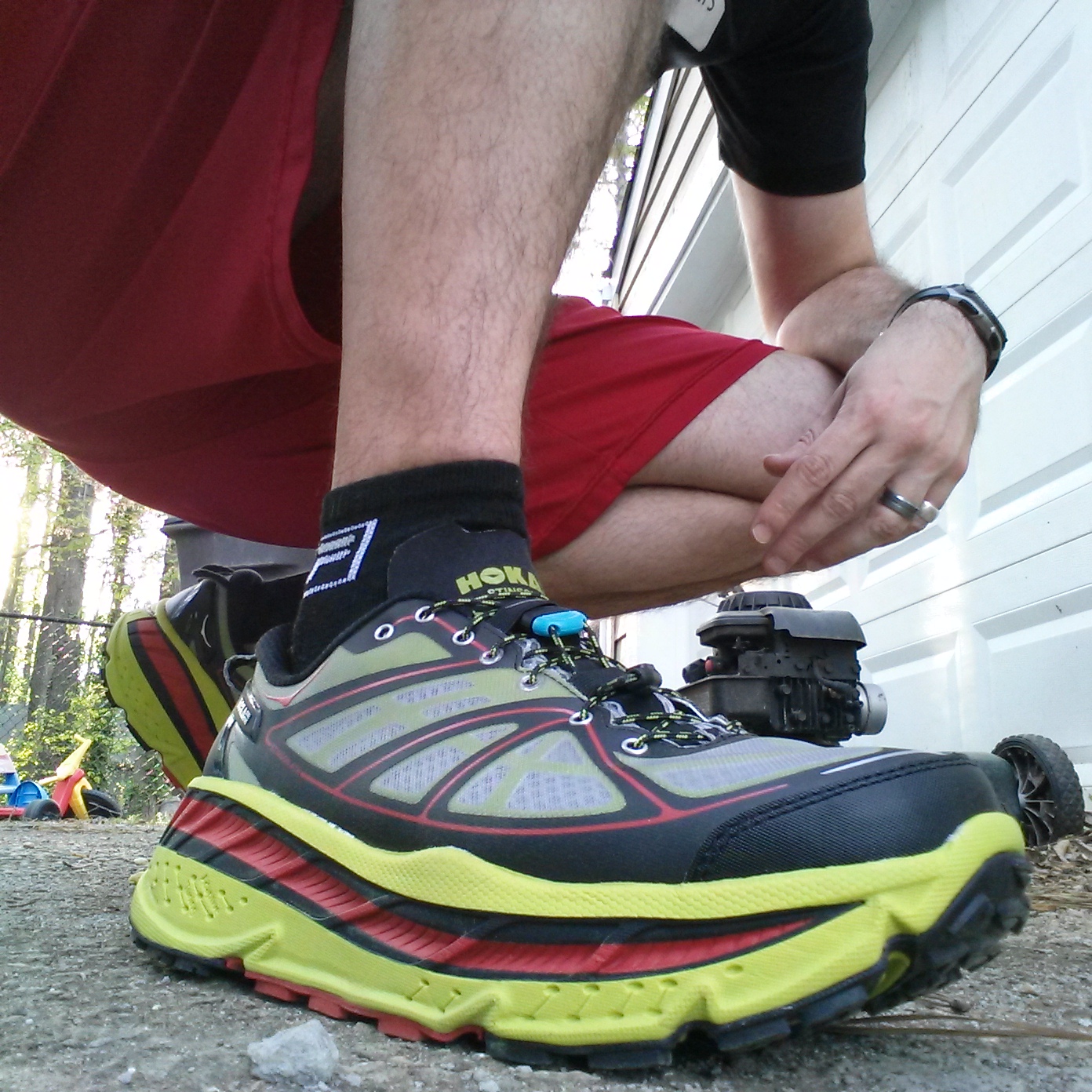
wpid-20150408_185956.jpg

I know, I know.

They look ridiculous. But I got a pretty sweet deal on them and, like I said, I’m willing to try anything.

If you don’t run in running circles (haw) you might not be familiar with Hokas and their ilk, so to put them in a nutshell (which is impossible, I mean, just look at the size of them), they are a new thing in running, the inverse pendulum swing from the minimalism trend that happened in the late aughts. Where minimalist shoes aimed to make shoes feel less like shoes by dint of removing padding and stabilizing elements and “putting you more in touch with the road,” Hokas and other so-called “maximalist” shoes take the opposite tack: they add frankly ridiculous amounts of padding to desensitize you to the surfaces you’re running on entirely. (I should note that “desensitize” is my word, not theirs.)

Now, I think minimalist shoes are the bomb. I think they are the way and the truth. They may have contributed to my injuries, and I’m willing to own my part in that, because I probably jumped in too fast and didn’t give myself the appropriate time to adjust. That said, I still believe in minimalism, because I believe in evolution, and I don’t think that millions of years of adjustment to the earth below our feet would have crafted a foot that needs perfect shoes to make us good at, you know, walking or running on said earth. Shoes being a construct of the past couple of millenia of human development, I’m going to trust natural selection and say that probably our feet are just fine as they are, and maybe it’s the way we’re treating our feet that’s fargoed up. But I digress. I’m not here to argue minimalism vs maximalism, I’m not here to open the Born to Run debate or touch on barefoot running or any of that.

I’m here because in desperation I ordered these shoes, and I’m going to try them out as part of my latest effort to fix my feet so that I can run pain-free again.

Let me make all appropriate disclaimers: “maximalist” shoes are too new for there to be any studies drawing far-reaching conclusions about their effectiveness at preventing or recovering from injury. However, there is a ton of anecdotal evidence out there, and much of that anecdotal evidence comes in the form of gobsmacked distance runners who are amazed that these shoes have allowed them to start running pain-free after extended bouts with hip pain, knee pain, ankle pain, back pain, foot pain… you name it. So I ordered them, and they got here, and I took them for a run yesterday, and here’s what I learned.

  1. They are huge. I’ve sat at 5’11” my whole life, and these shoes put me comfortably in the 6’3″ range. My wife, a demure and delightful 5’2″, tried them on and was able to look me in the eye for the first time in her life. The air just feels a little thinner while you’re wearing them, and maybe that makes you a little lightheaded, and maybe that’s why the pain goes away.
  2. They are soft. Boy, are they soft. Reviewers often describe them as “like walking on clouds”, which is the most overused simile in shoes, and I won’t be using it, because it’s nonsense. You can’t walk on clouds in the first place, and no shoe is going to remove all the groundfeel from your feet. That said, even just stepping into them and taking a few tentative steps around the living room I could feel my feet sinking into their pillowy depths. They compress like a worn-in tennis ball, which is to say, quite a bit, but not so much that you go right through it like you would with a down pillow or, if you must, a cloud. The padding underfoot is sensational, and it really does feel awesome just to walk around in them.
  3. They are bouncy. That tennis ball analogy I used was not a mistake. I thought hard about the best way to describe what running feels like with these things on, and it struck me. Every step is like landing perfectly on a tennis ball. You land, you feel the resistance, the resistance gives more than you expect, and then as your weight transfers over, there’s a spring effect that feels like the shoe is catapulting you forward just a little bit. That effect was disorienting in the first half mile or so, but once you get used to it, it feels normal.
  4. They are grippy. Here’s my primary concern about these shoes, especially having tried minimalist shoes and even my bare feet: you get used to feeling what’s under your feet and adjusting accordingly. That’s impossible in these clunkers. My kitchen floor feels exactly like my lawn feels exactly like my driveway feels exactly like pavement feels exactly like the rocky mudfield out back of the tire shop I run past every day. My concern is that I’d end up slipping because I can’t feel the little rocks or sticks or tiny bumps in the ground or whatever, but this concern broke apart in the atmosphere before I got to the end of the street. The sole of the shoe compresses so much that it actually seems to conform to whatever’s on the ground like a coat of paint going on over my shoddy drywall work in the bathroom. In short, the entire sole gets down on every step. It even makes this sound, like you’re running on velcro, with every step. The sound will probably go away as the shoes break in, but it demonstrated pretty clearly what the shoe was doing: bending and flexing to every contour of the road/lawn/tire lot.
  5. They are light. Enormous as they are, they’re as lightweight as any traditional shoe I’ve had, which seems counterintuitive I guess, until you begin to think about the composition of that sole that bends and flexes and compresses like silly putty.
  6. They are snug. Shoe sizes vary depending on manufacturer, yeah, I get that, but these fit me oddly. The length is fine, but it’s almost as if there isn’t enough room for the height of my foot in the shoe, which makes me wonder about taking out the insoles, even though I’ve never had to do that with any other shoe. Also, the toe box is — for my taste — exceedingly narrow, and my toes feel pretty squished in there. I can’t say I love that feeling. It’s hard for me to imagine running five or six or ten miles or more that way, but maybe they’ll loosen up as the shoe breaks in.
  7. They are huge. Did I say this already? It bears saying again. They’re enormous.

The question is, how did they do on the run?

First impressions only, but they felt pretty damn good. The pain in my foot lately feels like a needle going up into my heel, and I had a bit of that at first (as I do on every run). But by the end of the first quarter mile or so, that pain was gone completely; so completely that I switched to a heelstrike briefly to see if the issue was still there (spoiler alert, it was — and the shoes didn’t protect me from feeling the pain in a heelstriking stride), but as soon as I readjusted, it evaporated again. Lovely. Now, my aches and pains have a tendency to work themselves out after the first mile or so, so my good feels might be attributed to that alone, and not the shoes… but I didn’t have any additional pain later in the evening like I’ve had after my last few runs.

There’s more to be seen, here, but at least for the moment, I’m hopeful that the Hokas are going to help me out. It’s my hope that I can use the Hokas to start getting some regularity back in my runs — start pushing my distance up again, in other words — while allowing my feet to “rest”, while I can continue to use my minimals once or twice a week to keep strengthening my feet. We’ll see how that plays out.

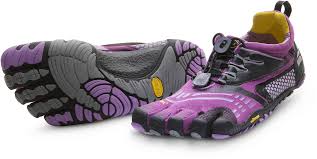
In the meantime, however, there is no cure for how goofy they look. Temper that, of course, with the fact that I much prefer wearing something like this…

vibrams

Terrible Reviews: Activity Tracker Edition


At some point in the past several years, trackers have gone from the stuff of spy movies and government conspiracies to the latest tech-slash-fashion-slash-fitness-slash-self-absorption craze. Being somewhat concerned with fitness, consistently fascinated by tech, not at all interested in fashion, and supremely selfish, I decided over the holidays that I might want one of these.

And I didn’t get one.

But that’s why God invented gift cards, innit? So a few days after Christmas, I had done some research with my wife looking over my shoulder, and we went and bought a Jawbone Up Move for each of us.

I’m pretty sure I hate the name. “Jawbone,” meh, whatever, that’s the name of the company, and I think they made headsets or something originally, so that gets a pass. “Up” is the name for their line of trackers (they make enough models to consider it a line now). I can’t say I endorse using an adverb as your product identity. Adjectives, sure. Speedy! Flamboyant! Hoopy! But an adverb? As an English teacher, I can’t say an adverb stands well on its own. Then there’s “Move”, which I don’t really have a problem with, as that’s what the gizmo is designed to get you to do. Plus, it’s in that authoritative imperative mood, so it sounds like an angry gym coach shouting at you to GET UP THAT ROPE COSTANZA. But you put it all together — Jawbone Up Move — and it sounds a little ridiculous. But you have to put it all together; you can’t just say “Up” or “Move” on their own because Google doesn’t know what you’re talking about, and other humans look at you funny or punch you. I’m just going to refer to it as the “JUM” herein, because that sounds a little like gum, and who doesn’t like gum?

In a world of Fitbits and Garmins and wrist straps and belt clips and skull implants and constant satellite monitoring, (you didn’t get the skull implant and satellite monitoring with your soy half caff? [I have no idea what a soy half caff is]) why the JUM? I’m not gonna lie, it was one of the cheapest options available, but it still boasts access to the Up app, which was highly favored by a slew of online reviewers, and which, after three weeks, I’m pretty fond of. What the JUM lacks in visual appeal and features it makes up for in simplicity and battery life — unlike most of these gadgets, it runs off a watch battery and doesn’t have to be plugged in every few days. Considering the veritable snakepit of little dongly things choking the drawers in our kitchen, this was no small selling point.

Look, it’s not my goal to actually review the thing, as I’m not an expert. All I really want to do is talk about my experience with it, which is equal parts insightful, amusing, and hilarious, and I imagine this experience would be more or less the same for any of these trackers.

Let’s start with insightful. The JUM perches quietly on your wrist or in your pocket or at your waistband or clipped to your earlobe or embedded in your spine (technology pending) and it counts your steps.

No, really, that’s about all it does. Like a sweatshop gnome hunched over an archaic adding machine with the tape spilling out onto the floor and his knobby knuckles hammering at the “+1” over and over again, it logs your steps throughout the day. More correctly, it counts step-like-movements, which can be gamed a little bit by swinging your arms around while you talk on the phone, for example. It also purports to track your sleep by the same metric (tracking movements while you lay in bed under the premise that you hold exceptionally still while asleep). That sounds cool, but I have my doubts about how accurate or reliable that information can be.

In short, all of this is built around the premise that 10,000 steps a day can help you lose weight and get healthier, which is probably true, because as it turns out, 10,000 steps is actually rather a lot.

But it’s more impressive than just counting, because it also syncs with your phone to track the time you took all those steps. So it can tell you, for example, that from seven-thirty AM until eight-fifteen AM, you took 300 steps as you milled around your apartment getting ready for work, from nine until five you took thirty steps as you parked your donk in your cubicle all day, and from five-after-five until five-twenty, you took seven thousand steps as you chased down and murdered your co-workers with an axe. The JUM then aggregates this data for you and pushes it at your face through these bright and cheerfully colored graphs.

So you’re left with collections of numbers and pages upon pages of graphs that describe what you were doing and when and for how long, which probably has useful implications in case you’re ever questioned about all the suddenly axe-murdered employees at your job. And that’s interesting and insightful because it allows you to pinpoint the times of day when you are active and the times of day when you could use a bit more chasing and stabbing and digging and burying to get your heart rate up.

It’s also where the JUM becomes amusing. Because, if I’m honest, I don’t need the step counter to tell me that between 5 and 9 pm I don’t move that much, or that I get a bunch of steps in every day at work without even really trying. But the amounts are amusing. Turns out I walk about 2-3 miles daily at work, most of it in a thirty foot square classroom. And while that 10,000 step goal seems lofty and hard to reach on some days, on other days (and especially on my weekend long run days) it gets shattered. I put in (checks a big orange graph with a smiley face) 16,000 steps last Saturday, which brought my daily step average up to a little over 12,000. So the app now thinks that I need a challenge and it wants me to do 13,000 steps a day. And maybe I could do it, but the app slides it my way like a high-roller palming a twenty off to the valet, like it’s no big deal.

Then there’s the sleep tracking. The JUM supposedly tells you not only how many hours you sleep, but how long it takes you to fall asleep and how many times you wake up in the night. This is well and good and cool as long as you take into account that the thing isn’t measuring your brainwaves or anything, so it doesn’t actually know you’re sleeping or not; all it knows is that you weren’t moving very much, and this it interprets as sleeping. But my wife and I have kids. Two of them, under three years old. They wake up in the night, sometimes often. (Don’t talk to me about how nonsensical the phrase “sometimes often” is. I stand by it.) As a result, when we view our sleep data, we wind up with these deep canyons of orange (wakeful activity) in between the scattered cliffs of blue (various “stages” of sleep). Like a river-carved monument to our ongoing sleep deprivation.  The amusing part is the concept that I might need the app to tell me I woke up in the night. As if the raccoon eyes and the fact that I can’t keep my head upright during the day would let me forget. (And the centripetal force from my wife’s eye-roll just literally knocked me from my chair.) (She wakes up with the kids WAY more than I do.)

Speaking of my wife, that’s where the JUM gets hilarious. We try to be health-conscious: it’s the whole reason I started running, and I think the JUM feeds that in a quantifiable and productive way. And if the aim of the product is to get people off their butts and moving their feet in an attempt to better their health, I think that’s admirable.

But now, things have taken a whole other turn. My wife and I have both hit 10,000 steps every day for almost three weeks now. That doesn’t, however, mean that we’ve each had full, active days every day. It means we’ve managed to place our feet on the floor in an alternating pattern 10,000 times every day. It’s not an uncommon sight to find my wife walking laps around the living room or the kitchen, listening to podcasts while the kids are napping or asleep. I’ve jogged in place in my pajamas next to the bed on a couple of occasions to get a final 1000 steps in. Even now, my as I type, my wife is stomping a moat into the carpet around our coffee table while my son chases her in advance of his bedtime. We’ve become walking robots. This little gizmo on our wrists has made us competitive to the point of absurdity, which I suppose means the product is working as intended, though I’d be lying if I said it didn’t make me feel like an idiot a lot of the time.

All told, the JUM (and, by extension, probably just about every other tracker on the market) therefore falls into the category of wholly unnecessary but nonetheless delightful little devices that are now a part of my life, next to my keyless entry for the car, my smartphone, my bluetooth earpiece (say what you will, I know they’re douchey as all get-out, but I love that thing for the car and while doing chores around the house), my GPS watch, and any number of laptop peripherals. This is one of those things that if you think you’ll enjoy it, you probably will, and if you think you won’t, well, there are certainly better things to spend your money on.

Now, if you’ll excuse me, I somehow have to find 3000 more steps before the bedtime my JUM has set for me at 9:57.

Surreal Cereal


Man, I just love cereal, don’t you? The way each individual froot loop tastes exactly the same as every other froot loop in outright defiance of the concept that the colors represent different froot flavors. The way Cap’n Crunch leaves the roof of your mouth with wicked road rash. The way that Corn Flakes literally taste more like cardboard than cardboard (and honestly, who in their right [or wrong] mind would eat corn in flake form?).

Yep, cereal is awesome.

What’s that? Oh. OH.

This post is about Serial. No, no, don’t get up. I’ll save you the trouble and deduct ten points for opening my post with that terrible joke.

''Serial'' (podcast) logo.png

In case you’ve been living under a rock, Serial is a spinoff from This American Life which focuses on a murder trial from 1999 Maryland. When I first heard about the show, I thought it was a fictional piece stitched together to look (or rather, sound) and feel authentic, but it’s not. It’s an actual case which has actually been tried. Headlined by This American Life’s Sarah Koenig and following the trial of Adnan Syed for the murder of Hae Min Lee, Serial has done for podcasts what The Daily Show did for news, which is make you give a damn about something that you were tired of.

As is the requisite with any sort of review post, I should disclaim that there are spoilers ahead, but they are minor. Essentially I’m only going to spoil the ending, which sounds like the worst thing I could do, but if you listen to even a couple of episodes, you will probably have an idea of how the thing will end, and you will probably be right. I’d also remind you of the ridiculousness of getting upset at having a series that’s over a month old spoiled for you. It’s out there. It happened. It’s over. It is not our fault if you get the ending spoiled for you at this point. So, SERIOUS SERIAL SPOILERS AHEAD.

I’ll start off with the effect that the show (I feel compelled to call it that, even though ostensibly it isn’t, but whatever) had in my household. I heard about Serial and silently filed it in a “to do one day if I ever get around to it” folder. It sounded interesting, but nothing I couldn’t put off. Then my wife heard about it, and since she’s finished her Masters’ program and is looking for things to do with her newfound free time, she loaded it up and had a listen to it while out for a run one day.

Then she got home from that run but kept her headphones on to listen to episode two while puttering around the house. She asked me if I’d heard of this Serial thing. I said I had, but I didn’t know much about it. She put her headphones back on and went in for another episode.

By the next day, when she had her headphones on again, I was feeling a little put out that my wife was spending more time with her podcast than with me, and she was dying for me to get on board, so we both listened to the first episode (she for the second time). I heard it. I processed it. I resisted.

She asked me what I thought, and I tried to get into this whole metatextual analysis of whether or not the format is right for what they’re trying to do, and why this is any different from any existing true-life crime show. Hemming and hawing about how I had kind of enjoyed it but didn’t really see what the big deal was, I excused myself. Later that night, she tried to say good night to me, but I didn’t hear her, because I had my headphones on in bed, listening to episode two.

For the next two days, we didn’t share much conversation at home aside from “What’s for dinner?” and “What episode are you on?” while we both poked around the house listening to Serial on our headphones. Finally, yesterday, we both finished (and I’m ashamed to admit that I finished ahead of her thanks to my work commute and some stolen time on a lunch break) and resumed normal human interaction.

I’ll say this. There’s nothing particularly novel about the show, or even the case it examines. If you’ve watched any true-crime show, it’s pretty much like that, minus the crime scene pictures and mugshots. The host shares her thoughts on this or that aspect of the case, then there’s a cut to an interview with a witness or an audio playback of a police interview or courtroom testimony, and then it’s back to the host. Nothing special.

And (here’s your spoiler) the ending is entirely unsatisfying. Koenig spends 12 episodes of anywhere from 30 to 55 minutes each agonizing over whether Adnan is guilty or not, and at the end of 12 she’s no closer to a concrete answer than she is at the end of about three episodes. Which is to say, he was probably wrongly convicted (based on the overwhelming dearth of hard evidence of his involvement in Hae’s death), but he is also probably not completely innocent either (there are too many coincidences and too many things people know that they couldn’t possibly know for him not to have been involved at least in some way). To sink in the requisite hours to listen to this thing and then not have a big climactic reveal at the end feels like a terrific let-down (a sentiment the host herself admits having misgivings about). Koenig and her team put in all this work — we the audience put in all this time listening — it seems like everybody deserves an answer, and the show doesn’t offer one. (They offer theories in the ultimate episode, but for each theory, they also offer perfectly feasible rebuttals). It’s frustrating.

But. (There is always a but.)

For some reason, when I was listening, I just couldn’t stop myself. I’d go back like a rat in a maze for the next tidbit, sneaking in five or ten minutes between meetings at my workday on Monday, kicking back during my lunch hour, listening on the way to and from school, just to hear the next piece of the puzzle. It establishes some sort of hold on you, like a leech suctioning itself to your thigh, and just won’t let go.

I’m not sure exactly why I found it so compelling.

Each episode focuses on one particular aspect of the case: there’s one episode, for example, where Sarah and an assistant drive around the town trying to recreate various possible sequences of events for the day the murder was committed. This microscopic rather than macroscopic view gave me the feeling that there was always something else to know, something just out of sight to be covered in the next episode. The soundtrack is quirky and sparse, never getting in the way but cleverly accentuating the feelings of doom or doubt that creep in as certain bits of evidence are revealed. The host’s certainties echoed my own as she learned more, but every time she seemed convinced, there was a new piece of evidence to swing the pendulum in the opposite direction. I was personally convinced of his guilt and innocence about four or five times over throughout the series. And finally, the case has so many moving parts and entangled elements … well, it’s easy to see why the producers chose this case to build the series around. The (alleged) killer and his victim were from overbearing families that didn’t want them to see each other. There’s a friend who gives up the killer to police with a story so improbable it seems impossible to make up, but wait — he’s a drug dealer and social misfit who’s not exactly trustworthy in the best of times. Friends at school alternately can’t believe Adnan was involved in the murder or aren’t shocked in the least, depending on whom you ask. And at the center of it all is Adnan himself, whom Sarah interviews regularly on the phone. He’s charismatic and charming and intelligent and eminently likable, and somehow the show introduces and entertains both possibilities: that he’s a good guy who’s been the victim of the worst luck in the world, and that he’s an insanely smart psychopath who plays the nice guy so well it’s impossible to detect the snake lurking under the surface. Oh, and this all happened about fifteen years ago, so everybody Sarah talks to has a memory like a bag of potato chips (mostly empty, and even the solid stuff at the bottom isn’t really good for you).

And as for the series not giving you any sort of resolution for the story it’s told… well, that’s life, innit?

Like I said, the series poses no answers, for all its trying. But I think the swings between certainty and doubt, between liking Adnan and hating him, between trusting the evidence and not believing a shred of it, are themselves evidence of a narrative that’s been masterfully crafted to rope in readers and keep them listening week after week. (Heck, it roped me, and I thought I didn’t like it after the first episode.) You need only google “serial theories” to find yourself in the midst of entire communities of people arguing, sometimes vehemently, about the case and why Adnan is irrefutably guilty against people who fervently believe he is untaintedly innocent. Granted, that’s arguing on the internet for you, but the fact remains: people across the country have had their lives consumed with this thing.

As for myself, the unabashed cynic and hater of all things popular, I didn’t want to buy the hype. I thought it’d be, as so many other stories that take the nation by storm are, like ice cream: delicious and sinful and in no way having any depth or beneficial to your health. But there’s something more to Serial. I have to say it’s worth the time it takes to experience it. I might even say it’s brilliant. Certainly it’s well done and compelling. However it holds up as a story, it certainly holds up as a podcast. And, love it or hate it, millions of people are talking about it, which basically puts it on the same level of pop-culture import as Kim Kardashian. Probably higher of late if she hadn’t done that thing with her butt. Without hesitation I can declare that anything to do with Serial is a better use of your time than anything to do with Kim Kardashian or her butt. It hasn’t just left a mark in the landscape of podcasts, it’s left a smoldering crater. Serial, I mean; not Kim’s butt. Incidentally, “smoldering crater” is the end I’d picture for Kim Kardashian.

And her butt.