Terrible Reviews: Deadpool


I can’t say I was dying to see Deadpool. It wasn’t even necessarily on my list of films to check out when they hit DVD. But it was Valentine’s Day weekend, my wife and I had the kids out of the house for a few days, and we needed something to do in public that made us feel like adults.

Short of going bar-hopping and ending with our heads in the gutters, there’s not a ton of stuff for a couple of crazy kids like my wife and I to do without driving to downtown Atlanta, which is not a thing we undertake unless we must. We decided to check out the latest Marvel offering instead. The reasoning went thusly:

(One of us, can’t remember who): I guess we could go to a movie.

Wife: What’s out that’s worth seeing?

Me: I dunno. I’ve heard interesting things about Deadpool.

Wife: What’s that?

Me: The new Marvel superhero movie. It’s about a guy who basically can’t die or something, I think.

Wife: Who’s in it?

Me: Ryan Reynolds.

Wife: SURE WE CAN SEE THAT

And so we ended up in a packed house the day before Valentine’s Day seeing the most buzzworthy film since Star Wars. And we really should have done some more research first. Not because we couldn’t handle the film, but because we weren’t properly prepared for it. You know how you like to have an idea that it’s fifteen degrees out before you crack the front door? Not because you can’t handle a blast of cold air to the privates or anything like that (what, you don’t open your front door naked in the morning?), but you want to know what you’re stepping into.

Deadpool is not for the faint of heart.

Here’s a film that knows exactly what it is, and exactly what it’s trying to do. It’s raunchy, irreverent, self-aware, and it pulls no punches. There’s gratuitous and excessive filthy language. There’s boobs and butts and … let’s just say unconventional sex. There’s straight-up murder perpetrated by the “hero” (though he does disclaim himself as “not a hero” pretty immediately). And I have no problem with any of those things! I just wasn’t prepared for it as I bought the ticket — I hadn’t even known it was rated R.

Which is entirely my own fault. And I do have some thoughts about Marvel suddenly releasing such a balls-to-the-wall, potentially offensive movie like this, when most of its product lives squarely in the PG-13 arena, but that’s a post for another time. For today, we’re here for the review, so let’s dive in.

This is the part where the review gets spoilery, so be forewarned. I’ll also disclaim that I know nothing about the character or the story outside of the film. I don’t read comic books. So if I’m missing out on some of the inside jokes … well, whatever.

What’s Good:

The writing and the central construct. Deadpool (the character) knows he’s starring in a movie. He regularly breaks the fourth wall to speak with the audience. He knows our expectations for the superhero movie we’re watching and he takes great joy in subverting those expectations. This little device could easily turn campy were it a thing the film simply dabbled in, but the writers don’t dabble — they throw us into the ocean. The film pretends to be about a guy who finds himself imbued with superpowers who must then go on to right a great injustice and save his girl into the mix, but it’s really about the sharp-witted protagonist taking us on a wild ride and messing with us every step of the way. It’s different, it’s fresh, and it works.

Feminism! One of the film’s central heroes is a young recruit at the X-Men academy (yeah, it’s a crossover, I didn’t know that either). She’s not gorgeous, she’s not troubled and fighting for revenge, she’s not that blightedly cliched Strong Female Character. She’s a grouchy teenager who’s a lot more interested in her phone than in saving the world; she just also happens to kick a serious amount of ass when she jolly well decides to feel like it. Likewise, one of the antagonists sort of fits into the same mold. Essentially she’s a lab assistant to the big bad, which lends itself to a certain set of traits by default. She’s nastyish and unsettling, but it’s not like, “oh, this is a woman who’s filling the role of a sadistic torturer,” rather it’s just “That character is messed up … I wonder what horrible thing she’s going to do next.” And then she ends up beating the hell out of a dude made of metal — with her fists.

So many films looking to get good female characters in there (as well they should) feel the need to justify every aspect of the character. This is why she’s strong, this is why she’s not afraid of men, this is where she still gets together with her girlfriends to get good and sloshed on a weeknight after she’s done saving the world. And that’s fine — but it often comes across as too much. Paper Towns was a good (or rather, abominable) example of this. They worked so hard to make the central female compelling and interesting that it all felt forced and ridiculous, ultimately stretching my credulity until I wanted to use the DVD as a drink coaster rather than finish the second half of the film. (I still finished the movie, though, because apparently I’m a glutton for punishment.) The women of Deadpool — with one notable exception — just are who they are, and that makes them so much more compelling.

The Not-So-Good:

(Lack of) Feminism! While the film’s peripheral women are outstanding, the central woman is a big swing-and-a-miss. She falls into the “Cool Girl” trap as outlined in Gone Girl: she’s that too-perfect combination of everything guys want. She’s quick with a geek-culture reference, down-to-earth enough to knock back beers with the guys, and just freaky enough in the sack to make you a little uncomfortable. Ryan Reynolds’s character remarks at one point something to the effect of: “did I create you with a computer?” This is maybe a little bit self-referential on the part of the writers, but still. The film’s climax happens because she essentially gets stuffed into a fridge. For a film which seems so savvy about the genres it’s toying with, the character is a bland disappointment.

Where’d that character go? The aforementioned bad ass sidekick woman literally just disappears from the film in its closing moments. One moment she’s fighting with the X-Men, then she gets beaten while Deadpool is up finishing off the Big Bad, and the next moment the film is over and my wife and I looked at each other and said, “but what happened to what’s-her-name?” (I saw the movie a week ago, okay? I’ve forgotten ninety percent of it.) It’s not like she vanished in a ooh-I-wonder-what-she’s-going-to-do-in-the-sequel way, it’s more like the filmmakers forgot to resolve this character in any way whatsoever. An unfortunately jarring note at the end of the film.

It’s Kinda Boring. To be fair, the film is much more about the wise-cracking, fourth-wall-breaking, not-your-average-superhero taking you on a ride than it is about the “superhero story” itself. Problem is, the film is still centered around that “superhero story.” Average guy acquires superpowers. Superpowers are awesome but they kinda ruin the guy’s social life. Superhero must find a way to balance superpowers with the life he wants to lead, and oh yeah, has to deal with a villain who threatens to ruin his personal life further. The tropes are stretched awfully thin, and again, in a film which really delivers in some other areas, for the plot to be so picked-over is a disappointment.

The Verdict:

Shortcomings aside, the movie is a hell of a lot of fun. It’s witty and sharp, and pokes fun at itself and its entire genre with hilarious abandon. If you like superhero movies, and you can stomach the f-word in large quantities and more than a few dick jokes and other perversions, it’s worth checking out.

Just don’t take your kids.

To the best of my knowledge, all images above are the property of 20th Century Fox.

Star Wars Owes You Nothing


There’s been a lot said about the new Star Wars movie. (Sidenote: Star Wars: TFA originally stood for Totally Fargoing Awesome) And, by the way, it’s been out in the ecosystem chomping down lesser films and records and pooping out money for almost three weeks, so, here’s your SPOILER ALERT: Go see the movie. There are spoilers below. Not big ones. But they exist. Seriously. See the movie.

I will happily place myself in the “loved it” category along with the millions of people out there who don’t have sticks up their butts about movies. Hell, I often have sticks (plural) up my butts (plural) about movies, and I still loved the movie. But, man oh man, the criticisms keep coming. And then the whiners. And then the haters. Even George Lucas has said he felt like he sold the film to “white slavers,” in a WTF moment that seriously just makes me want to sit down and wonder when the man was visited with an involuntary lobotomy. (The comment, of course, indicates that he does not approve of the new direction of SW7, which is fine, except that the mouth speaking the words is the mouth that gave us Jar-Jar, and … yep, sitting down.)

And look, critique is okay. It’s fine. Opinions are like funny uncles and all that. You’re entitled to dislike the movie! Rey’s too capable, too quickly. Poe isn’t featured enough. Starkiller Base is lame. Kylo Ren is too whiny. All this is fine, and maybe valid.

So much of the critique, however, takes on a different flavor than simple pro/con. Many critiques look far beyond what the film is and venture into the murky waters and unexplored jungles of what it could or should be. The plot is too derivative; it should have been more original. Star Wars has already shown us this father/son conflict, it needs to show us some totally new conflict instead. SW7 feels like a remake; we were expecting a sequel.

To any and all critiques in this vein, I say BOLLOCKS.

Finn

All thoughts in this vein share something in common: that is, they bring to bear the viewer’s expectations for the thing, and not just the thing itself. They presuppose that Star Wars, as a film franchise, as a part of their childhood experience, as a story in any shape whatsoever, OWES them something.

But Star Wars owes us nothing. It does not belong to us.

Sure, our experience with it belongs to us. My eight-year-old self, having just seen Empire, wanting an AT-AT walker of his very own to stomp across the neighborhood in was all well and good for me, but it doesn’t mean that George Lucas couldn’t, in Episode VI, drop an AT-AT into the middle of the forest for no goldfingered logical reason at all, just because he felt like doing so. (Seriously. How does that thing deal with trees at all? it corners slower than the Titanic.)

The creators of story are in no way beholden to their readers. We like to think they are, because stories matter to us. Stories which affected us, and especially stories which have aged with us, matter to us all the more. And sure, on some level, there’s a trust established between creator and audience; certain things are off-limits, whether due to constraints of the universe of the story, or out of fear of losing the audience. (We can all, after all, simply stop buying books and going to see Star Wars films.)

In short, the owners of Star Wars (and that’s now Disney, for better or for worse — though I’ll argue, especially with the prequels fading into distant memory, that it’s for the better) are free to do with it what they want.

Now, Disney wants to make money. It plans to achieve that goal through making media that draws people in, media that we want to consume over and over again and own tiny little pieces of. Well, just look at their box-office earnings: MISSION BLOODY ACCOMPLISHED.

But look a little deeper. Disney wasn’t in this just to make a film (or films — there will be two more, you know) to scratch the itch that fans have been picking at for thirty years. Why make a film just for the over-thirty crowd? They wanted to hook new viewers, too, while also keeping those older fans on the hook for a new series. Does it rehash old ideas, familiar tropes, well-visited themes of the original trilogy? No doubt. But it does so in a way that I found fresh and compelling, and that (and here I really apologize to any die-hard fan of the original trilogy) makes for a better film than ANY of the originals.

Seriously. Show any teenager Episode IV, and then show them Episode VII. We don’t even have to talk about which one they would enjoy more. Now, I’m not saying that a teenager is the best judge of a film’s quality (though, if you want to make money, teenagers are the ones to target). But a teenager is able to do something you and I can’t do: namely, view the original film(s) without the rose-colored rearview mirror of nostalgia.

I challenge you: go back and watch Episode IV, having recently seen Episode VII. (I did this when I posted about the similarities between the two films.) Cut the predecessor some slack for technology available at the time (notwithstanding the edits made in the 90s), and then — and this is the hard part! — strip out as much of your nostalgia as you can. What you’re left with is a very pretty action film about a whiny kid who goes on a space adventure. It starts off pretty good, but then the pacing drops out and doesn’t really get going again for about thirty or forty minutes. Then it’s fargoing excellent again until the ending, which features a repetitive and entirely-too-protracted battle in space and an abrupt-as-hell ending. On the other hand, you have Episode VII, which features two protagonists, both of whom have compelling backstories right from the gun (and they’re not white dudes, bonus for that), flung into a story which is paced like a chipmunk that’s been greased up and lit on fire. Sure, there’s a lame samey bit with a planet-sized space base that can blow up other planets. And maybe the last shot with Luke leaves a funny taste in your mouth. But there are multiple simultaneous plotlines. There’s a better, more deliberate sense of mystery. Even the villain is more relateable, whether you find him overly whiny or not — he shows weakness, he shows vulnerability, he has depth (and yeah, sure Vader has depth, but not in Episode IV).

I’ll argue that if you complete that exercise faithfully, you’ll find that SW7 is a better all-around movie than the original.

Kylo Ren

In my mind, the folks arguing about what SW7 should’ve or could’ve been are not so different from the blowhards railing against gay marriage (even after the book has been closed on it). You’ve got this nebulous thing which means something to you and which you probably feel strongly about, but the true meaning of which is flexing and adapting to fit the world we actually live in. The tide is inevitable. Star Wars owes you nothing, just as the institution of marriage owes you nothing. These things are just changing to stay viable for the times we live in. You can either go along for the ride or get trampled by the literal hordes of people getting on the ride without you.

Personally, I’m on board with the new Star Wars, and I can’t wait to see where it takes us … even if we’ve been there before.


71 Ways The New Star Wars is Exactly Like the Original Star Wars


My wife and I went to see Star Wars VII again the other day. (It holds up just as well on the second viewing. In fact, it’s maybe even more enjoyable, because you start to pick up on things you missed on the first go-round; like the training droid Luke used in Episode IV that Finn tosses aside while hunting for parts in the Millenium Falcon.) We went specifically to give the film a close viewing to see if we could discern any more about what’s going on with Rey, what’s going on with Kylo Ren, and — well, honestly, it was just so good we both wanted to see it again.

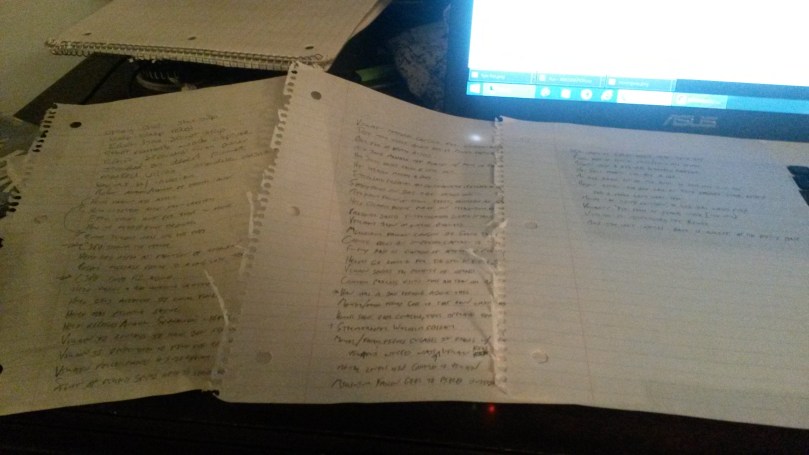
We noticed on first viewing that the new film is very much an homage to the first film, sharing not just similar themes and plot arcs, but often very specific details in common. So we came home and watched episode IV again, just to contrast and compare. And because we’re both that guy when it comes to movies and stories and nerd stuff, we took notes.

20151224_073604.jpg

Seriously, a lot of notes.

Here, then, are 71 ways that Star Wars IV: A New Hope and Star Wars VII: The Force Awakens are basically the same movie.

There are spoilers below. These things are not necessarily in order (but a surprising number of them are).

  1. Opening shot of a ridiculously big starship flying over an alien planet.
  2. A robot that talks only in bleeps is prominent, especially in the opening scenes.
  3. The robot is given a super-secret map by its owner.
  4. The bad guys invade. They wear masks and believe in a shoot-first-ask-questions-later policy.
  5. The bad guys pretty much rout the rebels they’re attacking.
  6. The Big Bad Guy (henceforth BBG) shows up, intimidates a ton of people, but doesn’t actually do any fighting himself.
  7. BBG straight-up murders a defenseless man because he doesn’t like what the guy has to say.
  8. The robot narrowly escapes capture by the faceless bad guys.
  9. The robot is separated from its owner.
  10. The robot becomes stranded alone on a desert planet
  11. This desert planet should, by all accounts, cripple the robot’s wheel-based propulsion, but doesn’t, because movies.
  12. The bad guys begin a hunt for the robot on the desert planet. You’d think they’d be able to use scanners or scopes to find it, but movies.
  13. The robot’s first encounter is with a scavenging alien critter who wants to sell the robot (maybe for parts).
  14. A young, somewhat dashing hero-type liberates the robot from its captors.
  15. This hero is exceptionally dusty, because he/she does dirty, manual labor to scrape out a meager existence.
  16. The robot follows the hero home like a little lost puppy.
  17. This hero’s parents are absent.
  18. The hero discovers that the robot is involved in the rebellion and gets hyped.
  19. The robot’s secret cargo points the hero toward an ancient, long-lost Jedi Master.
  20. C3PO slaps R2D2 around, perhaps a little more than is necessary.
  21. C3PO thanks the Maker, and it feels a little forced and weird.
  22. The hero drives a red, hovering vehicle.
  23. The hero gets attacked by local brutes.
  24. The hero is revealed to have a convenient set of piloting skills.
  25. The hero is presented with Anakin Skywalker’s lightsaber by a mentor figure.
  26. The BBG is revealed to have once been a good man who was later seduced by evil.
  27. The BBG is a little more consumed than his cohorts with finding the robot.
  28. The BBG force-chokes a subordinate officer over losing the robot.
  29. Extreme and gratuitous violence by the bad guys drives the hero to leave the home planet.
  30. The BBG personally tortures a captive from the earlier raid for information.
  31. The hero escapes from danger by Jedi mind-tricking a hapless stormtrooper.
  32. There is a bar full of weird aliens of dubious persuasion.
  33. A hero seeks passage off the planet and away from the Empire with a pair of shady guys.
  34. Han Solo’s debts catch up with him.
  35. Han straight-up murders a dude to escape capture or death himself.
  36. The female lead finds herself in the hands of the enemy.
  37. The interrogated female has “considerable resistance” to the BBG’s mind probe.
  38. The bad guys reveal that their newest base of operation is also a weapon capable of blowing up entire planets.
  39. The bad guys blow up entire planets, partly out of revenge, partly as a show of force.
  40. Shady aliens in the bar rat the hero’s presence out to the bad guys.
  41. The Millenium Falcon is where the Band of Heroes comes together.
  42. The Millenium Falcon, on first sight, is described by the hero as, basically, garbage.
  43. Han Solo bristles at the heroes’ unrecognition of the Millenium Falcon’s awesomeness.
  44. The hero escapes the desert planet aboard the Millenium Falcon.
  45. The Millenium Falcon, soon after escaping the desert planet, is caught by hostiles in a tractor beam, and the heroes find themselves in an unfriendly situation.
  46. The captured prisoner sasses the BBG interrogating him/her, and pays a price for it.
  47. Chewbacca punches out a bad guy captain to gain access to a restricted area on the enemy base.
  48. The Band of Heroes goes looking for the captured female on the enemy base.
  49. The BBG “senses the presence” of the mentor/father figure in the Band of Heroes.
  50. The captured female turns out to be just as capable of kicking ass as her “rescuers”.
  51. Han Solo has a bad feeling about this.
  52. A Stormtrooper, probably named Wilhelm, dies to the sound of a well-known film scream.
  53. The mentor/father figure separates himself from the Band of Heroes to disable a critical part of the enemy base.
  54. Heroes shoot the controls to a mechanical door; this causes the door to operate in their favor.
  55. The mentor/father figure engages in dialog with the BBG about his wicked ways.
  56. The mentor/father figure deliberately lowers his guard to the BBG.
  57. The BBG then straight-up murders the mentor/father figure.
  58. The Millenium Falcon goes to pieces inside (circuitry bursting into flames etc) during an escape attempt.
  59. A high-ranking bad guy doesn’t entirely trust the BBG.
  60. The rebel base is disguised in a series of caves and ruins on a forest planet.
  61. The rebels hold a big-ass strategy meeting to figure out how to destroy the bad guys base/weapon.
  62. Han Solo offers the hero a job as an alternative to going on the quest.
  63. A member of the Band of Heroes bails out of the quest to save his own skin.
  64. The rebels attack the bad guys’ base/weapon in tiny fighter ships as opposed to bringing in heavy artillery.
  65. The attack is focused on a video game weak point in the base’s construction.
  66. There is a minute-to-minute countdown all through the final sequences as the big bad enemy weapon prepares to fire.
  67. The BBG points out to his cohorts (and himself) that the Force is strong with the hero.
  68. In the final skirmish, the villain is neutralized for this battle — but not killed.
  69. The ally who left for selfish reasons comes back to aid the hero at the enemy base.
  70. The enemy base/weapon is struck by a few strategically well-placed shots from an ace pilot.
  71. The enemy base/weapon explodes in dramatic fashion.

So, this is all good fun. Of course, the films are also very different. The hero is not a whiny teenager but rather an ass-kicking desert girl. The villain is dark and terrifying, but is also incredibly vulnerable. The plot lines are more layered, more intertwined. And, my god, the film and its special effects are absolutely gorgeous.

It’s clear to me that this film is a sort of love letter to fans of the original series who were disillusioned with the prequels. “Look,” Episode VII says, “We see and respect the source material that you love so much, and we’re going to treat it lovingly and with respect.”

Only a year and a half until the next one.

See something we missed? Something we got wrong? Let me know below.

*Runs away making lightsaber noises*

A Non-Review Rave on Star Wars: The Force Awakens


I’ve just seen the new Star Wars movie, and waiting the two days after the opening to see it was … difficult. I’ve been avoiding social media pretty carefully to make sure I didn’t ruin any of the movie for myself. (Spoiler alert: there are no spoilers in this post.)

But anyway, I’ve seen it. And … I’m not going to write a full review right now, or maybe ever, because I have a feeling more talented people than I will surely have that covered.

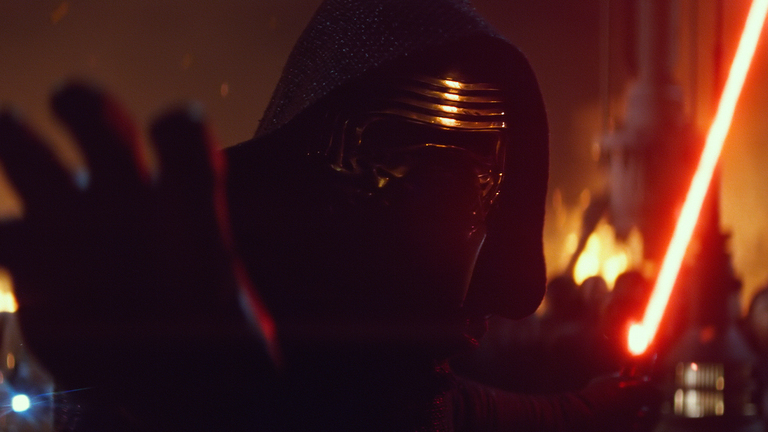
What I will say is that this guy:

Kylo Ren
Image lifted from starwars.com.

has just absolutely taken the heart of me.

I thought I knew what good and evil were in the Star Wars universe. I thought I knew what I could expect from a villain. But I did not.

Upon the first viewing, Kylo Ren strikes me as certainly the most interesting villain in the Star Wars universe so far (including good ol’ Darth Vader, though that’s maybe Lucas’s fault for making the prequels so … weird), and possibly one of the most interesting villains in recent blockbustery cinematic history. He has a terrifying, yet imperfect, control over the Force. He’s bad, but not in the way you expect him to be bad.

He’s vulnerable. Which is something no Star Wars villain has ever been, really. They tend to be invincible, until they’re not. Not so, Kylo. His quest leaves him scarred inside and out. And while his identity is not a mystery — we learn about halfway through the film who he is — what is a delightful mystery is what has happened to him to make him who he is.

A mystery for the future films to explain, no doubt.

But let me dispense with any possible spoilerating. The movie is as good as advertised. I suspected this about five minutes into the film, but knew it to be true beyond a shadow of a doubt thanks to my wife: my wife, who is as much a Star Wars fan as a cat is a fan of trying to murder you on the stairs (not so much seeking it out, really, but if the opportunity is there — well, why not). She leaned over to me about twenty minutes into the film and whispered, “I think I’m really into this.”

Me, too.

Now, having just come in from seeing the movie, I hope you’ll excuse me. I just … I just need a minute.

Terrible Reviews: Paper Towns


Usually I disclaim that I call these Terrible Reviews because I am by no means qualified as a film reviewer, and thus my reviews are likely to be terrible. However, this time, I feel pretty confident in telling you that this film has earned a terrible review.

First of all, this is one of so many novels which was a book first, and the transition from book to film is always fraught with difficulty. You can’t hope to translate the nuances of language from the page to the screen and have that warm, fuzzy feeling carry over with them. And to be fair, I haven’t read John Green’s Paper Towns prior to seeing the film, as I did with The Fault in our Stars. That said, I might have read TFIOS after having viewed the film, but I don’t think I’m going to bother reading Paper Towns at all.

**Also, edited after the fact: For some reason, I ended up having a lot to say about this movie. I don’t know why; maybe it’s because I felt so removed from the narrative that I had time to think about what it was that was removing me from the narrative. Anyway, read on at your peril.**

This is the part where I warn you that there are spoilers ahead. If you’re one of those who cares about such things, you might want to look away, perhaps at the slowly mounting list of things to be done around the house before Thanksgiving.

I’m going to go ahead and acknowledge that I am not the target audience for this film. I’m not a high schooler, and I’m not a romantic, and I’m double definitely not a hopelessly romantic high schooler. I’m thirty and change, jaded and grumpy. So this film is on its face Not For Me.

But here’s a film which features a bland-as-butcher-paper protagonist pining after a quirky-as-pineapples-in-pink-tutus imaginary female love interest with some really frankly hard-to-swallow-even-based-on-a-pretty-substantial-willful-suspension-of-disbelief events driving the story, though to say the story is “driven” is a metaphor I’m going to unpack in a minute. It’s not so much “driven” as it stalls out halfway up the hill and coasts backwards while you try like hell to figure out how to get out without shredding your face or breaking any limbs.

Now, maybe I’m just too old. It hurts my soul to say that, but I fully appreciate the possibility that Paper Towns might be the Breakfast Club of this generation, and I just don’t get it. But I don’t think so. I think the reason The Breakfast Club was so important for my generation (and still is, I humbly think) was because just about anybody watching it could see himself in one of the characters. I don’t feel that happening here. In fact, I don’t know if anybody can particularly see himself in these characters. But enough pining for my own lost childhood. Let’s dive in.

The Good.

The film’s central message — that nobody really knows who they are, and everybody is doing their best to figure it out — is one that I can get down with. My writings here at the blarg over the past (almost) two years are evidence of my selfsame quest. There’s an existential doubt there that the film communicates well, though I’ll point out that other films do it better (The Breakfast Club, not to beat a dead horse).

Also, there’s a decentish road trip sequence which captures nicely the soul-crushing monotony that a supposed romp across the country actually entails. I don’t know, however, if the filmmakers’ intention was to serve up a boring cross country jaunt. Further, again, so many other films tackle the romanticization of the road trip, and do it so much better.

In seriousness, the protagonist’s sense of doubt is pretty real, I would say, in upper-middle class, white America. He’s on a fast track to college and a career that he feels pretty confidently is the “thing he should be doing,” but his encounter with The Girl is the monkey wrench in the machine. His growing certainty that there’s something more and that maybe he’s been looking at his life in the wrong way is a sentiment that will echo with impending graduates. Again, though, this is not a new idea … again, it’s done (better, I think) in The Breakfast Club.

Then there’s the concept, which is actually pretty fascinating: the “paper town” being a fictional place that exists only on a map. It’s kind of a lovely metaphor for the lead female’s grail-quest to figure out who she really is; the only place she can find herself is in a place that literally doesn’t exist.

The Bad.

Oh, boy. Okay. I just sang the protagonist’s praises so that I could decry him here, because he is as compelling a central character as a slowly melting ice sculpture of a pile of cow dung. He’s not charismatic, but he’s not a wallflower. He’s not dashing, but he’s not  better off wearing a paper bag on his head. He’s not a jock, but he’s not a glasses-and-suspenders clad nerd. He’s a scoop of vanilla ice cream, but not even a heaping scoop with the bursting bits of vanilla beans that explode on your tongue; he’s the factory-made processed stuff flavored with chemicals derived from chemicals that were probably used to condition car bumpers or something. It’s hard to root for him or even to care about his struggle, because in the first place, he’s just so very lacking in flavor, but also because the stakes couldn’t be lower. Regardless of how this little love story plays out, he’s gonna be fine.

Then, there’s the girl. She might as well be wearing a big neon sign that says “I am that girl who’s not like the other girls.” She’s “delightfully” quirky and “refreshingly” blunt in her no-nonsense, no B.S., no rules approach to the world. My wife actually put her finger on it: “She’s the Cool Girl that the protagonist laments in Gone Girl.” If you didn’t read / see that one (you should, if only to see Neil Patrick Harris get his throat slashed open in one of the most genuinely fargoed-up things I’ve ever seen on film), Cool Girl an invented construct of male-centric media, a female who genuinely likes “manly” things and eschews “girly” things. She doesn’t play by “girly” rules but she is still quintessentially feminine, working her wiles upon the men in her life unintentionally through her cuteness and coolness, and remaining oblivious to how much these men want and desire her. Okay, maybe I overexplained that one a bit, but this is the character. She laments the entire town she lives in as being “made of paper,” the people and places made of flimsy, immaterial dreams and aspirations.

The problem is that as vanilla as the boy is, the girl is off-the-wall to the same degree. They are light and dark, oil and water, peanut butter and whatever the opposite of jelly is. If he’s too boring to care about, she’s too ludicrously constructed to believe. She traveled with a carnival for three weeks as an eleven year old? She routinely runs away and her parents don’t call the cops? She defaces property, going so far as to leave her name and signature at the crime scenes, and nobody ever presses charges against her? She somehow has connections that allow her to traipse around executive boardrooms in bank buildings? In what effing universe is even a single one of these things possible?

Now, apparently, it has been said that author John Green constructed these two characters to sort of spoof the roles that they, admittedly, take up to eleven. And I can see that… but I don’t see what the end is for all those means. If you’re spoofing the roles, why isn’t the story funnier? (The film has its funny moments, but it’s not a comedy.) If you’re just leaning on the trope, what’s the point? I seriously can’t figure out if the explanation that they are designed to be caricatures holds water, and that’s a problem if you view films critically, as I do.

We just won’t even mention the cardboard cut-outs that make up the rest of the cast. Or the fact that for each of the three “outcast” guys at the core of the film, there’s a perfect dream-girl who thinks he’s dreamy when they get to know each other. Or that there are conveniently six seats in the minivan that they trek across country in. (One seat never gets filled; ooh, symbolism.)

The WTF.

Again, I fear that maybe I’m just too old, but here are a few questions I found myself asking during the film:

  1. What parents — when called by their high-school child during hour 7 of an at-least-72-hour road trip — simply allow the thing to go off without raising a fuss?
  2. How does a 17- or 18-year-old girl manage to simply disappear while still apparently having her cell phone? (She explains to the protagonist, as if he were a simpleton, that she speaks to her sister every day.)
  3. Is she trying to be found or isn’t she? She leaves all these “clues” behind, but the hero tracks her down on some seriously flukey and frankly nonsensical coincidences and good fortune. If you’re trying to be found, you have to do better than hoping that the finder will find an atlas (an ATLAS, of all things, in the age of google) in your ex-boyfriend’s house. If you’re NOT trying to be found, what’s the goldfingered point of leaving behind addresses of your secret hideouts and cryptic messages that point to your secret location?
  4. Do none of these kids have parents? Seriously, there are five kids on this multi-day road trip, and apparently all of them just went for it and left their parents flapping in the breeze. NOBODY had parents who called the cops?
  5. How did “the gang” just barely make it back for prom riding directly there in a van, but the hero manages to derp around town for a few hours, find the girl, sit down to a lengthy milkshake and conversation with her, have his heart broken, then take a BUS home and still make it to prom in time to share a dance?

I have a pretty forgiving suspension of disbelief, but this isn’t some tacky, there-are-no-rules farce like a National Lampoon flick. The story seems to want to be taken seriously. Yet there are these tremendous gaps in the story that can’t be filled by any amount of audience-goodwill spackle. It asks too much of its audience. Or maybe I’m too old.

Maybe it’s poking fun at a genre of romantic comedy, coming-of-age stories, but I don’t see what point it’s trying to make, if so. Maybe it’s trying to follow the tropes of those genres only to buck our expectations at the end, but again, it’s not particularly original in doing so, and it’s no payoff when the “surprise” ending comes. It’s kind of like a whoopee cushion that the prankee discovers without sitting on it, then he picks it up and makes the fart noise anyway. It’s just weird.

Then there’s the pacing. My god, the pacing. Snails could outrun the narrative of this thing; in fact, there are sequences in the second half of the film where you see a map of the eastern seaboard with the classic dotted line creeping off the gang’s progress. In the scale, it positively creeps. I remember thinking, yep, that’s about how fast this feels. The central conflict (Cool Girl has disappeared) doesn’t begin until almost the halfway point of the movie; the first half is all taken up with the girl committing felonies (sorry, “pranks”) against a host of people who have wronged her. It’s fun, but my wife and I found ourselves looking at each other to ask, “exactly where is all this going?”

Back to the Redbox first thing in the morning, that’s where.

The Verdict.

Okay, so maybe I haven’t been particularly impartial throughout this film, but frankly, I’m disappointed. I’m a big fan of John Green. I’m especially fond of his youtube channels — Mental Floss and the Crash Course series are both educational fun worth checking out — and I dug The Fault in Our Stars even though I didn’t fawn over it like, I feel, much of its audience did. (Again, I’m not the target demographic, but I will maintain that much like with The NotebookTFIOS illustrates that the line between “stalker” and “persistent love interest” shifts wildly depending on how good-looking the pursuer is.)

In short, this effort feels hollow. Formulaic. As immaterial and fleeting as paper. Perhaps, then, the film is spoofing itself: It takes characters who don’t matter on a love story that isn’t real, toward a romantic payoff that does not exist. A Paper Romance.

Or maybe it’s just a bad movie.

All that said, John Green does have a knack for a nicely turned phrase, so I’m willing to bet the book is a fair bit better than the movie. For me, though, the movie was bad enough to make me seriously skeptical about the strength of the source material.

Sorry, JG. Maybe I’ll give it a try again on your next novel.

To the best of my knowledge, all images are copyright of Fox 2000 pictures, and based on source material by John Green.