Trees and Shrooms and the World is Awesome


I listened to a brilliant podcast the other day. This one: the most recent offering from RadioLab, a podcast I don’t always listen to, but which never fails to fascinate when I do.

In short, it’s about trees, and you read that and you think, wow, trees? Really? Instant snore, and you’d be right, except the podcast isn’t really about trees, it’s about the magic behind trees. About how we (meaning you and me and the rest of the undereducated public) don’t actually know sharknado about trees.

So, with trees, there’s literal magic going on at the microscopic level, which should come as no surprise at all but it surprised the hell out of me. Turns out that trees are only able to become trees because they get a crazy amount of help. In fact, a tree on its own would never grow into a tree at all — it would only grow about knee high. But there’s this fungus that isn’t really what you think of when you think of fungus at all, and that fungus lives basically in all the dirt everywhere, and that fungus synthesizes and assimilates itself into the roots of a tree and turn it into a fargoing superhero.

But that’s not all: this fungus is not content just to piggyback on one tree like a remora swimming beneath a shark for a bit of mutual fin-scratching. This fungus is a hive-mind governmental distribution system. It can literally take excess nutrients from one tree and transfer them to another malnourished tree. It can detect distress signals from one tree and divert resources to other trees in the area. In some cases, it can even decide which trees get to live or die when resources become scarce.

And hearing about that, of course my brain kicked into overdrive a little bit, because the world is one big metaphor, right? Everything is connected, things always mean things. And if trees can only become trees by standing on the figurative shoulders of a literal fungus, then maybe there’s something in that about how everything in my life feeds my writing one way or another, or about how running is the glue that somehow drains me and energizes me all at once.

And those connections could be drawn, probably.

But sometimes it’s better to just let a thing be what it is.

I learned about a nearly miraculous situation which is happening literally underneath everybody’s feet, every second of every day. And I think today, that will be enough.

Are you listening to RadioLab? You should be!

Terrible Reviews: Ghostbusters (2016)


So, the Ghostbusters reboot is out. And it’s gonna be hard to talk about the film without also talking about the six-hundred pound elephant in the room, which isn’t an elephant so much as it’s the manifestation of insecurities accumulated over decades.

There’s a bit of controversy around this film. I don’t know if you’ve heard. It has the dubious distinction of being the most downvoted trailer in film history, which I’m pretty sure wasn’t a thing until somebody who was determined to hate the movie went and counted to solidify his point. And, much like politics, the reasons for that largely depend on whom you ask.

Ask somebody who’s optimistic or indifferent about the reboot, and they’re likely to say the people downvoting the trailer and panning the film before it ever saw the light of day are antifeminist manbabies who, uh, tickle themselves to Pete Venkman getting slimed every night before they tuck in. These misogynists, they would have you believe, are just butthurt about the beloved franchise of their youth being repurposed with a female cast, and they are VERY VERY ANGRY ABOUT IT.

Ask somebody who’s not happy about the trailer, and they’ll blame it on any number of things: that the special effects look dopey, that the jokes aren’t funny, that the performances look flat, and the list goes on and on. Then there are those who insist that the film is “ruining their childhood” by remaking something that should never have been touched again, as if films, once they’re made, should get cast in bronze and locked in a hermetically sealed chamber until the rapture comes and Jesus himself uncorks them all for his own jolly consumption.

Then, of course, there are the actual misogynists, who literally say that it’s a bloody travesty for their beloved film to feature women in the lead roles.

Here’s the thing, though: It’s actually pretty damn tough to compare the 2016 Ghostbusters to the original, because they are not in any way the same film. They share the same conceptual core, the same nougaty center of “oddball scientists fighting ghosts and saving New York from the supernatural,” and pretty much diverge in every other way.

Whatever. Let’s get to the (spoiler-free!) review first, and we’ll get to the gender meta-analysis later. And I’ll go ahead and disclaim now that the original Ghostbusters is comfortably one of my top-5 films of all time. (And I didn’t hate this reboot.)

The Good:

Whatever else this film might be, it’s designed to be a summer blockbuster, which means action, some laughs, and a big, climactic showdown, probably one that causes millions of dollars in collateral damages and destroys most of a city.

And this film delivers that. The action sequences are pure eye-candy, with the redesigned but classic proton-packs slinging hot ghost death around willy-nilly, and a full load-out of new gizmos and doodads for the ‘Busters to show off. Proton Grenades, a Proton Shotgun, Proton Pistols … it’s all good and it’s all fun. (We’ll discuss the merits of this stuff later, but the visuals are top-notch.) McKinnon’s fight sequence with her Proton Pistols was a total wow-moment in the film, and her character is sure to be an audience favorite.

The comedy will be a sticking point for some people. The original had a dry, deadpan humor to it; this film is much more in the trenches. There’s slapstick. Poop and fart jokes. Ridiculousness. And a lot of people will hate that. But this film knows what it is, and that humor fits right in with the tone of this film, which is goofier than the original right from the start.

Then, the showdown. Buildings get smashed. Ghosts run amok. It’s pretty much what you’d expect, and it looks pretty great. I almost just typed that the final baddie was a bit ridiculous, but then I checked myself. We’re talking about a film in the original whose final showdown was with the StaPuft Marshmallow Man. So forget it. Last showdown is right in line with the tone of the film.

Finally, a note on the story: the main through-line of the story gets established a lot sooner in this film than in the original. Within the first twenty minutes or so, we see the guy (who will later become the big bad) messing around, acting weird, and his role is gradually fleshed out. In other words, we get an idea of what’s actually feeding the problem much earlier in this film than we did in the original (where we don’t really learn about Zuul or any of that until after the halfway point), and I think this film is better for it.

The Bad:

For me, the film has one critical flaw, and that’s the pacing. It’s forty-five minutes into the film (almost halfway) before the ‘Busters catch their first ghost, which is too long for my tastes. Those first forty-five are spent introducing characters, investigating hauntings, and in short, getting the team together. I felt like the introduction of the central two characters (McCarthy and Wiig) was entirely too drawn out, while the other two (McKinnon and Jones) get relatively little intro: then, all of a sudden, the four of them are together, on a gig, busting a ghost … and THEN the film takes off.

A related, but lesser, complaint is the development of these characters. Only one character really changes through the events of the film, and that’s Wiig’s — but the change doesn’t come at the climax of the film, rather it comes in the first thirty minutes. The film’s climax is therefore not transformative for any of the protagonists, which leaves a story wonk like me a little disappointed. Come to think of it, I could just as easily say the same of the original film, sooo….

Then there’s all those weapons I mentioned up above. Storywise, they’re a waste: the McKinnon character rolls them out, not because the proton packs are inefficient, but “just in case”. Every character gets one, and every character waves their altered boomstick around during the final showdown. They’re nice eye-candy, but that’s about it: in fact, the only non-proton-pack weapon that ends up having any story significance is a freakin’ Swiss Army Knife.

The Tough-to-pin-down:

Chris Hemsworth’s character is a big question mark for me. He’s so over-the-top stupid that it really stretches disbelief that the characters would allow him to stick around. Then again, he has some so-stupid-it’s-hilarious moments (the phone in the aquarium for example) which kinda make me rethink complaining about him. So he’s hard to nail down. Then again, my wife points out that he is the male equivalent of a worthless secretary hired just for her looks, so I guess that’s just my gender-blinders falling right into place.

Then there are the ghosts themselves. A lot of folks complained when the trailer came out that the effects on the ghosts looked lame or cheap. Hogwash, if you ask me. They look a little over-the-top, maybe, but this entire MOVIE is over-the-top. Still, the first ghost they catch is not so much a ghost as a freaking winged green devil monster. Maybe I’m nitpicking too much, but that seems less “ghost” and more “demon”. Regardless, in their first attempt to capture a ghost, they go up against this monstrous thing and they bring it down with relatively little trouble. It felt a bit like too big of a victory, too early, against too powerful an adversary.

Outside the Frame:

I said at the outset that you can’t really talk about this film without acknowledging the gender controversy. You might have noticed that I haven’t mentioned it at all (well, a little bit around the Hemsworth character). There’s a simple reason for that: gender couldn’t be less of a factor in the movie. Which kind of makes this film the height of a feminist accomplishment.

How’s that, then? Easy. The protagonists are women, but it doesn’t matter that they’re women. The film would work just as well with the original cast of Spengler, Stantz, Venkman and Zeddemore as it does with these four ladies, as it would with any four male actors from today, as it would with any permutation of players and genders. That’s because these characters are not strong female characters, they are simply strong characters who happen to be female. There is no chest-beating, bra-burning moment of “look what we women have accomplished! See how we have thrown off the patriarchy!” No, these are simply capable women, going about their business, kicking ass and saving the day. They don’t need to prove how “feminist” they are. They just do it.

Then, there’s the fact that the film is a reboot (not a remake). Obviously it will be compared to the original, even though to do so is an exercise in futility. This will never be the same as the original, which means that the haters crying that the movie got remade at all will never be wrong. Still, the movie pays homage to the original in the form of cameos from the original cast and callbacks to well-known gags from the original. You still have the hilarious moment when they crank up the “unlicensed nuclear accelerator” in a backpack for the first time, and the other characters slowly edge away. Rehashed again is Bill Murray’s yank-the-tablecloth-off-a-set-table gag that he can’t resist, only this time it’s Kirsten Wiig being dragged out of a restaurant by security, grabbing the tablecloth as a last resort. Some will claim that these callbacks show the film is unoriginal, that it’s simply scavenging the corpse of the first film. Nonsense. They are little head-nods to fans of the original, they are winks-and-nudges to the folks who recognize them for what they are.

The Verdict:

The fact is, this is a perfectly ordinary film. It’s not going to change your life. It’s a good time with some funny ladies and some pretty excellent explosions and light shows along the way. There’s nothing earth-shattering going on here, outside of the sheer balls it took to retool the original so completely. That said? It isn’t a bad film. Not on its own merits and not by dint of re-inventing a film that, truth be told, probably didn’t need to be reinvented.

But when did “need” have anything to do with the movies being made in Hollywood? This is a perfectly good film with a lot of controversy around it. The fact is, your experience of the film will almost certainly depend on the baggage you bring to it. If you come to the film determined to compare it to the original, you’ll be disappointed. This film isn’t trying to improve upon the original; it’s trying to spin the yarn anew for a younger generation. If you come to the film with a more or less blank slate, you’ll have the chance to enjoy a visually delightful take on a true classic.

I’ll reiterate here something I said when Star Wars: The Force Awakens came out, and the purists were jawing about “IT’S NOT A SEQUEL IT’S JUST A REMAKE,” “YOU CAN NEVER IMPROVE UPON THE ORIGINAL HUR HUR HUR”. Which is: at the end of the day, Ghostbusters is not just a film, it’s a franchise. Movies, TV shows, video games, toys, motherfargoing Ecto-Coolers. And that franchise? However much you may love it? However much it may have influenced you in your youth? It owes you nothing. Star Wars owes you nothing, and Ghostbusters owes you nothing. If you loved the original and think any new take on it is an abomination? Well, for yourself, you’re right, and this film isn’t for you. But if you are willing to take a chance on something a little different, a little less heteronormative (and I just broke the word bank with that word), then hey, holy sharknado, you might have a little fun along the way.

Finally, just look at this viral photo of Kirsten Wiig greeting some young fans at the red carpet:

If the looks on those little girls’ faces don’t make this film worthwhile, then I don’t know what does.

All images are the property of Columbia Pictures.

Is Marvel Bloat Reaching Critical Mass?


I’m not going to give a full review on Civil War today, but I just want to pose a question.

Is Marvel bloat reaching critical mass?

The obligatory: There are spoilers ahead. Minor ones, but spoilers nonetheless. If you’re that type of person, make sure you see the movie before you read on.

Okay? Okay.

In recent years, the film franchise has been growing and growing in popularity, not just among comic books nerds or even geek culture at large, but among perfectly normal members of the perfectly normal populace. For example: my wife. She hates most nerdy things I love (Doctor Who, Orphan Black, Mythbusters) and can at best be said to tolerate geek monoliths like Star Wars. But she’s fully on-board with the Avengers franchise.

Problem is, the Avengers isn’t just about the Avengers movies. Now there are tie-ins with other films, shows running in parallel, characters appearing in other characters’ individual franchise films … okay, I get it, that’s how the comic books work, and that’s probably fine for comic books, but I don’t think the movie-going public is fully on board for the films bloating out in the same way.

The newest Captain America film has been billed as Avengers 3, and with good reason: it features the entire cast of Avengers 2 minus Thor and the Hulk. And the events of Civil War, without getting too spoilery, leave things in a pretty precarious place for the Avengers going forward. Which is … okay, great, but it basically means that if you want to get the most mileage out of your viewing of future Avengers flicks, you have to be up to speed on the Captain America films. And that leaves the door open for saying the same of all the other films.

Which is a problem, I think. Because until recently, you could enjoy the Avengers franchise without necessarily watching the Thor films, or the Captain America films, or whatever. But if a Captain America movie can be a canon tie-in, then a Thor movie can be necessary viewing, and a Black Widow movie (hey, I hear it’s in the works!) can be necessary viewing, and and and … hell, this movie brings Ant-Man and Spiderman into the mix as well, so … where does it stop? That’s a whole lot of ancillary films to watch, when all I really wanted was more Avengers.

Which brings me to a second point. It’s pretty clear at this point that Marvel is becoming a self-perpetuating nightmare machine, using its established films to drum up audiences for its lesser-known properties and vice-versa. As I said a moment ago, Civil War brings Ant-Man and Spiderman into the middle of an Avengers conflict. I’ll disclaim that I don’t know anything about the comic books, so I don’t particularly know or care whether this is accurate or justified. The problem is that in the story that the film tells, the inclusion of these characters is completely unjustified.

Captain America needs a bit of help, so he brings in a fanboying Ant-Man … for exactly one battle. Iron Man also wants a bit of muscle on his side, so he hunts down a somewhat reluctant Spiderman … for exactly the same battle. Now, I’ll admit that as far as that set piece in the film goes, it’s spectacular cinema. Tons of fun to watch. Great stuff. Problem is, if you remove Spiderman and Ant-Man from the film entirely, the narrative thrust of the film is completely unchanged. (Not to mention about fifteen or twenty minutes shorter, which wouldn’t be a bad thing.) Having a dead weight character in your book is usually narrative suicide, so why are they there?

CGI eyes were pretty creepy, though.

Easy. That one shot in the preview — Spidey with Captain America’s shield — was geek gold, and the battle with an enormous Ant-Man made an otherwise pretty stock battle in an Avengers movie unique and hilarious. It also doesn’t hurt that Spiderman has built-in cred as one of Marvel’s most well-known and well-liked characters ever, and Paul Rudd turned Ant-Man from a joke into a sort of culty curiosity.

And, oh, by the way, Ant-Man just had a pretty successful run this last year, and …  isn’t Marvel sending up some new Spiderman films in the near future?

It’s a little too convenient, a little too blatant, a little too obvious. Ant-Man gets shoehorned in because audiences really enjoyed Paul Rudd, and why not bring him in? Spiderman gets tossed in because audiences love Spiderman already, so let’s get them excited about the new Spiderman.

The first Avengers movie was a fantastic thrill-ride that stood entirely on its own without cameos by the X-Men or whatever other heroes or backstory from a dozen subsidiary movies. Avengers: Age of Ultron was much the same, though I felt a bit in the dark as to the whole SHIELD v HYDRA conflict (fleshed out in other properties, maybe?) at the beginning.

But if you go into the next Avengers without seeing this installment of Captain America, you’ll be completely in the dark as to what brought them to their new starting point. I didn’t dislike Civil War, but I don’t like at all the precedent Marvel is setting by not calling Civil War an Avengers movie. This is an Avengers movie masquerading as a Captain America movie. Which means any future movie featuring any one of the Avengers could go the same way.

Man, am I thinking too hard about this? These little hangups are ruining my enjoyment of what was in all truth a pretty good movie.

Terrible Reviews: Born to Run


I know, I know. I just wrote about Natural Born Heroes, and here I go, writing about another Christopher McDougall, granola-crunching, you-are-your-own-gym dissertation.

Sorry about that. But Natural Born Heroes didn’t float my boat the way I hoped it would, and in reflecting on why, it made me wonder if I was just remembering Born to Run the way you remember the girl who broke up with you in high school, who you still stalk on Facebook every now and then to see if she’s still married or not. So I went and read it again. (Born to Run, not my ex’s Facebook.)

Born to Run starts with the writer’s own hangups about running, detours into the Copper Canyons of Mexico to meet a tribe of hermetic but seemingly superhuman distance runners, and crisscrosses running history while dipping its toes into evolutionary theory and an analysis of the modern running shoe.

If that sounds like a lot, well, it is. The book is lengthy, but I think its length and its hype are well-earned. Let’s dive in.

The Good:

McDougall covers a heck of a lot of ground, and the book would seem scattershot if not for the throughline of McDougall’s fascination and interaction with Caballo Blanco (White Horse), the near-mythical figure at the heart of the story. Caballo is alternately venerated and vilified in the book; on the one hand, he’s a gringo on a quest for self-discovery like so many runners, on the other, he’s a grouchy, flaky, off-putting sort. He’s weird, but he works, because he feels like fiction, even though he isn’t. Too strange to make up sums him up nicely.

What also works for the book is its grounding in a couple of places: specifically the Leadville 100 Race and the underground race that takes place in the Copper Canyons. Multiple chapters are given over to these two races, which gives the reader a sense of the sprawling nature of distance running and the time and introspection that such an endeavor invites.

And I’d be remiss if I didn’t talk about the two chapters that keep me coming back to the book the most (and which have nothing to do with its narrative … more on that later): the chapters on the history — and indictment, really — of running shoes and on biomechanical evolution (chapters 25 and 28, respectively). These two chapters have done more to change the way I think about running as a whole and the way I run than a couple of years’ subscription to Runner’s World magazine and endless hours trawling running and exercise forums. In short: the human body evolved as a paragon of distance-running, and it didn’t evolve that way with $200 motion-controlled shoes on its feet.

The Bad:

McDougall describes talking with Caballo Blanco as a dizzying experience: he introduces a story, then detours into another, then goes back to recall details on the first while starting up a third, then has to stop and correct a mistake he made on the second … exhausting to listen to.

Well, the book is a little like that, sometimes. You’ll be cruising along, neck-deep in McDougall’s first-person narrative as he explores the Copper Canyons, then — whap! — you’re in the Leadville 100 race following rags-to-riches distance runner Ann Trason. Or, at the drop of a hat, you trade charting the bizarre course of Emil Zatopek for a rundown of the finer points of the Tarahumara diet (basically corn). I’ll go ahead and say that all of the book is well-written and fascinating to read, but following all the threads in the novel feels like McDougall took a big plate of spaghetti and flung it at the wall. The individual strands are great, but as a whole, it’s kind of a mess.

Then there are the characters. I get what McDougall is doing: trying to show the reader the breadth of distance running’s soul by showing us all sorts of runners from all walks of life and all parts of the world. But my goodness. If you simply compiled all the names he lists in the book, you’d have the beginnings of a phone book for a decent-sized suburb. There are coaches, biologists, anthropologists, psychologists, nutritionists, writers, mathematicians, gurus, weirdos, mariachis (really), and business executives. Then there are the runners: small-time recreationals, olympic hopefuls, collegiate athletes, nature-bound escapists, and then, of course, the tribe of unknowns in the depths of Mexico who can outperform the best the distance-running world has to offer. Trying to keep up with all the characters is like putting your head in a blender and trying to chomp that one grape that’s going around and around. The only characters that really matter outside of the chapter that focuses on them are Caballo and Arnulfo. The rest is all window dressing (but fascinating window dressing, at that).

The WTF:

This book, much like McDougall’s recent Natural Born Heroes, feels like it’s trying to be all things to all people: part human interest, part scientific treatise, part evolutionary textbook. Like I noted above, it works, but only just. I wonder if the story of Caballo Blanco couldn’t be its own autobiography, but then I wonder if McDougall could have gotten throngs of people to read his scientific spiel otherwise.

Also:

If I had a fiery pen, I’d emblazon it all over every copy of this book: PSEUDOSCIENCE.

I love this book. I really do. And I want to believe every word of it. But McDougall goes way beyond what’s hard and fast and ventures into the wispy realm of the whimsical. Running can cure obesity, diabetes, cancer? All anybody has to do to become an excellent runner is take off their shoes? Adopt a diet of 90% corn, live in the mountains, run from dusk til dawn, and solve all of life’s mysteries?

Mmmyeah… maybe. These are certainly things that a lot of runners and practitioners believe, but it’s a hard thing to call them truths. Humans are biomechanically optimized to run long distances? Sure. But that doesn’t mean that any and everybody can train up for a marathon in the space of a year. Shoes get in the way of our naturally-evolved gait? Yes. But that doesn’t mean we should chuck out our Chucks and never run a shod step in our lives, either. It’s thinking like that that gets us to the Vibram Fivefingers lawsuit of a couple of years ago, or that causes ridiculous and avoidable stress-related running injuries.

On the other hand, qualified statements don’t sell a lot of books, either. I can’t imagine the book would have had the impact it has had with a title like Born to Run — most of us, anyway, but be sure to consult with your doctor before beginning any new diet or exercise program.

Make no mistake; there’s good science being documented in this book. But McDougall presents running as this magic bullet solution for all the world’s ills, and, well. It might be true, but it moves from the scientific into the philosophical realm.

The Verdict:

By and large, “running” books are crap. I mean, what can you really say about a sport the heart of which is putting one foot in front of the other until you can’t anymore? You either detour into a long and sprawling narrative that only occasionally features running (a la Once a Runner), or you fall into tedious blow-by-blow accounts of training and races and eating and the myriad ways that your coworkers treat you like an insane person (a la Ultramarathon Man). The competition, therefore, is not particularly stout when it comes to running books.

Warts notwithstanding, Born to Run, I think, takes the flying leap from being a good book about running to being a good book. If you’re going to read a book about running, this is the one to read.

4/5 sharp rocks in your bare feet.

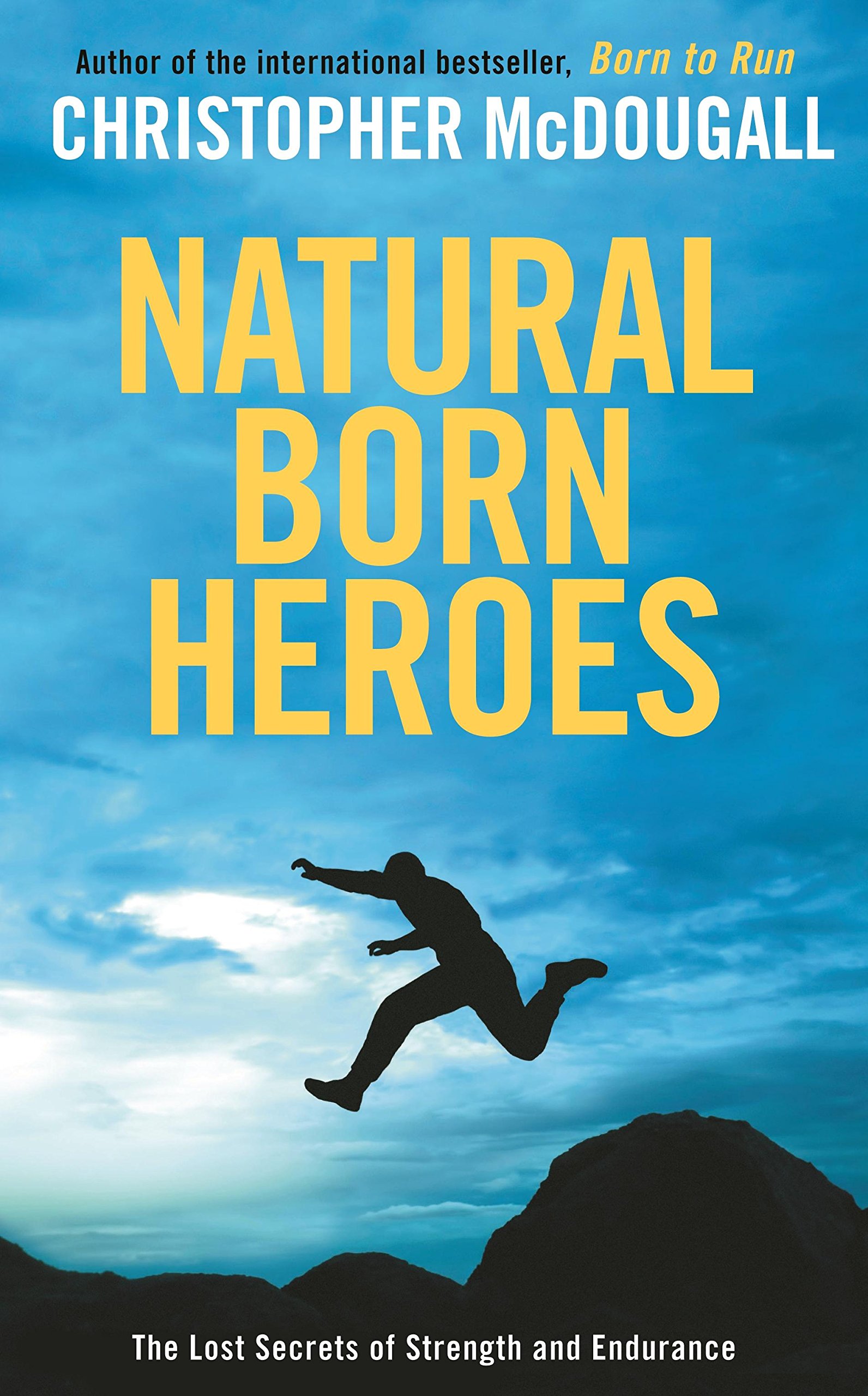
Terrible Reviews: Natural Born Heroes


I’ll admit it, I’m a fan of Christopher McDougall.

I can’t say he’s the most artful of writers, but he spins a good yarn, and he has a way of taking subjects that could easily get very preachy, and packages them in a straightforward, simplistic, trust-your-gut kind of way that makes it all very believable.

McDougall is better known as the author of the incredibly popular Born to Run, which would most certainly crack my top five non-fiction books (not that I’ve actually made that list in my head or anything) and might crack my top five books period. When I saw he had a new book out that attempted to give mountain climbing, street fighting, parkour and other natural feats of strength the same treatment that he gave to distance running in Born to Run, I was sold immediately.

Natural Born Heroes is kind of two books in one. It’s the tale of a daring feat of espionage during World War II on the island of Crete, but it’s also a treatise on diet, exercise, and the virtually immeasurable limits of human strength and endurance. The author himself acknowledges in his notes that these two ideas have sort of been smashed together and run through the blender. While exploring the two ideas separately, he realized that there was quite a bit of overlap, and so: one book.

I liked it, but I think I might have liked it better if I hadn’t read Born to Run first. And maybe that’s my fault; it’s not entirely fair to judge a book based on other books, but in this case, it’s hard not to.

Let’s get down to some word salad (see, because in this book and in Born to Run, McDougall makes a big deal out of all the salad he eats):

The Good:

So, this book is two concepts, right? Those two concepts are excellent, and treated excellently.

I’m not much of a history guy, but the story of the kidnapping of a German general during World War II is fascinating. The tale is audacious from its inception, harrowing in its execution, and compelling from start to finish. Some of the characters bleed together a little bit (there are so bloody many of them, I felt overwhelmed at times), but on the whole the narrative portion of the book is cogent and satisfying.

Then the health and fitness part: this stuff is outstanding. I’m a little biased in this regard. In my recent stabs at fitness (in fact, let’s call them less stabs and more fumbling for light switches in a dark hotel room) I’ve come independently to many of the same conclusions that McDougall makes in this book. To wit: gyms are a waste of time, and natural, functional exercises and movements are not only more efficient but actually make you stronger and more useful in the world. (Think zombie apocalypse. Who do you want in your crew: the musclebound dudebro who can squat 500 lbs and squish your skull with his biceps, or the wiry guy who can scale walls, run for an hour at a decent clip, and deliver a knockout punch with little or no warning? On second thought, maybe you don’t want that guy; if things go sideways, he’d sucker-punch you and leave you as bait.) Further: Most diets are a load of hot garbage. Calorie counting and low-fat foods and all that are for the birds. Eat more vegetables. Eat protein. Stay away from processed sugars and carbs. Profit.

Person, Silhouette, Jump, Male, Young, Sky, Sunset, Joy

In short (too late!) the creamy center of the book is exactly as advertised, and it makes for really compelling reading (I highlighted and dog-eared the heck out of the book so I can go back through it and look up a bunch of the fitness concepts). It sent me scurrying to youtube more than once to look up things either directly or indirectly referenced by the books (like this and this, for example), which made for a neat experience while reading.

The Not-so-Good:

As much as I liked the two foci of this book, I have to quibble. Rather unlike peanuts and nougat, the narrative and the fitness informational do not mesh well on the palate. It feels more like jalapenos and chocolate. (Yeah, I know people eat that crap, but they shouldn’t.)

Maybe it’s because there’s such a broad focus on the fitness concepts (first it’s boxing and pankration and Wing Chun, then it’s parkour and mountain climbing, then it’s fascia and elastic motion, then it’s foraging for herbs in Central Park), or maybe it’s because there are so many damned characters and threads in the WWII story (The story follows mainly Paddy and Xan, the guys at the heart of this abduction attempt, but is also awfully concerned with a veritable host of people who pop in for a chapter to dispense a bit of knowledge and then are never seen again), but the book left my head spinning. It became downright hard to read, sometimes, which is basically a death knell for a novel. It’s a shame, too, because individually the two halves of the book are so strong, but together, like overlapping radio waves, each one interferes with the other’s signal.

For my money, if these two concepts were two separate books, then each of those books would have been stronger in its own right than the swirled mishmash they’ve become in this book.

Yarn, Colors, Tangle, Thread

I have another quibble with the fitness portion of the book, which is that it’s a shotgun blast of information: it hits hard up close, but it dissipates quickly and becomes useless the farther you get from your target. (I have never fired a gun. Thanks, first-person-shooter video games!) I came into the book … expecting isn’t quite the word, because I try not to read with too many expectations … but hoping to learn a lot about natural movement and the merits, strengths, and methods of some of the techniques described within. And … those things are there, but it’s barely a skimming of the surface.

I know, I know; this isn’t an instructional text. But I feel like with so many of the things discussed in this book, all that I can really say I know about them is: they exist. McDougall spends a lot of time talking about the ancient Greek art of pankration, for example, but the only technique he describes in any detail is a heel-kick (the “THIS IS SPARTA” one from 300). Even there, he talks about the force it delivers, but says little about how it’s achieved and how much practice is required to master it.

And for all the book has to say about diet, there’s very little said about the things which would be reasonable to eat. It’s not unusual for books that talk about diet to have … I dunno, an appendix listing, at the very least, a few easy-to-make meals, or a sample shopping list or something? I guess I wanted that portion of the book to be a little more actionable, though again, I may have been wanting too much.

The WTF:

As if the two halves of the book weren’t enough, there’s a third story thrown in there, which is a framing device for the one and connective tissue for the other. That story joins McDougall in his quest to follow in the footsteps of the abductors, and it is in the following of that thread that he learns about these fighting arts, practices parkour, and tracks down a dietary swami.

Of course, none of this is linear — how could it be? — spanning, as it does, several years of research across no less than three continents. So the book jumps from a moment in the abduction to McDougall’s firsthand experience with a rabid historian to a treatise on how the jagged rocks of Crete forced the ancient warriors and goatherds to adapt the way they moved and then back to the abduction and … see, that right there? That dizzy feeling you’re getting? The book does this to you every fifteen pages or so, and it’s disorienting as hell.

Greek God, Zeus, Mythology, Sculpture, Statue, Myth

Then, amidst all of this historical fiction and apparently well-researched fitness credo, there’s a ton of allusion to Greek myth and legend, up to and including the recent bastardization of those myths vis-a-vis the Percy Jackson series of books (which are fine for what they are, but they’re hardly canon and don’t really deserve a place next to the proper myths of Theseus and Odysseus, for example). These moments seem misplaced and not helpful when they crop up. In fact, they seem like remnants from an earlier draft when they might have been a more central focus of the book, but like a vestigial tail, no longer serve any particularly useful function.

The Verdict:

The book was frustrating at times, and took me longer than a book of its length would usually take me for that reason, so it’s hard to give it good marks. For all the natural movement sections left me wanting more, however, those sections had me riveted and kept me coming back. In fact, the movement focus of the book was interesting enough to make me care about the historical portion of the book, which is saying something in my case (the last time I did any extracurricular reading about historical events, outside of awesome freak occurrences like Tunguska, was … let’s see … yeah, never). So that’s something.

If you read Born to Run and enjoyed it, you may well enjoy this, though it will probably not leave you quite as satisfied. Born to Run is a far superior offering in many respects. It is focused where this novel is scattered, it gives depth where this novel dips its toes in the water. Still, this ain’t bad.

I give it three out of five bare footprints in the sand.

Sand, Footprint, Water, Beach, Coast