Terrible Reviews: The Hobbit: It’s Over (Rest In Peace)


Time, now, to take on the final chapter in Peter Jackson’s epic, six film series.

What’s that? Oh. The … final third of… the first book in JRR Tolkien’s epic … no, wait, The Hobbit was just one book written long before the epic that would come later. Damn. Let’s just get on with it.

Spoiler alert: this post got longer than I really intended for it to be, but I stand by all of my critiques. There’s a proper spoiler alert ahead, which makes this a spoiler alert for the spoiler alert. (This is how loopy the review gets.)

I saw the movie on opening weekend. I really wanted to see it. By the end, I was glad I had seen it, in the same way you’re glad that your long-suffering pet, who had been in pain, unable to eat or play or survive, just got put down at the vet. You’re not happy about the experience, but at least the worst is over.

Let’s start with the good (and I’ll keep this brief): the movie is gorgeous. Let’s not speak about the film being in 3d, as it’s completely unnecessary. I saw the 2d version and it was as gorgeous as you could ask for. But saying that a Hobbit film is gorgeous is a bit like saying that outer space is a little sparse. It goes without saying. Peter Jackson, level what complaints you will, knows a thing or two about presenting an epic fantasy world, and as usual, he does it proper. And the acting jobs are all pretty superb as well: Freeman is charming as ever as the titular hobbit, and all the others blah blah blah ENOUGH.

There was so much in this movie that was frustrating, I’m only going to be able to hit the high points before I need to light up a pipeful of shire-weed and rub my illustrated copy of The Hobbit on my face to dull the pain.

By the way, sound the klaxons and cover your eyes, there be spoilers ahead.

The best thing about the trilogy is over before the opening credits.

Smaug dies in the opening sequence. To be fair, he dies well before the end of the book, too. I knew it was coming, but… god, the dragon was so beautiful, so well done, and it’s there, wreaking hell and spewing death like a lawn sprinkler loaded up with agent Orange, and then it’s just dead. Yes, I know, the end of the book is not about the dragon. That’s fine. But it would have been so easy to have him dead at the end of the 2nd film. Why not have him die at the end of the 2nd film? So that that film could end on a cliffhanger, of course. Why do we need a cliffhanger ending? Why, to keep fans coming back to see the 3rd film, naturally.

But there’s a problem with that logic. If you’ve sunk your hard-earned dollars into seeing the first two films (and, let’s face it, the original LOTR trilogy, so really the prior five films), you were already going to see this movie. Cliffhanger or no. Hell, the preview could have showed Bilbo and Thorin playing Chinese Checkers and Gandalf napping in his pointy hat and we’d still have gone to see it. Ending on the cliffhanger, and thus being trapped into starting this movie in the most anticlimactic way possible, was pure cinematic masturbation. “Hey, everybody else ends films on cliffhangers, we should do it too!” Except you don’t have to. Let the films stand independently rather than stitching them together like so many random body parts with the thin thread of one stretched-out incident. Seriously. The action of this film is enough in its own right without having the death of Smaug tacked on before the opening credits even roll. I got so excited to see the dragon again, only to have my heart smashed when Benedict Cumberbatch and his smooth-as-butter digitally-modified voice exited stage left immediately. The cliffhanger sucks, and I’m not even talking about this film. It needs to be put out to pasture. And speaking of overused tropes:

Get ready for an overdose of oh-sharknado-that-character-is-dead-oh-wait-no-he-isn’t.

I hate this trope. I hate it, hate it, hate it the way I hate my oldest, ugliest, meanest cat, minus the part where deep down, I really still love the cat despite all her bullsharknado, because I do not love this trope even a little bit. Maybe, maybe this trope might have surprised people when they pulled it the first few times, what? Back in the sixties or seventies? In the worst of the worst slasher films when that was the only way left to scare the audience? Here’s a goldfingered clue to filmmakers: if a six-year-old in the audience can predict what’s about to happen, you need to do something different. Now, I saw the film almost two weeks ago, so some of the details are fading from memory I’m sure, but in this film alone, BOTH of the big baddies have that moment where, oh, the-hero-has-bested-the-monster-and-ended-the-fight-oh-no-wait-this-is-a-hollywood-movie-where-anybody-can-survive-anything-for-the-purposes-of-narrative-CPR.

Legolas buries a big bad orc under an entire freaking TOWER of some dilapidated castle (we’ll get back to Legolas in a moment) and turns his back, sheathing his oh-so-cool elvish daggers and wearing that I’m-so-cool-I-just-killed-100-orcs-and-my-elf-hair-is-still-fabulous smolder, but WAIT, the orc pops out of the rubble and attacks again. If you were surprised by the orc jumping out of the pile of two-ton bricks as if they were made of papier-mache (haha just kidding it’s all CGI you ninny), then you might also be surprised when the air conditioner clicks on in your house when it was otherwise quiet. OOH SCARY.

Moments later — sheer countable moments later, before you’ve even had a chance to wash that feeble attempt at shock and awe has even had a chance from your palate — Thorin does battle with an even bigger, even badder orc on a frozen lake, and through dwarven cunning, tricks the fiend into crashing through the ice on his way to a drowned, watery grave. Huzzah! We’re even treated to a suspicious-looking Thorin (who himself seems to know what’s up) watching the body of the monster drift away under the ice. The monster is completely still, because you know, that’s what happens when you’re plunged into icy water and you’re drowning, but then there’s a long shot as Thorin seems to decide that the baddie is well and truly dead, just in time for the baddie to erupt through the ice behind Thorin to do battle once more. It’s almost funny, really, the way it insults our intelligence (but, ah-hah, now I see it — we’re already dumb for throwing all our money down this bloated franchise… TOUCHE, PETER JACKSON). First, we’re treated to the so-overused-it’s-idiotic shot of the baddie’s eyes slammed, deathlike, closed, only for them to SLAM OPEN to the dramatic sound of a mime tripping and falling into an orchestra. And the orc shoots through the ice like he was launched out of a cannon. Like… god, just whatever. I can’t even dissect this moment anymore. I’m sad for the people that thought it would be a compelling moment.

And while we’re on the topic of things that might have been compelling but weren’t:

Hey, here’s a badass heroine, just kidding, she’s just a damsel-in-distress who can fight a little bit but still needs rescuing.

I’m going to ignore any analysis of the fact that Tauriel does not exist in the book — nor, for that matter, does Legolas — and, by extension, ignore the insulting-in-its-own-right attempt at a love story between the elf and one of the bumbling dwarves. I don’t even have to go there to tell you how badly this character gets shafted.
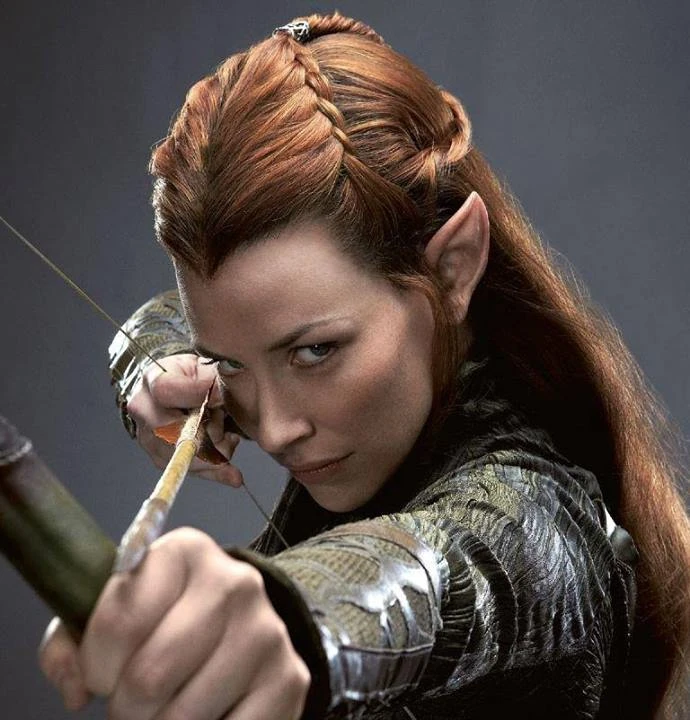
Tauriel is an elf. One of the only female elves, if we are to believe the films, aside from Galadriel, who is a point of analysis for another time entirely, preferably after I indulge in a little shire-leaf. But she’s an elf, and elves in Tolkien’s world are FARGOING AWESOME. They move with precision and grace! They live forever! They can defy gravity and, in fact, all of physics as they fight off hordes of evil demons with nary a scratch! And even though she’s just a girl, Tauriel can do all of that sharknado. She’s the very definition of an anti-hollywood-female-character as she slices and dices her way through the ranks of evil, defies the ridiculous edicts of the men in charge of her world, and joins the cause of the dwarves against the great evil of the land.

In the midst of the fighting, we watch as Tauriel dispatches… it’s hard to say exactly, but I’m gonna say forty or more orcs in the space of just a few minutes. She skewers them with arrows, slits their throats with daggers, runs them through with swords, tosses them from the ramparts with her dainty-yet-insanely-powerful elf arms. At one point, I think she was sipping a cappucino and complaining to her half-human friend about how the dwarf wasn’t responding to her text messages  while clawing an orc’s eyes out with her perfectly-manicured nails, but I might have gotten that confused with another movie. Anyway, she’s a whirlwind of destruction, until the moment when she spies her beloved in the distance, and — gasp and egads — he’s in trouble! And in that moment, the big-bad second-in-command orc pounces upon her from behind and she’s in a fight for her life.

There’s the first problem. Because take, oh, I dunno, ANY action movie with a male heroine, show him cutting a path through his foes, let him see the inevitable love interest in danger. A foe jumps him from behind. The hero will dispatch this idiot with barely a backward glance, and then set about saving the girl. But here: Tauriel gets distracted by her man and suddenly an entire elvish life of hundreds if not thousands of years of orc-slaying training and instinct goes out the window, and she’s getting pummeled by this ONE ORC.

I’m put in mind of Indiana Jones and the Raiders of the Lost Ark. The Nazis have kidnapped Marian and the Ark and are high-tailing it out of town, and Indy has to fight through the crowd. He deals with some hapless denizens through crafty use of his whip and his fists, then the big bad jumps out — a turbaned, terrifying dude with a scimitar the size of El Paso. He growls. He brandishes his sword. Indy is in trouble. Except he’s not. He pulls a pistol and shoots the dude, and turns to look for Marian with boredom curling his lip. Because Indy is a goldfingered man’s-man HERO.

Then, the second problem. Legolas arrives, pulls the baddie off her, and allows her the chance to recover from the beatdown she’s just received. Does she do what a hero — or a soldier — or in fact anybody with a bit of sense would do, and help Legolas dispatch this fiend? No, she flerps around on the balcony pitifully for a minute and then goes off looking for her boyfriend. But this orc was bad enough to give you a run for your money — you don’t think Legolas might appreciate a little hand? (Let’s forget that Legolas is to this series what Conan is to Conan and therefore has no chance of dying, or in fact of being in any sort of danger whatsoever. He kills the beast as described above. But still.) No, she turns her back on a comrade and doesn’t even get the satisfaction of slaying the foe that almost bested her.

Now, again, take any action movie with a male hero. A villain is besting the hero in hand-to-hand, or sword-to-sword, or whatever-to-whatever combat. He’s outmatched. Sharknado, he’s going down! But a well-timed interruption, distraction, or anything to draw the foe’s attention for a moment will present itself and then the hero will overcome the villain himself. Allow a sidekick to strike the killing blow? NEVER.

Again, I’m reminded of Indy in Raiders. He’s on the ropes for real this time, overmatched by a burly, chest-oiled, bald-headed Nazi who has dismissed Indy’s punches without so much as a flinch and put Indy on his ass with a single well-placed jab. Indy stands no chance. But look! A twin-prop airplane is coming about right behind the villain! Now, Indy doesn’t strike the killing blow, but he’s sure as hell involved — he smiles at the guy to distract him then ducks for cover as the propeller grinds him into a fine mist. Funny, but HEROIC.

There’s more, but my fingers hurt.

This is turning into one of my longest posts ever, and I’ve only scratched the surface on this film. I’m going to cut it short here for my own sanity and yours, if you made it this far. But let me set the record straight. I enjoyed the film. It’s a fitting (if long) end to the series, and it does a good job of throwing into sharp relief the tribulations of men faced with a sudden windfall, while also providing an uplifting message about how ultimately, when the sharknado really goes down, people bind together to weather the storm. It’s a good movie. But it’s also full of some of the most head-scratching moments I’ve endured in a film I enjoyed.

But it’s all over now, and there will never be another Hobbit movie. The tale is well and truly told, which means we are now, finally, safe from Peter Jackson. Forever.

What’s that? He’s still making movies?

Damn.

By the by, I was inspired to start thinking about this movie again after reading Myzania’s post on it. She’s kinder to the film than I was. Thanks — I think — for reminding me how frustrated I was by the movie.

Time Out for Reading!


Weird circumstances the past couple days have seriously disrupted the routine, and as a result I’m getting virtually no work done on the novel, nor am I having any particularly useful things to post about here on the blarg.

That’s partly due to the honest-to-goodness fact that my daily schedule is all screwed up and partly due to the fact that there is some heavy sharknado weighing on my mind that I am literally not allowed to discuss.  More updates in a few days when the dust settles.

However, my activities the past few days have left me with some rather large gaps during the day which I’ve had to fill using no electronic devices at all, and since I plan ahead for these eventualities, I’ve gotten to do something I haven’t enjoyed in quite some time: sit down and read.  You know, from a book.  Like in the olden times.  Pages and all.  Bookmarks.  Dog-eared pages and jotting little notes in a notebook.  (Yeah, that’s how I read, I can’t help it.)

In particular, I’m sinking myself into the second in a series by Jasper Fforde, Lost in a Good Book.  The series in question is the Thursday Next series, which follows the titular heroine (a literary detective) as she gallivants in and out of various works of fiction, some renowned, others reviled, in pursuit of her duties tracking unauthorized changes to priceless manuscripts and verifying the authenticity of lost works of Shakespeare.

Now, “literary detective” is a job title which immediately makes me want to fall asleep, but these books are just flat out fun.  They detail a fantastically well-imagined alternate reality in which, to name just a few key differences, ownership of the Crimean peninsula is still in dispute, long-extinct animals have been genetically resequenced as household pets (Thursday keeps an adorable and rare second-sequence dodo bird, Pickwick, in her home), and Gravity Tubes allow anybody to travel to anywhere in the world in the space of just over forty minutes.  If that sounds whimsical, rest assured that I’ve only just slipped you the tip of the taco.  Fforde weaves the details of this fantastical world so thoroughly into his narrative that I never find myself questioning how things work; rather, I bounce happily along for the ride.  In fact, the alacrity and gusto and sometimes the offhanded way in which he creates the tiniest of details in this world is so charming and effective that it makes me feel woefully inadequate as a writer.

To wit, this passage from page 112 of Lost in a Good Book:

“Looping” was a slang term for Closed Loop Temporal Field Containment.  They popped the criminal in an eight-minute repetitive time loop for five, ten, twenty years.  Usually it was a Laundromat, doctor’s waiting room or bus stop, and your presence often caused time to slow down for others near the loop.  Your body aged but never needed sustenance.  It was cruel and unnatural — yet cheap and required no bars, guards, or food.

He tosses off this explanation like sluicing water off the hood of a freshly waxed car, deftly weaving the callous cruelty of the monstrous corporation together with the unfathomable scientific capabilities of the universe and, oh, just for fun, offers a clever explanation for why we always sit around checking our watches (sharknado, I just dated myself) or rather our cell phones in waiting rooms.  And he does this every three or four pages.

I’m not here today to offer a review of the entire book, let alone the series.  I haven’t yet reached the point in the book where somebody does get Looped, though it’s not necessarily an eventuality I expect.  It’s simply one example out of hundreds that detail the possibilities of an alternate universe that plays fast and loose with the laws of physics.  Fforde is also unrelentingly British and has that delightfully dry wit, so the books scratch that Douglas Adams itch that seems so untameable.  (Untameable?  Untamable?  Spellcheck doesn’t like either option.)

In short, if you’re a bookish sort, you should be reading Thursday Next.  Possibly you could read Thursday Next on Thursday next.  (I think the man must have been chuckling sideways at himself with just about every character name in the thing.)  And no, it’s not a particularly new series — Good Book came out in 2002 — but who cares?  It’s brilliant and clever and whimsical and ridiculous all at once.

The last several books I’ve read have been so heavy and dark and drear that these books have felt like a much-needed B12 shot.  Anybody else out there reading books that make you laugh?

Things Writers Need — The Hemingwrite


I’ve just seen a thing.

I don’t know what to make of it.  I’m very much of two minds.

I’ve had my say about typewriters before.  I think they’re cute and quaint and entirely impractical for any writer to be using to do any real writing in the — and I say this with no irony whatsoever, except for the implicit  — modern era.  I stand by that wholeheartedly.  When you consider the gamut of writing devices, a machine that uses paper, has no means to erase or edit on the fly, and that cannot multitask in any way, shape, or form, is simply an inferior alternative to any device which can, you know, backspace, or fit in your pocket, or at least your carry-on.

Don’t get me wrong.  There’s a certain romantic nostalgia about typewriters.  The sounds they make as you click away at their keys are soothing and hypnotic — much more so than the impersonal muffled thumps that issue from the plastic construction of a laptop or a multi-function bluetooth keyboard.  And, you know, the greats wrote on typewriters, or something like that.  So there’s hero emulation thrown in there to boot.  I see the draw, even if it doesn’t measure up to even the flimsiest of word processors.

But then tonight, I see this.  The Hemingwrite.

render_low

It’s a word processor stuffed into the body of a typewriter analog.  It syncs wirelessly and automatically with backup services like google docs and Evernote (which I love).  It has weeks and weeks of battery life.  It’s about the size of a very large book, or a very small chessboard.  It’s adorable.  And all it lets you do is write.

It looks like much of what I love about WriteMonkey (my drafting software of choice) literally crammed into a box that lets you write without the distractions of the wily internet and whatever apps you have chiming and sucking your life away.  And my Id-Writer stops slavering, looks out through the bars of his cage toward this unassuming little box, and ponders.

I can’t decide if I love or hate this idea.

The pendulum swings in favor of this thing initially.  It’s undoubtedly brilliant.  There are, I have no doubt, scads of writers and would-be writers, their heads clouded with that romantic image of Hemingway bent over a buzzing machine, the keys clattering into the night, who will happily throw money at the manufacturers of this thing just for the chance to ape the greats while still maintaining the creature comforts of cloud backups and wireless syncing.  The Hemingwrite website, which has only been up for a few months, overtly states that the creators are overwhelmed by the response already, and they’re not even past the prototyping phases yet.  This thing is going to sell like crazy to people wanting one for themselves, let alone as gifts for the writerly types out there.

But is it necessary?  I mean, my laptop automatically backs up my work as I write and is just as portable as this little gadget.  It also allows me to browse the web, watch movies, play games, and you know, anything else you can do with a fully-powered computer.  For that matter, it allows me — with the use of the proper programs — to have the same uninterrupted, distraction-free writing experience that the Hemingwrite seeks to provide, minus of course the vaguely romantic notion of typing on a typewriter that’s not really a typewriter.

But there’s something to that, isn’t there?  The feel of creating on something that’s not a do-it-all magic box.  They say you should dress for the job you want, not the job you have (though that’s perhaps a bad idea if you’re a businessman who wants to be an ice fisher), and doesn’t this gizmo allow you to advertise to the world that “I AM A WRITER” in a way that no simple laptop can?  And isn’t writing all about being in the proper mindset to create?  By extension, then, if this tool helps you, in any small way, to get a little bit closer to the zone, isn’t it worth the trouble?

And then my pendulum swings the other way again, because don’t I — don’t we, as Americans (make no mistake, this is for Americans, much as I hate the “we as fill-in-the-blank” construction) — have enough stuff already?  Part of the romance of writing (and I’m overusing the word “romance” in this little entry, I now realize, but fargo it, it cuts both ways) is the simplicity of it.  From the blank screen, the blank page, the flashing cursor on the screen, I craft worlds and people and plots and MacGuffins and really wild things.  If I’m a writer, I already have a computer or laptop to help me do those things.  Do I need another thing on my desk to help me do the same things?  I’m not sure I do.  In fact, I’m pretty sure I don’t.  I have enough of a headache working on two different computers in two different settings; I can only imagine the frustration of getting all keyed-in and in love with this little machine and then having to haul it back and forth from home to work.  And then forgetting it and having to work on my laptop anyway.  Or finding room for it on my already cluttered desks.  And justifying to myself and my wife the existence of this thing which doesn’t really do anything for me that the stuff I already had isn’t capable of doing.

Then again, it looks like they’ll offer it in Georgia Bulldog Red.

red_render

I think it’s a fascinating little thing.  I’m sure it will help writers if only in a Placebo Effect, I’m-becoming-a-better-writer-because-I-feel-like-a-writer kind of way.  But the more I think about it, the more it feels like too much novelty, not enough practicality.  I think I’d love to test-drive one, but I definitely can’t see buying one for myself, unless, when they finally get around to selling these things, the price tag ends up in the realm of the ridiculously low.  Based on the hype around this thing, though, I’d be shocked if it goes for less than $80, and I even think that might be optimistic on my part.

What do you think?  Am I being too harsh on the little Hemingwrite, which for all intents and purposes hasn’t even been born yet?

The New Batch of TV Shows Is So Depressing


I’m going to embarrass myself (again) and say that we watch a lot of TV in my house.  Too much, really, for a couple of otherwise intelligent adults.  Now, we read a lot too, but most of our “together time” is spent watching one thing or another on the good ol’ boob tube.  Needless to say, we are enthusiastically anticipating the return of some of our favorite shows and curious about the wave of new entrants to the fling-advertisements-at-our-face race.  We’ve seen some of the new pilots, and the general consensus so far?

Network TV is trying too hard.

I’m going to talk mostly about The Red Band Society, because it was the guiltiest of the parties, but all the shows I’ve seen yet are coming up a mess in one way or another; usually by dint of insulting their audiences.

First and foremost, RBS is trying to capitalize on the The Fault in our Stars dollar by shoving cancer kids in our faces and counting on that fact alone to tug at our heartstrings and keep us tuned in.  A sympathy play as empty as the heart of a god that would allow kids to get cancer.  There’s nothing wrong with trying to ride the coattails of a successful product, but, I mean, at least embellish upon the idea.  TFIOS resonated with readers (and subsequently, viewers) because of its compelling, flawed, sassy but ultimately likable and admirable protagonist and her relationship/obsession (resessionship?) with Cancer Jesus.  RBS takes that trope (compelling, flawed, sassy) and paints a caricature of it.  Bitchy girl is so bitchy she’s unredeemable (but I’ll bet my no-longer-attached-left-nut she will find redemption, oh, somewhere toward the end of season 1, but slip back into her bitchy bitchiness just in time for season 2, should the show survive that long).  Sassy guy has every answer for every situation ever, knows everybody and knows how to get what he wants from everybody, but he’s too smart for his own good.  Horny black teen is horny and black and a teenager in the most transparent of ways (“awkwardly” propositioning his new nurse since he doesn’t want to die a virgin in a scene so painful and forced that … well, the point of all this is that it insults its viewers, so you know, THAT).  Uptight girl is uptight, but she OH SO DESPERATELY SECRETLY WANTS TO BREAK THE RULES.  And the protagonist (how is he a protagonist without being involved in any of the action?) watches (???) all this unfold from the depths of a coma in which he can hear everything around him, and boy has he learned a lot about life!

These are cardboard cutouts of tired characters who have appeared in every teen story we know since FOREVER, and they all have cancer and they all fight ferociously to prove who they are at every stage and they all spout pseudo-philosophical drivel in an attempt to sound deep that ultimately just left us scratching our heads.  Example:

Put-upon Doctor:  I guess the word “no” isn’t in your vocabulary?

Cancer Kid:  If it was, would I be asking you to say “yes?”

That’s not clever, it’s an idiotic non-sequitur.  And EVERY KID HAS A LINE LIKE THAT.  That’s not character development, that’s a sledgehammer with the word “character” scratched in the side by a rusty penknife.  And don’t tell me, “well, of course the characters are simple, it’s aimed at a teen audience!”  It’s going into the Prime-time lineup.  Glee is a show ostensibly for teens, but it has tremendous viewership outside of that demographic (or HAD, until the sharknado writing became super-sharknadoey writing after the second season).  No, teens might be a focus of the show, but they are not the only audience intended for the show.  But even if they were, that doesn’t change the fact that even teenagers are tired of these cookie-cutter characters.  Glee was a bag of chocolate covered potato chips — an interesting treat, but not something you want to eat a whole bag of.  RBS is trying to be a bag of chocolate covered potato chips with a dead frog in the bag for good measure.  They’re counting on the fact that the kids have cancer to bring weight in and of itself to a show as hollow as anything on TV, and it’s not going to make me want to eat a dead frog.

Also?  And this is not just RBS, but all the pilots we’ve watched yet — Narration.  God, gag me with a hammer over some narration.  Coma kid narrates all the comings and goings of the hospital from his coma.  (How does he know what’s going on in the basement, by the way?  Did everybody tell him everything after he woke up?  Isn’t that sort of spoiling the entire show for us?)  Some female voice narrates every facet of the female protagonist’s life on A to Z.  It’s not the female lead’s voice, which is odd, because the female lead is grown and theoretically should not need an “old person” to provide her voice in flashback, so who is she?  If she’s a character who will appear later in the story, why not introduce her in the pilot?  If not, why have a separate voice narrating a character’s life?  This show, also, suffers from trying-too-hard-to-be-significant disease in its dialogue: “Their relationship will last for three hundred, twenty-two days, seven hours, and fifty-six minutes.  This is their story, from A to Z.”  It’s cutesy the first time you hear it in the opening, but then you hear it again as the show closes out and you realize it’s going to keep happening and I just want to reach for a hammer.

Screenwriters:  If the action is strong enough, YOU DON’T NEED A NARRATOR.  If the action is not strong enough, WRITE BETTER ACTION.  The only time you need a narrator is if there’s some seriously deep behind-the-scenes stuff developing, and even then the narrator should be hamstrung and chained to a post with a five-foot leash.  Narration KILLS stories.  And while I’m on the A to Z show, are you just going to make 26 episodes?

The only show that’s shown any promise yet, to my mind, is Selfie, and even that promise is dubious.  I found myself wondering how I was supposed to identify with and root for a scummy shell of a human being, but at least the show had the good sense to poke fun at the shell and make the show about redeeming that person.  It’s a good message for our technologically-advanced-socially-retarded society, but I wonder whether there’s any longevity in the concept.  I fear that, more likely, it will splash around in the waters of social commentary for a little while and then get sand in its britches when it realizes that depth is hard and move to the kiddie pool with the other sit-com-rom-com dropouts (looking at you, A to Z).  It does, however, have that girl from Doctor Who, so that’s a plus, though hearing her speak with an Americanized accent seems wrong somehow.

To be fair, I’ve not looked at any of the new dramas this year, but do I need to?  More crime procedurals, more gritty tales of outside-the-box, not-by-the-book antiheroes with hearts of gold?  Is there anything coming out with a legitimately original concept and a legitimate chance at longevity?

It’s all so depressing.  Why can’t we have a show like Sherlock being produced in this country?  Where is the next Breaking Bad, the next Dexter (prior to season 3)?  Where, in short, is the next show I can get lost in?

Do We Hate Women This Much?


My wife and I don’t have cable.

I view this as a good thing because gone are the nights of watching something just because it’s on.  (Oh, a 36-hour marathon of Law and Order, Extra Sassy Unit?  SCORE.)  If we want to watch something, we have to seek it out.  But it’s also a bad thing, because there are times when there is a serious dearth of decent entertainment to be had, and that time is the summer time.

Anyway, if you, like we do, get your programming on a streaming device, you know the glory of the commercials that you see five, six, twenty times in an evening.  The computer tailors ads to your interests and funnels them into your eyeholes, banking I suppose on the law of averages; if I see the ad enough times, I’ll just go ahead and buy / watch / ingest the damn thing.  One thing I won’t ingest, however, is the show on the advertisements of the last couple of weeks, Celebrity Wife Swap.

A brief sidebar.  As a creative type, I think — and it may be wishful thinking, I’ll grant you, but that won’t stop me thinking it — that Reality TV may have run its course.  It’ll kick around and thrash in its grave for a little while longer, and we’re certainly not done with the likes of rinkydink shows like Duck Dynasty or Pawn Stars, but the days of Reality dominating the discussion are over.  Recent ratings of powerhouses like American Idol and others tell me that.  The fact that a bizarre, quirky, what-seems-like-it-should-be-a-niche-diversion show like The Big Bang Theory can run the show when it’s airing tells me that.  But that doesn’t stop the Reality ship from setting out to sea again, like the Exxon Valdez transporting its load of hey-you-need-this-stuff-for-real on a crash course with your unsuspecting occipital lobes.

/soapbox on

I won’t be watching Celebrity Wife Swap, in the first place because it’s just another Reality show putting “ordinary” people in “everyday” situations and I have real fargoing life if I want to see that.  But this show has really struck a nerve with me, and I’ve not even watched an episode (I don’t even know if it’s a first run or if it’s back for another “unbelievable” season).  To be clear, it’s struck two nerves.  One: can our entertainment-obsessed society delegitimize women ANY MORE?  Two (and it’s a far lesser concern than the first point, but it still irks): it seems on the surface like the worst kind of celebrity worship extant.

Let’s start with marginalizing women.  It’s not bad enough that our “great” nation’s highest court has just placed the rights of intangible corporations above the rights of women, or that women’s roles in narrative entertainment are always viewed and evaluated through a male gaze, but now for your evening entertainment, we have Wife Swap, a show whose very title is working to shoot Feminism in the kneecaps in between adverts for spaghetti sauce and overpriced luxury sedans.  If you’re a regular reader of the blarg here, you know I’m an English teacher, and as an English teacher, I tend to fixate on language.  The way things are said matters.  Think about the LANGUAGE OF THE TITLE OF THIS SHOW.  Celebrity Wife Swap.  “Swap.”  What do you swap?  Property, first and foremost.  The searing I-can-hardly-call-it-subtext-with-a-straight-face subtext of the title says that YOUR WIFE IS YOUR PROPERTY.  Brilliant, I knew there was a reason I married my wife.  Now I remember, it’s because I got sixteen acres of land and a couple of donkeys into the deal.  Wait, no I didn’t, because it isn’t THE FARGOING DARK AGES ANYMORE.  The last time people were considered property in this country, I’m pretty sure there was a pretty significant disagreement over it, and that disagreement reached the conclusion that hey, no, people aren’t property.

To dig further into the entrails of this fetid carcass of a show title, what sort of property do you “swap?”  The kind of property that has no practical value to you anymore.  The toys that you’re done playing with.  The intrinsically worthless “collector’s items” that you’re hoarding for no reason other than that they’re “exclusive” or “limited edition.”  “Swap” is a word most at home between preteen boys and their baseball cards.  What’s that?  Dated reference?  Sharknado.  Um… Pokemon cards?  No?  Damn… look, the point is, you swap something because you don’t want it anymore.  So your wife is your property, and you’re done playing with her so your neighbor can have her for a while.  Brilliant, ABC.  I mean, the housewives that are watching this steaming pile of horse turds are probably past the point of redemption, so I’m not worried about them, but what about the next generation of women in this country?  That’s the message we want to send on NETWORK TV, of all things?  It’d be one thing if an obscure cable network were showing it to garner some viewers, but this is a broadcast network.  We have to do better.

The other point, here, is much more of a personal one, and it’s one of celebrity worship, which is one of the most useless forms of idleness and of opiating the masses that I’m aware of.  I understand a fascination with celebrities… to a point.  They star in your movies and TV shows, they run the touchdowns, they lounge around inheriting hotel fortunes.  Bully for them.  By all means, watch the celebrities in your movies and TV shows, watch them run the touchdowns, watch them do whatever the likes of Paris Hilton and Kim Kardashian do WHEN THEY’RE DOING THE THING FOR WHICH THEY ARE FAMOUS.  As soon as you start wasting your time worrying about what Ryan Gosling has going on in his personal life, you’re essentially saying that your own life is less interesting to you than the life of somebody you will never meet.  Ultimately, celebrities are just people.  On one level or another, their lives are as mundane as yours and mine.  When we (and by “we” I mean people who are not me, because I don’t go in for that sharknado) live vicariously through celebrity, we give up a bit of ourselves, and that is really, really sad.

So what’s the point?  The point is (and I’m conjecturing, here, because again, I’ve not seen an episode and I don’t plan to) that Celebrity Wife Swap is going to show you some of your favorite “celebrities” and put them in the ridiculous situation of stepping into another family’s life for a few days for the purpose of your amusement.  This is idiotic thinking of the highest order.  One family’s life is not like another’s, OF COURSE there will be conflict and misunderstanding and argument about what should be done.  It doesn’t take celebrity to make that situation any more compelling (and here I say compelling not in the sense that it’s actually compelling but in the sense that the network execs think we’ll just HAVE TO WATCH IT).  What, then, is wrong with putting celebrities in this situation?  Because it’s just an iteration of knocking down the other guy to make yourself feel better about your life, which is lazy and lame and sad.  “Oh, look at how silly *insert celebrity name* looks trying to deal with *other celebrity name*’s wife, MY LIFE IS SO MUCH BETTER THAN THAT.  God, I feel good about myself.”  No.  Don’t.  Begrudging somebody their success is just being selfish.

You might argue that the show is just a bit of frivolous fun, that I read too much into it.  Maybe so, but if you want an idea of how screwed up a society is, look at what they do for fun.  Roman gladiator arenas, anybody?  Greek debauched wine-fueled orgies?  TV is possibly our nation’s greatest escape, and the things we PUT on TV and the things we WATCH on TV say a hell of a lot about us.  In short, if you’re watching the show, you should be ashamed, because you’re telling the network that this is the kind of thing you agree with.  That is, you agree with trading women like cattle and with watching the lives of other people rather than living your own.

/soapbox off