The Prisoner’s Dilemma, Egomaniacs, and the 2016 Election


There’s a simple thought experiment in game theory known as the Prisoner’s Dilemma. Perhaps you’ve heard of it:

Two criminals are apprehended on suspicion of a crime and separated so that they cannot communicate with one another. The police know that both individuals are involved in the crime, but not in what capacity; therefore they offer each prisoner a deal. Rat on your friend and you will go free while he gets five years in prison, or remain silent and get one year in prison. If each prisoner rats the other out, however, both prisoners will get three years. Each prisoner being offered the same deal results in the following outcomes:

A rats out B, B stays silent: B serves five years, A serves zero. Total: 5 years in prison.

A stays silent, B stays silent: Both serve one year. Total: 2 years in prison.

A rats out B, B rats out A: Both serve three years. Total: 6 years in prison.

A stays silent, B rats out A: A serves five years, B serves zero. Total: 5 years in prison.

It’s a simple and perhaps unlikely scenario, but it shows the obvious benefits to working together and the disadvantages in being selfish. The logical thing — if we assume that time spent in prison is a bad thing and we want to minimize the damage to ourselves — is to always, ALWAYS take the team play, staying silent and serving one year while counting on your partner to do the same. (Staying silent also ensures that you won’t have an angry, embittered ex-friend coming after you when he gets out of prison in five years.)

In practice, though, it doesn’t work out that way, because — spoiler alert — we aren’t always logical creatures. In fact, even the best of us are egotistical in this problem. To many, the chance of getting off scot-free blinds them to the fact that their partner is likely thinking the exact same thing, so they turn on their friends in a heartbeat. Or, an even more cynical approach: they know (or fear) their friend will take the deal and rat, so to avoid getting beaten to the punch and serving five, they rat first. Either way, the Prisoner’s Dilemma gets resolved in a deeply illogical and counter-intuitive way. If the prisoners hope for the least unpleasant outcome, they should stay silent, yet their desire for the least unpleasant outcome is exactly the reason they do not stay silent.

The team game is a winning strategy. The individual game, the selfish game

donkey-1062669_1280

So. What does it have to do with the election? I’m glad you asked!

Donald Trump is closing in on the Republican nomination like a wolf stalking a wounded squirrel. If things proceed on their present course, he will be the nominee, no question about it.

This, if you’re a Republican, is probably viewed as a bad thing. (Maybe not so much if you’re not; I don’t think there’s any way he wins the general, if he becomes the candidate.)

The remaining candidates, then, face a dilemma. They must decide what’s more important: an individual victory, vis-a-vis their own path to the presidency, or a party victory, vis-a-vis dropping out of the race and forming ranks behind one of their competitors.

The correlation isn’t a perfect one, but it’s pretty darn close.

You can insist that your opponents can’t win and that you’re the one to beat Trump, hoping your opponents will drop out and preserving your shot at the presidency. (The partner serves five, you serve zero.)

Or you can meet with your compatriots, choose a champion to fight against Trump, and concede your own chance. (Everybody serves one year, except for one lucky guy.)

Trump is winning a lot of support: taking states in last night’s primaries with as much as 40% of the vote. 40% is a plurality, but not a majority. The other guys are scrambling and stomping on each other for 25, 30 percent, or scooping up the scraps for 6 and 7. The difference is, people either love Trump or hate him. His 40%, if he dropped out, would probably not throw their support behind another candidate, nor is it likely that if another candidate dropped out, their supporters would jump on the Trump train. Supporters of other candidates don’t (I think) feel nearly so do-or-die about their guy, and will probably take the party candidate, whoever it is — especially if their first choice throws his support behind another. In other words, I can see Cruz supporters going for Rubio if Cruz were to drop out much more easily than I can see them going for Trump.

The solution? The Republicans need to cut the crap and form up behind one guy. If the candidates in the race sit back and take a hard look, it’s not hard to see a couple of candidates that need to go yesterday. Then the ones left standing need to have a good hard talk about who can possibly win an election in November.

But let’s not forget (as if we needed reminding) that we’re dealing with politicians. Egomaniacs to the stars. They know exactly what the situation is: a Republican field of five candidates ensures a Trump nomination. But each one apparently still believes that he (and none of the others!) is the guy to beat Trump. So you’re going to see each of them calling for the others to drop out of the race for the good of the party.

But none of them is going to drop out, because that would mean a personal loss.

Give up my shot at the presidency? Nonsense. The OTHER guys should drop out — this is MY race to win!

Everybody rats each other out, and everybody loses.

Except for Trump.

Prison, Jail, Detention, Fence, Wire


The Weekly Re-Motivator: The Writer’s Diet


Pizza, Lunch, Meal, Food, Baked, Italian, Sliced

I remember a time when I was in college, when money was tight, that I literally ate nothing but pizza for about four or five days. Breakfast, lunch, dinner. I was working at a Papa John’s doing delivery at the time, and there was always extra pizza left over at the end of the night which we’d take home. It was a college student’s dream (free food, say no more), and it almost ruined me for pizza.

Let’s clarify: I love pizza. Maybe it’s the simplicity, maybe it’s the grease, maybe it’s the geometric perfection of a perfectly-crafted pie. Time was when I could eat an entire pie by myself, but (probably for the better) those days are long past.

So to have nothing but pizza for almost a week is one of those things that maybe sounds like a good idea before you actually try it, like a juice cleanse, or a trip to the beach with your two sub-preschool-aged kids. The beginning is fine, maybe even fun. But before long the monotony sets in, then the actual physical discomfort, and before very much time passes at all, you realize what a terrible decision you’ve actually made, but there’s no way out.

By the end of the week, I felt ill, with terrible whanging headaches. I didn’t feel like getting out of the house at all; I had to force myself out of bed for class and work. My friends said I looked terrible. I believed it. I had put on three or four pounds gorging myself on pizza just because it was there and it was free. Needless to say, when my paycheck came in, I rushed to the grocery store to pick up a more equitable spread of staples for the college student (Ramen noodles, cereal, peanut butter and jelly … you know, the healthy basics).

Short of the actual physical difficulties you can cause yourself eating basically nothing but bread and cheese for days on end, the boredom and monotony are even worse. We humans may be creatures of habit, but as has been said before, variety is the spice of life. Until they start selling Soylent Green, our physiology dictates that we need a varied diet. You can’t get everything you need from just one source.

So what’s all that got to do with writing?

Pretty much everything, actually.

The monochromatic writer is as boring (and possibly as hazardous to your health) as an all-pizza diet. The writer owes it to himself to consume a varied diet of literature, as well as to serve up a spread that satisfies a bunch of different tastes. Both in the form (novels, short stories, plays, poetry, or even blogs) and in the substance (the genres, the types of characters, the tone and timbre of the stories).

To focus only on novels is to neglect the elegant brevity of the short story. To write only poetry robs one of the nuance of a finely crafted dialogue.

And if you only read in your genre, you’re sealing up the door of your own echo chamber. It’s much more interesting than reading horror over and over again to read science fiction, explore mysteries, go galloping through YA or coming-of-age stories, and weave into your own writing the little gravelly bits that stick to your brain from those other stories.

Or, you know, you could just eat pizza all the time.

Just don’t come running to me with your blockage issues.

This weekly remotivational post is part of Stream of Consciousness Saturday. Every weekend, I use Linda G. Hill’s prompt to refocus my efforts and evaluate my process, sometimes with productive results.

An Open Letter to the Creators of FreeWrite


I heard about a product a little over a year ago: The Hemingwrite. I wrote a little piece about it then, in which I waffled between two opinions. namely that it would probably help some writers to a) write more and b) feel better about their writing, but ultimately I came down on the side of feeling that the thing was decidedly silly for the price. It was still in development, though, and everything was fair game for change.

Astrohaus-Freewrite_lg_05-1024x768

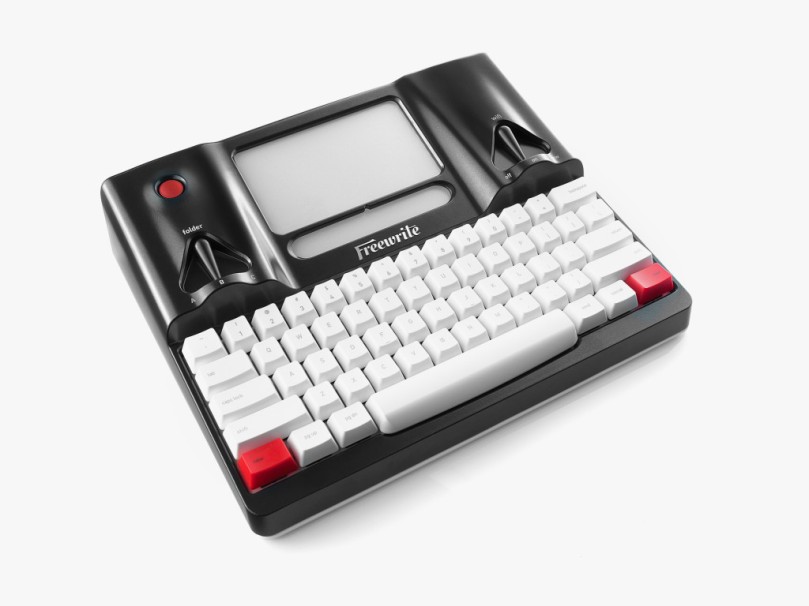
Well, the wait is over, and the discussion is no longer hypothetical: the device is here. You’ve rebranded it the FreeWrite, which is maybe less catchy than the obvious play on Hemingway’s name. I like it, though. The new name taps into the inspiring soul of the idea: they’re branding it as “your distraction-free writing tool.” It conjures up images of writing wherever, whenever you feel like. A lonely beach at sunrise! A breezy mountaintop with the whispering wind swirling about you! The cozy confines of your murder cabin! Er, writing cabin. I meant writing cabin. Take it anywhere, write anywhere. Distraction free!

And I stand by most of what I wrote in my original review. I would love to test-drive one. It’s still adorable. And I can totally see the draw it will have. We writers are a strange lot — what looks odd and useless to the general public can be a source of endless inspiration for us. Having a tool “just for writing,” especially a tool in which one makes a serious financial investment, is almost certain to do two things: remind the author that he has made a commitment to his craft, and remind him that he really should be writing.

Of course, we have Benedict Cumberbatch for that.

tumblr_mg9p3wt2xu1rwir03o1_1280

But I see one problem towering above all the rest with the FreeWrite.

The investment.

When I first wrote about it, I (crazily, apparently) mused that I might be willing to spend $100, maybe $150 on something like the FreeWrite. I also realized at the time that that figure was probably laughably low, and I was right; I checked their website and the price, to my memory at the time, was projected to be in the $200-250 range. That’s frankly too rich for my blood.  I’m a guy who agonized for a month over shelling out $40 for a copy of Scrivener. (Which I love, it turns out, although they seriously need to implement a Track Changes feature for the Windows version.)

So what does $250 get us? A typewriter simulator with an e-ink screen and a wi-fi switch for automated cloud backups and a couple of weeks of battery at full charge (which is pretty cool). No internet connectivity for anything other than your backups (which is, obviously, sort of a core tenet of the idea — no distractions). A million pages of internal storage (which is, in the scheme of computer storage, not actually all that much, but since this is all the thing does, it’s more than adequate). Feels a little overpriced to me, but I guess I would have been willing to shell out extra for the kitsch factor.

Except — surprise! — the price on the current iteration of the FreeWrite is $499.

Four hundred ninety-nine dollars. (Which is a specially discounted, limited-time offer over the apparent original price of $549.)

Look. FreeWrite creators.

I wanted to like the product. I really did. In fact, I still do. I think, conceptually, it’s absolutely got a place among burgeoning, youngish writers like myself. (Sorry, I just had a coughing fit over calling myself a youngish writer. Whoops, it happened again.) I can even envision how I  would use it:

“I’m going out to write!” I announce to nobody in particular, as I throw a scarf around my neck and don my tweed jacket with suede elbow patches and spontaneously sprout a beard. I put on spectacles for no apparent reason (they’re just empty frames and YES I CALL THEM SPECTACLES), scoop up my FreeWrite by its collapsible handle and bicycle off on my 19th-century huge-front-wheeled bicycle (because modern bicycles are so mindlessly corporate, and yes, I use “bicycle” as a verb AND a noun in the same sentence; I’m a writer, whee). Along the way, I stop and pick some coffee beans from the living trees and brew them with my own urine, then I perch in the crook of a mighty elm in the heart of the wood, sipping my coffee and typing away on the next American masterpiece while the fauna of the forest swirl lazily around me.

Seriously, the site features pictures of a bearded dude writing on this thing. So tranquil! So creative! So hip! This is what you’re’re selling to the throngs of would-be writers out there. Don’t get me wrong, this is a great vision. People would buy that! I would buy that!

But — five hundred dollars? That’s almost a mortgage payment. Rent for a month. That’s two months worth of car payments. A university course. Four weeks’ worth of groceries for my family of four. 2500 packets of Ramen Noodles, enough to subsist on for over ten years!

So who are you really selling this to? I have to imagine that any “established” writer is already going to have their routines and favorite tools well-ensconced; they won’t have any need for this thing. Poorish college types will balk at dropping that kind of cash on this thing when they can easily get a laptop — and a damn good one at $500 — to do everything this machine does and more. And middle-of-the-road types like me (my wife and I are comfortable, but by no means flush with extra money) are never going to be able to justify dropping that kind of coin on a unitasker like this.

In short, I feel you’ve priced yourself out of the very market you hope to attract. The only people I can see spending $500 on this device are the very rich who have run out of useful things to spend their money and time on (which may be a bigger segment of the population than I give credit for) or those who believe that the tools seriously make the writer (which I sincerely hope is a minuscule portion of the writing population).

For the same $499, I can buy myself a laptop and a copy of Scrivener (which not only offers a distraction-free writing mode, but will also package and format my book for submission to agents or even self-publishing) or any other free programs that do what the FreeWrite does (q10 and WriteMonkey, just off the top of my head, are two free programs that are excellent for drafting), and still have $200 to throw at the tsunami of credit card debt rising outside my door because of all the frivolous, needless things that I buy.(I’m an American, after all).

I would have loved for the FreeWrite to be one of those things. I love its design and I love its concept.

But I can’t, in any type of conscience, let alone with a straight face, consider paying $500 for $100 worth of hardware and $400 worth of kitsch.

Bleh. Back to doing this thing I love using the tools I already possess — which are more than adequate and don’t make me feel like a stinky hipster in hiding.


The Weekly Re-Motivator: Mental Contractions


I love a good metaphor ’round these parts, and the SoCS prompt this week plays right into it.

I’ve likened writing to a lot of things in the past. Hiking through a dense, all-engulfing jungle. Dragging yourself through a brutal desert. Rebuilding a car from its component parts.

But my favorites are the visceral ones, the ones with lots of fluids involved. The messy ones. The human ones. Hacking a malformed creature to bits and building a new monstrosity from the leftover gore. Slicing off redundant flesh, vestigial limbs. Draining the narrative of its thick, murky, purple-prosed blood and refilling it with clear, slippery, quick-flowing prose.

Or giving birth.

See, some writers are like insects or even trees or flowers; dropping eggs every so often or scattering spores and seeds around willy-nilly, giving birth to one narrative after another, writing regularly every day, staying productive even as their everyday lives swirl around them in a tornado of accomplishment and fulfillment.

But some of us are mammals. We can’t procreate all the time; we have to incubate, to grow the thing in utero until it’s fully-formed and ready to spring forth into the world. The work is done internally, gestating in the mind, sprouting limbs in secret, growing lungs safe from the light of day. Over months — sometimes even years — the thing takes shape. It kicks and squirms and twists, banging at the writer’s insides like a blind rhinoceros. It becomes all the writer can think about. It becomes as much a part of the writer as her own heart and brain.

And then — when the time is right (I actually wrote “write” when I meant to write “right”, which tells you how sunk I am in the metaphor) — contractions.

The body begins to reject the mostly-formed critter forcefully, urgently. In the space of a couple of hours, every system that worked to protect the young one and keep it safe reverses gears. The incubation is over: now the thing must come out or one of them may die. And come out it does. Amid screams of torturous pain, the expulsion of blood and a host of other unmentionable fluids, and an unending flurry of pushes which seem unproductive, the thing slowly slithers its way into the light.

There are writers like that. We incubate the ideas in the mind, insulating them from the light of day until they burst forth, uncontrollably and with great vigor, scattering the inkblood and amniotic word fluid across the previously perfect blank page.

And we expel this little miracle onto the table/page, where it flops around, taking its first breaths and spreading its wings (or whatever) for the first time.

And it’s … well, it’s imperfect. But it’s a thing we’ve created, and so in a way, it is perfect. And we’ll spend the coming months if not years nurturing it, feeding it, teaching it to walk and talk and influence the minds of the weak.

I’ve lost track of whether I’m talking about a story or a baby.

What are you? An incubator or a spreader-of-spores, a populator?

(And usually I include a picture, but I just can’t bring myself to post a picture of a mother in childbirth. Having witnessed it firsthand — kind of [my kids were born by Caesarean] — well. I just won’t do that to you.)

This weekly remotivational post is part of Stream of Consciousness Saturday. Every weekend, I use Linda G. Hill’s prompt to refocus my efforts and evaluate my process, sometimes with productive results.

Moniker Mischance


So one of the books I’m currently reading is Dean Karnazes’s autobiography, Ultramarathon Man. Karnazes is, as the title suggests, a well-known athlete in a particular field (or at least he was at one time … I don’t really follow the charts) in that particular sport (an ultramarathon is in practice any race longer than a 26.2 mile marathon, though the real events are the fifty-milers and hundred-milers).

Yeah, people do that.

I mean, I love running, but there are limits.

Anyway.

It’s 10:30, I’m in bed reading, about thirty pages in. He’s detailing the end of an ultramarathon he ran, where his wife and kids met him and picked him up in their van. His kids, Nicholas and Alexandria.

And I stop. Sit up straight. Read it again. Wake my wife up to make her read it. (She isn’t impressed — she has to work in the morning.) I read it again. I marvel at the bizarre world we live in.

Those are my kids’ names, with a single letter difference between the two of them.

This is a hell of a coincidence, but as Sherlock teaches us, the universe is rarely so lazy. No, this is kismet of the cosmic sort. There is some common thread, some replicated section in our DNA, which has caused both Dean and myself to love running and to give our kids the same names.

Or maybe the commonality is with our wives. Probably we both have really smart wives.

Whatever. It’s weird and freaky and awesome.

*Burrows back into his book-hole*