The Weekly Re-Motivator: Nothing Halfway


There’s a mantra I regularly preach, scream, whisper, write, and otherwise fling at my soccer team: Nothing Easy. I’m sure it’s not original to me, though I can’t say I got it from anybody outside of my own skull. I like it — and I encourage my players to repeat it, internalize it, live it — because it can be taken several ways and it works several different ways.

First, the external: the other team wants the victory just as badly as you do. They owe you nothing, and they’ll give you nothing, so don’t make it easy for them. Control the ball so you don’t give them any easy turnovers. Get good position so you don’t give them any easy passes. Mesh on defense so you don’t concede any easy shots. Nothing easy.

Then, the internal: in soccer, more often than a lot of players would like to admit, speed beats talent. Hustle and hunger beats technical know-how. You might have the best touch, the most precise passes, the most devastating shot, but if you can’t beat the other man to the ball, all that skill goes for a big fat goose egg. So, you have to play hard from the opening whistle. Fight for every ball. Run on every play like it’s the one they’re going to break away and score on. Nothing easy.

Point is, if you play easy — if you give the match a halfway effort — you’re giving the opposition an advantage in every phase of the game. Which means, you’re putting victory that much farther away (if not entirely out of reach).

Well, soccer season is almost over, and I’m sitting here really analyzing my writing process, because I’m in a transitional time. I’m almost done with the final (for now) edit of the novel, which means it’s time to start considering what I’m going to dedicate my writing time to next. That means setting new goals, planning a schedule, determining how I’m going to approach the project.

In all this analysis, I realized that, among other things I haven’t been doing in my writing of late was writing short fiction — those 1000-word-or-so stories that I was pretty religious about posting for a long time, those little pressure-release valves for the creative energies I was bottling up while I worked within the confines of the overarching Project. So last night I embraced the prompt and wrote one. And I’ll admit — it may not have been my best work, but what was different about it — what worked about it — was the approach. I didn’t fine-tune the idea to death. I didn’t plot it out meticulously before I put keys to board. I didn’t sit back and wait for it to be perfect before taking my shot (much like the protagonist in the tale). I leaned into the uncertainty and I wrote it full-steam ahead.

I haven’t written like that in a while. I’ve tried out some new approaches (and liked them a lot, to be fair!), honed my craft, become a bit more exacting in terms of how I build stories. But what I realized is, that approach has me operating at half capacity. Throwing myself halfway into the work, keeping one foot on the edge of the pool as I dunk my toes in and test the water. It keeps me from making as many mistakes along the way, but it also keeps me so focused on the road that I forget to enjoy the view along the way.

Like my soccer team working easy in a match, making things easy for the opposition, I’m working halfway and making it easy to get distracted, easy not to finish, easy to pretend I’m working when really I’m just hiding behind excuses.

Now, the only absolute is that there are no absolutes. I’m not going to say that there’s not a time for the methodical, measured, relaxed, easy approach. Sometimes if you rush the work, you make foolish errors that cost you. But if you embrace the easy approach too much — if you work halfway all the time — well, first of all you never get anything done, and second, you don’t make the mistakes that make the work interesting.

When it comes to writing, you have to throw yourself into it the way you’d run out into the road after your kid. You have to give yourself over to it like jumping out of a plane. You can’t keep one foot on solid ground while you let the other foot acclimate. You can’t do it halfway.

Combat Diver, Special Forces, Sonderkommando, Frogmen

So the mantra for my writing — for a while, at least, until I think of a new one — is: Nothing Halfway.

This weekly remotivational post is part of Stream of Consciousness Saturday. Every weekend, I use Linda G. Hill’s prompt to refocus my efforts and evaluate my process, sometimes with productive results.
On Cliffhangers and the Season Finale of The Walking Dead


Spoilers below for the finale of The Walking Dead season 6. Be warned.

Stories are like missile launches. Somebody, somewhere, gets pushed out of their comfort zone, so they push a button. The symbol of their hurt feelings, anger, frustration or desperation goes sailing through this liminal space, there’s maybe some doubt about whether or not it will actually hit its target, then it either hits the target and blows it to holy hell … or it doesn’t.

That’s a story. Problem, struggle, solution.

Stories play with this simple but fundamental structure all the time, especially in the contemporary age of sequels and sagas and ten-book series and multi-season television dramas. Harry Potter, for example, hasn’t beaten Voldemort by any stretch at the end of Sorcerer’s Stone (or Philosopher’s Stone if you must) — that problem remains to be solved. He has, however, halted Voldemort’s plot in its tracks, found a long-lost magical artifact, and established himself as at least a passable wizard. Book one of Harry Potter sets up a lot of problems (is the stone real? what’s up with that weird professor? who were Harry’s parents and why did they leave him with the most horrible people in the world?). And Book 1 answers something like 90% of those problems (the answers are “yes”, “he’s possessed by Voldemort”, and “they were crackshot wizards themselves who died saving the world”).

To return to the missile metaphor, Rowling aims at the problem of becoming a wizard and finding out what’s up with this stone, fires, and obliterates her targets. Out of the rubble arises a new problemthough. The cliffhanger here is: Voldemort is not actually killed in the encounter with Quirrell, and he escapes to fight another day.

This is an acceptable cliffhanger. The critical moment has passed. Answers have been provided, and the cliffhanger establishes a new question that doesn’t need an answer right now, but rather gives us something to think about in the space between the book and its sequel (how will Voldemort strike next?)

Then, you have the unacceptable cliffhanger, like the one we saw at the end of The Walking Dead earlier this week. (You have seen it, haven’t you? This is the part where I cry SPOILERS and wave my hands frantically as you read on into the abyss.)

The entire season has revolved around a couple of questions: namely, can Rick’s group survive in their new community, and who the balls is Negan? Well, here comes our missile metaphor again: the writers take aim at these problems and push the button to deliver annihilation. Midway through the season, it seems the missiles have found their mark: a man claims to be Negan and the group kills him, and life seems to be stable (if not entirely safe) in the compound.

But then more threats are discovered, and we learn that the compound isn’t safe at all, and that Negan is probably still out there. This is well and good — we don’t mind that our missiles missed the mark, as we can always adjust mid-stream and launch again.

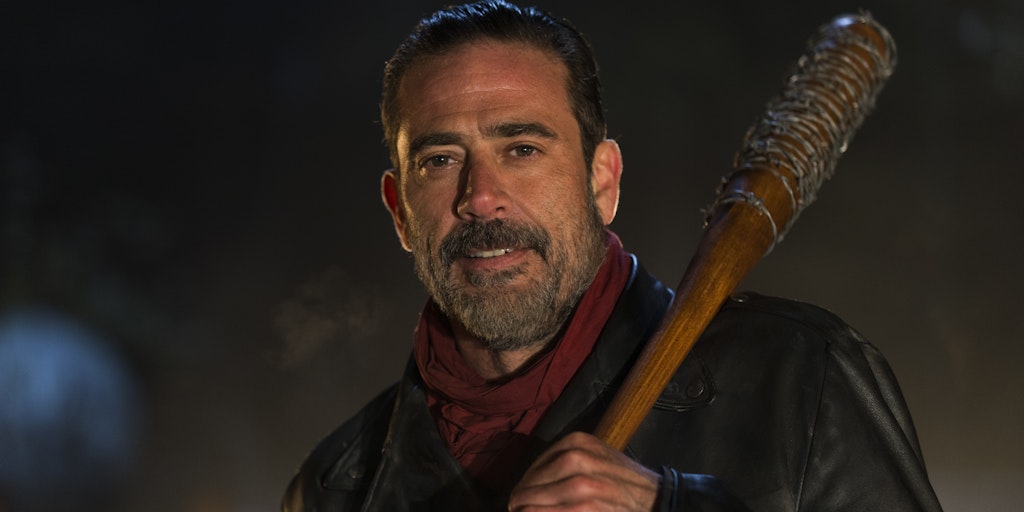
Which brings us to the finale. It answers our two questions, and thanks, at least, are due for that. Is Rick’s group safe in Alexandria? No, not even almost. Who the balls is Negan? He’s a leather-jacket-wearing, barbed-wire-wrapped-bat-wielding, ruthless but cultured sonofabitch. Okay, great, awesome. Targets fired at, and we have the answers to our questions, yay!

But then.

The ending.

Image is the property of AMC.

Negan beats the everloving hell from somebody, and presumably that somebody dies from his or her wounds (hard to argue otherwise from the camera angle that showed blood flowing into the victim’s eyes, not to mention that a blow to the top of the head like that — and I’m not a doctor or anything — seems like it would almost certainly shatter some vertebrae, if it didn’t simply split the skull like a vat of cottage cheese dropped from a tall building).

And we don’t get to see or know who it is. The show works really hard to establish that it could in fact be anybody who’s present at the encounter, except for Rick himself, who must bear witness.

That’s not a cliffhanger. It’s a cheap shot at the end of a boxing match. The critical moment is interrupted.

With the introduction of Negan, and the dire predicament that Rick and co. find themselves in, we have both the answers to the questions that got us here, and a question that will drive us forward into next season (now that they are so clearly outclassed, outmanned, and out-ruthlessnessed, how will Rick’s gang survive this?).

But then, the attack.

It pretends to be one of those questions that carries over to next season, but it isn’t. Because it’ll be answered in the opening minutes of episode 1 (or episode 2, the way this show goes — they’ll join some new ancillary character derping around in the woods for 90% of episode 1 then cut back to Rick and co. for two minutes before the credits). It isn’t a driving question, it’s a sucker punch to frustrate us and keep discussion alive through the off-season.

And I guess, at that, it’s functioning as intended.

Still, for a show that really handles itself well when it comes to surprising its audiences, this cheap shot feels especially cheap. Because you don’t need it. In fact, cut the episode either thirty seconds longer — showing us who dies to end the season rather than start the new — or thirty seconds shorter — leaving the attack as a shocker to open the new season — would be immeasurably more powerful, narratively speaking.

It feels like a flub, or worse, it feels like a calculated measure to frustrate the audience and get them trading enraged tweets on the net. It follows the Donald Trump election strategy — just get people talking about you, who cares if they’re saying good things or bad?

It sucks. It’s exploitative.

But I shouldn’t be surprised. They did the same thing earlier in the season, showing the apparent death of a beloved character and then cutting to alternate storylines for two episodes only to reveal that what we thought was that one guy getting devoured by zombies? Yeah, no, that was just sneaky camera angles exploiting our viewpoint, and it was the guy that our guy was hiding underneath that had his intestines ripped out, not our guy.

Shameful. Cheap. It insults the intelligence of the audience. I remember watching that moment and thinking, “I see intestines, and I see our character, but I don’t see the actual intestines coming out of his actual body. The show doesn’t shy away from stuff like that. What are they trying to pull?”

Audiences expect things from their stories. You play with those things at your own peril. And a cheap cliffhanger like this … that’s one you use before a commercial break to make sure folks sit through all the DiGiorno ads so they don’t miss the reveal. It’s not something you leave sitting on our stomachs for six months while we wait for the new season.

That’s long enough for audiences to decide they’re tired of your crap and move on to stories that don’t suck.

Like Star Wars VII. It’s out this week, did you know? I bought it twice, once for home and once for the office.

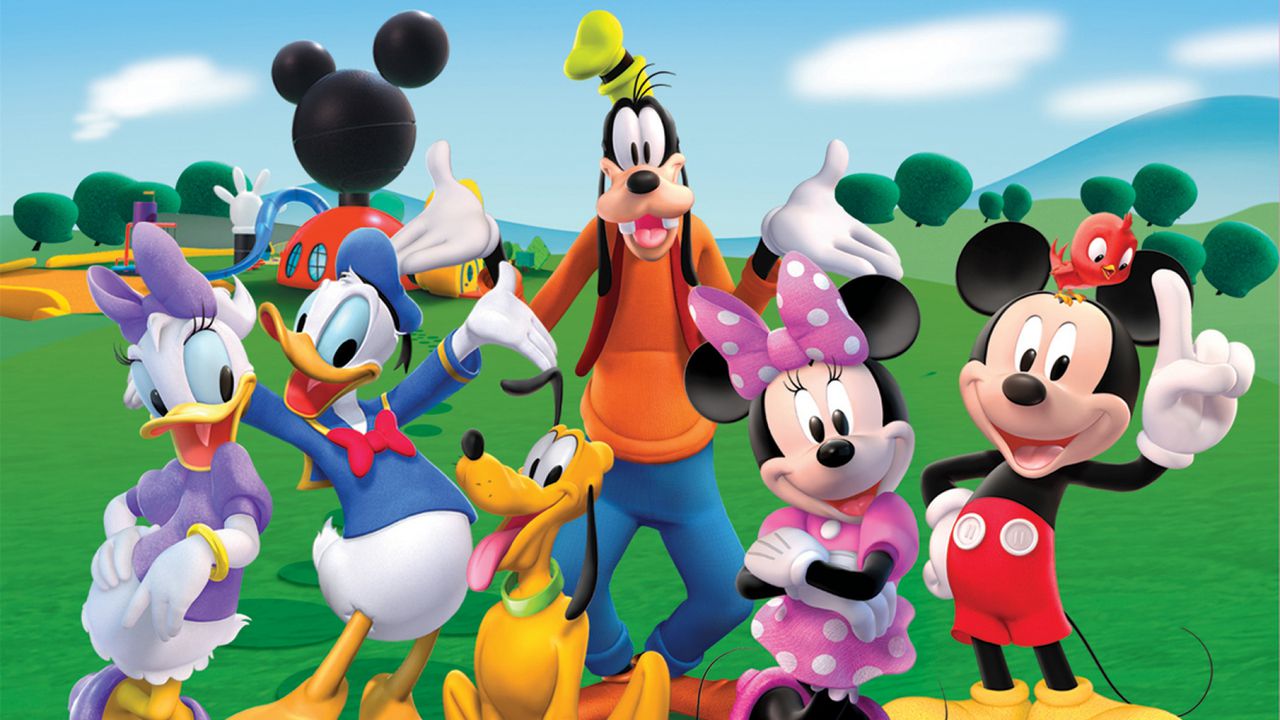
Why Mickey Mouse Clubhouse is the Worst Kids’ Show


Writing is a skill, much like any other. Sure, some of us are gifted in the art more than others, and acquisition of the art comes easier to some than to others. Nonetheless, it is a craft with techniques, maxims, principles and tropes. I like to think that I’m one of those who is to some extent “gifted” as a writer — it’s always come naturally to me and I’ve always enjoyed it — but I can still track my improvements, even markedly so, over the past couple of years. I can see where, when I started out, I was not particularly good at this or that aspect of storytelling, and where and when I learned how to tell my stories better.

But learning is a double-edged sword. When you’re oblivious to things, they don’t bother you; nobody in the dark ages gave a flying sharknado about whether the world revolved around the sun or whether an astronomical turtle carted it around the universe. They didn’t know any better, so they didn’t care. Meanwhile, in contemporary times, B.o.B. can scrap with Neil deGrasse Tyson on twitter over whether the earth is flat, and a fair contingent of people get rather reasonably upset with him. Once the knowledge of a thing is readily available to anybody (i.e., that the earth is round), it becomes your responsibility to know the thing or suffer the consequences (ex., ridicule in the public arena).

All this is to say that, once again, a little bit of knowledge has ruined me. Specifically, it’s made being a parent harder, because I can’t watch Mickey Mouse Clubhouse any more. (For the uninitiated, toddlers run in phases. One TV show, one movie, one character, will hold their focus for months at a time and then, like a fickle spring zephyr, the old stuff is on the garbage heap and it’s on to the new hotness. Well, it’s a Mickey Mouse Clubhouse hurricane season at our house right now, and avoiding it is nigh impossible.)

Sounds like an invented problem, you say. You don’t actually have to watch the shows with your kids, you rightly point out. Better yet, why let your kids watch TV at all? To which I say, “maybe,” “good point,” and “get off your damned high horse.”

But I think the underlying problem I have with this show is a lot more pervasive and insidious than “not liking it.” Rather, this show teaches poisonous lessons about life

So how has knowledge ruined me for this show?

My wife points out that it only takes having a brain to feel numbed by the show, and I’ll agree with that. The problem I have is that I can see the withered heart pumping the oily blood through its crumbling extremities. Which is to say, I know (a few things) about storytelling, so I recognize all the ways the show gives the finger to everything that humans love about stories.

In a nutshell, this is a kids’ show much like any other. A band of sillies get themselves into weird little dilemmas (we lost the magic thing! soandso has to prepare for something! there’s a journey to be taken!) and they solve their problems in a half hour.

Except there’s nothing satisfying in the way they solve problems, because all of their problems are solved by a floating deus ex machina that they call on every time something gets in their way. This deus ex machina is called “Toodles”, and at the outset of every episode, it girds itself with a handful of disparate items designed to help the characters out on their journey.

I feel like I’m not getting the full picture across. What we like about stories is seeing characters put to the test, seeing the unique ways they solve (or fail to solve) their problems, seeing how they grow as a result. But these characters don’t solve their own problems. They don’t bring a unique set of traits to bear on a problem, they don’t worry away at it like hamsters gnawing at corn cobs until a solution presents itself. They hit a barrier, they call on their magic problem solver, and he gives them something that lets them solve the problem immediately. It’s like you were playing Super Mario, and every time you came to a tough group of goombas, an invincibility star dropped out of the sky, or every time there was a tough series of jumps, a handful of platforms would suddenly appear for you to just walk across. Sure, you’d beat the game, but there’d be no point: nothing you did had an effect on the way the game played out.

But this isn’t a hallmark of kids’ shows. I’m not unfairly singling this one out. Blue’s Clues was a favorite around my house when my younger siblings were growing up, and that show works as a storytelling exercise. In every episode, the dog wants something, but the dog can’t talk to tell its master what he wants. So he marks a series of objects around the house with pawprints, and the master (with the help of the viewer) has to put those objects together to figure out what the dog wants. The dog uses its brain to find a way to solve its problem.

Then there’s the more contemporary Animal Mechanicals. My son loves this one, and I can’t stand it, but it still works as a story. You’ve got the usual band of sillies, but in this one, each character has a special ability: there’s the fast one, the stretchy one, the strong one, the one that’s got a swiss army knife implanted in his tail, etc. And those characters cooperate with each other, using their special abilities to overcome their problems.

But who gives a damn? I hear you ask. It’s just a kids’ show.

I’m not saying that kids’ programming should be the epitome of storytelling. But in just the way that a bicycle for a five-year old looks pretty much like an adult bike, just smaller, I think that stories for kids should parallel the stories we tell as adults. I mean, that’s part of why we tell stories, isn’t it — to vicariously experience the world, to teach ourselves ways to be (or ways not to be) and ways to solve problems?

That’s what the core of this rant is about, and that’s what really bugs me about the show. In literature, just like the world we actually walk around in, the world does not solve problems for you. All the world does is dream up more and more exquisite ways to challenge your abilities. But in Mickey Mouse Clubhouse, the storytellers solve all the characters’ problems for them before they even leave home.

Too Much Technology: Tableside


I was at the Olive Garden today and I saw the latest incursion of technology into daily life.

Image stolen from techcrunch.com.

Each table is outfitted with a tablet on which the patrons can browse the menu, order items off-the-cuff, request drink refills, even pay the check — without the need for a server to visit the table.

And I thought, wow, that’s cool, for about five seconds, before I realized, wait, that’s actually kind of messed up.

It isn’t hard to see what’s cool about it. And the server I asked about it was quick to sell me on the fancy features of it, all the neat and nifty things the customer can use it to do. Got kids whom you want to get a plate of food in front of, like, immediately when you sit down? Use this tablet for that. Had a rough day at work, and need a refill on your glass of wine right this instant? You can place the order yourself without waiting for the server to place it, then wait on the bartender, then run it to you. Movie’s about to start, and you need to pay your ticket right now if you hope to make it in time for the previews? Swipe your card right at the table.

Convenience! Ease of use! Instant response!

But. (There’s always a but, isn’t there?)

I quickly realized that I feel about this pretty much the same way I feel about self-checkout lines at the grocery store. Which is to say that the restaurant is now forcing me to do some of the work that I take as a given will be done for me as part of the social contract of visiting a place of business that, I thought, was in the business of serving the customer.

What I mean is, I have a job. I go to work for eight hours every weekday (and often eight hours is just the beginning) to earn my paycheck so that I can buy for my family the things we need. You know: roofs over our heads, clothes on our backs and shoes on our feets, little toys with a hundred detachable bits for me to step on in my bare feet at five in the morning when I sneak downstairs for a run. When we have a little left over, we like to splurge by going out to dinner.

And a not-at-all-insignificant part of the going out to dinner experience is the fact that we do it precisely to get a break from the reality wherein my wife and I have to do everything. Who’s cooking the meal? We are. Who’s filling the sippy cups and rushing to the sink to rinse off the toddler spoon that fell on the carpet and is now sporting a hunk of cat fur and carpet schmutz? We are. Who’s cleaning up the table afterward, doing the dishes, and in short doing everything that makes living unlike a band of complete savages possible? We are. We go out to eat to avoid all that.

And now this tablet. It pretends to be there for our convenience, but it’s not. Okay, maybe it kind of is … many are the times I can recall sitting at the table for minutes (entire minutes!) on end, waiting for the server to come round again for any one of the services outlined above. (Come to think of it, I think we get avoided more now that we have kids, but maybe that’s a post for another time.) But I have a sneaking suspicion that while this tablet pretends to serve the customer, it’s really to serve the restaurant, in that it cuts out the middle man. It eliminates a link in a chain, and any time you can shorten a chain, sheer probability dictates that you have less likelihood of encountering a weak link in that chain. And the weak link in this chain is … the server!

Far be it from me to say that servers are by definition weak links. I did my time waiting tables in many a restaurant, as did my wife. It’s a difficult job. Thankless. Much more complicated than a lot of people give credit for. Believe me, I have respect for the good servers out there (and we tip accordingly … none of that “your reward is waiting in heaven!” crap from my pocket). That said, there are some really garbage servers out there, and they can ruin the experience for the customer … and a customer who has had his experience ruined is likely to take it out on the restaurant vis-a-vis not coming to the restaurant anymore. So: install a tablet to take the place of a server descending on your table like a hummingbird every couple of minutes (or, maybe more like a migrant goose, every couple of months). Drinks are low? Need to pay and skedaddle? You don’t have to wait on another person to handle these things for you; just push a few buttons. In fact, with the tablet, you could really eliminate dedicated servers altogether and just staff the front of house with food runners and busboys (or busgirls, it’s the 21st century after all, although busgirls doesn’t sound quite right). I could sit down, tap up my drinks order, tap up my appetizer, and even tap up my entree (complete with preparation instructions that I now know will definitely make it to the kitchen — so when they serve me my chicken with fargoing mushrooms on it I’ll know it was the kitchen that screwed up and not my server). Why bring another person into the mix?

Monkey, Buttler, Operation, Waiter, Control

Because, as I said before, we go out to dinner so that we don’t have to do it all. I go out to dinner so that I can have a stranger kiss my butt a little, serve me with a smile, come around and fill up my water five or six times. I want them to do these things for me so that I don’t have to do these things myself. And yeah, this tablet means just pushing a few buttons to get these things done, but sharknado, if I wanted to push buttons and have it happen that way, I’d order online and bring the food home to eat. I like the interaction with a person. I like getting to boss somebody around for a little bit. And I will gladly pay for this service in the form of the gratuity we add on to the check at meal’s end.

Of course, as I said earlier, I don’t think this service is about me, the customer, at all; I think it’s much more to the benefit of the restaurant. No longer will I be able to complain: “well, I didn’t order that.” If I put the order in myself, then yes, I bloody well did order that. No longer will I be able to leave angry reviews on Yelp that we had to wait fifteen minutes for the server to collect and process our check: if I have the option to pay right there at the table, then it’s my fault I sat there like a dunce with my card in my hand and my elbow in a puddle of orange Crush that my toddler expelled through her nose. The tablet protects the restaurant from all these complaints you could theoretically level against a server, and it gives the customer more control over their dining experience.

Thing is, though?

I don’t think I actually want that much control over my dining experience. I want it to be good, but I want it to be good because it’s orchestrated by people that care enough about other people to make it good.

I dunno, man. The robot revolution is not that far enough. I know this is a road we’re going down sooner or later. Maybe I’m turning into a curmudgeon. But this feels like yet another thing we’re removing the human element from when, maybe, it ain’t quite time to cut people out of the picture just yet.

Am I wrong? Is this the wave of the future, or does this unsettle you a little bit?


The Weekly Re-Motivator: Humans Being


I’ve just finished reading Christopher McDougall’s latest offering, Natural Born Heroes. (Review forthcoming.) The central tenet is: you can’t always tell a hero just by looking at him. The strongest fighter? The girl who can outrun everybody in the field? The guy who can traverse a forbidding mountain range in the dead of night on nothing to eat but weeds and acorns? They don’t look like much. They become who they are and capable of what they can do out of necessity, innovation, or sheer bloody-mindedness.

You can’t build resolve like that. You can’t engineer ingenuity. You don’t unlock the secrets of human potential on a whim or by mistake. These things only happen when we eschew the trappings of the modern world, when we cut through the nonsense of our capitalist culture, when we tap into what makes us who we are, what we evolved to do.

Which is, to survive.

Girl, At Night, Running, Cloud, Silhouette, Freedom

But it’s more than that, more than just being. We are human beings, but it isn’t being that makes us human; it’s our doings.

Each of us has within ourselves vast, untapped reservoirs of potential and energy. Everybody knows (or at least suspects) that they could do this or that unbelievable thing. (I could write the next great novel. I could run a marathon. I could quit my job and go herd goats. I could go and ask that girl/guy out.) But most of us don’t do those things. We allow them to remain unbelievable and go on just surviving. Which is easy! But it doesn’t put our names in the history books.

So let me stop myself before I get carried away on a tidal wave of my own ego. I’m not saying my name is going into the history books thanks to anything you might read around here. But there’s a slew of sayings on this particular subject:

You miss one hundred percent of the shots you don’t take.

You can’t hit a home run without swinging the bat.

You can’t hit a target that isn’t there.

Darts, Dart Board, Bull'S Eye, Game, Playing, Target

And with that in mind, this is me taking this opportunity to remind myself that this blarg, this past two years of writing novels and letting the voices in my head take the reins and spill over onto the page, of exploring the vast uncharted recesses of my storyteller brain, is me trying to tap into my inner hero.

Did I actually say that? Yeah, sure. Storytellers are heroes of a sort. We connect through stories. We live expansive alternate lives through stories. We learn to appreciate others through stories. And at their core, stories tell us about who we are.

We can be heroes.

We just have to take that chance on ourselves.

This weekly remotivational post is part of Stream of Consciousness Saturday. Every weekend, I use Linda G. Hill’s prompt to refocus my efforts and evaluate my process, sometimes with productive results.