You Can’t Fix It In Two Days


Once, there was this guy.

He taught high school, and he was at least passing average at it.

And for months he told his students that grades are cumulative, and that work left til the last minute would become unmanageable and impossible to finish on time and would make everybody’s life harder.

But as everybody knows, students of high school age have already learned everything they need to know about the world, and furthermore, they’re not interested in the half-baked school or life advice of a guy twice their age, thank you very much.

Then, when the last day of the semester drew near (as it inevitably does — time is insatiable and all that), the students realized that their grades were not what they wanted. And the time of the great panic began, as it does every year, and as it will every year without end, amen. The teacher’s door was beset in the wee hours of the morning by the very same students who had scorned him just a few short months ago. The teacher’s inbox was inundated with e-mails asking for details on that one project, um, I think it was on Antigone? The teacher’s phone rang non-stop as parents, suddenly realizing that their children might not pass and might not graduate and might therefore live in the basement forever, became infected with the panic as well; calling to beg, to plead, to cajole and to appeal to the goodness in the teacher’s heart.

Unfortunately, there was no goodness left in the teacher’s heart. It had burnt up like the last log on a Christmas fire, it had blown away like the leaves on an Autumnal wind, it had withered and rotted away like an overripe banana. After the months of banging his head against the wall, trying like hell to get the students to take an interest in themselves and their futures and maybe, I don’t know, just maybe, putting the cell phone down for a second, all that was left of the teacher’s good will was a shriveled husk, a sad, blackened, neglected scrap of cardial tissue.

And the cries of student and parent alike fell not upon deaf ears, for the teacher was more than happy to listen to their tales of woe and recount them over a glass of wine with his wife or to blarg about them anonymously on his tiny corner of the internet (being sure to omit all personal details and thus absolve himself of any legal liability, naturally). No, the teacher’s ears were not deaf to their pleas, but his ears were indifferent as the sunrise. For you can no more undo in a few days of frenzied work what you have spent an entire semester building.

Momentum matters.

So has it been for ever. And so, sadly, shall it be for all time.

…And that’s why I haven’t been posting a lot lately. Regular programming will resume when the summer gets here. If the apparent flow of time over the last few weeks is any indication, that should be in approximately three years.

The Power of “If”


If there’s one word that drives creativity, it’s if.

Wouldn’t it be cool if a mountain could come to life and tell you a story? 

What if evil space monkeys descended in little silvery spaceships and started grooming everybody for fleas and nits?

How about if your Math teacher were secretly a piece of sentient toast, and nobody knew it but you?

I was involved with the theatre (yes, that’s theatre with an -re and not an -er, you philistines) for many years, and as any student of the theatre knows, one of the most powerful and most basic tools in any actor’s toolbox is Stanislavski’s magic if. The actor must behave as if it is vitally important to him that he not upset his deranged disgruntled insurance salesman brother. The actor must act as if her next word might summon Cthulhu to destroy this universe.

These things are, of course, not true. (At least, not in this dimension.) Therefore the actor must construct similar circumstances to represent the appropriate mental and emotional state.

My brother is not a deranged insurance salesman, for example, but I  do have a brother-in-law who does classified work for the military,so it’s probably best to be careful what I say to him (or post about him on a public blog). And the wrong word might not summon Cthulhu, but the wrong word can most certainly send either of the sprouts into a screeching, banging-on-the-walls and flailing-like-a-cat-in-a-Christmas-sweater-fit, which is close enough to the same thing for my monry.

The magic if drives the actor, and in much the same way, it drives the writer.

The writer gets to imagine how the world would be if people were different. If the rules were different. If gravity were different. If biology were different.

And whereas the magic if opens up the entire range of the human experience to the actor, the writer’s magic if is greater still: it grants him the power to recreate reality itself.  To make world’s as big or as small or as strange or as perfectly normal as he chooses.

We are limited only by our imaginations, and perhaps even those limits are waiting to be broken as well.

idea-1296530_960_720

If only we have the courage to follow our minds and our pens.

(Okay, our keyboards. Jeez. You try to be a little poetic…)

This weekly remotivational post is part of Stream of Consciousness Saturday. Every weekend, I use Linda G. Hill’s prompt to refocus my efforts and evaluate my process, sometimes with productive results.

Is Marvel Bloat Reaching Critical Mass?


I’m not going to give a full review on Civil War today, but I just want to pose a question.

Is Marvel bloat reaching critical mass?

The obligatory: There are spoilers ahead. Minor ones, but spoilers nonetheless. If you’re that type of person, make sure you see the movie before you read on.

Okay? Okay.

In recent years, the film franchise has been growing and growing in popularity, not just among comic books nerds or even geek culture at large, but among perfectly normal members of the perfectly normal populace. For example: my wife. She hates most nerdy things I love (Doctor Who, Orphan Black, Mythbusters) and can at best be said to tolerate geek monoliths like Star Wars. But she’s fully on-board with the Avengers franchise.

Problem is, the Avengers isn’t just about the Avengers movies. Now there are tie-ins with other films, shows running in parallel, characters appearing in other characters’ individual franchise films … okay, I get it, that’s how the comic books work, and that’s probably fine for comic books, but I don’t think the movie-going public is fully on board for the films bloating out in the same way.

The newest Captain America film has been billed as Avengers 3, and with good reason: it features the entire cast of Avengers 2 minus Thor and the Hulk. And the events of Civil War, without getting too spoilery, leave things in a pretty precarious place for the Avengers going forward. Which is … okay, great, but it basically means that if you want to get the most mileage out of your viewing of future Avengers flicks, you have to be up to speed on the Captain America films. And that leaves the door open for saying the same of all the other films.

Which is a problem, I think. Because until recently, you could enjoy the Avengers franchise without necessarily watching the Thor films, or the Captain America films, or whatever. But if a Captain America movie can be a canon tie-in, then a Thor movie can be necessary viewing, and a Black Widow movie (hey, I hear it’s in the works!) can be necessary viewing, and and and … hell, this movie brings Ant-Man and Spiderman into the mix as well, so … where does it stop? That’s a whole lot of ancillary films to watch, when all I really wanted was more Avengers.

Which brings me to a second point. It’s pretty clear at this point that Marvel is becoming a self-perpetuating nightmare machine, using its established films to drum up audiences for its lesser-known properties and vice-versa. As I said a moment ago, Civil War brings Ant-Man and Spiderman into the middle of an Avengers conflict. I’ll disclaim that I don’t know anything about the comic books, so I don’t particularly know or care whether this is accurate or justified. The problem is that in the story that the film tells, the inclusion of these characters is completely unjustified.

Captain America needs a bit of help, so he brings in a fanboying Ant-Man … for exactly one battle. Iron Man also wants a bit of muscle on his side, so he hunts down a somewhat reluctant Spiderman … for exactly the same battle. Now, I’ll admit that as far as that set piece in the film goes, it’s spectacular cinema. Tons of fun to watch. Great stuff. Problem is, if you remove Spiderman and Ant-Man from the film entirely, the narrative thrust of the film is completely unchanged. (Not to mention about fifteen or twenty minutes shorter, which wouldn’t be a bad thing.) Having a dead weight character in your book is usually narrative suicide, so why are they there?

CGI eyes were pretty creepy, though.

Easy. That one shot in the preview — Spidey with Captain America’s shield — was geek gold, and the battle with an enormous Ant-Man made an otherwise pretty stock battle in an Avengers movie unique and hilarious. It also doesn’t hurt that Spiderman has built-in cred as one of Marvel’s most well-known and well-liked characters ever, and Paul Rudd turned Ant-Man from a joke into a sort of culty curiosity.

And, oh, by the way, Ant-Man just had a pretty successful run this last year, and …  isn’t Marvel sending up some new Spiderman films in the near future?

It’s a little too convenient, a little too blatant, a little too obvious. Ant-Man gets shoehorned in because audiences really enjoyed Paul Rudd, and why not bring him in? Spiderman gets tossed in because audiences love Spiderman already, so let’s get them excited about the new Spiderman.

The first Avengers movie was a fantastic thrill-ride that stood entirely on its own without cameos by the X-Men or whatever other heroes or backstory from a dozen subsidiary movies. Avengers: Age of Ultron was much the same, though I felt a bit in the dark as to the whole SHIELD v HYDRA conflict (fleshed out in other properties, maybe?) at the beginning.

But if you go into the next Avengers without seeing this installment of Captain America, you’ll be completely in the dark as to what brought them to their new starting point. I didn’t dislike Civil War, but I don’t like at all the precedent Marvel is setting by not calling Civil War an Avengers movie. This is an Avengers movie masquerading as a Captain America movie. Which means any future movie featuring any one of the Avengers could go the same way.

Man, am I thinking too hard about this? These little hangups are ruining my enjoyment of what was in all truth a pretty good movie.

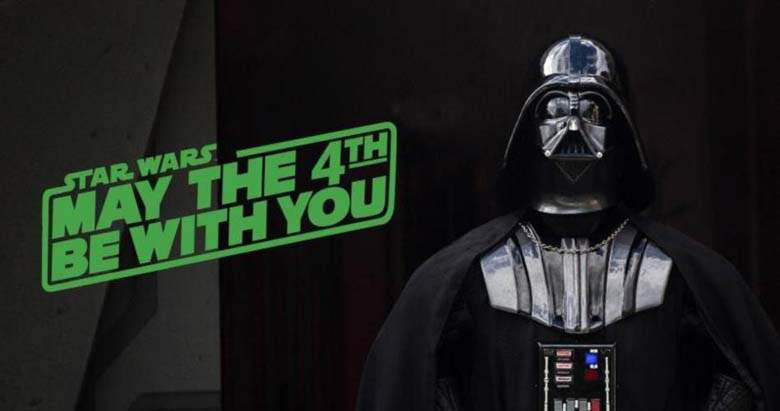
May the Fourth Be With You (And Also With You)


Know what I like best about the “religion” of the force in Star Wars? It doesn’t take sides.

I mean, let’s be honest, the Force is religion. This guy or that girl or some other dude or your long-lost father is strong in the force for reasons never stated and certainly not comprehensible (and you can GTFO with that midichlorians sharknado). If the Force is on your side, you can perform straight-up miracles, like levitating your Orange Crush across the room because you’re too lazy to go get it during the commercial break in Coruscant’s Next Top Jedi, or force-choking your idiot friend who won’t shut up about how Han shot first.

The miracles are cool and awesome and super. But what I actually like best is that the Force is an equal-opportunity personal savior. The Force is perfectly happy serving Darth Vader or Luke Skywalker or Kylo Ren or Rey WhoTheHellKnows. Everybody and anybody can call on the Force to bless themselves or anybody else.

Maythe4th

“May the Force be with you.”

Ben Kenobi says it. Anakin Skywalker says it. Emperor Palpatine says it. Princess Leia says it. Yoda says it. Darth Vader says it. Even Han Solo says it, and he is an explicit non-believer on the subject.

It doesn’t matter if you’re a tree-hugging freedom fighter, a power-crazed space slumlord, a half-insane cave monkey or a floppy-haired debonair space ace, you can call on the Force to help you out, and if you’re lucky, it just might save your ass.

What does this mean?

Well, if the Force is an explicit metaphor for religion, I think it shows that religion, faith, belief, are much like a lightsaber. Be it red, yellow, green or fantastic purple, it’s just a tool. It isn’t intrinsically good or bad. It just is, and whether it’s a symbol of good or bad depends entirely upon the person wielding it.

And if the Force isn’t religion, well, that’s okay too, because it’s still just a tool. Like the hammer collecting dust in your garage, it doesn’t have a stake in whether your house stays in good repair or if it crumbles to dust. It’s there to bang on some nails if you want to, or to go smashing up some drywall if that’s your thing, or, hell, it’s even happy just hanging there watching dust motes swirl in the stale air.

*makes the jump to lightspeed without plotting coordinates first because that’s the way we do it in the new era of Star Wars*


The Menagerie of Bad Ideas


The mind is like a zoo.

A panoply of animals separated by a profusion of cages. Noisy kids running here and there. Somebody’s vomit there, just right there, next to a trashcan. (How they managed to get so close and miss the trashcan will forever baffle.) A series of footpaths connecting the lot. Maybe a little train to let you take it all in while you kick back and relax.

Our brains compartmentalize just like a zoo. Can’t have the dark thoughts of your latest antagonist kicking around your head while you’re pushing your little ones on the swings. Can’t have lions sharing the cage with the cockatiels. (Is that how you spell cockatiel?) Rather, you keep it all separate. Go visit the dark part of your brain when you need the antagonist. Stick to the flamingo exhibits when you’re with the kids. And so on.

Confined, Monkey, Cage, Animal, Prison, Captivity

But zoos aren’t perfect. Neither are caretakers or cages. Look at the octopus that just recently escaped to the ocean, or at any number of stories of people falling into wild animal enclosures and being mauled (or rescued!) by the inhabitants. Every once in a while, the externally-imposed order breaks down, and things get messy.

And in a zoo, that’s maybe not such a good thing. But in the mind, that’s a necessity.

If you’re like me, you’ve got maybe a dozen different story ideas swirling around in your head at any given time. And those ideas are in their cages, sure, but you can’t help noticing them as your consciousness strolls by. They rattle the bars. They chew on the locks. And occasionally, they break out. Cross-pollinate. Pollute each other.

And for the writer, that’s a very good thing.

The sci-fi idea that you had might just be awesome with a bit of that romantic comedy thrown in. The alternate-history period piece could crackle to life with a dash of the thriller you thought of last week over a plate of meatballs.

Or maybe those ideas will breed and collapse from genetic deformity.

That’s okay, too. Ideas are as numerous as grains of sand, if we’re only open to seeing them.

We can’t keep our ideas in their cages.

We’ve got to let them out once in a while.

This weekly remotivational post is part of Stream of Consciousness Saturday. Every weekend, I use Linda G. Hill’s prompt to refocus my efforts and evaluate my process, sometimes with productive results.