Unexpected Fauna in Suburbia


The first one I noticed was a cat.

Actually, I’m not sure what the first one was; but the first one I knew for what it was was a cat.

See, any animal in the wild will startle and then stare at you. They suss out the danger, watch you for movement, decide whether to run or fight. But not these things. Not this cat. They stare through you, like you wandered into a place you’re not meant to be, seen things not meant to be seen. They stare at you like they’re waiting on the word from some master you can’t see for permission to tear you apart.

You might think that suburbia is a totally tame place to go running for exercise, but any place can seem alien at four AM, especially a place where civilization and vast stretches of untamed land butt up against each other. (I run at four AM because I have to — it’s the only time of day that really belongs to me. The kids and wife are asleep, work is still a long way away. It’s quiet, peaceful, calm. Perfect for running. And despite living in the suburbs, the regular route snakes right out of the neighborhood and onto a road that carves through a forest, dipping and winding through trees and growth that feel old, the way only an old forest can feel old. Like if you stepped off the road and wandered fifty yards into the trees, you might find yourself lost for days.

It’s not quite like that, but at four AM it definitely feels like that.

Wildlife is common at this hour. There’s the neighbors’ cats that stare, golden eyed and still from front porches and from under bushes. Sleepy dogs out in their pens that come to and give chase along the edge of their fences. The occasional stray that pursues for a while, but gives up rather than follow too far. Then, across that imaginary border between civilization and the woods, things get a little more exotic. Squirrels and rabbits everywhere, poking their heads up for an instant then bolting for cover. Coyotes aren’t unheard of; I never see them up close but have glimpsed them at a distance. Unlike dogs, who will head right for a person, a coyote will see you from afar and melt into the trees before you can even tell what it is.

Then there are the deer. There’s something magical about deer at four in the morning, gliding like shadows across fields or through the trees, sometimes alone, more often in herds whose size is only grasped when they all suddenly explode into movement together. But these, too, just startle and run.

But like I said, the first one I saw — the first one I knew — was a cat. It came into view at the top of a hill as a flurry of movement, hard to identify but clearly animal. Then it froze. But not the freeze of the spooked animal; this was that other freeze. It halted mid-stride and didn’t move again, didn’t take eyes off me, until I rounded the next bend and it disappeared behind me. I kept my eye on it the way you keep an eye on the potentially dangerous person talking out loud to nobody in particular on the city street — you don’t think it’s out to harm you, but you can’t be too careful.

Then, there were the rabbits. A whole crew of them, about six or seven, in a clearing in the trees, just staring. A lone rabbit will freeze, hoping to avoid notice, but a group of them will always break and run: when one goes, they all go. Not this group. Being watched by them felt like being watched by people: people who didn’t want you in their area, people who wanted you to leave.

Then I started noticing the deer. Normally you glimpse them at a distance and they ghost away, but they started appearing in more and more obtrusive places. Closer than usual, too. They started showing up in the middle of the road sometimes, or right at the edge of the trees, just off the road. And they didn’t spook, either, not until I’d get almost close enough to reach out and touch them. Their heads just swiveled as I’d plod past. Watching.

Until finally, this morning, the latest. This was in that really dark stretch, trees creeping close at both sides of the road, thin hazy fog blocking out the starlight. Troublingly dark. One of those real man-goes-missing-on-his-early-morning-run-in-the-woods kind of moments. And there it was — a shadow coming out of the fog. Not aggressively or curiously, but steadily and inevitably. At first, it seemed to be a dog, but as it grew closer, it was obviously too big. A deer? Maybe, but it was too heavy set, too plodding.

A few more steps, and it was undeniable. A human. Or at least a human shape. In the dark, it was more like a human-sized hole in the night.

I froze, my heart pounding. There was no discernible face, no discernible features. I couldn’t tell you how tall it was, but I could tell it was staring at me as it came nearer, as it passed just on the other side of the road. I tried to call out, weakly, some sort of greeting, but the voice died in my throat. You don’t really feel fear like that as an adult in this world, but I felt it then, and I found myself the frozen animal, spooked and startled, ready to bolt. It glided past, and it was gone; not gone like it retreated into the mist and out of sight, but gone like the mist had swallowed it up or spirited it away. Either way, it was gone, and I ran home in uneasy silence.

I don’t know who that person was, but I hope I don’t see them out there again.

It’s actually funny; as I’m writing all this out, there are deer gathering in the yard, just staring at the house.

I wonder what that’s about.
The Perfect Way to Do the Thing


That thing you’re thinking of doing. You know the one.

Maybe it’s the big project you’ve been putting off starting. Or maybe it’s the habit you’re trying to set. Or maybe it’s just some daily drudgery you have to get through. Maybe it’s even a thing you really, really want to do, but you just haven’t been totally sure how to get the ball rolling.

Whatever it is, you have this thing you want / need to do, but you don’t want to screw it up. Screw-ups are the last thing you need. What you want is perfection. A no-mistakes, no-time-wasted guaranteed method for Doing the Thing without the costly and stressful cock-ups along the way.

Have I got news for you!

What follows are the 100% perfect, tried-and-true tips, tricks, and toodlepips to make your time as productive as possible.

Ignore these tips at your peril.

  1. You need a space. This space should be dedicated to your Thing and shouldn’t share form, function, or storage with any other Thing.
    1. The space should be in a location within your home or your regular area and should always fit the optimal conditions for your work. It should be quiet, insulated from distractions like family, internet, and sadness.
    2. The space should incorporate natural light, face the rising sun at an oblique angle and the setting sun at an acute one.
    3. The space should have a ready supply of oxygen in tanks for emergencies.
  2. Do not embark on your Thing without the perfect soundtrack. The perfect soundtrack depends on you and your Thing, but here are some guidelines:
    1. The beats-per-minute, should you choose music, must match up with your effort and output precisely.
    2. The thematic content of your soundtrack must align perfectly with your Thing. A thematic mismatch leads to disharmony, disharmony leads to frustration, frustration leads to failure.
  3. Do your thing before sunrise. It is well known that the only time for the doing of Things is before the sun is up, for the very simple reason that inspiration and motivation can find you more easily while everybody else is sleeping.
    1. Set at least sixteen alarms in three-minute intervals to ensure that you don’t do something stupid like sleep while the sun is down.
    2. If you do sleep through your sixteen alarms, forget about engaging in your Thing even a few minutes after the optimal time. The train doesn’t come back to the station until the next day.
  4. Gear and equipment are everything. You can’t do your Thing without the proper kit; don’t waste your time trying.
    1. Lay out your gear the night before. In fact, lay out your entire gear for the entire week’s worth of Thinging a full ten days in advance; this creates a subconscious contract with your future selves that, should they break it, entitles you to legal redress.
    2. The best gear is the most expensive; cheap gear will poison your entire process. If you take your Thing seriously, expect to sink serious coin into the pursuit.
    3. If you can’t get the right gear, put your Thing on hold. The shelf life on any Thing worth Thinging is like, super-long.
  5. Under no circumstance should you attempt to do your Thing while you’re not “feeling it”. Best case, your Thinging will be crap. Worst case, you risk serious injury or death.
    1. When you are feeling it, you should do your Thing at a brutal rate. Some might say an insane rate. When the moment strikes, abandon all else: family, friends, day job, personal health, to do your Thing, as you never know when the moment will strike again.
    2. When you are not feeling it, all bets are off. Do nothing. At all. You never know what might recharge your batteries, and you don’t want to miss the opportunity to “feel it” because you were distracted doing something less important than your Thing.

Ok, so, this post is crap. The fact is, when you’re thinking about doing a Thing, you can find any number of reasons why you can’t do the Thing, most of them crap-scented tripe aimed at convincing you that there’s only one way to do your particular Thing properly.

But that’s crap.

You do your Thing where you can. My “dedicated workspaces” are anything but: at home I share an office with a couple of high-traffic catboxes and my wife’s side-hustle, and at work my writing space is also my main “work” workspace. In both places, cross-contamination is unavoidable, in every sense of the word. (Ew.)

I like podcasts while I’m running and instrumental music while I’m writing, but sometimes I run with music and sometimes I write in silence and sometimes the music or the podcasts are dumb and make me angry and the point is, I run or write anyway.

I run — and write — before sunrise because if I don’t, it ain’t gonna happen. I work full-time and parent sometimes and once the day begins, there are too many demands on my time to steal an hour for a run. And I steal ten minutes here, fifteen minutes there to work on the novel during the day. You find the time to do your Thing like a puddle filling a pothole.

Gear doesn’t mean a dadgum thing, but it’s an easy thing to hide behind. All you need to write is a pencil, some paper, and the drive. All you need to run is some sneakers (and depending on how much of a hippie you are, maybe not even those). Gear is an excuse. Do what you can with what you’ve got.

“Not feeling it” is the easiest way to hide from doing your Thing. It’s also the most insidious, because it’s a term absolutely without meaning. If you really know why you’re doing the thing, there’s no such thing as “not feeling it.” The motivation finds you when you care about the Thing. But even when you’d rather do something else, you know that you should be doing your Thing, so you do your Thing anyway. And you end up glad you did it.

Point is, if you want to find a reason not to do your Thing, the excuses are plentiful. But when you get serious about doing your Thing, you realize how stupid all the excuses are.

The time and place to do the Thing is here and now.

The way to do the Thing is whatever way you can get it done.

Don’t get hung up on the particulars.

There is no perfect way.

The only wrong way is Not to Do It.

Math Night


I’m gonna generalize in this post because I have to. I’m also sort of uniquely positioned to generalize because I see this issue from both sides — being both a teacher and a parent. So I know this is a not-all-parents situation, but man oh man, it feels like too many parents.

Anyway.

Last night was Math Night at the sprouts’ school, and because we are dutiful parents, my wife and I were in attendance.

And, I mean, maybe I’m dumb for thinking Math Night is going to be some sort of *event* — you know, a math-themed sort of celebration with games and events and all. (This is at an elementary school, after all.) But no. Math Night is essentially an expanded parent-teacher conference; a way for the teachers of each grade level to meet with parents en masse and disseminate information about upcoming tests and what standards they’re covering and all of that good stuff. Actually very useful information, but really, just a conference.

Of course, if they call it an “informational meeting on math and standards”, attendance would be even lower than it was. So “Math Night” it is. And they serve pizza. Because nothing brings people in like free cheap pizza.

Ahem.

We go to Math Night.

And I immediately find out what I already knew, which is that I don’t really need to be here. Both of our kids are doing pretty well in math in their classes (which I already knew) and the teachers’ purpose tonight is to sort of explain how the curriculum works and what strategies they’re teaching the kids (which the kids have explained to me). The presentations only take about twenty minutes. Blissfully short, in my opinion. Then there’s a question-and-answer period.

Which is where it goes off the rails.

Look, a question-and-answer period is pretty straightforward. A speaker gives out a bunch of information on a topic. When they’ve finished, they allot extra time for anybody in attendance who didn’t quite get it or who missed something to ask clarifying questions about the topic. You know, information that might directly benefit everybody else in the room, said information being pertinent to the topic at hand. And as I always tell my students, if there’s a question you have after listening to somebody talk, odds are somebody else in the room has the same question, they’re just too afraid to ask it.

But I know what’s coming, because this is not our first Math Night. We’ve done it before. And there is always a parent (or two!) who want to ask questions totally unrelated to the topic or the occasion. They’re sitting here with their kids’ teachers, after all, so why not ask the teachers specific questions about their student specifically?

(This is not the way to do it.)

So the rest of the parents in the room get treated to a lengthy discussion about how this student struggles with her work habits (not the topic) and is struggling with reading (also not the topic) and gets upset when they correct her work (still not the topic). The teachers are uncomfortable as roaches under a sun lamp discussing this stuff in front of the group — you know, because teachers aren’t meant to divulge personal information like that (and also because, y’know, NOT THE TOPIC) — but the mom keeps going on and on. And I’m not really listening and it’s just kind of droning on and man could the clock please go a little faster so this session can end and we can leave and somehow it breaks through the fog:

“I mean, of course, we took her phone away, but I don’t know what to do besides that.”

What? Er — what??

We’re in a 2nd grade class. Kids seven and eight years old. “We took *her* phone away.” Which means it’s the kid’s phone, not mom’s or dad’s phone that the kid uses.

So — let me get this straight. You gave your kid — your (let’s be charitable) eight-year-old kid — a magical internet box of her very own, and you’re confused as to why she gets upset about doing homework? Heck, most adults you come across can’t successfully integrate their lives with these things — we get consumed with social media likes and Youtube rabbit holes and push notifications to the point that they destroy our lives. And your kid has one of their very own.

Gee, I wonder why your kid is having math issues! I flippin’ wonder!

On the one hand, I get it. I really do. Screens are prolific and it’s next to impossible to keep kids off of ’em. Our kids use the tablets to watch garbage before they go to sleep at night, which, okay, yeah, I know, it’s terrible. But the tablets are not theirs, they don’t have ready, instant access to the things just anytime and for lack of anything better to do, and we monitor their time. And yeah, I also get that the “new math” of the Common Core is hard. I’m decent with numbers and even I go a little bit glassy eyed trying to understand some of the techniques they use. (The way they teach regrouping now is … just do yourself a favor and avoid it if you can. They showed us an image of the method and it looked like the hash-mark riddled wall of a twenty-year death row inmate. Hell, they’re teaching the kids “base 10” notation in the 2nd grade now. I don’t think I even heard of base 10 until I was at least 17 and even then struggled with it; and I’d wager that half the adults my age couldn’t explain what base 10 even is.) But you know what that means? That means you have to shake off the dust and learn the stuff so you can help your kid do it.

That’s what being a parent is. You suffer some inconveniences — and often some outright pains-in-the-tuchus — for the benefit of your progeny. That’s the deal you make when you bring a kid into the world.

But the problem isn’t even that this woman’s seven-year-old has a phone of her very own. I mean, that’s a problem, but it’s a relatively minor problem.

The problem is that this woman is the type of parent who’s involved enough to go to the Math Night event in the first place.

As a teacher, I can tell you (and here’s where I generalize) that the parents who come to events for parents are the types of parents who don’t actually need to come to events for parents. What I mean by that is, the parents who come to these things are the parents who are going the extra mile anyway — you’re talking about the top 10-15% of parents when it comes to more-or-less healthy involvement in their kids’ lives. The parents who need to come to these things — the parents of those kids “on the bubble” as it were, who need an extra push to help school make sense and come together — those parents are nowhere to be seen on parent nights. They’re off doing whatever else they have to do that’s more important than their kids’ education.

You see the calculus ticking toward a result, here.

This woman who was here for parent night — and therefore in the top 10-15% of parents — thought that giving her seven-year-old a phone was a good decision. Didn’t know how to help her kid focus.

This is what we’re up against. This is what these kids are up against.

Point is: Math Night is annoying.

And every parent needs to be there.

Early-Man Ennui, ep. 2


Some time ago, I wrote a scene with a depressed caveman in it.

The style of it was fun, and I’ve been wanting to write more scenes, so — here’s another chapter. Please to enjoy!

#######################

Ext: a rock wall at the entrance to a cave. BLOOG, a young, hip, cavewoman stands at the wall, chiseling away with a rock and another sharper rock. She seems to be etching a likeness of a person in something like a seductive pose, though it’s hard to tell, as she is not an artist.

GRAAT, a more reserved cavewoman, enters.

Graat: Hi, Bloog. How you doing?

Bloog: Oh, Graat. Good to see you. Been a few weeks, hasn’t it?

Graat: Yes, it has. (Pause.) What are you doing there?

Bloog: Oh, this? Just putting the finishing touches on.

Graat: And what is it?

Bloog: Why, it’s me.

Graat: Well, okay, I see that, but what I meant was: why are you doing it?

Bloog: This is my InstaCave.

Graat: Your what?

Bloog: My InstaCave. It’s the latest.

Graat: You’ve done a cave painting, I see that. A couple, actually, we’ve been seeing them all about the village, even though we haven’t really got a village, us being hunter-gatherers and all. But, dear, don’t you think it belongs a bit further down in the cave?

Bloog: What do you mean?

Graat: Well, it’s just, they’re called cave paintings for a reason, aren’t they?

Bloog: It’s on a cave.

Graat: Yes, true enough, but we usually put the art down, you know, in the interior of the cave.

Bloog: Nobody could see it in there.

Graat: Well, people might not see it from just walking by, but it won’t last out here. Inside the cave, it’s protected from the elements, you know? The wind and the rain? Wash it right away, wouldn’t they?

Bloog: Who cares if it washes away?

Graat: That’s why we do art, Bloog, dear. For future generations. To tell our story.

Bloog: Future generations can piss off, Graat, I’m in it for the likes. I’m getting monetized, soon.

Graat: But what about posterity?

Bloog: Posterity? What do I care about posterity for? We’re cavemen. If we’re lucky, we’ll kick off before we’re thirty.

Graat: Cave women.

Bloog: Oh, yes, big women’s right movement we are, what with the loincloths and getting dragged about by the hair, and all. Why, next, we’ll all have the right to vote?

Graat: What’s a vote?

Bloog: Never mind. It’s a social statement, Graat. You wouldn’t understand. I’m an influencer.

Graat: A what?

Bloog: An influencer. I set trends. I influence the social discourse.

Graat: By chiseling a tart with her tits out?

Bloog: Well, it gets people talking, doesn’t it?

Graat: Talking about your tits, Bloog!

Bloog: Better they talk about my tits than whatever pedestrian nonsense they’d be talking about otherwise. Oh, did Dag sod up the hunt again today? Did Klod whack his toe with his stupid oversized club? Sure, that’s worth our time. Besides, people like this.

Graat: Nobody likes this! It’s obscene!

(At that moment, a pair of cavewomen — ARK and PROOT — wander past. They see Bloog’s artwork as Graat and Bloog stand aside nervously.)

Ark: Did you do that?

Bloog: Yeah, what do you think?

Proot: (After some consideration) Brilliant, I think. Progressive, even. Real women’s lib stuff. Good job.

Ark: It’s a sight more interesting than Klod stubbing his toe again, that’s for sure.

Proot: Yeah, well done. You’ve seized your femininity and demonstrated that you won’t be a stooge for the patriarchy.

Ark: Right. Totally bitchin’.

(They make to move on.)

Bloog: (to Graat) See? They like it. (Bloog goes after them.) Excuse me? Could you just come back for a minute? See, I’ve got this “like” pebble right here. I wonder, could you just put your mark there? Just there. On that “like” pebble. Just smash it.

(Proot points at Bloog’s chisel-rock questioningly. Bloog nods. She takes the chisel, adds a little mark to the wall. Ark does the same. They nod and grin at each other while Bloog claps delightedly. During all this, Graat rolls her eyes more and more dramatically.)

Bloog: Cheers! Make sure to subscribe! New cave paintings every full moon!

(They leave. As they go, another pair of cavemen — KLOD and DAG — saunters past, glances at the artwork, and immediately — almost automatically — mark the “like” pebble.)

Graat: Excuse me. What was that for? You hardly even looked at the painting.

Dag: (shrugs) Her tits are out.

Graat: Oh, piss off.

On the Life and Death of my Pen


Tools.

Every profession has ’em. Hammer, scalpel, ruler, drill. Depending on the profession, the tools become more or less important. A manufacturer or fabricator lives and dies by his tools; a

Me, I’m not particularly arsed about the tools of my writing. I have some tools that I like — Scrivener being the big one for work on my main project — but I’ve worked with other, less flashy processors in the past. And when it comes down to it, I could work on any clunky old laptop or desktop computer; hell, in my particularly motivated phases I’ve even typed project notes on my phone. Sometimes I’ll use a bluetooth keyboard for that, sometimes the dreaded touch screen. (Though typing anything of substance that’s more than a line or two on a touchscreen is enough to make me want to rip out what little remains of my hair.)

The writer’s tools, it seems, are largely digital these days, no?

I mean, there are typewriters, but I’ve given my thoughts on typewriters before: in short, if you think a typewriter is essential to your process in any significant way, you are fooling yourself and being pretentious besides. They’re not bad, not at all, but they’re impractical, and to use one is to needlessly draw attention to yourself just for the sake of using antiquated equipment.

So. Digital tools. Right?

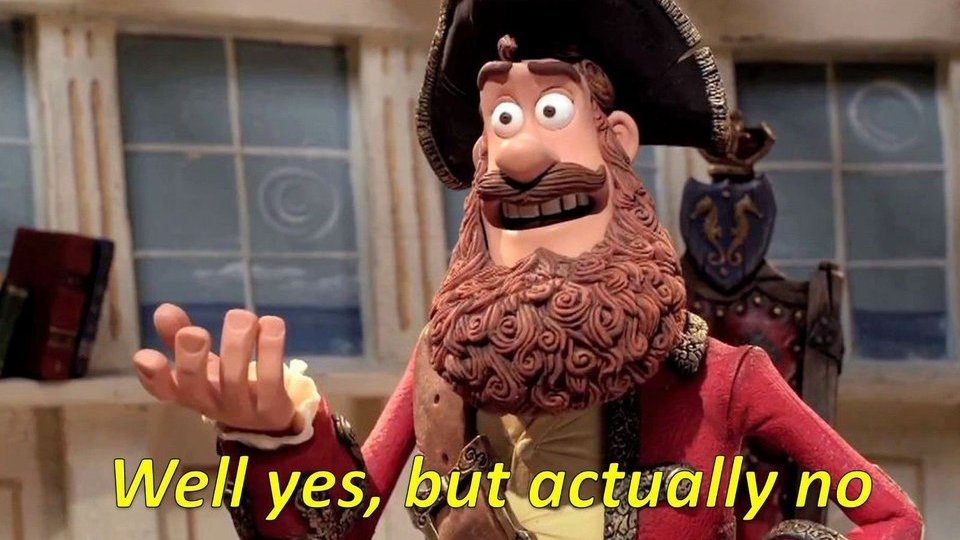
Image result for well yes but actually no

Digital tools may be awesome and nigh indispensable, but to me, if you’re a writer, you can’t get away from the written word. The literally written word. You know: you learned to make them in grade school? You hated every minute of it? Your craft for creating it atrophied over time like a vestigial tail until now your written words look like the frenzied scratchings of a terrified animal on your back door?

Handwriting. There’s something almost magical about it, about putting words to paper directly using your hand and an implement designed to put marks on things. I do rather a lot of handwriting lately (and it’s more than a little bit of the reason I haven’t posted here as much in the last year or so — because what I would otherwise be blathering into the digital expanse I instead scrawl into my growing collection of Drivel notebooks) and I have strong feelings about it. A keyboard and computer (or, if you really, really insist, a typewriter… hnngggrrrrrh) is great for getting the words from your brain to the paper quickly — maybe maximally quickly (barring text-to-speech dictation programs but there I will grind my heels into the earth, fold my arms across my chest, and gruffly direct you to GET OFF MY LAWN). But maximally quickly is not always the best way to do a thing.

Handwriting, for me, forces me to slow down a little. Not a lot — I scribble pretty fast, and the crooked, haphazard stumble of my words on the page belies that — but I can’t write by hand as quickly as I type, not even close. When typing the words race out almost as quickly as I can conceive of them; when writing by hand, there are mental pauses as the hand catches up. Each next sentence gets to rest just for a moment, gets to simmer in the cognitive juices for a second or two before it goes on the page. I become more engaged with what I’m writing precisely because I have to slow down and I get the time to think about it.

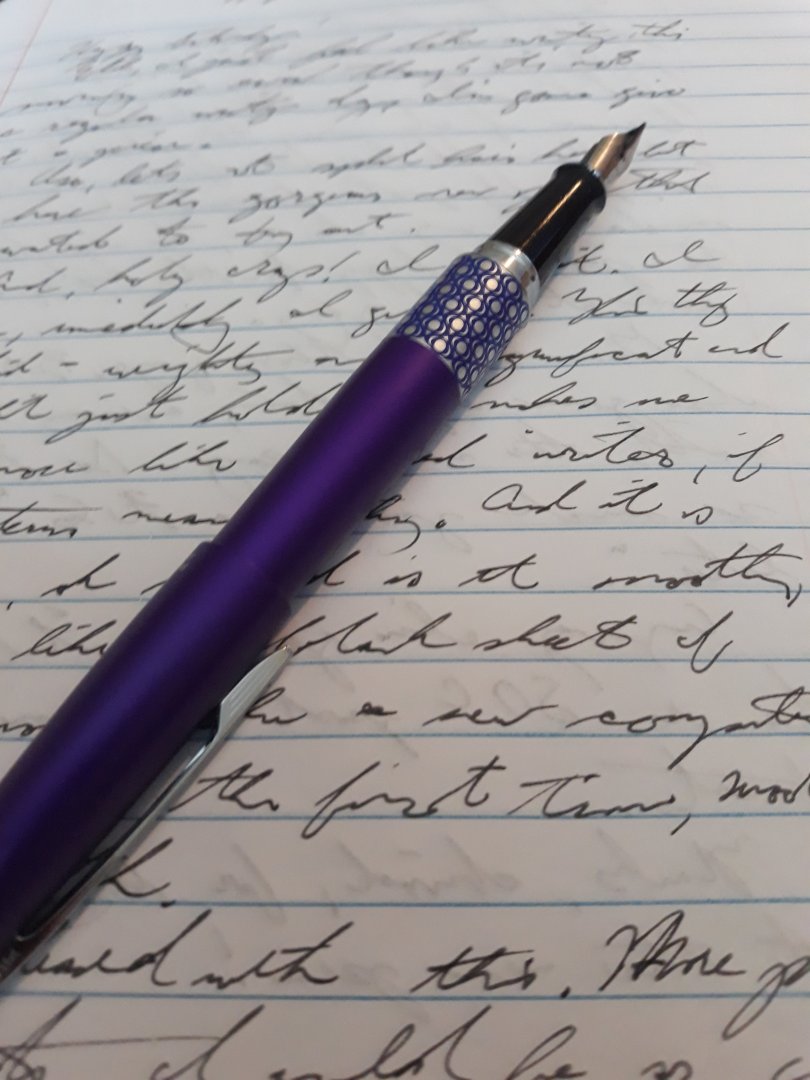
So I take my writing by hand (but not my handwriting — because YEESH look at that picture up there) pretty seriously.

Then I went and did a dumb thing last year. I listened to a podcast featuring Neil Gaiman. There, Neil talks about process and experiences and all sorts of fascinating things (somehow everything Neil talks about seems to become fascinating to me, maybe that’s a character flaw) but along the way, he talked about his fountain pens. Something, I believe, about writing his first draft of American Gods in these stacks of notebooks using this series of fountain pens, and how he could retrospectively tell where he was and how he was feeling based on the ink and the color and all of that. Really singing the praises of his tools. (And of writing by hand, too, for that matter.)

And I thought, well, I’ve got to try it. This is a thing that a Real Writer does, I want to be a Real Writer, ergo, get out of my way while I plunk down some dollars to get me one of these things.

So I dithered a little bit before buying a fountain pen of my very own: A Pilot Metropolitan in purple, if you must know. I may have posted about it before. I certainly tweeted about it. (Twitter being the perfect place to boast about such trivialities.)


And I loved it! It wrote smoothly, but not just smoothly: like gliding across a frozen lake on skates made of butter. It was heavy and satisfying in the hand like a candlestick before you bash in Mr. Body’s skull, and the tip and the whole feel of writing with it was just so classy even though what I was using it for was so pedestrian and boring. It felt like putting on a dinner jacket to go to the grocery store.

It was my “Writer’s Pen,” the tool I not only wanted to use for my daily writing, but the one I needed, the one that made what I was doing feel special.

And then I broke it.

I mean on the one hand, the glib “this is why we can’t have nice things” quip is made for situations like this. On the other … I really liked my fancy pen.

I was preparing for my morning drivel session, perhaps holding a freshly steeping cup of tea in my other hand and my notebook and The Pen in the other, and it slipped through my fingers. Straight down, it dropped. Like a torpedo, or more accurately, like a Kamikaze pilot. Landed right on the nib (a horrible word for the business end of a pen like this, a word I never knew before I looked into fountain pens, a word that still makes me squeamish and giggly to use). You know when Elmer Fudd points his shotgun at Bugs Bunny, and Bugs sticks his finger in the barrel, and when Elmer pulls the trigger it goes off and blows the barrel out like a spent banana peel? That’s what the end of my pen looked like.

Well, looks like, because there’s no fixing it. These things — these nibs (squee!) — are machined and measured with meticulous precision to allow for air flow and capillary action with the ink and, well, there’s no repairing it. It was broken. Not only was it broken, but you can’t (to my knowledge) buy a replacement nib (tee hee!) for this pen — they’re just not expensive enough to justify it; you’re better off just buying a new pen.

And, sorry, I’m a teacher. Disposable income ain’t a thing I’m well acquainted with. I spent $12 on the thing the first time around, I wasn’t gonna spend another twelve bucks for a second one that I am surely equally likely to break given enough time (enough time, in this instance, being probably about three or four months seeing as that’s how long this one lasted me).

So I did my writing with a lesser pen, one of my old soldier Pilot G2’s. Until, a few days later, I misplaced that pen (having no particularly strong feelings for it) and had to do my drivel with a still lesser implement, a “Clik-Stik” out of a dollar store multipack.

Neandarthalic.

But here’s the thing — as soon as I settled into a groove (which when writing by hand now only takes a few lines — a fraction of a minute) I wasn’t paying attention to the cheap pen in my hand and how it wasn’t my beloved fountain pen. I was paying attention to the words, to the process, to the writing. You know, I was paying attention to what mattered.

And then I rethought the whole thing. Having the fountain pen (and worse, relying on it) sort of flies in the face of my whole oeuvre: that brands don’t matter, money doesn’t matter, what matters is that you make the best out of what you’ve got, and who gives a Fargo if you’ve got the latest luxury sneakers on your feet or if you drive the fanciest car or if you have a full head of luxuriant hair? I’m a barefooted bald guy driving a twenty-year-old Camry, why am I mucking about with fancy pens?

Because I got distracted, that’s why.

I got delusions of grandeur. I got caught up in the tools of the craft instead of the craft itself and then I suffered this blow to my ego when I broke my tool. (Heh, heh.)

Which is easy to do. You don’t have to go looking for distractions: this is the 21st century on the internet, the distractions find you.

And you know? Sometimes a distraction can be a good thing. Sometimes it can be nice to try something new. Sometimes you want to break out the nice jacket for a quick run to the store. But at the end of the day, what matters is that you remember to bring home the eggs.

(Have I butchered that metaphor enough?)

All that is to say, I have been doing my morning pages for a few months since without a thought towards plunking down the cashola to replace my fountain pen, and my writing — and my thoughts about my writing — haven’t suffered a stitch.

(They’ve suffered for entirely different reasons.)

I haven’t thrown The Pen out. It seems too nice to do that, even though it’s now useless, to toss it aside like trash. It taught me a lesson, after all, and it was lots of fun while it lasted. But now, like the smashed-up drunk-driving car out front of the school during Prom week, it’s there to remind me of something.

To stay focused on what matters.