How Not to Backslide


I talk a lot about how hard it is to do the thing, and especially how hard it is to start the thing. There are endless ruminations — here and all over the web — about how difficult it is to start: how scary and intimidating the blank page is, how difficult to even step out the door in the morning, hell, just the challenge of getting out of bed itself, of reaching for your shoes instead of the snooze button.

And there are endless examples of people asking how to start. Looking for the magic bullet, the one piece of advice, the secret techniques to start them on the path. (s if there were just one. Or even a collection that might work, that wouldn’t require retooling and retweaking every time you go to employ them.)

And you know what? That’s fine. Starting is hard, it’s arguably the hardest step in a project, because you have to get past all that built-up doubt and insecurity, you have to give yourself permission to suck, and all that. Starting the Thing is basically like a mental version of the twelve labors of Hercules.

But Starting the Thing is only one piece of the puzzle, and as important as it is — and it is important, super important — it’s actually one of the smallest pieces of the puzzle.

The bigger piece? Probably the biggest piece? Maintaining.

Maybe this is on my mind because so many of us are entering another week of quarantine — be it self-imposed or otherwise — and we’re getting a little squirrelly. Week 1, we panicked and then we locked it down; week 2, we started getting some routines in place, now week 3 … we’re starting to feel the grind. This is when you need to focus on that other piece. When you have to focus on Maintaining.

See, when you Start the Thing, there’s this bait-and-switch that happens. Yes, it’s difficult. Yes, it seems impossible. Yes, you can’t see the end from where you are — you can’t even see beyond the first turn in the path. But the moment you do Start, there’s this incredible positive feedback loop that kicks into action. It’s immediate. “Oh, man, I wrote a few words on my space zombies fighting dinosaur pirates novel and it turned into two hundred — that feels great!” Or, “Whew, I was dreading starting this run, but I had to take my dog out to pee anyway and it turned into a mile before I knew it.” That happens. It happens often. You do the Thing that you’ve been building up in your mind as SO HARD, then you do it, and you get this great big payoff.

But dopamine is a kind of drug, innit? And like any drug, the more you get, the more you need. The high still hits as you keep Doing the Thing — as you keep adding to your word count, as you keep running the miles, as you keep making that progress — but it’s not like the first time. So you do a little more — you go harder, better, faster, stronger — and that picks up the slack. Sooner or later, though, you hit your limit, whatever that may be. You can only carve out so much time in the day, after all, and the body and mind can only take so much strain … so you can’t just add to the workload ad infinitum. For me, I peaked out at writing for two hours a day, and at four miles per run during the week. That’s what my schedule would allow, and that’s about all I really wanted to do.

That was enough.

So when you’ve reached “enough” — what then?

Then you move to the next phase: Maintain.

And Maintaining is hard. Way hard. Super way harder than starting. Because Starting comes with its own reinforcement. But Maintaining does not.

Gone is that rush of GoodFeel from just showing up, from just getting something done; you know what you’re capable of, so you now have a series of expectations for yourself. You don’t get bonus points for opening your project up, or from just jogging to the end of the street. You’ve got a quota to make. It begins to feel more like work than a new, exciting project.

Worse than that, when you Maintain, you’re by definition doing the things you’ve already been doing. I’ve been stuck in edits on a series of three chapters for the last several work sessions, because there is just so much to be fixed in there. And I’ve run the 5k loop near my house, and all its sundry variations, more times than I can count. These things are no longer new and shiny and exciting. They have become routine.

And to face that every day? To cope with the harsh truth that this thing you wanted to do — this thing you Started full of hope and excitement and a deep sense of purpose — involves, in no small part, drudgery? That’s a harsh truth.

It’s so easy not to maintain the progress, to let slip the work rate. Ahhh, I wrote extra yesterday, I’m gonna let it slide today. Well, I ran long this weekend … I can take it easy during the week. You know, I’ve been plugging away on this project … I’m gonna take a day off. You can be forgiven for thinking that way, and in truth, you’re not wrong to think that way. Accomplishment merits rest. Getting things done should earn you some downtime.

Problem is, you let it slip a little bit, and it becomes easy to let it slip a lot. That rope starts to pull through your fingers and all of a sudden, it’s moving too fast to grab hold of as it whips itself away. The rock rolls past you down the hill, and it’s all you can do to get out of its way as it crashes down toward the bottom.

The only way to Maintain is to return to the work with the same perseverance, the same sense of determination and drive that got you to Start in the first place.

How do you do that?

Simple. You don’t.

Whatever it is that got you to Start the thing carried with it a little spark of magic, a little shock to the system that spurred you to motion where you were once at rest. Like a germ that hits your immune system and forces it to adapt (to use a really troubling though apt metaphor), once it’s struck once, it won’t hit you the same way again.

What you have to do is re-evaluate. Remind yourself why you are doing what you’re doing. Check in on yourself now and then, see if you’re still on the path you want to be on, if you’re still making progress toward that goal you set so long ago, or whether you’re simply coasting along. You stop being driven by the dopamine hits and you start being driven by knowing that it matters.

Turns out all those jerks who told you all your life that hard work is its own reward were right, even if they never explained why (or if they could even articulate it themselves).

There’s no easy way to flick this switch. It comes only from introspection and from a willingness to look yourself in the face and tell yourself the hard truth: that you’re slipping, that you could be doing more, that the work still needs doing and nobody is going to do it for you.

There’s no secret, no magic bullet.

I know, I know. I wrote this whole post out only to reveal that I don’t know a damned thing about how to stick to it, how to keep coming back to it, how to keep your head down and keep pushing forward when it gets hard. Fact is, the only secret that will work is the one that’s buried in your own brain already.

And you’ll either find it, and keep putting in the work … or you won’t.

(I hope that you will.)

We Have To Get Out


You could be forgiven for not realizing it’s Saturday right now.

With much of the US (and much of the rest of the world, frankly — though I haven’t heard much about Australia during this time; care to chime in, Glen?) on lockdown, either enforced, encouraged, or self-imposed, the time begins to blend together. One day looks much like the next. I mean, that’s the case anyway, but it’s doubly so when many of us aren’t seeing our usual coworkers, aren’t going through the usual stimulation of the job, maybe aren’t even leaving the house.

To further add to the confusion, if you’re an introvert like me, you now have the permission of the entire community to get away with your preferred behavior of vegging out on the couch, not going out, and generally keeping the world at arm’s length. You know, the things that, under normal circumstances, people try to talk you out of doing.

Which is all well and good for a few days. But we’re a week deep on the social-distancing, minimize-contact-with-the-world, wash-your-hands-everytime-you-have-an-errant-thought adventure train, and that’s when we start to go crazy a little bit. As any teenager will tell you, you can only stand your family for so long, but it’s not like that feeling goes away when you grow out of your snarling, brooding phase.

You have to remember that you are a product of millions of years of evolution. Our species did not develop so that we could watch endless hours of Netflix while sprawled on the couch shoveling the Cheetos we bulk-bought in a panic into our gobs. We aren’t made for bunkering and hiding.

We’re built to move. We’re built to survive in groups.

One of the most important things to do in a time like this, I think, is to remember that.

Don’t get me wrong, there are great things you can do while you’re isolating, and there are tons of blog posts and tweets to tell you all about the things you can do to stay productive — or be more productive — while you’re stuck inside. And you should maybe do them!

And we also need to understand that, in these trying times, it’s gonna suck. Productivity will take a hit, we’re gonna end up feeling crappy sometimes — if not a lot of the time — and that’s gonna slow us down from the things we want and need to get done. That’s okay, too. We can’t (and shouldn’t) expect ourselves to be perfect during this time, to weather the storm with style and grace and ‘gram-worthy hair the whole time.

But we can help ourselves out — and maybe more importantly, we can help out those who are cooped up with us — if we can remember that we are not meant to live this way and we conduct ourselves accordingly.

That means taking a little bit of time for self-maintenance. My early-morning runs feel more important now than ever. (I’m sleeping in until 5:30 instead of 4:30 to get them done, but I’m still up before the sun, because that’s when it happens.) On the days I don’t run, I’m doing calisthenics and strength workouts in my garage, in the cramped, kludge space I’ve cobbled together between the piles of junk we’ve been meaning to throw out and the Christmas decorations.

But you don’t have to get after it like me (aka like a psychopath).

Get outside for a little while.

Take a walk.

Do some work in the yard or the garden.

Heck, even just opening the window to let a little fresh air into your lair can do wonders for your subconscious self-calibrators of goodfeels.

You need this. You owe it to yourself, and to the family and friends you’re stuck at home with.

The Obstacle Is the Way


I got my world rocked this week, reading up on stoic philosophy.

The stoics are awesome. I don’t even know all that much about stoicism except to say that this is the philosophy of the ancient Greeks — the really smart ones, not the ones who just lounged around in togas all day slathering themselves in oil and lusting after young boys (I mean, okay, the stoic philosophers probably did that too, but they didn’t just do that) — and when you ponder on their wisdom, you figure out that they really had this life thing figured out.

They weren’t religious. They weren’t spiritual. But they also weren’t despairing or existential as you might expect from people lacking religion or spirituality. (I’m not saying lacking religion or spirituality makes you bleak or dark or depressed or depressing — that just seems to be the perception our culture has for some reason, because y’know, a life without belief in fairy-tale creatures in the sky must obviously be a life devoid of joy — but I digress.) To the contrary, the stoics held that because life is devoid of magic and higher powers and providence, it falls to each of us to create our own joy, to create meaning, and to work for the betterment not just of ourselves, but of everybody around us.

This is powerful stuff, perhaps most powerful when combined with certain doses of certain substances and prefaced by sentences like “you know, man,” or “dude, I just realized” spoken at three in the morning. But still powerful enough when consumed in bite-sized quotes from the internet or delivered daily to your face by your magical pocket-sized telecommunications device. (I have an app called “The Stoic” that serves up a quote from a stoic philosopher every day. Yes, I am a nerd. I love it. Today’s nugget, from Marcus Aurelius: “The happiness of your life depends upon the quality of your thoughts; therefore guard accordingly.”)

Anyway, all this is to return to my original point. I got my world rocked by a central tenet of stoicism: The obstacle is the way. I read that and I realized that it’s perfectly in line with my thinking of late, with my recent productive streak, with the through-line of all the nonfiction books I’ve been reading lately about the way we think, the way we connect, and the way the world affects us.

See, we think of obstacles as bad things. I want to go a certain place, do a certain thing, and this other thing is in my way. This other thing is keeping me from the thing that I want. How could that not be a bad thing?

But it’s not a bad thing. It’s just life.

Because the things we want are, by necessity, on the other side of things that are unpleasant. Put another way, if there weren’t unpleasant things in the way of the things we want … we’d just have them. We’d go over there and get them and there’d be nothing stopping us. To put it in concrete terms: I want to publish a book. (Preferably, books, plural.) But first I have to write it, edit it, make sure it’s good, get it into the hands of an agent, then to a publisher. It’s gonna take work. A LOT of work. Hours and hours at the computer, hammering the words into shape and arranging them just so. I also want to be healthy and strong for my family, so I can live a good long time and annoy them for decades to come. That, too, takes work: it takes thinking about what I eat instead of just shoveling donuts down my gullet (which I would prefer!), it takes making time to exercise (which in my case means waking up at five in the morning to get it done before anybody in the house is even awake). Not easy. And while I’m at it, I’d like to ensure my job security, which means challenging myself at work to be not just a decent teacher but a good one, which means improving myself and investing in my students and a bunch of things it would be easier not to do.

We have all these things that we want, but the path is littered with these obstacles. Big or small, minor inconveniences or major heckin’ setbacks, some struggles you can work past in a day or even an hour, others you can’t even see the end of from where you’re standing. The obstacles are out there, and they’re not going anywhere. My books aren’t going to write themselves. I’m not magically going to discover an extra hour during the day to work out on my own time. I won’t become a better teacher by doing the same things I did last year and the year before.

And that’s enough to keep some people from doing these things. It’s easier not to face those obstacles, to keep things as they are, to accept what you’ve got and be complacent. (I was going to write “content” instead of complacent, but there’s a big difference in those words. And there’s something to be said for feeling “content” with what you have, but it’s another thing entirely to be “complacent”.) I mean, I lived with my parents until I was thirty. Because it was easy. I’m not particularly proud of that, but it did lead me to the path I’m currently on, which makes me thankful for it, even though I now lament how much time I wasted.

But the path to Better is laden with obstacles. Which means that the obstacles are the way forward.

Image by skeeze from Pixabay

When we can view the world in this way, the obstacles become less scary. They cease to be bad things, they cease to be things to be avoided. Viewed this way, obstacles become welcome. They become necessary.

And when you tweak your brain enough, you can even begin to view obstacles as a good thing.

The obstacle is the way.

Are you on the path?

This post is part of Stream-of-Consciousness Saturday.

This is Fine


Just as a brief follow up to my story from a couple of weeks ago — these handsome fellows have been on my lawn this morning. Literally for hours. Working over a dead squirrel that got mushed yesterday.

And yes, that is a graveyard behind them. Yes, I live across the street from a graveyard.

This is a good sign, right? No chance at all that this could be a horrific omen of disaster, right?

Nobody Knows How to Do the Thing Until They Do It


Once in a while, a man of a certain age gets it into his head that he’s capable of certain things; certain things that he never thought about before. And depending on how much of an idiot he is, he may actually try his hand at these things with varying levels of disastrousness.

Which is my cheeky way of saying I re-did the floors in my basement this weekend.

I should preface by saying I don’t feel I’m particularly handy, which I will then undercut by saying that over 10+ (help!) years of homeownership I’ve done drywall repair, replaced toilets, fixed a ceiling (never do this by yourself) twice (definitely don’t do it twice), replaced faucets, rewired lighting fixtures and garbage disposals, and any number of tiny fix-it tasks around the house.

So maybe I’m slightly handy.

The usual pattern — almost without deviation — is as follows.

  1. Notice the thing that needs doing
  2. Ignore it for a few months
  3. Get annoyed by the thing in a heated moment
  4. Get good and angry and watch a few how-to videos
  5. Go to Home Depot and buy about 2/3 of the required supplies (possibly also buying the wrong items)
  6. Attempt the repair, in the process removing the original thing or damaging it beyond repair, thus moving past the point of no return
  7. Screw up and start over
  8. Slink back to YouTube covered in grime to watch more how-to videos
  9. Attempt the repair again, going slower and super cautious not to make mistakes and screw it up even worse
  10. Realize I’m short on supplies or have the wrong equipment, go to Home Depot again
  11. Finish the job in roughly twice the time the how-to videos suggested it should take
  12. Feel immensely satisfied
  13. Spend the next several weeks to a month cleaning up the mess from the job
  14. Get annoyed over new thing, repeat process

I’ve done this over a dozen times, now. So I dunno what I was thinking, thinking I could handle a large basement room (plus an angled hallway) in a single day, but there I found myself, standing by a stack of floor planks, ready to rip up the carpet.

Needless to say, the pattern held. I was a box short of enough planks to finish the job, necessitating a return trip to the HD. I didn’t know what the fargo I was doing installing the stuff, resulting in a totally crap job after four hours of work covering about 15% of the room that had to be disassembled and started over. I tore up the walls taking the baseboards off, a subsequent repair I have yet to properly tackle. And instead of finishing the job on Saturday evening, it took me until late Sunday afternoon before I was satisfied enough to call the job “done” (barring the unfinished baseboards and the aforementioned holes in the wall).

And as with everything, or at least, as should be the case with everything, there were some lessons to be learned in the doing. Here they are, in no particular order.

The hard part is starting.

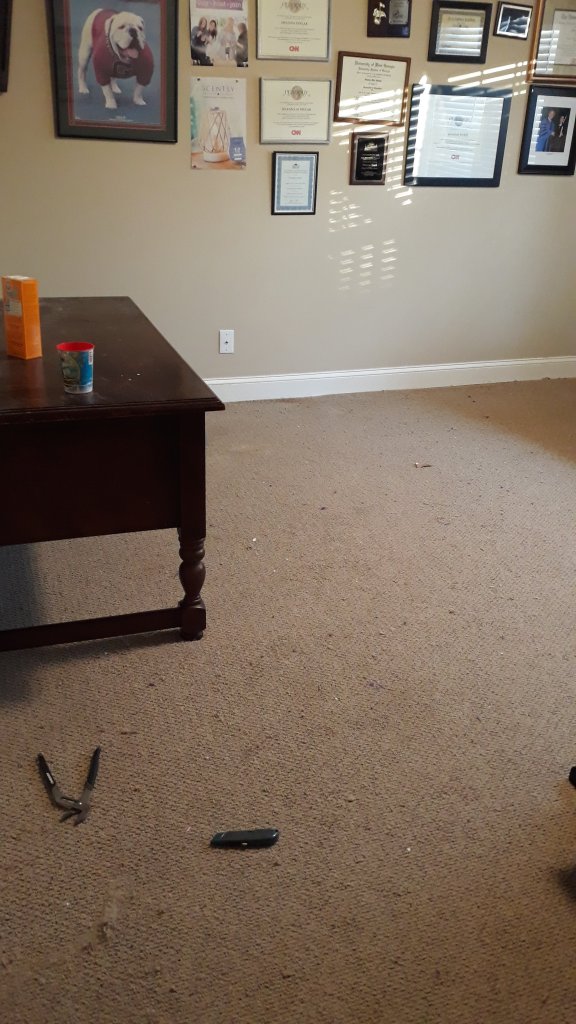
Before. Bonus points: All those plaques and awards belong to my wife. My awards are on the same wall. There just aren’t nearly as many of them.

This isn’t news to me: every time I run, I have to convince myself to step out the door. And the first mile is nothing if not mild self-torture. Every time I sit down to work on my novel, I hesitate: do I really want to put myself through the pain of working on that project? Can I really face the task of pulling words out of the nothing in between my ears? The starting is the hardest part.

As I stood there, pliers and pry-bar perched in my hands, staring at the carpet before me (which I hated), I hesitated. Once I start, there’s no going back. And the doubts were the same. I’m not up to this task. I don’t know what the hell I’m doing. I shouldn’t be doing this at all; I should hire a professional.

But up the carpet came, and from there, it never made sense to stop. Just like the run — as soon as I’m out the door, it feels foolish to even think about going back. Just like the novel — as soon as I’ve written the first word (or deleted it, as the case is lately), stopping or going back seems idiotic. Take the first step, and the rest of the steps follow after quickly, almost automatically.

You’re going to screw it up

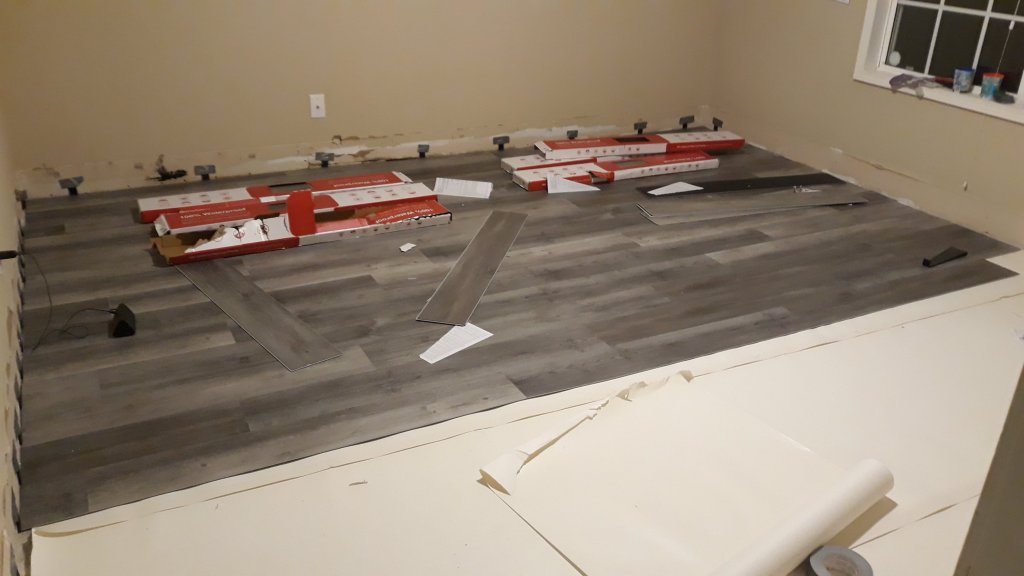
Finally making progress … eight hours later.

Fix-iteering is about trial and error, it’s about testing yourself, it’s about learning. And unfortunately, nobody starts life knowing how to lay down laminate planks. (Or, for that matter, knowing how to write a novel, or how to run long distance.) You figure these things out by taking that first step, screwing it up (perhaps even catastrophically), learning your lesson, and coming back to the task like Rocky getting up after Creed has brought the thunder to his skull for the forty-seventh time.

Once the carpet was up, I started the job the way I thought it was to be started — and it didn’t work. So I scrapped it and started over, and it still didn’t work. So I started over again and I thought it was going better, until the wife came down to check on me and the look on her face told me I still didn’t have it right. This was four hours into the work, by the way. I was ready to stop, return all the flooring to HD and pay triple to have the carpet replaced.

But I didn’t. Partially because that’s not how you grow, partially because I’m penny-squeezing cheap, and partially because …

You can’t do it alone

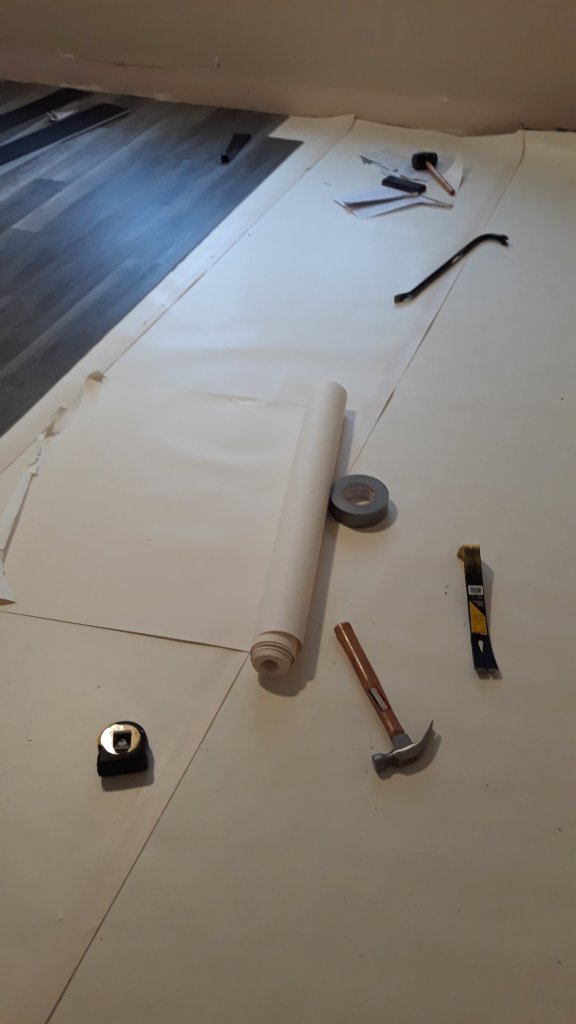
Laying the floor turned into a family affair. First the wife came down — bless her — and helped me puzzle over the process, pick a new starting point, and convinced me to apply a little more force — a little more EFFORT — to the task than I had been comfortable doing before. I had been afraid to damage the flooring, but it turns out, to make this stuff click together, it takes a bit of percussive maintenance (i.e., a few — or a few dozen — whacks with a mallet). Then my father — bless him — came over to help out when he learned that I was not nearly finished with the project by 7pm as I had naively boasted that morning, but rather just starting over. We listened to the Beatles, who usually I can’t stand, but somehow under the circumstances quite enjoyed, and laughed as we figured out the tricks and the techniques to get the job done.

Come to think of it, my brother helped me move the furniture out of the room before I actually started the job — and would come over again several days later to help me bring it back in. My mom would offer to help re-paint the trouble spots afterward. Even my seven-year-old son would help me out with the cleanup afterward, doing what would have been the backbreaking work of pulling spacers off the walls, had I been the one doing it.

We all have a lot of sweat equity in the finished product, which makes it feel a little sweeter, a little more satisfying, a little more ours.

And, you know, the running and the writing are like that, too. Sure, these are activities completed mostly on one’s own — but comes a time you need other people to check on your work, because they’ll see it in a way you don’t. Comes a time you’ll want a running partner, because it’s too hard to get out the door on your own if you don’t have the extra obligation of somebody counting on you (even if the somebody goes on four legs).

Point is, no man is an island, even when he’s laminated himself into a corner.

Starting day two.

Finishing feels incredible, no matter how long it takes

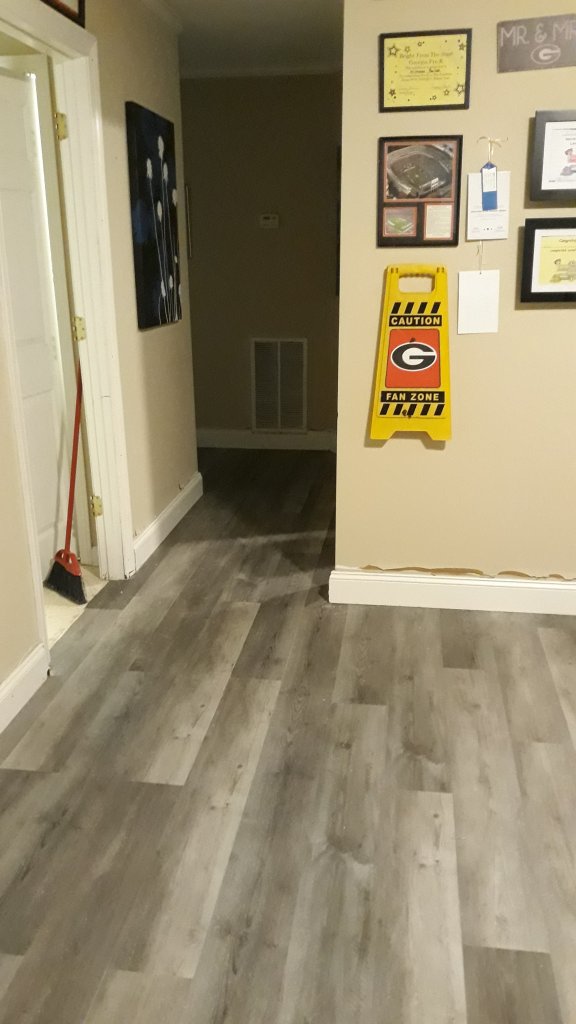
Long story short (too late!) we have brand new floors in the basement. And they look bloody awesome.

Not bad for a Drama major. Now about that drywall…

And yeah, it took about nine hours more than I expected. And yeah, working my butt off for two days wasn’t what I wanted to wrap up our vacation days. And yeah, I was sorer than I’ve been in recent memory. But the floors are done, and I love them; not just because they look great, but because they’re also a symbol.

They’re a symbol for all that hippie-dippy stuff I was talking about up there; a symbol of teamwork and of willpower and of tenacity. And above all, they’re a testament to the fact that if you put your mind to it, as George McFly once said, you can accomplish anything. If you decide to do the thing, and undertake the task, you can get it done — as long as you’re willing to suffer a bit, learn from your mistakes, and keep hammering away, you can do the thing. Be it running your first mile, writing your first chapter, or laying down the floors in your basement. Do the thing.

Even if you have no idea what you’re doing.