Savage Race Recap: Blow-by-blow part 2


Disclaimer: This is the second part of a race report. If you care about continuity, the first part is here. If you think that running and obstacle course races are endeavors fit only for the insane, well, you might not be wrong, but feel free to skip this entry. If you’re intrigued by all this, you can find lots of pictures and in-depth descriptions of these obstacles at Savage Race’s website. Now, onward!

For a guy who runs mostly roads, it’s challenging enough going off-road. The footing isn’t as sure, the hills are ubiquitous, and you have to watch your every step for roots and rocks and, in this case, horse sharknado. From speaking to a few finishers before my wave started, I know enough to know the hills are going to be nasty, but I’m still not prepared. The first half mile of the course takes us down from the start line, up over a tree-lined hill that we couldn’t see past before, down again across the inline toward the lake (which has us leaning sideways to keep our balance), and back up again to get into the woods proper. As we roll down into another valley, we have to cross this tiny stream of runoff,  just wide enough to be unhoppable. Racers are hesitating and trying to pick a dry footing across. I shake my head in wonder. This is a mud run, isn’t it? And I pile ahead, right through the stream, kicking up spray and mud in my wake, and I hear the splashing of other feet right behind me. I immediately wish I hadn’t, though — mud run or not, running in wet shoes is not fun, and with all the hills and cambers, my feet and toes are sliding around and raising blisters already.

Despite all that, I can feel myself breaking the first rule of racing: don’t go out too fast. I can’t help it, though — the adrenaline is surging, I hear the light tromping of feet all around me, and there’s a cool breeze through the shaded paths, so that even at ninety-plus degrees outside, the running feels like heaven.

But we’re at the first obstacle: a pair of fences made of widely-spaced two-by-sixes about eight feet high. I don’t break stride — from my run I hop onto the fence and climb it like a ladder, toss my legs over, and drop to the ground. One down, and while it was hardly a challenge, I’m exhilarated. Then it’s through another patch of trees, and I see barbed wire stretched low across the ground. I’m preparing to drop to my belly when I see another racer lay out sideways in front of the obstacle and begin to roll through the dirt. Well, that looks a lot easier than commando crawling, so I follow suit. What I don’t notice is the downhill grade in the second half of the obstacle, and by the time I roll out the far side, I’m not so much rolling as tumbling. Clear of the barbed wire, I sprawl out and watch the sky spin crazily overhead for a few seconds before I stumble to my feet. I’m not the only one spun like a top, but we master it and truck on.

It’s a hot minute, fully a half mile of hills and trees, before it’s obstacle time again: another field of barbed wire. Didn’t we already do this? No, this one’s different — in addition to low-slung barbs, this one has lanes marked off with wire as well. No rolling through this one — it’s time to crawl. As I’m shimmying along, I hear the inevitable skritch of a snagged shirt and torn skin; the guy next to me just popped up too high and paid for it. Meanwhile, on my other side, there’s a commotion of rustling grass and a cloud of dust as another guy rolls past like Wile E. Coyote on rocket skates. Basic training comes in handy, it seems.

A bit further on, there’s a deceptively simple-looking set of chest-high pommel horses that must be vaulted; I clear them pretty easily with a half-cartwheel, half barrel-roll over the top, but I see lots of folks getting tossed on their backs as they hit the far side, or unable to get a grip enough to clear them at all. What’s easy for one is never easy for all.

Just after the start of mile two is the first obstacle that looks truly imposing, the strangely named “Venus Guy Trap.” If you’re picturing the jagged, toothy plant laid open for a fly, you’re not far off; this is a set of two ramps at 45 degree angles facing each other across a mud pit. You must first climb up the seven-foot back of the ramp (and the lip hangs well over the support, so you’re really dangling), navigate down the one ramp, tromp through the mud, and then do the same thing in reverse, except now you’re slippery from the mud. I watch a few people attempt it before trying my hand; some can muscle right over the edge, others can’t even get their hands on it. Well, hell. You got me, and I got you, right? I step up to a struggling racer, make a platform of my hands, and offer a boost up; figuring if I invest some karma now, it’ll be there for me when I need it later. I boost three people over the first lip and then turn around for my own attempt, and here I’m surprised again; turns out I can make the climb just fine. Not exactly graceful, but I clear the edge and roll down the ramp with no trouble. That’s the first daunting task, but it won’t be the last.

But here, again, this race is shaking up my preconceptions. Because there are people in the race who are clearly not physically fit enough for an obstacle like this, and I’ve been wondering just what the hell they were thinking, signing up for this thing. Case in point: there’s an older guy I’ve been gaining on for the last quarter mile who I finally catch up to at these two ramps. He’s overweight, too, and clearly struggling already just from the run, even though we’re only two miles in. To add to the indignity, his shirt is torn from the barbed wire a half-mile back. But he’s not in it for himself; he’s here to support his daughter. As they approach the obstacle, he wordlessly hustles up to the base of the climb and goes into a wall-sit, offering her both his knee and his shoulder to help her get to the top. Once she’s over, he hoofs it around to the far side to meet her on the other side. And suddenly I feel a little bit like an a-hole for being so judgey — everybody comes to this test for their own reasons. And the family that runs obstacle courses together…

The next mile has a handful of challenges that look tougher than they are — there’s what looks like a giant Swiss cheese wedge and a traverse across chain-link fences suspended over murky water, both of which are easier than they look. Then a few that are designed to make you uncomfortable and literally cover you in mud and muck: these are ditches with barriers submerged in the water/mud that you must crawl/swim/claw your way under to advance. If dignity was intact before this point in the race, it’s gone now — we are all unidentifiable orange-brown foot soldiers tromping off to new discomfort.

But in the midst of all that is another challenge to the spirit: one of the simplest obstacles yet, but a doozy nonetheless. This one is simply a free-standing wall eight feet high that offers no handholds or footholds. Nothing but upper body and scrambling feet will get you over — and maybe a leg up from your fellow racers. But I clear this one on my own as well, surprising myself again in the process.

We’re through eleven obstacles now, and three miles into this six-mile affair, and I’m already noticing changes in myself and the other racers. Not nearly as many people are running in between obstacles; myself included. I’m still jogging the straightaways and the descents (where I can manage it without risking a catastrophic tumble), but anything more than a gentle incline has me walking, and the course is stingy with anything gentle, even leaving the obstacles out of the equation. The walking is not terribly surprising, though. What’s surprising is that as the obstacles get tougher (and make no mistake, there’s a pretty steep difficulty curve the farther you go, which is actually kind of cruel … you might say SAVAGELY cruel, okay, I’m sorry, I won’t make that joke again), the people attempting them get fewer, and the camaraderie among those that fling themselves into the maw strengthens. Kind of like a chinese finger trap — the harder you work against it, the stronger it becomes. Those of us who try every obstacle get more determined, we help each other more, and when we succeed, there’s back-slapping and high-fiving and primal screams all around.

There’s a high in all this. As much as my body hurts more and more the further I go, there’s a sort of euphoria settling in. It’s not a runner’s high (although to be fair, I’m not sure I’ve ever actually experienced one of those in five years of running). The pain doesn’t disappear and give way to magical feelings of well-being and serenity. The pain is there, lurking in the back of the mind like a murderer hiding in the basement in the latest slasher flick. But who cares about the murderer in the basement when there’s a crazed, endorphin-fueled party going on upstairs?

I’m starting to see why this OCR has become such a thing. I came to the race alone, but now I’m recognizing the faces of the handful who are on the same pace as me. We’ve become almost a family flung together in this gauntlet; we kvetch and moan about the brutal hills, we encourage each other in the run-up to each new obstacle, we wait with hands outstretched as each of us muscles through the next struggle. I don’t even know their names, but I know their shouts of jubilation and their groans of agonized defeat.

And I’ll hear a lot more of both in the second half of the course.

Concluded here.
 

Savage Race Recap: Blow-by-blow part 1


Disclaimer: I ran my first obstacle course race this weekend, and it was awesome. I gave a sort of holistic overview of the whole race from this past weekend, and that overview is here. But it occurred to me that one, I left out a lot of what I was thinking during the race, and I wanted to get those thoughts down. And two, if you’re reading this and thinking of signing up for a race, having a blow-by-blow account might be more helpful to you than some unfocused, broad thoughts on the whole thing. So what follows is that account of the whole run. It might take a couple of posts. Skip at your pleasure!

It’s 10:30 on a Saturday morning, and I’m walking through a cow pasture.

I parked the family van in the grass after driving it a half mile down a gravel drive in rural Dallas, GA, and now I’m following the crowds of people toward the top of the hill. The low sound of birds gives way to the drone of human voices the closer I get to the staging area, and before I know it I’m surrounded by people: musclebound men and women who’ve already run and finished the race, and some more moderately dressed folk (like myself) who have yet to run. Some of them look as uncertain as I feel — other first-timers, I suspect — others swagger around the commons, lounge around the tables and the food trucks, or stretch casually by the starting line. Some are individuals. Some are friends. Some are co-workers. Some are families.

This is Savage Race — a mass of humanity about to embark on six miles of pain in the backwater hills of suburban Atlanta. All of us have spent the past months if not years training for the event, but how do you train for an event that has you crawling through mud, jumping like a lunatic from a twenty-five foot height into murky water, vaulting over walls and fences, and slithering under barbed wire?

I’ve previewed the course and the obstacles dozens of times in the months leading up to now, but being here is different. Down the hill there, at the bottom of the pasture, I can see racers on the course trudging up and down a series of rills with long wooden beams across their shoulders like Jesus on his way to the crucifixion. In a little gully off to the side is another leg of the course that features a series of grooved telephone poles that ascend toward a cowbell. I watch a few racers clamber adroitly across the maze of poles and whack the cowbell triumphantly; I watch several more slip off the second pole, unable to find a foothold, and walk on, shaking their heads in frustration.

At the top of the hill is the big one: the monstrous sixteen-foot quarter-pipe ramp outfitted with knotted ropes and smeared with mud from the failed attempts of would-be climbers sliding back down its face. That’s Colossus, the final obstacle on the course, and it’s flashy, but it’s far from my mind.

I’ve been at the gathering areas of dozens of races, and the atmospheres are as varied as the events themselves, but the central area for Savage Race is a unique animal. It’s part tailgate, part wildlife retreat, part bacchanalia. There’s the usual array of merchandise tents, packet pick-ups, and volunteer stations. Then there are the tents set up by participants and their cheering stations, complete with kegs and captain’s chairs and college logos. There are food trucks and a surprisingly well-stocked beer stand (attached to every participant’s bib is a voucher for a free brew, which they rightly advise you to detach now and store safely, as it is likely you’ll lose it on the course). And then there are the people.

The participants at any road race tend to be a fit bunch, but this goes a step further. About a third of the men are shirtless, and would look right at home in a promotional spot for 300. The women, alike, are dressed to show off their gym bods, many with their bib numbers inked on their shoulders (pictures during the event are sorted by bib number, so this is a good way to find your photos even if your bib is hidden, say, underwater, in a shot). Lots of beards. Lots of tattoos. Lots of skintight clothing. Superhero shirts and custom-made group tees: Bailey’s Badasses, for one. But there’s a fair contingent, like me, a bit more modest, watching from the fringes, trying to take this all in.

The course is set up in a strange, almost clover-like arrangement, so that the runners pass again and again near the central area. As such, you’re often in view of other obstacles on the course and other participants in various stages of distress depending on what particular pain they’re undergoing at the moment. So it’s a lot to take in. But there isn’t much time for that, now. My heat departs in five minutes, so I make my way to the starting corral, where I line up next to a couple of guys dressed in Dragonball shirts and wigs and a dude who looks like a black version of the Rock. Suddenly, I feel very out of my depth.

There’s an announcer at the starting line, which is a novelty. He asks how many are repeat racers, five-time racers, and finally, how many Savage Virgins are with us today, to a chorus of WHOOOOOO’s each time, and I throw my lot in with that last. He tells us what we already know: that the next six miles are designed to test our limits, to punish us, to show us what we’re made of. He invites us to stare down the people in the corral with us, to see which of them each of us is going to beat to the finish. I keep looking at the Rock (this is the last time I’ll see him — he leaves me behind early) and the Dragonball guys (surprisingly, I’ll see them again and again throughout the event), and feel pretty confident that I’m going to be in the bottom third of this particular heat, but who cares? We’re all shouting and laughing and high-fiving and chanting “you got me, and I got you,” and even though I’m the kind of guy who stays silent when Gene Simmons comes onstage and demands are you ready to rock???, I’m hollering and shouting myself hoarse with the rest of the Savages. It’s all very cult-ish, all very for those about to rock, we salute you.

And then we move to the starting line, and the gun sounds, and the waving, sun-baked grass stretches out before us.

And we run.

Continued here.

Effing Savage — A Holistic Race Report


Not that it’s any surprise to anybody around here, but I love running. So much so, that I keep doing it even when, perhaps, it were better for me to take a break — just look at my plantar fasciitis that’s plagued me for the last three years or so. Can’t help myself. If I have a drug addiction, that drug is running.

Still, there’s not all that much to it, is there? You put one foot in front of the other, a few thousand times, you crank up your heart rate, and aside from a few changes in scenery, that’s about the end of the show. You change it up now and then — try a new route, take it off-road, sign up for a race and run with a few hundred other masochistic souls — but the soul of the run doesn’t change.

As such, it’s been a while since I ran a race. One race is pretty much like another, and I’ve done them.

But lately, there’s been this critter scampering around like mad outside the gates, recruiting the unwashed masses into its ranks, howling at the moon and slathering themselves in mud.

Obstacle Course Racing.

Part distance running, part American Ninja Warrior, OCR is this weird, primal thing that fact-checks your fitness and puts you through the effington wringer for the pure, unadulterated hell of it. OCR feeds you into the maw of pain and ugliness and sweat and blood and even, sometimes, fear, chews you up and spits you out. Like Fight Club, it takes guys that are lumps of Jell-o and, after a run through the gauntlet, leaves them carved out of wood.

Savage Race Georgia is a 6-mile gauntlet of some of the nastiest hills you’ve ever seen; lunatic ascents and mad, breakneck zig-zagging descents across woods and pasture that had us — people who paid to be put through pain — shaking our heads wordlessly at each other. In the 90-degree heat, even without the obstacles, the course would be nasty; with 27 obstacles, it really becomes brutal.

I signed up for Savage Race some months ago, enchanted with the idea of this OCR thing and looking for a new test when it came to my running. I ran it this weekend — actually, “ran” isn’t the best word, because I found myself walking a fair portion of it –and learned a few things in the process.

20160924_153622.jpg
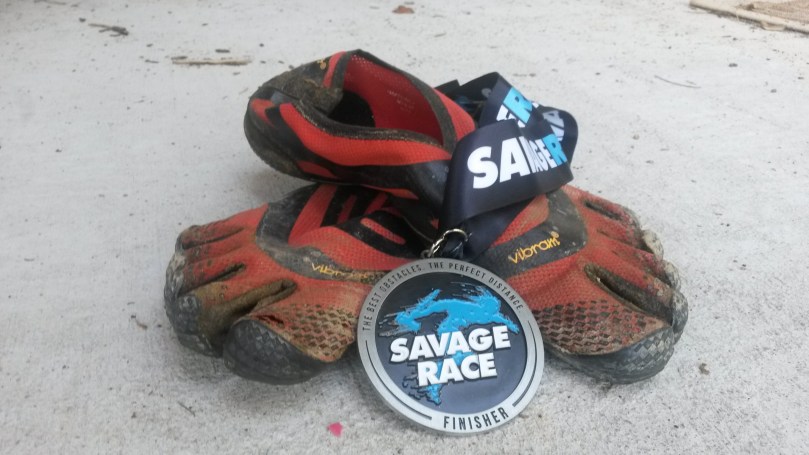
Surprisingly enough, my toe-bags held up for the race. I got more than a few weird looks for them along the way — but I saw a bunch of others rocking them, too.

First of all, I’m nowhere near as fit as I thought I was. I finished in the top 50% — both overall and within my age group — which I thought was pretty respectable! But as much as I pride myself on being a runner, I ended up walking almost all of the ascents and walking a hell of a lot of the gaps between obstacles. I was just that spent, and just that gassed by the obstacles. I knew Savage Race was going to be a test, but I didn’t know it was going to be that hard. Picture wrestling an angry seal while climbing a ladder slathered in muddy, oil-slick Georgia red clay, and you get a sense of the exhaustion and the tenuous hold you have on yourself during the event. I finished — in a humbling two and a half hours, when I thought and hoped I’d finish in under two — but not without some serious digging and introspection along the way.

Despite a lot of training — even training specifically tailored to this race — I came up short on some of the obstacles. A declined climbing wall dropped me at the halfway point. A diabolical, jagged up-and-down monkey bars tossed me in the drink just past halfway. And a seemingly simple gauntlet of ropes and rings threw me to the ground just shortly after the start. Failures notwithstanding, even succeeding on an obstacle isn’t the end of the road. On an unassuming series of what were basically telephone poles with tiny footholds calling for a climb-and-traverse, I completed the obstacle, but couldn’t find a safe dismount and fell right on my ass; an impact that still has me sore a few days later. Even the victories left me bruised.

That said, I did better than I hoped in a few areas, as well. I only failed to complete three obstacles, and those were the ones I knew would be the biggest challenge of the bunch. I overcame some of the obstacles that I thought would unhorse me, and I’m happy to say that I at least attempted every challenge that the course threw at me (and I saw a lot of folks — even folks who looked fitter than me — walking around some of the nastier obstacles), even knowing I was likely to fail. Even the failures were fun, no matter how humbling.

And finally, camaraderie. This is the biggest thing that wowed me about this event, and even expecting it, I was blown away. Because while the elites might be able to handle everything this event throws at them without assistance, the average Joe is going to need a little help. At the start of the race, we chanted to each other: “you got me, and I got you.” Well, I gave help where I could, and I got help when I needed it. And road races are great for putting you in the midst of other masochists like yourself, but it’s a totally different experience to literally give your fellow pain-chaser a hand up over mud-slick wall as you chase your finisher’s medals together. But you get what you give: on the last obstacle of the race (a towering quarter-pipe ramp called Colossus), I found myself dangling fifteen feet above the ground from a slippery, knotted rope, inches from the ledge I was trying to reach. My muscles burned, my hands screamed, and I felt the rope slipping away from me. Just above me, on the ledge, a guy whose face blends into the mud-coated masses knelt with his hand out. With my teeth gritted against the strain, I couldn’t speak, but my face must’ve done the talking. “I’ll help you, man,” he said, “but you better grab that ledge first. Grab it.” And somehow, I did.

Image result for savage race

So here’s the thing. It’s three days later, and I’m still sore. My upper body feels like I was put on the rack and stretched by a man in a black mask. Below the waist, I’m covered in nicks, scratches, and bruises from throwing myself against all manner of walls, crawling through tunnels, slogging through mud patches. My hands took a beating like I haven’t seen: I’ve got ripped calluses, rope-burned fingertips, and mud shoved up under my fingernails almost to the cuticle. Savage Race beat me like a rented mule and left me in a quivering pile of raw nerves and burned-out muscle.

And I can’t wait to do it again.

If you’re on the fence about trying one of these races, stop hesitating and do it — if nothing else, you’ll learn some things about yourself, and you’ll have an unforgettable experience into the bargain.

Our Voices Reach Far


The focus of this blarg has never been to rack up huge numbers of readers or views. Those things are nice — it’s nifty to watch the spinning wheels of the virtual odometer on the wall click over and reach new heights — but, even almost two years after I laid down the first lexile brick here on my corner of the net, the purpose is the same as it was: to think and write about the process of my “real” writing, and to serve as a release valve to vent my spleen from time to time.

Still, it’s neat to see those numbers grow. And while it would be hard to call my readership a horde, there’s an uptick that’s measurable. 1000 more views from my first year to my second. I’ve already had as many unique visitors this year as in last year, with three months to go. Which means that my little imprint here is growing, that more people are reading what I’m shouting into what I so often think of as the void.

measured-sandwich
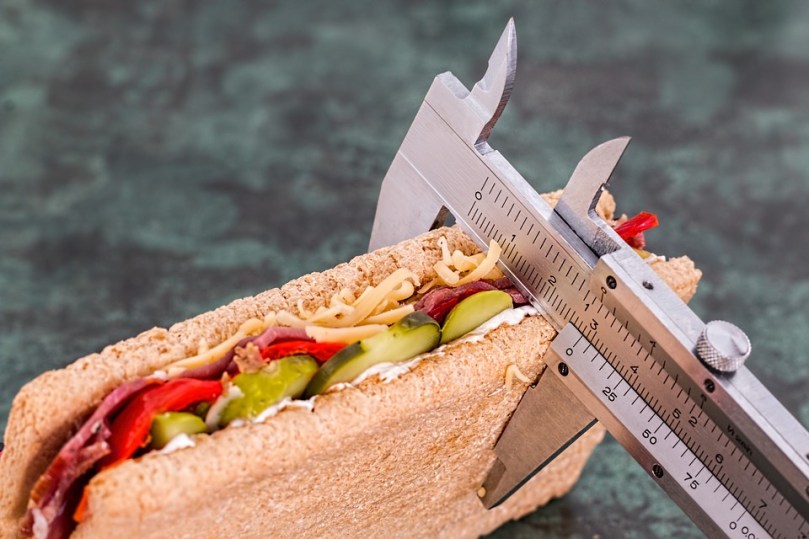
I went to pixabay.com for an image of an odometer and found this picture instead. You’re welcome.


And that inevitably causes me to wonder how people end up at my site, and for those that end up clicking around a little bit, what makes them stay. Usually I have no idea. WordPress reveals my “trends” and my most popular posts to me, but there’s little rhyme or reason there. This year, the top of the pops has been my “Do You Wanna Go To Target” bit of fluff, composed after listening to the Frozen soundtrack for roughly the three-thousandth time when my wife and I were making a day run to Target. Then there’s a little muser of a piece I popped off about the symbolism and the ubiquity of light and dark in literature, which gets a handful of hits every week. And then, it’s been a constant head-scratcher ever since I penned it, but the story I didn’t write about giving my son an enema never seems to leave the top five.

Still, trends seem to balance out and I have a more-or-less regular crew of readers, I think. Unless I go crazy and write four or five posts a week, I usually get about ten reads a day. And while that’s not shattering any internet records or anything — I mean, if I wanted views and clicks, I’d go spout profanity about Donald Trump while wearing a fire helmet and slathering myself in chocolate sauce on youtube or something — it’s an extra little kick in the pants to keep me writing, knowing that there are people out in the cyberverse picking up what I’m putting down.

But then there are the outlier days, like this wekend, that strike like lightning and with about as much explanation. Saturday, my website was accessed from eleven countries. Eleven! Imagine, the drivel I penned while sitting on my couch with my lazy golden retriever sitting next to me and my kids strewing Legos across the living room floor (setting traps for my tender feet), somehow made it, literally, to the far corners of the globe. Wild. And then, Sunday, my website had over 100 views. A hundred! That’s never happened, and I have no idea why it happened. I can hope that some doppelganger, some kindred spirit, read some old post of mine and spent hours plumbing the depths of my site, nodding his (or her!) head in silent, shocked agreement and wonder. Equally possible, I guess, is that it was a gaggle of readers whose cats fell asleep on their keyboards and kept hitting the refresh key.

Who can figure these things out? Determining what will resonate with readers is about as easy as reading your future in the entrails of the hobo you killed and buried in the crawl space. Which is to say, tricky at the very least.

As usual, the only thing to do is keep writing.

Thanks for reading.

Or, maybe, thanks to your cat for falling asleep on the keys.

The Weekly Re-Motivator: To Business


If I could go back and give my previous self any advice about this whole writing thing, it’d be: treat your writing like a business.

See, I always thought I was the creative sort. And I guess I was, but for pretty much my entire twenties, I thought that creativity was this gift; this mystical, un-pin-down-able thing that I was just lucky to have. Now, I still believe that’s true — to a point — but I’m learning that there’s a lot more to creativity than the occasional kiss from the muse.

Because the problem with thinking that creativity is magic — that some people “just have it”, and others “just don’t” — is that one of two things happen. One: you don’t appreciate it, because, like a pile of cash from a wealthy uncle, it just fell in your lap, so you don’t really know its worth. Or two: if (but actually, when) it deserts you, you have no idea how to get it back. And while the muse may in fact carry a cell phone (she does in my as-yet-unpublished first novel), she certainly doesn’t give out her number.

But creativity isn’t magic. Or at least, it isn’t all magic. Creativity is like that kid who wanders around the neighborhood looking for other kids to play with. He doesn’t call in advance. He doesn’t send you a note to say he’s coming around. He just tools around on his bike looking for places to play and people to hang out with. And if you happen to be out in your yard playing when he shows up? Well, you’ll have the craziest afternoon of playing space baseball and ninja cowboys and Calvinball, until the kid has to go home and you have to go in to eat dinner. But if you aren’t out in your yard? That kid rolls right on by. He won’t knock on your door, he won’t peek in the window to see if you’re waiting for him — he’s got places to be and hell to raise with the other kids who are already outside.

Which is why, if you want to encourage him to visit, you have to spend some time playing in the yard, even when he’s not around.

This seems counter-intuitive. There’s no point playing in the yard by yourself, after all. The fun is in playing with a friend, in tapping into your collective imaginations and adventuring together through the boundless reaches of the imaginations of little kids. Playing by yourself is boring; what’s the fun in doing a backflip off a tree branch if nobody else is around to see it, or in throwing a ball over the house if you have to walk around the back to retrieve it?

But if the neighborhood kid doesn’t see you out there playing already, he isn’t taking time out of his day to see if you want to play. And creativity is just like that: if it doesn’t see you already working, already flexing your creative muscle, it’s not going to waste its time knocking on your brain to see if you want to make something awesome. The muse has places to be, novels and poems and stories and paintings and interpretive dances to inspire.

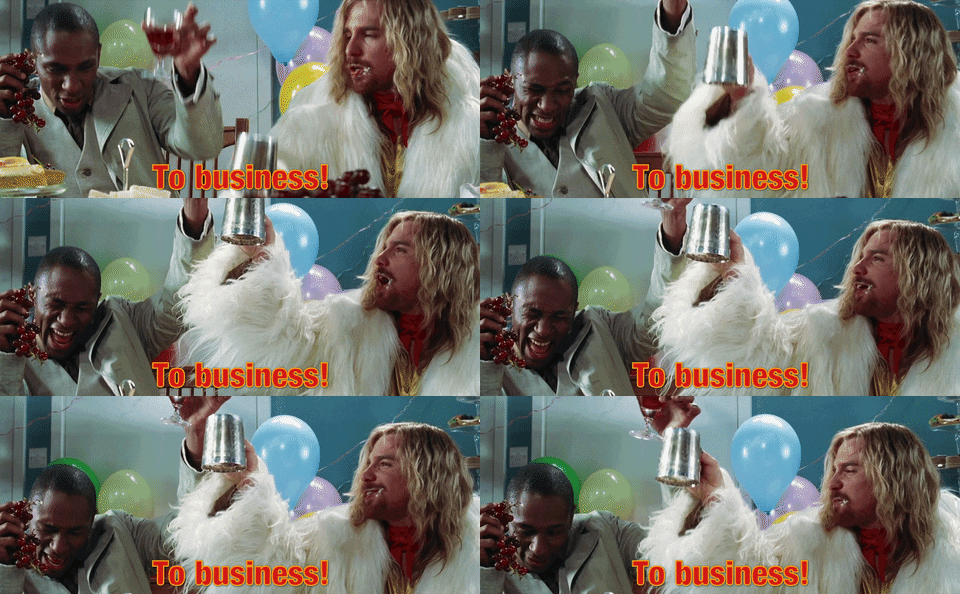
And that’s why we have to treat writing like a business.

mrw hd galaxy guide hitchhikers

You don’t do business when you feel like it: business needs doing with consistency, and pretty much all the time, or else the business dries up. When you treat writing like a business, you make time for it every day. You set aside time for it, and you protect that time like a mother bear protecting her young. You do the writing even when you don’t really feel like it, because if you don’t handle your business even when you don’t feel like it, you lose your business.

The unfortunate fact is, we don’t always feel creative. And it can be hard to force ourselves out into the yard to play when we’re just not feeling it.

But if this is a thing that matters — and I would argue that if you’re writing at all, or thinking about writing, then it matters to you at least a little bit — then we have to get out there anyway.

Because if we don’t? Well, the muse has plenty of other house calls she can make.

This weekly remotivational post is part of Stream of Consciousness Saturday. Every weekend, I use Linda G. Hill’s prompt to refocus my efforts and evaluate my process, sometimes with productive results.