The Weekly Re-Motivator: No Such Thing as Coincidence


I posted earlier this week about my missing flash drive.

It’s now been a solid week since I realized it was missing, and having now cleaned the house and looked in every reasonable place three times (and the unreasonable places, once or twice), it’s hard to argue with the simple, impassive truth. It’s gone.

And because I’m an idiot, the missing little chunk of plastic and silicone has taken with it about 40,000 words of work — the bulk of almost three months daily wordhammering — on the latest novel.

Just gone. Not like somebody broke into my house and my TV, dvd player, and all my wife’s jewelry are missing — that sort of thing, while senseless and random, would at least make sense in a causal sense. There would also be the lovely spectre of somebody to blame. No, it’s rather like I went to the grocery store and came back to find my dog gone. All of her toys still strewn around the house. Sprouts of fur on her blanket and bed. Leash on the wall hook. But no sign of the mutt herself; just the back gate swinging in the breeze. The gate I forgot to close before I left the house.

It’d be tempting to think that it’s an awfully big coincidence that my entire project literally vanishes when I’ve been struggling so mightily with it over these past few months. Some of the days have been good, but most of them have been a bit too much like work, and as much as I like the central idea of the book, there’s just something … off about it. Maybe it’s the tone, maybe it’s the point of view, maybe it’s the setting; hard to pin down, but the idea just hasn’t caught fire with me the way I wanted it to.

So it disappears when I haven’t backed it up in months, and wipes out all those months of work.

But I don’t believe in coincidences; at least not in that cosmic, maybe it was meant to be kind of way. I’m furious with myself for losing it. I’m ready to throttle myself over the idiocy of failing to back up my project. And no matter how the project might have pained me, I don’t believe that simply throwing all that work out the window — literally, it turns out — would have been the best choice. Even bad writing sometimes reveals hidden gems, turns of phrase worth keeping, little narrative nuggets buried among the scree and scrap.

But I also don’t believe that it just happened. I think that, if I were really proud of this work, if I really felt it was worthy of my time, I probably would have safeguarded it a little bit better. I think if it mattered to me that much, I would have found the time to click a few buttons and back it up.

I don’t think me losing the flash drive and the project is the universe’s way of telling me that the project is wrong. I think that me losing the project was my own way of telling myself that the project was wrong.

Because here’s something I noticed in edits for my first novel: as much as I changed things, there was a hesitation to really deconstruct the thing, to shred it to pieces and rebuild the stuff I had spent so much time building the first time around. I did that deep rebuilding in places here and there, but a not insignificant portion of the first draft survived, coming through with only cosmetic changes.

With this project, though, I won’t have that option. I know the outline of what I wrote — the plotlines and the character developments that need to take place to get me to the middle — but I won’t have the fleshy bits, the meat of the story. I’ll have to rebuild all that.

Which is frustrating, but also kind of liberating. Not only am I not tethered by the shortcomings of the draft, but I can’t even see them in the rearview mirror. I’ve got no choice but to take this in an entirely new direction.

And the fact that I’m not filled with dread at the prospect tells me that, even though it burns worse than a throatful of rotgut bourbon, it doesn’t have to be all bad.

So maybe it’s just a coincidence that my project vanished into the ether when I was filled with so much doubt about it.

But I kind of don’t think so.

Maybe it’s just more likely that I’m devoted enough to this thing to turn this lemon — and man, is it a hell of a lemon — into something like lemonade.

Or maybe I have an alter ego who knows what’s best for my writing and chucked the thing in the garbage disposal while I thought I was asleep.

Either way, it’s time for a fresh start.

This weekly remotivational post is part of Stream of Consciousness Saturday. Every weekend, I use Linda G. Hill’s prompt to refocus my efforts and evaluate my process, sometimes with productive results.

Lost


I have a confession.

A writer’s confession, which should be taken with all the appropriate hand-wavings and grains of salt. When you look at the real problems of the world, my meager problems mean little. But it’s weighing on me nonetheless.

I haven’t worked on my novel in almost two weeks.

On the one hand, I feel okay about that, but on the other hand, I feel very much not okay about that, because I know I’m not going to be able to work on it today, and it’s dubious whether I’ll be able to get to it later this week either. The excuses for this are twofold:

One, it was vacation last week, and as much as writing is a release and an adventure in pink unicorn land, there are days when it’s work, too. And of late, the writing has felt more like work than like a unicorn frolic. As such, a little vacation from it is, I think, warranted, and what better time than when I’m on a vacation from actual work? I got to turn the ol’ brain off, veg out and watch some TV, take the kids and the wife on a few day trips … it was good. Didn’t have to worry about how to get my protagonist out of his latest scrape. Didn’t have to construct the machinations of the villain working behind the scenes. Didn’t have to batter my brain against the Rube Goldberg machine of gears and spindles and flywheels that constitutes the plot of this thing.

Still, I felt guilty about leaving that creative garden untended for the week, sort of the same way I feel about letting my lawn continue to grow, sprouting weeds and dandelions and the occasional mushroom, while my neighbors keep their lawns neatly trimmed.

Sidenote: there’s a new show out called Speechless, about this deadbeat family with a handicapped, mute son. No idea if the show has any staying power or not — the first few episodes have been pretty funny, but who knows — but I at least resonate with the family. Not because they’re jerks — the mother proudly drives in the emergency lane, runs stop signs, and flings bluster and righteous indignation and her son’s handicap at anybody who even looks sideways at her. And I have a hard time getting down with that. What I totally get, though, is that they just don’t give a sharknado what other people think of them. Lawn is overgrown? Paint is peeling? Car’s looking a little dumpy? Yeah, no, we’re not going to fix those things. They just don’t matter to us; we have only so many fargos to give. To that, I give a deep, sonorous AMEN.

So I returned to work on Monday, all set to hunker down and return to the love-hate relationship I have with my current novel. Which brings me to…

Two: I can’t find my flash drive.

Now, before you say anything, know that I’ve already said every possible thing to myself, mostly inside my own head, occasionally in raging, fists-pounding-on-the-desk angry shouts. How can you be so stupid? Haven’t you heard of backups? How could you possibly lose it? Dunce! Idiot! Disorganized, sloppy, careless!

And my excuses are like the rain in Arizona: woefully inadequate, but all there is. I write the novel mostly at my job, so keeping it on the flash drive makes sense for taking it home, back and forth. But I have to steal time at work to write, so I don’t exactly have a routine, and, well, backing up is the last thing I’m thinking about, because usually I’ve either got parent calls to make or meetings to get to or students coming to my room and …

Well, here’s my other dirty confession. I haven’t backed up outside of the flash drive in over a month.

Sigh.

And of course, with the whole of the novel missing (or at least my recent work on it), I can’t re-read to get inspired to write the next bit. Not to mention the soul-crushing stupidity I feel when I think about the project at all, which pushes every creative thought right out of my ears.

But I’m going to have to face up sooner or later. If the drive doesn’t turn up in the next few days, it probably never will; there’s only so many places it could reasonably be, and considering all the places we went over the break … well. That little piece of plastic and silicon could be anywhere in a fifty-mile radius, which means it might as well be on the moon for my likelihood of stumbling across it again.

Luckily, the weather is changing. Morning runs have been downright pleasant — sixty degrees or so with the stars twinkling overhead — and have done good things for my blood, which on Monday was boiling, and which today is only simmering. Further, when I think about it, the beginning of the novel was going to need massive re-working anyway, probably a complete re-write in lots of places, so the first 40,000 words were hardly carved in stone.

Still, for the moment, they’re not carved anywhere, and that’s tough to see around.

Image result for headdesk

The Weekly Re-Motivator: Awkwardity


I’ve always been pretty awkward.

That might come as a shock, given my background in theater and my career choice as a teacher and the way I prattle on at length about any- and everything around here, but there it is.

Socially awkward. I’ve even gone so far to consider myself socially retarded. I’m often the quiet guy in the room, not because I don’t want to take part in conversations (well, sometimes), but because I just don’t know what to say. But then, what feels like a comfortable silence to me will turn into an uncomfortable silence in the room, and then I sit there thinking I should really say something, but then the words come out like cow vomit.

I think a lot of people struggle with this, but I also think I maybe have it more than most. (Then again, maybe that’s the old Dunning-Kruger effect talking — that thing that makes you overestimate your experience when you don’t have much. Americans, it turns out, suffer from Dunning-Kruger than most other nationalities.) Like, I know that some people feel awkward sometimes. There are hashtags about it. But for me, it feels like it’s all the time.

And I think that’s part of what compels me to write. Because I screw up these social interactions every day, so I get another crack at them when I create these alternate realities in my own head. And again, I think we all do that — we all play the I shoulda said THIS game — but for a writer, it’s different. When I tell a story, I get to get it right, and (hopefully!) readers get to see me get it right.

They say you should write what you know, and while I think that advice can be overly limiting (if we kept to it, we’d never have science fiction), it’s also pretty impossible to avoid. All writers, I think, write themselves into their stories. And in looking at the stories I’ve written, the characters I’ve spent the most time with… well, it’s safe to say that they’re pretty socially awkward like me.

First novel: A struggling writer battles through his self-doubt with the help of a muse. His only real friend is the one who is financially obligated to spend time with him. Hmm!

Second novel: A girl who is socially segregated because of the role that’s been selected for her by the community. She doesn’t have friends because she will, for all intents and purposed, be “killed” when she comes of age, and everybody knows it. Hmm, hmm!

Third novel: A kid born to superhero parents has no superpowers, but falls in with the superheroes anyway — so that he can learn to exploit them. He trusts none of his “classmates,” and in return they ridicule and fear him. Hmm, hmm, hmm!

So authors write themselves into their stories; this is a trope we’re all familiar with, and I certainly seem to be doing it. But is it a thing we can avoid? Well, with novel #2, the protagonist I described was not actually the protagonist for 80% of the first draft; she was a supporting character who I realized was a lot more compelling than the protagonist I was trying to write. That person was popular, and fit in effortlessly with his social group and with somebody beyond it — and he rang hollow to me for most of the writing. So it can be done, but not without its pitfalls.

Pitfalls. If there’s an apt metaphor for the writing process, it’s a field littered with pitfalls. Because as you build this story for your characters (the ones who are totally yourself), you have to place pitfalls in their path, try to trip them up at every step. But you have to watch out for your own pitfalls, the gaps and the traps that threaten to snag you in the midst of your process. It’s a delicate dance.

And dancing is something we awkward types don’t really do so much.

This weekly remotivational post is part of Stream of Consciousness Saturday. Every weekend, I use Linda G. Hill’s prompt to refocus my efforts and evaluate my process, sometimes with productive results.


Heads Against Walls


Why am I still watching news about Donald Trump?

Why did I stay up late — on my vacation, even — to watch Monday’s debate?

Why do I know what’s been said on both sides about this latest scandal, the beauty queen and what he said about her?

Why do I keep reading like an intern trying to break the big story, clicking every damn headline that has the word “Trump” in it?

He looked into building in Cuba during the embargo. His foundation doesn’t have the proper paperwork. He might have drunk the blood of puppies to get that lovely orange glow. (This isn’t verified, but he would deny it, which basically makes it true.)

Unless you’re new around here, you probably know that I basically made up my mind in this election months ago, when it became clear that Trump would win the Republican nomination. Notice I said when it became clear he would win, not before the primaries ever took place. I tend toward the liberal side of the spectrum, but I might have — and possibly even probably would have — voted for a Marco Rubio or a Jeb Bush over Clinton, who, whether it’s justified or not, does not have a reputation for trustworthiness.

But as soon as Trump became the Republican running man, the Democrats could have put up a trained chimp, for all I care.

Fine and good. I, like most, have made up my mind, and at this point, that opinion might as well be cast in stone.

And yet, like a suburbanite to a Starbucks, I keep coming back. I don’t know why. And that kind of scares me.

Because, in my heart of hearts, I still believe that Trump might not actually want to win this thing. I still suspect, as I have from the beginning, that his campaign is about increasing his own visibility and putting his name in people’s mouths. The “no such thing as bad publicity” principle.

Which means that anything we say to one another only helps this man to get what he wants. And I am not okay with that. Which is why I’ve been relatively silent on the matter for a while.

But dammit, this sharknado is coming to a head, now. It looks very much like the news cycle will consist of Donald Trump first and everything else happening in the world second from now until the election, even though by all accounts, the two sides in this election are fixed in amber. Clinton supporters aren’t going to switch and go for Trump. Trump supporters aren’t going to switch and go for Clinton. All that’s left is the (somehow) undecided people in the middle.

But here’s the problem with that. (For non-Trump supporters.)

With a normal candidate, any strike, any ding on their record, any scandal can do serious damage to their image and their perception. But not Trump. There are so many scandals, so many scars, so many warts all over him already — what harm can another scandal possibly do? How much difference does a single grain of sand make when added to the Gobi desert?

I know the irony is rich here, but I just want to draw attention to the fact that I think any attention drawn to Donald Trump is a mistake. Which is why I won’t be doing it again.

I hope.

Savage Race Recap: Blow-by-blow part 3


Disclaimer: This is the third part of a race report. If you care about continuity, the first part is here, and the second part is here. If you think that running and obstacle course races are endeavors fit only for the insane, well, you might not be wrong, but feel free to skip this entry. If you’re intrigued by all this, you can find lots of pictures and in-depth descriptions of these obstacles at Savage Race’s website.

This entry concludes the (maybe too) lengthy detour I took to talk about this race. Regularly scheduled programming will resume.

The first half of the course, despite its challenges, has been a kids’ gloves introduction to the course. In the second half, the gloves come off immediately. Mile four begins with the craziest ascent I’ve ever seen on a running trail. We’re leaning against the hill itself for support in climbing the hill; ropes and pickaxes wouldn’t go amiss here.

Then we turn around and come right back down it; apparently we climbed that monster for the sheer hell of it, and if that isn’t a perfect metaphor for this race, then I don’t know what is. Our next obstacle is a dunk into ice water — there’s literally a refrigerated truck next to two pools, and as I go under, I can feel the cubes clinking off my dome — which, frankly, comes none too soon in the ninety degree heat.

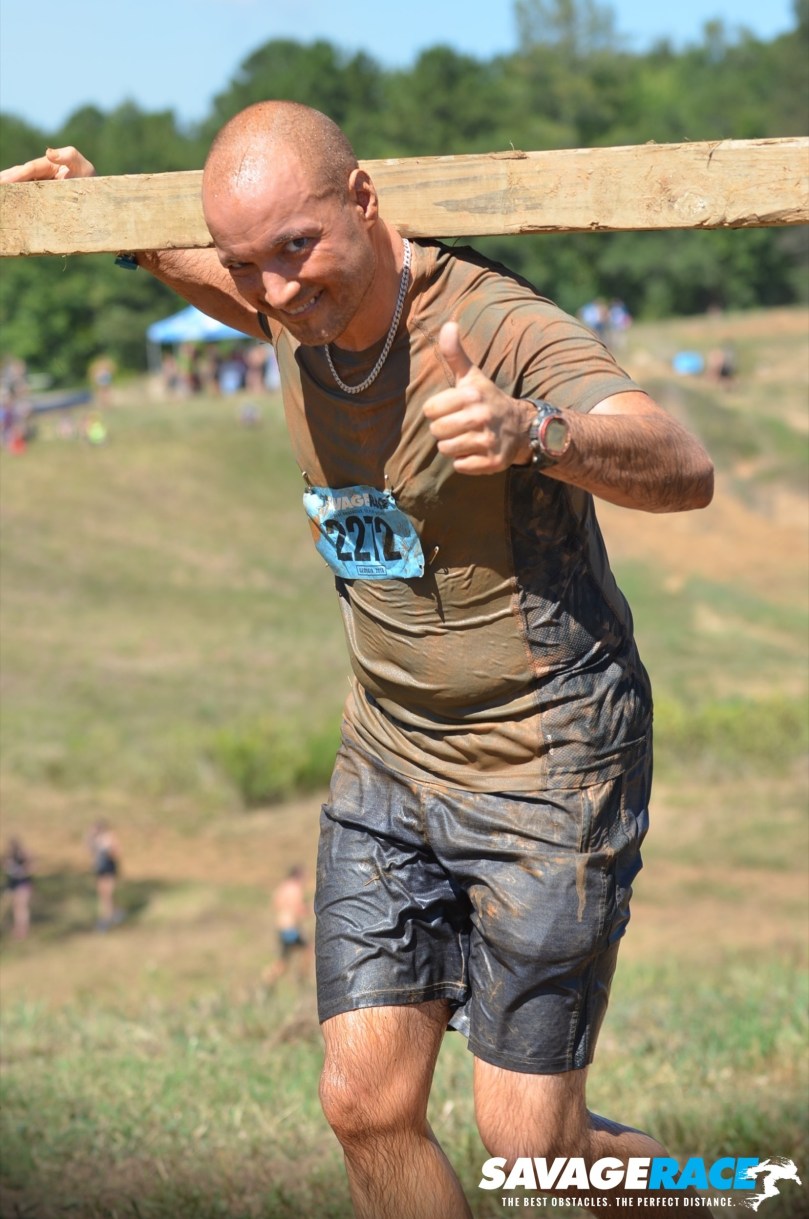
Then there’s more pain: we pick up lengths of 4×4 and sling them across our backs to carry them a quarter mile across more rolling hills. Why? Because we can. We’ve already run a 5k and covered an elevation gain of something like a half mile, given and taken; why not slog some lumber while we do more of the same? And then we shimmy sideways across railings not unlike the ones you stand in while you’re waiting for your turn on the American Scream Machine, and if you haven’t fantasized about doing that, well, then maybe you’re reading the wrong race report.

The obstacles come fast and furious now; the first half of the race gave us maybe three challenges per mile, but we’ve got twenty more to cover in the last 2.5 miles, which means a lot less running and a lot more scrambling. “Wheel World” pits us against rotating garden spigots that leave a lot of racers twisting and spinning helplessly in space before splashing down in defeat, but a simple application of my old maxim — momentum matters — carries me through the obstacle. Instead of attacking it head on, I roll into it sideways off the launch platform, and the rotation carries me cleanly across.

Then it’s up a culvert on an incline which shifts to a decline when you’re halfway across. The culvert is too narrow to crawl on hands and knees but too slick to commando crawl. I inch forward like a slug until it tips and spits me out into the dirt, my abs burning and my knees bruised.

Then a climbing wall; not up, but across, and it’s leaned backwards at a fifteen degree angle. This is my first failure: I just don’t have the grip to hold myself up and I stumble off into the dirt. But here’s the thing about that: at this point in the race, people are failing obstacles left and right, and there’s no shame or anger in it. You just dust yourself off and truck on. A point of training to return to for the next time.

Now another crawl under barbed wire, but this one through the thickest, soupiest mud yet; we come out the other side looking like the Michelin Man hosed down in brown goop. It clings and clumps to us as we mount the hill for the next challenge: a simple ramp. Except, thanks to the mud, it’s impossible to climb the thing. Even the rope is slick with the mud of hundreds of previous runners trying to summit this thing.

At this point, you can barely finish an obstacle before you’re on to the next. A twenty-foot climb followed by a terrifying leap into a deep pool. A diabolical jagged monkey bars over murky water. (This one puts me in the drink halfway across.) An inclined traverse around telephone poles that you have to hug like the college girlfriend that’s looking for a reason to dump you. A maze-like series of ropes and rings that drops racers like a series of particularly bad habits. (I slip off the rope almost immediately, with burns on my pinkie and ring fingers to show for it. Never in my life have I injured my pinkie finger, until today, but there it is.)

And here, again, I’m forcibly informed of the key difference between an OCR and a road race. Road races, and to a lesser extent, trail races, are a more or less linear challenge. The difficulty goes up predictably with the distance, and the race gets harder the farther you go. The effort wears you down, but you know what distance and pace you’re capable of. But with OCR, the challenge is on an exponential curve: they save the best (most challenging) obstacles for last, but by the time you get to them, you’re gassed out by the previous obstacles and/or the viciousness of the run itself.

I’ve now failed three obstacles and I’m almost a half hour behind my predicted finish time. And in a strict running race, that would be shattering. But here? Today? Staring down the final obstacle — a fifteen foot quarter-pipe, mud-slick from failed attempts to summit it and topped with hooting, cheering savages who’ve already made the climb — well, earlier I likened the event to a bacchanalia, and while there are no chemicals involved, we’re all drunk at this point. The falls on earlier obstacles don’t matter, the bruises on my knees, shins, and elbows are irrelevant, the mud caked in my eyebrows and the stubble on my scalp is totally off topic. I don’t care about the burning in my calves from the relentless ups-and-downs of these murderous hills. Every runner who makes the top of this ramp does so to a chorus of cheers and howls, and every one who fails and slides back to the earth meets a sympathetic groan.

But I’m tapped. I’ve got nothing left. The six miles of the run and the ridiculous crescendo of the obstacles have left me a pile of sentient Jell-o. I can no more make it up that ramp than I can sprout wings and ascend into the heavens. But I lower my head and charge at the ramp anyway.

I grab at the rope. My fingers seal around the knot, strangling it. Somehow, I fling my arm upward and catch the next know, and creep higher. But that’s it. I’m done. The ledge is right there, but I can’t reach it. I cry out, or at least I think I do. On the ledge above me is some guy I don’t even know, and he’s shouting at me like I’m Rocky. Grab that ledge. You can do it. Grab it. Come on! He could help me, but he knows — as I know — that it’ll mean that much more if I can make it on my own.

And I do. My fingers catch the ledge, then a hand has my forearm and I’m being lifted upwards over the edge. I tumble onto my back and stare up at the sky for a moment.

It’s a clear, beautiful Georgia afternoon. Wispy blue clouds, postcard blue sky. The roar all around me goes dull.

I’m acutely aware that this afternoon would have been a gorgeous one whether or not I had put myself through the wringer of this race. But somehow, the air is a little sweeter, the breeze a little cooler, the sky a little bluer.

But there’s no time to rest. I get to my knees and turn around to offer a pay-it-forward hand up to a few other racers climbing their way up after me. High-fives and slaps on the back abound. Then, it’s over to the other side of the wall — a slide right back down into (you guessed it) more muddy water. And there’s the finish line. Somebody puts a medal around my neck. A bottle of icy water is shoved into my hand. Half of it goes on my head, half of it goes down in a few greedy gulps. It tastes like the untamed glaciers of the Arctic.

I’ve spent a lot of time thinking and writing about this race, a lot more than I usually bother to write about running. (Partly that’s because fitness isn’t really the focus of my blarg here, but partly that’s because there’s really only so much you can say about running.) But I think the race deserves a bit of time and reflection. It wasn’t just an event, it was an experience. I’m not going to say I’m a better person because of it — that would be shallow and too easy, I think — but there’s an ineffable sense of accomplishment swirling around me after finishing this thing, even almost a full week later.

There’s something primal about it that no amount of running or hours spent in a gym can replicate. Running, jumping, crawling, climbing — these are things our bodies evolved to do, and the creature comforts of this modern life have allowed too many of us to forget we can do them. Savage Race was a test in a way I’ve never been tested. It’s a bit like life, really: it throws a challenge at you, beats you up, bruises you a bit, knocks you in the mud. Then, if you come through to the other side, it says, “okay, you handled that. Now how about this one?” And it repeats, on and on until you drag yourself across the finish line, or until you tap out, give up testing yourself and walk the rest of the way home.

I’m happy to say that, even though I didn’t complete every obstacle, I tried every one. And my run may not have been pretty, but life ain’t pretty. We all get a little dinged up, a little scraped and bruised along the way. We all get a little dirty. Sometimes it hurts. But you can still run the race with a smile on your face.
race_2453_photo_45899933