
Trying out a new look for the ol’ site, something I haven’t done for … *checks notes* yep, years upon years.
Is it crap? I’m not sure if I like it. We’ll see how I feel in the morning.
Trying out a new look for the ol’ site, something I haven’t done for … *checks notes* yep, years upon years.
Is it crap? I’m not sure if I like it. We’ll see how I feel in the morning.
Know how you’ll be, like, watching a thing, or reading a thing, and your brain just sort of wanders off to wherever brains wander off to, and flicks a switch, and all of a sudden everything makes sense? (If you could control when this happens, one imagines we’d live in a world much, much different than the one we apparently live in).
That happened to me when I was watching The Black Phone, and I don’t know if the switch that got flicked is super smart or super dumb or, I dunno, maybe it’s just like super obvious? I mentioned this to my wife and she wasn’t impressed — I got a big “yeah, so?” — so I bring it to the internet, where people love things and nobody says anything mean ever, to validate myself. So here it is.
Oh, and, fairly major spoilers for The Black Phone, and also I guess for The Karate Kid. This is where you get off if you care about such things.

So, I was watching The Black Phone — which, while I’m not going to do a full-on review of it, given there’s been plenty of that for this pretty excellent not-exactly-horror movie (it’s more of a thriller, in that there’s just this looming and inescapable sense of dread permeating the whole thing from top to bottom) — is a pretty excellent movie. But I couldn’t shake this feeling that was really bugging me.
Consider the central conceit: a kid is napped and brought into a sadistic murderer’s basement prison. In this prison, though, is a Black Phone, which Doesn’t Work, but our protagonist begins receiving calls on it from the ghosts of the sadistic murderer’s victims, ostensibly to help him escape. Problem is — and here’s what was really bugging me while I was watching — the things the ghosts are telling him aren’t actually helping him to escape.
Well, what the hell kinda good is it being dead if you don’t get the power to see beyond seeing? You want to help this kid escape and you tell him what to do and … it doesn’t work.
Seriously. Ghost #1 tells him he needs to dig thru the floor and up around the side of the house but … there just isn’t nearly enough time for that. Ghost #2 provides him with a handy-dandy wire to climb and reach the barred window — but all it does is yank the grating out of the frame. Ghost #3 tells him to punch thru a wall into the back of the freezer … but he can’t unlock the doors from the inside and getting into the freezer doesn’t help. Only Ghost #4 (our protag’s buddy taken just before our protag himself) helps him in a direct way, by giving him a quick combat lesson and telling him to use the up-until-now apparently useless phone in a concrete way.
But then, it all works in the end, right? The half-pit he digs turns into a Vietnam-guerilla-warfare trap pit, the displaced window grate turns the pit into a full-on spike trap, and the freezer access gives him an out to get past the guard dog after the big bad is dispatched.
And I realized:
This is The Karate Kid.

You see it, right? I’m talking about the classic, of course — I haven’t seen the remake — where young, goofy Daniel LaRusso finds himself in a strange place, beset by bullies, looking for a way to stand up for himself. He convinces local karate master Mister Miyagi to train him, and this feels like the way out — until he shows up to the old man’s house.
“Paint the fence,” the old man says. Danny, confused but willing to do what it takes, dutifully paints Miyagi’s fence. Finished, he asks if they can train now, and Miyagi tells him, no, go home, rest. He comes back again. Time to train? Miyagi nods. “Sand the floor.” Danny sands the entire deck and gets sent home again without training. Next day? “Wax these cars. Wax on, wax off.” Really frustrated but still determined, Danny does the work.
Then, the inevitable blow-up. When Miyagi sets him another chore, Danny freaks out. I wanted karate training, I didn’t want to remodel your backyard and fix up your cars, old man. Miyagi, stoic ever, says “show me paint the fence.” Miyagi throws a punch as Danny does the motion — and Danny perfectly blocks the attack.
Miyagi was training Daniel all along by teaching him fundamental movements. Miyagi gave the boy tools and drilled them into automaticity so that when the time came for the real work, he’d be ready for it.
Why? Because Miyagi had the long view. If he’d tried to give Daniel the complicated stuff right away, tried to give him the blueprint to beat up his bullies, it wouldn’t have worked — because the fundamentals were not in place. There was prep work to be done.
So it is in The Black Phone. Each ghost, like Miyagi, plants a seed that will come to fruition during the final confrontation, even if the seed itself seems useless, or, worse, an outright waste of time in the moment.
So, uh, that’s it. That’s my great big realization. These two movies couldn’t be more different, but they share the same through-line. They’re both these coming-of-age movies, both center on a kid who needs to stand up for himself, and they both get mentors who bread-crumb him to success rather than just giving him the tools and techniques straight-out.
Point is, there are only so many stories to be told out there — what matters isn’t the story itself, but how you tell it. Which is pretty cool, I guess — and a good thing for budding storytellers to keep in mind.
I knew that this book had come out, and I was conflicted about it. On the one hand, I’m a fan of Delilah S. Dawson’s books that I’ve read before, so I kinda knew I was gonna read it … but the writeup made me nervous.
Three generations of abused women must navigate their chilling new reality as a mysterious epidemic of violence sweeps the nation in this compelling novel of self-discovery, legacy, and hope.
Now, nothing against stories with female protagonists, or anything like that … but I read “compelling novel of self-discovery, legacy, and hope” and I think “Eat, Pray, Love” and … that’s just not my thing, man.
But you can’t get to that last phrase without reading about the “mysterious epidemic of violence” and that very much *is* my thing, man.
Mild spoilers only for this review ahead. I’m going to do my best to talk about this delightful book without giving too much away, as it really does deserve to be experienced with its surprises intact.
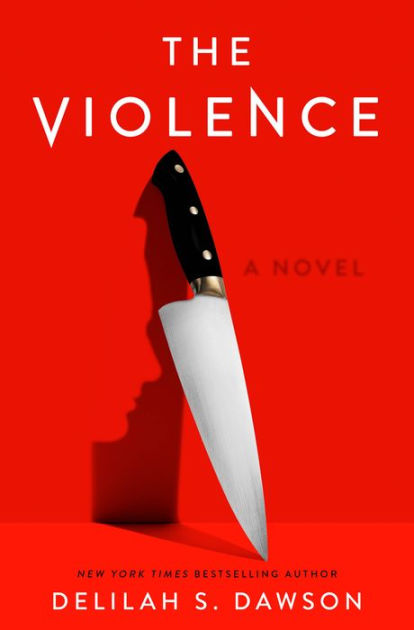
Truthfully, I’ve not been reading as much as I would like this year (throw that in the bucket with everything else I’m not doing as much as I’d like in the past couple years…. let’s not talk about any of that) and even when I do, it’s a little bit here and a little bit there, and it kinda feels like a slog. But The Violence was, for me, that rare book that you legitimately do not want to put down.
From the first mini-climax where the main protagonist (yeah there are 3 main female characters but Chelsea, the wife and mother, is pretty obviously the central figure) escapes her abusive husband, I was glued to the pages and cheering on the inside … and then I realized I was only a quarter of the way into the book.
And it’s a wild ride for the rest of the story. Most of the book takes place in a wild hellscape where at any moment, the person sitting across from you could rage out and murder you for no particular reason, which is both extremely unsettling and extremely understandable in a post-COVID world (yeah, I know, we’re not exactly post-COVID because it’s here to stay, but because it’s here to stay and everybody has had the chance to get vaxxed or take whatever preventative measures they plan to, we’re essentially post-COVID, again, let’s not get sidetracked). On the one hand, it’s metaphorical — that person looks harmless but they could very well actually kill you, in the way anybody carrying a deadly communicable disease could. But here in The Violence, it’s terrifyingly literal and immediate. Dawson has somehow captured that uncertainty inherent in every personal interaction in 2022 (is this person a threat to me if I do the wrong thing, say the wrong thing?) and made it tangible, and that’s something.
What’s fascinating about this book is how the protagonists go from fearing this disease, to exploiting it, to coping with it in a way that’s safe for them and for everybody around them. The turns are unexpected, the payoffs are huge, and the climax is as satisfying as could be hoped for.
Look, I was about to wrap it up right there, and I know I said only mild spoilers, but I can’t help it. I can’t talk about this book without gushing a little bit. Each of the three central women faces an oppressive male figure, and each of them deals with her abuser in a creative, unexpected, and satisfying way, the central character actually doing so twice.
Damn, I just can’t. I just can’t with this book. It’s so good, and it’s so enjoyable, and I loved it, and I wish I could re-read it and be surprised again.
This is not your mom’s female empowerment novel; this one is bloody, and terrifying, and so, so good.
Five out of five pink plastic makeup cases, all splattered with blood.
For good measure, a couple of passages so good I had to yoink them for the ol’ quote book:
To think: Two huge, earth-shattering, terrifying things happened yesterday, and yet here she is at the breakfast table, pouring a bowl of Cocoa Pebbles.
“Never make yourself smaller to suit someone who wants to feel big.”
…she realizes that out of all of them, Brooklyn might make it to adulthood in one piece, not weighed down by the bullshit trauma they’ve been passing along hand-to-hand like a coveted recipe that always omits some important ingredient out of spite.
Do yourself a favor: head on down to the ol; bookstore, or your library, or your fancy clicky e-reader and give The Violence a try. And make sure your immediate area is clear of Yeti beverage tumblers … it turns out they can be lethal in close quarters.
In February, I decided I was going to start posting again. I did a couple, but it became abruptly clear to me that I needed to answer for my absence in some way. (Why? And to whom? I don’t have great answers for these questions.)
I so badly needed to answer for my absence, for whatever reason, that I felt I couldn’t just get back into making any sort of regular posting without it. So I worked on a post where I aired out some of the struggles that kept me from writing or posting, explored some of my hangups, and otherwise flogged myself for the better part of 1200 words. I told myself that posting it would be like clearing the blockage in a pipe — all the backed-up gunk would come flooding out and things would be good as new again.
Problem is, even in writing the post, it felt incredibly self-indulgent, and whiny, and poor-me-ish, in ways that even now I find embarrassing. Which in some ways is fair: after all I’m a middle-aged white guy whose life is relatively together and secure — what right have I to complain about anything that’s not going particularly my way? There are people out there with Real Problems.
In other words, I was Being a Little Bitch, to give you a snippet of my self-talk.
Still, I wrote it out and planned to post it, but even posting it felt indulgent somehow. So it’s saved. It’s in the drafts. I could share it out at any time if I think it’ll help. But for now, I’m just hoping that the pipes have been cleared just by the exercise of having written it.
So — ooh, boy. We’re going to make a mistake here. We abandon the website for a year, then with the second post upon our return we wade into the waters of fandom, racism, and social media. Top shelf idea, there. It’s gonna be great.
Look, LOTR and criticism thereof sort of has this problem.
And the problem is that you have to measure anything LOTR against the films of the original trilogy.
Why is this a problem? Because the films were just so damned good.
Say what you will about the novels. (They were formative for me — I discovered them in high school, read them, loved them, and have re-read them a few times since.) And say what you will about the adaptations. (There were some things I disagreed with, given my knowledge of the books. Some things that just didn’t make sense to me then, though now that I know a bit more about storytelling and movies, we get it. (See: moving the encounter with Shelob from the end of book 2 to the middle of book 3.)) But good ol’ PJ did that rare thing with the trilogy: he caught lightning in a bottle. He brought to life on the big screen a story that for so many of us had lived only in our imaginations, and it was as good, if not better, than we expected. He brought new fans to the story who never would have read the books otherwise. Oh, and he changed the way Hollywood thinks about stories and trilogies and series and all that stuff (for better or for worse.)
(Sidenote: We don’t talk about The Hobbit films.)
And, well, now we have to (or rather, now we get to) live in the universe where all those things happened.
And like any good series or book or otherwise IP, What Comes Next will inevitably be measured against the standard of the original. (Which is never going to be favorable for the new stuff. You can’t catch lightning in a bottle twice. You can’t even catch it once. This is metaphor.)
We talked about this a bit back when Star Wars: The Force Awakens came out and all the hubbub about that film (spoiler alert: the hubbub did not quiet down, it only got worse, and that’s all very dumb, but that’s not our focus today, please stay on topic). About how the longtime fans feel some ownership over the thing, so when the New Stuff comes and it’s not exactly what they remember and expect, they get upset. But it’s rearing its head again and we’re thinking about it again, and well, I’m back, baby, so we’re gonna dive in and make some sweeping generalizations.
So, the new series is coming out. We haven’t even had the first episode yet, but people are angry. They will cite any number of reasons for their anger, but what they generally boil down to is: Thing Does Not Conform To My Expectations For Thing. Dwarves and elves with dark skin, Galadriel in battle armor — these things did not exist in the original works of Tolkien and they therefore have No Place in the new Tolkien thing.
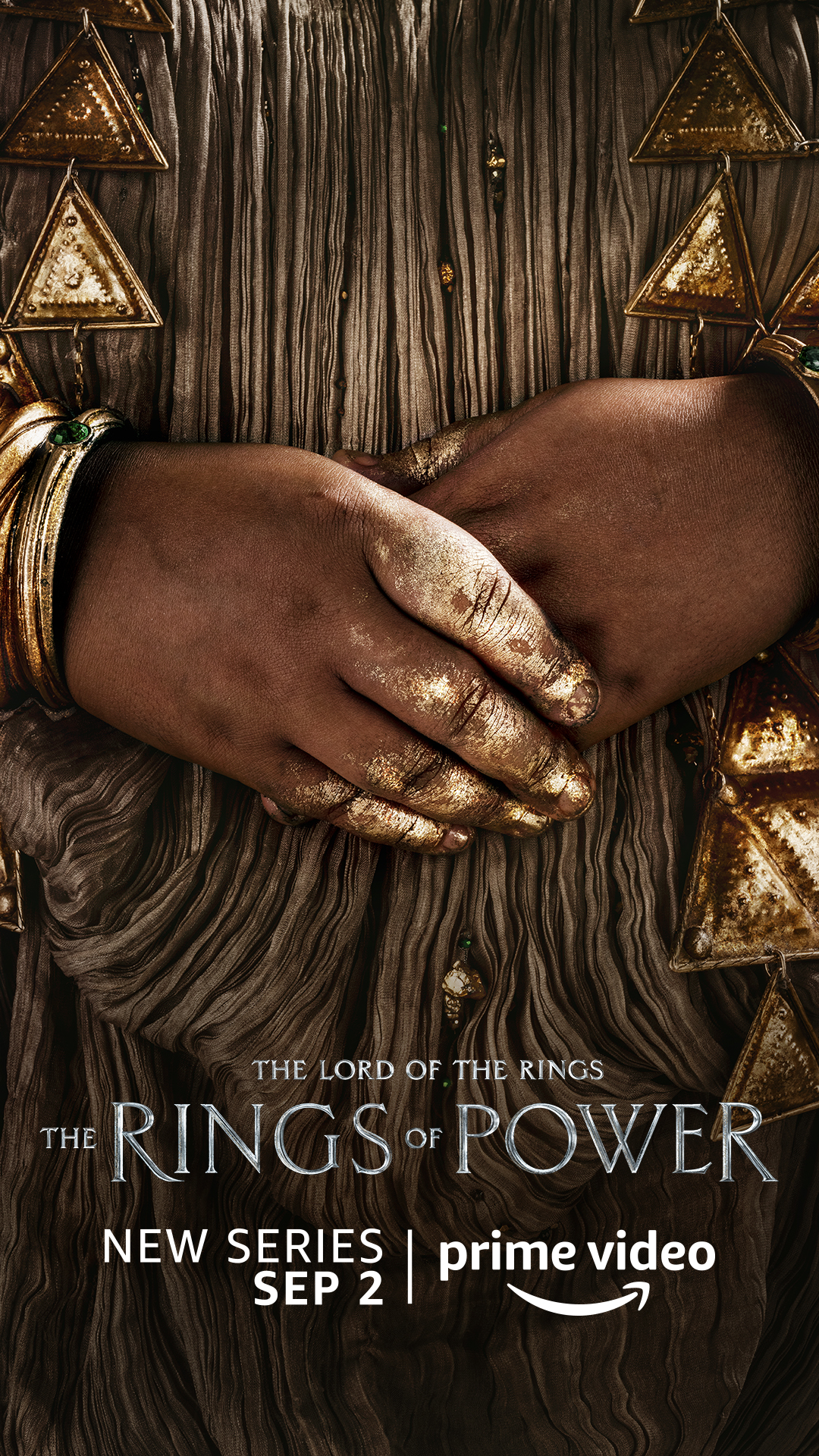
And then, like clockwork, come the rebuttals and indignation from the other side. We’re not living in Tolkien’s time; we’re living in the 21st century, and representation matters. These stories belong to everybody, not just a bunch of white dudes. Say what you will about the response to the response, but it follows its own (entirely predictable) patterns.
We should point out, here, that there’s no simple answer to this problem, for reasons that will quickly become apparent, but it’s important as story-consuming people to think about these things, and what they say about us, and what we can learn from this, so that maybe (okay, probably not, but we can dream) we don’t have to keep having the same arguments over and over again.
The problem here is the same problem you have when debating a societal issue of any other stripe. Abortion. Religion. Gay marriage. Trans issues.
That problem is: both sides are right.
Let’s pick a spicy one, to make sure to offend as many people as possible. Abortion. One side says it’s the woman’s body, so it’s the woman’s choice, and they’re right. The other says all life is sacred, that every new life should have a chance, and they’re right, too. Gay marriage? On one hand, two people who love each other should be able to enjoy the benefits that society offers to the married just like anybody else. On the other, if marriage is defined as a union between a man and a woman, then calling a same-sex union a marriage is, by definition, wrong. (Personally, I think we need to abolish the concept of recognizing marriage through government institutions anyway — theoretically we have a separation of church and state in this country. That would unmake this whole issue, but it’s largely moot these days anyway. History moves on and the arc bends towards justice, or so they say.) The problem is that we get all territorial and tribal and we take bad-faith shots at the other side’s arguments and call them idiots and knuckle-draggers and anything else under the sun, and we try to make that comment that’s going to go viral, and we can’t compromise. We’ve forgotten how, in The Discourse.
Well, LOTR is the same. Dedicated, lifelong fans are right. Tolkien’s works were written by a white dude without much consideration for diversity, and possibly (probably?) with some assumptions that might not sit well with our collective consciences here, half a century and more on from when he set his tales down. To change the texts, to introduce characters outside of that mold, is, in fact, to change the texts themselves. But fans who want more inclusivity are also right: that the texts don’t represent the world we live in now, that the stories have appeal for a broader audience and, as a result, it would be nice to have a bit more inclusivity than the books did in their original form.
And you can already hear the arguments from both sides. “Why not make new stories with more diverse characters and casting needs — why do they have to change this one that’s already out there?” Well, that might be a good point … but no new series is going to have the brand appeal that LOTR has. It just can’t. New stories are great — and coming out all the time, by the way — but they’re not LOTR, and they can’t be. And from the other side — “why do these fans have to be so closed-minded and racist? Why do they have to pretend like they own everything?” But they’re not wrong — the original series actually is written that way.
Is there middle ground to be found between these two viewpoints? Almost certainly not, because we’re too conditioned by our echo chambers to seek out the support of those on our own side while scoring points at any cost against those guys over there.
It’s a depressingly obvious and probably unavoidable cycle. It played out with Star Wars, it’s playing out now with the LOTR series, and it will keep playing out as long as there are fandoms and social media and the internet and, probably, people.
I don’t actually have a solution for this problem at the macro level, because the problem doesn’t get solved at the macro level. It comes from one-on-one conversations and the commitment of the individual to stop shouting “OTHER SIDE BAD” for a minute and actually listen to what’s being said.
Our society just isn’t built for those conversations any more. It’s built for quippy one-liners, mic-drops, and dunking on the other side. And it’s a shame.
Sidenote and disclaimer: the world we’re in is changing, and media and filmmakers are changing with it. If you are bound and determined that your old stories remain what they are and never get changed to adapt to the times we’re living in … I have some unfortunate news to give you. That may or may not be right, but it is a fact. And life is just easier when you accept facts as facts. But that’s a whole other topic.
Welcome. This is my page for sharing projects associated with my coursework in Media and Technology at the University of West Georgia. Assignments will be posted here as they are completed.
(...and some I have)
George Ledo's notes on 35-plus years of set design and technical theatre experiences
As Always, More to Come
Antidote to the Novel
Still on the Internet, Still a Nobody
for readers who write and writers who read
Shortness of Breadth
A blog by Nancy Abrams
 Accidentally Inspired