Weekly Re-Motivator: Summary Stew


I can’t stand the summary.

You know, you crack the book open, and on the inside fold or the back cover or wherever, you get the blurb that tells you in a nutshell what the story is all about.

Karl Wisenberg is a mild-mannered office worker hiding a secret: his radioactive toenails. But there’s something more sinister than glowing fungus afoot…

Alice Klepper sells jewelry by day and state secrets by night. But will an unexpected purchase by an eight foot tall stranger provide her with the biggest secret of all?

The summary is supposed to give you a taste for the story without spoiling it for you; it’s supposed to whet your appetite and get you to crack the book and keep on cracking it until the end.

And I hate it. Because it gives the impression that the story is all about plot, that the narrative is a simple math equation with all these different elements — character, setting, tension, conflict — that add up to something. But a story is more than the sum of its parts. Because holding it all together is a fumy glue all the stuff you can’t fit in the summary: the creeping sense of dread you get every time a character opens a door in the story, where you don’t really know whether behind the door will be a harmless delivery man or a hatchet-wielding trans-dimensional wasp-man. Or the biting irony that infuses every word, wherein you can feel the author’s arched eyebrow and hear the sardonic twist behind every turn of phrase.

You can’t get that in a summary, and that’s the most important part of the story, I think. Because really: whatever you’re writing, the story has been told before. No matter how unique, how original, how unexpected your twists and turns are, somebody, somewhere has twisted and turned down that road. The only difference, the only thing that makes your story unique, is the way you tell it, the specific blend of spices you drop into the mix, the character that you build the story into.

Because a story is a living thing. It’s not just a chain of events, one thing leading into another like a dull-witted chain-gang of tromping inevitability. The story itself, just like the characters, has a flavor; the narrative itself has a feel about it that is much more than just the things which happen in it. And that flavor is what makes the story unique, that flavor is the thing that sticks with you after you’ve finished the book and brings you back, like the unbelievable egg rolls at your favorite restaurant.

Which is what I’m struggling with in my current project. I’ve got a decent chain of events, I’ve got decent characters and reasonable tension and a good smattering of conflict. But I haven’t found the right flavor for the brew. And the story, and my motivation for working on the story, is suffering as a result. I haven’t found the right feel for the story, and the story feels wrong as a result. Feels bland, uninteresting. Luckily, writing isn’t like cooking. You want a good solid stew, you have to get all the spices in at just the right moment to release their flavor and bring out the best in the dish. In writing, though, you get as many chances as you need. Screw up the flavor and you can add more salt at the last minute, or strain out the bad spices and replace them with new ones, or even toss the whole dish and rebuild it from the ground up.

But the flavor will come. The thing with writing is to keep plugging away at it, keep working, keep creating. The more these characters simmer in the narrative stew I’ve created for them, the more the subtle notes will come out, the more I’ll be able to tell what flavor is right for this tale.

So, as you’re writing, don’t stress about the summary. Focus on the flavors, focus on the interplay between elements, focus on the parts between the “important” story elements, because those are what keep readers coming back for more.

Am I wrong? Is the summary more important than I give it credit for? What flavor do you most appreciate in a story?

This weekly Re-Motivational post is part of Stream of Consciousness Saturday. Every Saturday, I use LindaGHill‘s prompt to refocus my efforts and evaluate my process, sometimes with productive results.
Love and Marriage


I’m not going to go on at length, but a few thoughts:

If you are gay, today is a big day for you. That’s awesome.

If you’re not gay but you have gay friends who are happy today, today is a big day for you. That’s awesome.

If you were against the decision today… I’m not going to say you’re living in the past or anything, but really? Your life doesn’t change in ANY way because of today’s decision. The only difference is that more people around you are happy today. That’s awesome, even if you don’t think it is.

Never mind that this ruling on gay marriage is coming about a decade too late.

Never mind that we’re only the 21st country to make it officially legal. (Seriously. The 21st.)

Never mind that holdouts across the country are crying in their beer and trying to figure out how to keep fighting against the ruling, even though there’s really nothing to fight.

Today, some basic civil rights were upheld for a lot of people. Probably for somebody you know.

That’s awesome.

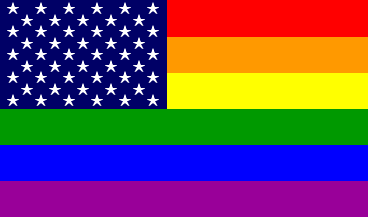
Today is a historic day. Today is a day for rainbows.

Symbols and Smoke Signals


Things stand for things, right? That’s the whole precept of language, of art, of stories, of life. The banding on that snake means that if it gets its fangs in you, you’re dead. Stay away. The presence of all these closed doors in this character’s life show you how trapped she feels. Let it go. That painting of a monkey doing a handstand on top of the tin man is symbolic of, you know, the struggle of the primitive against the technological. Or something. Or maybe it’s just some jacked-up Wizard of Oz fan art.

It’d be hard to identify a symbol as intrinsically symbolic as a flag, though. A closed door can be a symbol of entrapment or inaccessibility, but sometimes it’s just, y’know, a door. A flag, on the other hand, by its very nature stands for something. When you fly a flag, it’s a big announcement to the world that this is who I am, this is who we are, this is what we stand for.

Which is why I think this psychopathic racist kid with his shooting spree, in trying to set off a race war, has actually done something productive. Not with his murders, but by associating his particular brand of poison with a symbol.

This symbol.

The confederate flag has long been a troublesome symbol. On the one hand, it is, legitimately, a symbol of the Confederate States back at the time of the Civil War. And lots of people, especially in the South, have family that lived in the same area at that time. That probably died for that cause. And the flag is, for them, a symbol of their heritage, their family, their land. Flying the flag demonstrates their pride in that heritage. And the fact that they see it that way is fine.

Problem is, the Confederates were fighting, among other things, to retain the ability to keep slaves. So of course, the critics are quick to point out that to them, the flag is therefore a symbol of slavery. Flying a flag, then, becomes a statement in favor of slavery, in favor of segregation, in favor of any sort of racist thing you can think of. And the fact that they see it that way is fine.

Symbols are tricky things. They mean only what our society agrees they mean. We can all agree that the green light in The Great Gatsby represents the love Gatsby feels for Daisy, a love he will never actually reach, a light whose heat he will never feel. Or maybe it represents Daisy herself, again, perpetually out of his grasp, separated from him by a bay of misunderstandings and screwed-up ideals. There’s no controversy because either a) we all agree on its meaning or b) we can understand why others view it in a different way. With the Confederate flag, there’s no such agreement, because the people who hate it are morally and righteously offended by the people who fly it and the ideals they embrace, while the people who honor it don’t understand why the critics get so uptight about it. (Except for the racists who fly it because they’re racists. Screw the racists.)

And that’s where the conversation about the Confederate flag has been locked for, oh, I dunno, decades? No headway is made because these people have their view and everybody else can go to hell, and those people have their view and everybody else can go to hell, and everybody who decides to get involved in the discussion just ends up sore and pissed off over it.

Until this guy went and shot up a church after taking a ton of pictures of himself with the Confederate flag. You or me flying a Confederate flag outside our houses is a tiny splash in an enormous pond. A cold-blooded mass execution carried out while waving a Confederate flag around and posing, grumpy-faced, in front of a flag is a hundred-gigawatt, laser-guided broadcast via every major news network into every living room in the country.

It’s going to be a very, very long time indeed before anybody is able to see the Confederate flag without thinking of Dylann Roof. For better or worse, that means that for the time being, the Confederate flag is unequivocally and inarguably a symbol of racism, murder, and evil. The governors of South Carolina and Alabama have already moved to stop flying the flag over their state capitols, tradition and heritage be damned. This is a pretty remarkable thing. It might even be a historic thing. The flag won’t go away, but maybe it will move from front lawns into museums and history books, where it belongs. We can only hope the movement spreads.

If you’ve been watching the news lately, you might have heard that several major retailers are no longer going to be selling merchandise that features the confederate flag. They’ll cite any number of reasons, like inclusiveness or discouraging hurtful public statements or not wanting to be associated with controversy, but at the end of the day they’re pulling the merchandise from their shelves. Which is fascinating. Merchants are taking a stand, making a statement about this symbol. Saying that they don’t want to profit from it, that they don’t want to be associated with it.

Some will argue that those retailers are doing themselves a major disservice by losing out on sales of these items themselves, but more so by people who refuse to shop there because of the statement these companies are making. I’m no economist, but I feel like they’ll pull in as much business with their statement against this symbol as they cost themselves. But I don’t care about their bottom lines, I care that they care enough to put their dollars where their mouths are.

I read a brilliant short story earlier this year: The Appropriation of Cultures, by Percival Everett. In his story, a black man begins flying a rebel flag and urges others in his community to do the same, and within a few months, the Confederate flag becomes a symbol not of the South, but rather of civil rights activists. If only the real-world treatment of the symbol had been as nonviolent. Still, it shows a model, fictional or not, of how the meaning of a symbol can change.

Maybe we’re on the brink of making this symbol as a divisive force in our country a thing of the past. Maybe it can just be evil and we can lock it in a coffin and bury it far from daylight.

The Toddler Wobbles (or, the Tripwire of Self-Doubt)


My daughter is this close to walking.

She’s been doing the “cruising” thing for about a month now, where she’ll grab the edge of a table, or the couch, or the leg of my shorts, and just sort of shimmy along, one shaky step after another; but of course, she can only go where whatever she’s clamped onto can take her. And she’s been walking assisted for several weeks beyond that, holding gleefully to the hands of whoever has the patience and the dorsal fortitude to bend over and escort her around the house. Again, of course, she can go only where her guide takes her.

There is an unmitigated joy about her as she does any of these things. Her little stumpy legs clomp along not unlike those of the imperial walkers in Star Wars, stable enough only if everything goes according to plan. She laughs, shrieks, smiles. Then tumbles.

But she won’t walk on her own.

And I know, I know. She’ll get it in time. But there’s something frustrating and heartbreaking in seeing her shuffling along, a wobbly snowman on stilts, and knowing that she could walk if she would only decide that she had the capability.

She’s done it before.

She’ll cruise along the table for a minute, then pick up a toy and turn and totter over to the sofa — a yawning gulf of two steps or so, but a moonshot in the scope of toddlers. I’ll stand her up in the floor across from her mother, and she’ll hold my hands until she’s within a step of her mother, then detach in time to fall forward into her mom’s loving embrace. She has the strength. She has the balance. What she doesn’t have is the knowledge that she’s perfectly capable.

Now, she can crawl with the best of them. In fact, she can muster so much speed on her hands and knees that it’s a little startling: she can cross a room in just a couple of seconds, and be sitting there angelic as ever when you come back in from getting a glass of water. This, paired with her propensity (and joy) for grabbing things and sticking them in her mouth is enough, almost, to keep you from leaving the room at all when she’s around (what if she pulls the TV over on herself, or what if she swallows the dog, or what if she goes into the garage, fires up the pneumatic hammer, and takes out the retaining wall?). An inability to walk isn’t, in other words, keeping her from getting around.

But when she starts walking, she’ll be so much better off — she’ll be faster, she’ll be able to take things with her, she’ll be able to reach her hands up and hug your knee when she walks by. She needs to walk. She just won’t.

I can’t say it’s fear, because she isn’t afraid of falling. She’ll gladly pitch herself sideways while my wife or I holds her, despite the five-foot drop to the ground that surely awaits if she manages to escape. It’s as if she simply doesn’t grasp the idea that walking instead of crawling might be a better way to do it. Like cave dwellers who won’t take the ipod that’s being proffered to them, believing instead that eating worms and running from daylight is better than the natural next phase in human evolution (selfies and social media, of course). She just doesn’t realize that she’s hamstringing herself by keeping to all fours, doesn’t understand that her muscles and her sense of balance are ready for her to walk, doesn’t get how much her world is going to open up for her when she begins to walk.

She’ll get it eventually. One day — maybe tomorrow, maybe next week — she’ll shuffle off on her own and then my wife and I will really be in trouble — but until then, she’s stuck crawling, cruising, and being escorted everywhere she goes. Which works, but when you consider the alternative, is a bit lousy.

But then it got me thinking. (As such things often do.)

If my baby has the capacity to walk, but lacks the knowledge of that capacity, what am I capable of that I just haven’t grasped yet? If she’s only holding off on taking her first steps because she doesn’t realize that she can, what am I keeping myself from just because I lack the belief in myself?

How much more could we be, if we could only believe we were capable?

Are you crawling, when you should be walking?

Father’s Day, and Social Media is Still Special


Father’s Day is one of those weird times of year where weird things happen and I just roll with it. Okay, pretty much every day of the year is like that, but Father’s Day is more so. Because really, think about your father.

All he really wants is to be left alone to watch some football or read or play some video games, depending on how old he is. Give that to your dear ol’ dad, and he’ll be a happy camper. But here we have Father’s Day, wherein you’re supposed to buy ties and wallets and tools and goofy t-shirts and cards for the old man, and don’t get me wrong, he’ll appreciate the gesture, but he doesn’t need any of it. He gets the joy of watching you grow up and do silly things and take first steps and be decent human beings and make him laugh, and occasionally he’ll photobomb you or take you to school in his bathrobe, but you forgive him for that. Because it makes him happy.

That’s what Father’s Day is about. Make the old man happy. But don’t do anything for him that you wouldn’t do on any other day, because he probably doesn’t like being made a big deal over.

Maybe I just speak for myself. But my Father’s Day consisted of staying home with the kids, taking them for a walk in the park, the 1-year-old having a screaming fit for about an hour before she passed out for a nap on my chest while I watched some Football (that’s proper football: the Women’s World Cup is on — and the Americans play tonight — you know), then wrestling with the kids, going out to the grocery store when the wife got in from work, cooking some hamburgers for the family’s dinner (yeah, I cooked, and I chose it!), and having a refreshing adult beverage before bed.

Not pictured: the screaming fit that made me want to die.

In other words, a day more or less like any other day. And you know what? It was pretty sweet.

But a weird thing happened this Father’s Day. I’ve been a dad for three years, and this hasn’t happened before. Strangers were saying “Happy Father’s Day” to me. In the park, pushing the sprouts in the double stroller: “Good job, dad! Happy Father’s Day.” Chasing the sprouts around on the playground: “Oh, I know you’re having a Happy Father’s Day.” In the grocery store, carting the sprouts around: “Why are you shopping on Father’s Day?” And it’s not like I crave or even want recognition for doing dad things — that’s just what you do — but I can’t lie, it perked me up and made me walk a little taller. I dunno if there’s something different about this year or different about me or the kids, but those little moments of recognition kinda made my day. (My wife pretty much wrangling 100% of the kids’ nonsense when she got in from work was awesome, too.)

So, there are good things in the world for dads.

But then, there are dumb things, too.

This is Matt McGorry:

He’s an actor on Orange is the New Black (among other things) whose character has done some unsavory things in the wake of fathering a child on a prison inmate (no spoilers beyond that, okay? sheesh.) His character has left a bad taste in the mouth of lots of fans, to the extent that real life fans started harassing the real life actor in real life about things his character did on the show.

He fired back on Father’s Day with a pretty hilarious tongue-in-cheek response on his Instagram (seriously, he and I seem to come from the same school of dubious wit), but it really makes you stop and think. There are people out there watching this show who think that attacking Matt McGorry is the way to resolve their feelings about what his character has done on the show.

As if McGorry has anything to do with what the character does. (Sorry, that would be the writers and the producers.)

As if McGorry would do anything like what his character does in real life. (That’s what “acting” means, boys and girls.)

And as if an irate tweet from @JoeBobDerpSalad266 would have an impact on what McGorry is going to do in his real life, regardless of whether he’s behaving like his character or not.

Similar things happened to Sarah Wayne Callies, of The Walking Dead fame:

Her character was so hated, people would come up to her on the streets to tell her “I [fargoing] hate you.” Because actors actually become their characters when they act.

The people who can’t make this distinction are probably pretty normal people. They have jobs. They have friends and families. They probably look exactly like normal people, except that they lack the ability to distinguish between what’s real and imaginary.

But they have access to social media, which allows them to bring their special variety of crazy into the rest of our lives at any time, without warning, and without remorse. I have a twitter where I tweet intermittently, but this kind of crazy makes me think everyday about just deleting it, and leaving Twitter to burn interminably in the smoldering dumpster fire it is.

Where was I?

Oh, right. Happy Father’s Day.